Solana Drops 'Mainnet Beta' After Six Years: Here's What 1.0 Is All About

In briefSolana has retired the “mainnet beta” label it used since March 2020 and adopted Solana 1.0 as a shared protocol version.The change helps Agave and Firedancer operators track network compatibility, but it does not activate new features or alter user balances.Solana points to the Alpenglow consensus upgrade and Firedancers deployment as signs of maturity; neither was introduced by the renaming.  Solana is officially out of beta, more than six years after launching a blockchain that has been handling real money the whole time.  The Solana Foundation on Monday retired the “mainnet beta” label and introduced Solana 1.0, a shared version number for the networks underlying rules. The change is primarily about how developers and validator operators coordinate software updates, not a fresh boost to transaction speed or any other meaningful improvement over what users already have.  Solana launched its mainnet beta on March 16, 2020, and kept the experimental-sounding name even as users traded tokens, built applications, and moved assets across the chain.  Predict·CryptoBTC Highs in November  80,00042%YesNo  82,5003%YesNo  85,0002%YesNo  87,5002%YesNo  90,0001%YesNo  +6 more outcomes+5 more outcomes  NEW  $205.05 volume  Dec 1Closes: Dec 1, 2026, 04:59 UTC  Closes: Dec 1, 2026, 04:59 UTC  Nothing happens to those assets now. “Your SOL, accounts, assets, applications, and transaction history remain the same,” the Foundation said. Users
3 دن پہلےانڈسٹری

DTCC, Barclays Say Tokenization's Real Prize Is Unlocking Idle Collateral

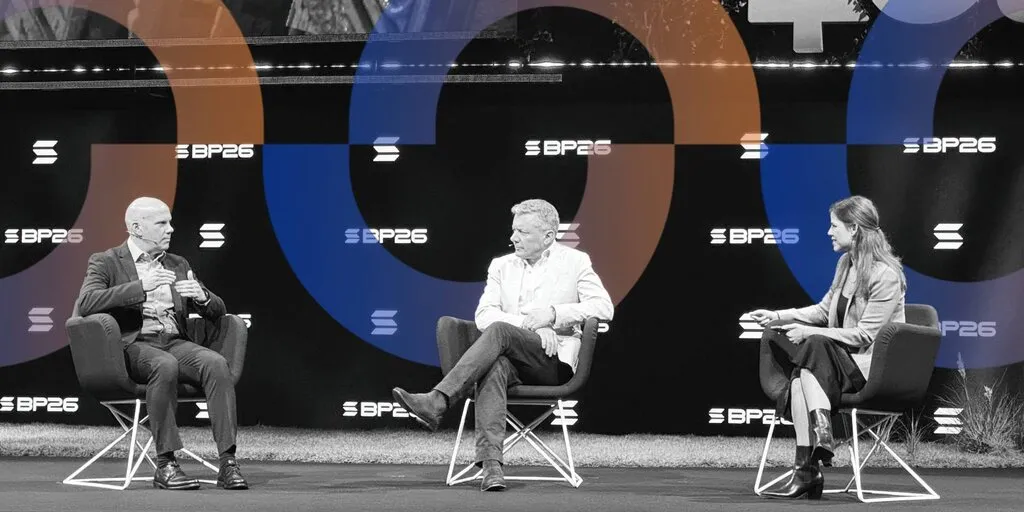
In briefExecutives from DTCC and Barclays said the biggest near-term payoff from tokenization lies in putting collateral to work around the clock.Barclays head of digital assets said much of the early value lies in moving collateral between banks own accounts, before extending it to clients.Both executives said adoption is still early, but that institutions have moved from asking questions to putting real money into building.  The biggest payoff from tokenizing traditional assets wont come from simply putting them onchain, but from putting idle collateral to work, according to executives at the Depository Trust t do anything with it, whats the point?” Val Wooton, DTCCs global head of equities solutions, said at Solanas Breakpoint conference in London. “For me, it really is around collateral and liquidity.”  Scott Lucas, head of digital assets at Barclays, agreed. A lot of collateral sits “relatively idle” at central securities depositories, he said, and much of the early value for banks will come from moving it more efficiently between their own accounts, before extending that to clients. “Theres a lot of money in good housekeeping,” he added.  The pair spoke on a panel days after DTCC announced that its tokenization service will connect to Solana, with tokenized assets expected

3 دن پہلےانڈسٹری

HKMA, Swift explore tokenized deposits for cross-border bank payments

The Hong Kong Monetary Authority (HKMA) and Swift will explore connecting their payment infrastructure to support cross-border transfers using tokenized bank deposits, the authority said Monday.  The work will examine links between Swifts blockchain-based ledger and the settlement infrastructure of Project Ensemble. Participating banks include Bank of China (Hong Kong), Standard Chartered Bank (Hong Kong) and HSBC, according to the announcement.  Tokenized deposits are bank balances represented on a blockchain. They remain claims on the issuing commercial bank, unlike central bank digital currencies, which are claims on a central bank. The proposed Swift connection would explore how separate payment systems could work together across borders in multiple currencies.  The collaboration follows a Nov. 2 upgrade to EnsembleTX, the pilot phase of Project Ensemble, enabling banks to settle tokenized deposit transactions around the clock using tokenized central bank money. The pilot launched in November 2025 and initially relied on Hong Kongs dollar-denominated real-time gross settlement system.  In July, Swift said its blockchain-based ledger was ready for initial use and that it was preparing to pilot tokenized cross-border payments with 17 major banks, including Citi, DBS and HSBC.  Related: DBS, JPMorgans Kinexys launch 24/7 transfers of tokenized deposits

3 دن پہلےانڈسٹری

RWA protocol stUSDT winds down 3 years after $2.3B TVL peak

Real-world asset (RWA) protocol stUSDT has begun winding down operations, nearly three years after reaching a $2.3 billion total value locked (TVL), ending rewards and opening a six-month redemption window for tokenholders.  The team said that interest accrual on stUSDT ended on Saturday, with holders of stUSDT and its wrapped version, wstUSDT, able to redeem through its official portal until May 14, 2027. The team said requests submitted after the deadline will be handled through customer support in monthly batches through August 2027.  The team did not provide a reason for the shutdown but said all underlying assets remain fully backed. Holders with tokens on exchanges or DeFi platforms must transfer them to personal wallets before redeeming.  Cointelegraph reached out to stUSDT for more information but did not receive a response before publication.  Meanwhile, JustLend DAO said it would phase out supply and borrowing functions for its wstUSDT market as part of the transition.  Launched in July 2023 on Tron, stUSDT allowed users to deposit USDT and earn yields from investments in real-world assets, including short-term government bonds. The protocol later expanded to Ethereum.  According to DefiLlama data, stUSDTs TVL peaked at about $2.3 billion in November 2023 before declining substantially in subsequent years. It stood

3 دن پہلےانڈسٹری

Zelle picks Solana for ZelleUSD stablecoin and international payments

Zelle, the US peer-to-peer payments network operated by Early Warning Services (EWS), a consortium of banks that includes JPMorgan and Wells Fargo, is partnering with Solana to support its expansion into international payments. The company announced on stage at Breakpoint 2026 that its proprietary dollar-backed stablecoin, ZelleUSD (ZLUSD), will launch on the Solana blockchain to allow for peer-to-peer payments internationally.  The move brings one of the largest domestic payments networks in the US into the blockchain-based payments market. Zelle processed more than $1.2 trillion in US payments in 2025 and has since taken steps to establish an international business. In June, the company named India as its first international remittance corridor, with plans to allow US consumers to send money to friends and family in the country. In the same announcement, the company unveiled ZelleUSD, intended to underpin future international payment capabilities in additional markets. ZelleUSDs issuer is Anchorage Digital Bank.  “Sending money around the world is a pain; it‘s complex, it’s fragmented and it‘s often unfamiliar. Over half of the Remittance services that are offered today don’t deliver money as fast as we‘d like them to,” said Alexandra Lang, vice president of digital asset partnerships at Zelle. “Solana is a partner

3 دن پہلےانڈسٹری

Hyperliquid Policy Center backs CFTC event-contract and gambling rules

Hyperliquid Policy Center has backed two CFTC rulemaking actions separating event contracts from casino-style gambling, submitting letters dated Nov. 16 as federal regulators fight state efforts to restrict prediction markets.  SummaryTwo letters support federal oversight of event contracts and a separate exclusion for licensed gambling products.The gambling exclusion is already effective, while the companion event-contract rule remains a proposal.Louisiana became the 12th state sued by the CFTC over its claimed exclusive derivatives jurisdiction.Hyperliquids HIP-4 framework already supports outcome contracts, including a recurring daily Bitcoin binary.  Hyperliquid Policy Center, an independent research and advocacy organization, said its submissions support a national framework that distinguishes exchange-traded derivatives from wagers offered by state- or tribal-licensed gambling operators.  Signed by CEO Jake Chervinsky and senior counsel Brad Bourque, the letters ask the Commodity Futures Trading Commission to preserve the gambling exclusions text and clarify how it works alongside the event-contract proposal. Public comments on both actions are due Nov. 18.  CFTC rules separate exchange trading from gambling  Published Oct. 19, the gambling exclusion took effect that day as an interim final rule. It excludes qualifying sportsbook wagers and casino games from the definition of a swap, one of the main types of derivatives the CFTC regulates.  The companion proposal would

3 دن پہلےانڈسٹری

Harvard Bitcoin ETF stake rises 42% to $144M in Q3

Harvard Management Company has disclosed an unchanged Bitcoin ETF share count for the third quarter, with its BlackRock position rising 42.2% in value to $144.1 million as of Sept. 30.  SummaryHarvard reported 3,044,612 IBIT shares, matching its holdings at the end of June.The stake gained $42.8 million in reported value without a net addition to shares.Dartmouth kept its Bitcoin ETF share count steady, with its position reaching $9.5 million.The quarter-end disclosures cover September holdings, before the cryptocurrency markets November sell-off.  Harvard Management Company‘s Nov. 13 Form 13F lists the iShares Bitcoin Trust ETF, known by its IBIT ticker, among 18 reported holdings worth a combined $3.95 billion. The filing’s Bitcoin position is valued at $144,131,932, according to the holdings table reproduced by Disclosery.  Its June filing reported the same 3,044,612 shares at $101,355,133. Comparing the two disclosures puts the gain at $42,776,799, or approximately 42.2%.  Harvards Bitcoin ETF shares remain unchanged for a second quarter  The latest share count extends a period of stable quarter-end holdings that began after Harvard reduced its position earlier in the year.  Harvard had reported 6,813,612 IBIT shares at the end of September 2025. It reduced that balance to 5,353,612 in the fourth quarter before making the larger first-quarter cut, according

1 ہفتوں کے اندرانڈسٹری

Michael Saylor says banks could ignite Bitcoin’s next rally as Strategy eyes $48 billion credit expansion

Michael Saylor expects bank lending and a new wave of BTC-backed credit products to drive Bitcoins next bull market.  Related Asset Bitcoin #1 BTC · $64,525.20 24-hour change: down 0.28% Loading price history… 24H Down 0.28% 7D Down 14.44% 30D Down 20.61%  Speaking at the Cantor Convergence conference, the Strategy chairman outlined how expanding access to financing could increase Bitcoin purchases, discourage existing holders from selling and attract institutional capital.  He said:  “Bank credit is going to be the key driver of additional buying and the key driver for the not selling.”  His outlook rests on two related developments: Strategys efforts to raise billions through digital-credit securities and growing interest among traditional banks in accepting Bitcoin-related investments as collateral.  Related Company Strategy Business intelligence software  Saylor expects both channels to strengthen demand for Bitcoin, although their ability to sustain purchases during market downturns remains uncertain.  Strategy outlines $48 billion in potential Bitcoin-backed credit expansion  Saylor said Strategy could significantly expand its Bitcoin accumulation program by issuing additional digital-credit instruments, building on a financing business he estimated had helped create a $16 billion market in 21 months.  He said:  “The company has right now the capacity to sell 48 billion of this stuff without Bitcoin price moving.”  Strategys model involves raising capital through

1 ہفتوں کے اندرانڈسٹری

Gnosis Safe wallet reportedly drained of $6.45M in suspected exploit

A Gnosis Safe multisignature wallet has reportedly lost $6.45 million in a suspected exploit involving its Zodiac Roles permission module, with the attacker converting part of the stolen funds into Monero (XMR).  Blockchain security firm PeckShield flagged the incident on Nov. 16, citing findings from on-chain analyst Specter, who identified suspicious transfers involving approximately $4.3 million in USDC and $1.7 million in syrupUSDC.  #PeckShieldAlert Specter has reported that a Gnosis Safe may have been compromised, resulting in $6.45M being drained, including $4.3M in $USDC and $1.7M in $syrupUSDC. The hacker has spent ~$813K to buy $XMR on Hyperliquid. pic.twitter.com/BLqlcswoO8  — PeckShieldAlert (@PeckShieldAlert) November 16, 2026  The attacker subsequently exchanged the stolen assets, with PeckShield reporting that roughly $813,000 had been spent purchasing XMR on Hyperliquid. Specters findings separately indicated that approximately $1.2 million had been converted into Monero through Wagyu.  The two estimates describe different reported transactions, with the funds traced through services used to exchange cryptocurrencies.  Gnosis Safe exploit reportedly involved existing wallet permissions  According to Specter‘s findings, the attacker used permissions already configured through the wallet’s Zodiac Roles module to transfer assets out of the Safe.  The Zodiac Roles Modifier is a smart contract tool that allows wallet owners to assign specific permissions to other addresses.

1 ہفتوں کے اندرانڈسٹری

'Nobody Knows Who's in Charge': Boris Johnson Stands by Bitcoin Skepticism at Breakpoint

In briefFormer UK Prime Minister Boris Johnson told Solanas Breakpoint conference in London that he remains skeptical of Bitcoin, asking who guarantees it and who is in charge.Johnson said his doubts dont extend to blockchain, saying London should lead in the technology and in tokenizing assets.Lord Ross Kempsell, a Conservative peer and former Johnson aide, said the UKs coming crypto rules leave room for a “high growth industry.”  Former UK Prime Minister Boris Johnson is sticking to his doubts about Bitcoin, telling a room full of crypto developers that he still cant see who is in charge of the worlds largest cryptocurrency.  “As far as I can see, nobody knows whos in charge, apart from Yakimoto Nakasori, and I dont know where to find him,” Johnson said at Solanas Breakpoint conference in London, deliberately mangling the name of Bitcoins pseudonymous creator, Satoshi Nakamoto. “If six billion got stolen from some cryptocurrency, I wouldnt know who to apply to, or how to get the money back. Thats my problem.”  Johnson was asked about a column he wrote in March for the Daily Mail, in which he called Bitcoin a “giant Ponzi scheme.” The column drew pushback from the crypto industry, including Strategy executive chairman

1 ہفتوں کے اندرانڈسٹری
1
...
2022
...
1000