XRP Reserves on Track to Hit 2026 High: What's Happening?

As XRP continues to show mixed price action after multiple weeks of extreme volatility, the latest onchain data from crypto analytics platform CryptoQuant shows that XRP reserves across all major exchanges have remained substantially high.  While the metric has drawn attention from market participants, analysts reveal that the surge in XRP supply indicates that traders are reducing leveraged positions while the amount of XRP held across exchanges remains unusually high.  Nearly 12 billion XRP still available for sale  Per the data, the aggregate XRP exchange reserves have surged to 11.81 billion tokens as of October 17, nearing the highest levels recorded over the last year.  This means that the available supply of XRP across all exchanges has yet to reach its highest level of the year, but it remains unusually high.  While the massive surge in XRP reserves has come as its price struggles to recover from its recent decline, market participants are beginning to raise questions about whether the growing exchange supply could have been fueled by selling pressure.  Nonetheless, this provides a bearish outlook for XRP, especially at a time when the broader crypto market is facing a major downtrend.  XRP OI on Binance Drops by 15.8%  The data further showed that the rise in XRP
10-19انڈسٹری

NEAR targets protocol security after $112 AI proof-generation run

NEAR Protocol has outlined plans to apply AI-assisted formal verification to its protocol and core smart contracts after reporting 672 solved mathematics problems at a submission-time model cost of $111.85.  NEAR Protocol said in an Oct. 16 announcement that its research seeks to reduce the specialist work and computing costs involved in proving software follows defined rules.  Formal verification proves that software follows defined rules.  Our goal is to make it affordable for more developers. NEAR AIs progress in automated proof generation brings us closer.  Next: applying it to the NEAR protocol and core smart contracts.   The planned application covers the networks protocol and core contracts, alongside tools for ecosystem developers. NEAR described production verification as a goal, while its completed benchmark work concerns automated mathematical proof generation.  NEAR plans to move proof generation into production software  According to NEARs announcement, applying the research to running software involves three stages. Developers must represent a program mathematically, define the properties it should satisfy, and construct proofs showing those properties hold.  NEAR AIs recent benchmark results demonstrate progress on the third stage. The announcement says production work still requires accurate models of software behavior and a clear connection between the proofs and the implementation users rely on.  In its explanation,

10-19انڈسٹری

Aaves proposed USAT gateway could cut off the return swap after a deposit

Aaves proposed USAT gateway would require approval for every return swap, allowing access to be revoked after an institution had exchanged its deposit receipts for GHO.  TokenLogics Oct. 15 governance proposal would introduce a permissioned GHO Stability Module, or GSM, on Avalanche. It would let approved counterparties exchange waUSAT, a receipt for the dollar stablecoin USAT supplied to Aave V4, for GHO. Approval would apply in both directions, so revocation could prevent a participant from returning GHO to recover waUSAT.  That creates three separate conditions on the route back to dollars: access to the return swap, the ability to withdraw underlying USAT from lending, and eligibility to redeem USAT with its issuer, Anchorage Digital Bank.  Related Asset USAT USAT · Stablecoin  As of Oct. 18, the public proposal still describes a Snapshot vote followed, if approved, by an implementation proposal as its next steps. Important addresses and contracts remain unspecified.  The proposed entry route involves two transactions. An approved counterparty would supply USAT to Aave V4s Tokenization Spoke and receive waUSAT. It would then exchange those receipt tokens for GHO through the GSM, which would hold the waUSAT while the USAT remained supplied to Aave.  Related Asset GHO GHO · Stablecoin  The return swap would therefore recover

10-19انڈسٹری

AI Predicts Bitcoin Stays Still While Oil Breaks $110

AI Predicts Bitcoin holds the $82,000 area through a geopolitical shock that would normally have moved it: the supply that used to meet every rally has stopped arriving on exchanges. BTC trades at $82,198, up 0.21% over 24 hours, with market cap at $1.65 trillion.  The news flow says this should be a worse day. Brent crude pushed above $110 after the United States warned Americans in twelve Middle Eastern countries to prepare for cancelled flights and closed airspace, with alerts saying hostilities could spread and that Iran and its allies may target US interests. Oil moved roughly two dollars in a matter of hours.  BREAKING: ???????? Brent crude oil surges above $110 as the US warns Americans in 12 Middle East countries to prepare for cancelled flights and closed airspace.  The alerts say hostilities could spread, and Iran and its allies may target US interests including American businesses.   Bitcoin barely registered it. The move over the same period was a fraction of a percent, and the current four hour candle is down 0.52% after trading between $82,071 and $83,009.  One number does stand out. Volume rose 84.8% to $24.7 billion while price went nowhere, which means a considerable amount of stock changed hands

10-19انڈسٹری

Rome Protocol details Solana EVM access as lending demos run on testnet

Rome Protocol has published connection details for its Hadrian testnet, giving developers a USDC-funded environment to try Ethereum-style applications inside Solana, while its documentation separately lists a mainnet network called Rubicon.  SummaryRomes Hadrian testnet runs on Solana Devnet, while its documentation separately lists Rubicon as mainnet.Compound v3 and Aave v3 implementations remain reference applications, without confirmed official protocol migrations.Hadrian uses test USDC for gas, with transaction pricing controlled through configurable operator settings.Rome reports a Halborn audit, while its documentation lists Ethereum compatibility and execution limits.  Rome Protocol‘s Oct. 18 post identifies Hadrian as a testnet running on Solana Devnet, with chain ID 200010, an RPC endpoint, an explorer, and instructions for obtaining test USDC. The supplied screenshot directs developers to Circle’s faucet and a bridge interface to fund their wallets.  The project‘s developer documentation lists Rubicon separately as mainnet, with chain ID 7531 and a different RPC endpoint. Its introductory page describes Rubicon as using real USDC, distinguishing the production environment from Hadrian’s testing assets.  Rome EVM runs Solidity code within Solana  Romes execution documentation describes an Ethereum Virtual Machine implemented as a Solana program. A proxy receives signed Ethereum-style transactions, checks them through an offchain emulator, and packages their instructions for execution by Solana

10-19انڈسٹری

Shiba Inu Burn Rate Rockets 2,349% but Just $5 Burned: What's Happening?

Shiba Inus daily burn rate has jumped 2,349%, but the real figure behind the surge remains surprising. Despite the sharp rise, the total value of Shiba Inu tokens burned during the reported period amounted to just about $5.  According to the Shibburn page, Shiba Inu burn activity rose 2,349% in the last 24 hours, with 1.10 million SHIB burned in the timeframe, amounting to just $5 in monetary terms. This highlights how a relatively small number of token burns can produce a striking percentage increase when activity in the preceding period is low.  The burn rate alone does not reveal how many tokens were destroyed. If there was little or no burning in the prior period, a small transaction can cause a large percentage increase.  Here, the reported $5 of burned SHIB suggests that the growth is due to a large percentage change rather than a large drop in Shiba Inus total supply.  The weekly burn rate was down 83.47% with 79.85 million SHIB burned in the last 7 days; meanwhile, the monthly burn rate was up 84.73% with 749.93 million SHIB burned in the last 30 days.  SHIB price action  At the time of writing, Shiba Inu was up 2.33% in the last 24 hours

10-19انڈسٹری

Crypto ETFs Lose $593M in a Week as Bitcoin, Ether Selling Persists

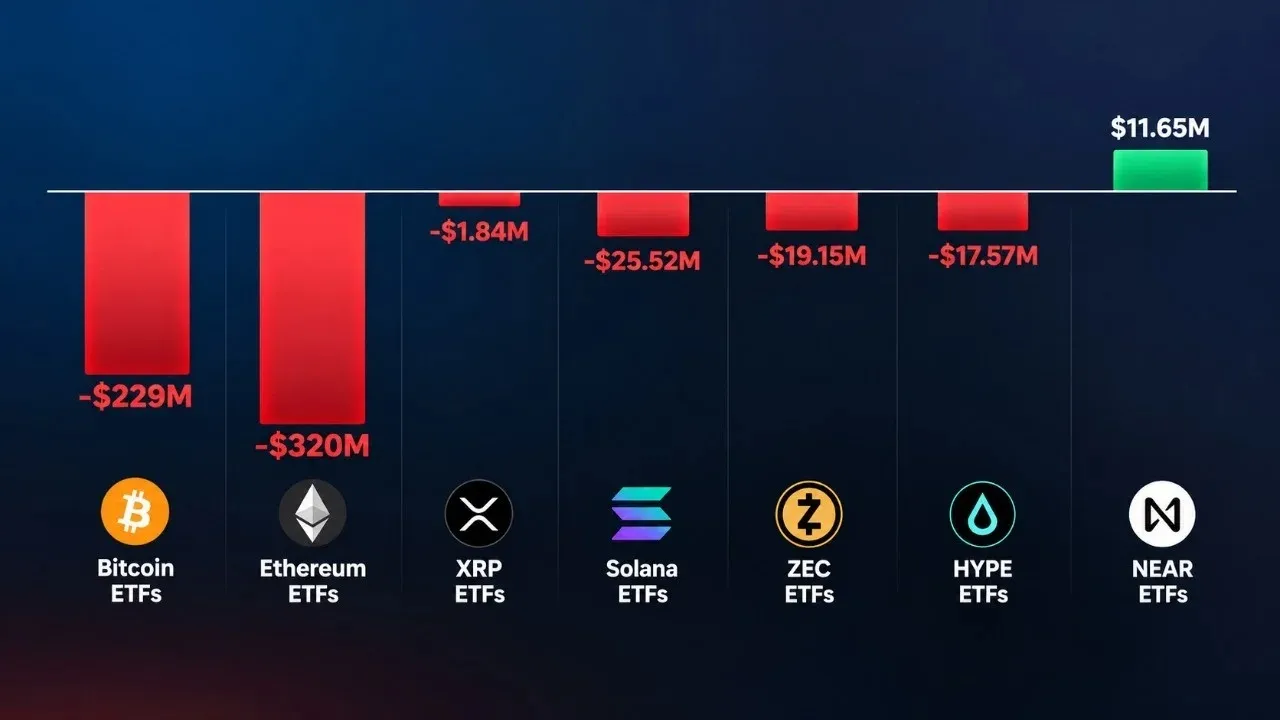
U.S. crypto ETFs remained under pressure in the week through Oct. 16, with bitcoin funds losing about $229 million and ether ETFs shedding $320 million. The pace of withdrawals eased from the previous week, yet selling spread across all major ETFs as investors continued to reduce risk.  Key TakeawaysCrypto ETFs lost about $593M through Oct. 16, down 52% from the prior weeks $1.2B.Ether faced the heaviest pressure by assets under management (AUM), while solana has now logged 10 straight outflow days.NEAR stood apart with $11.65M of inflows as investors stayed selective and defensive.  Crypto ETF Outflows Drop 52% but All Major Funds Finish Red  The intensity faded. The caution did not.  Institutional investors pulled roughly $593 million from the five major crypto exchange-traded fund (ETF) categories last week, about 52% less than the $1.2 billion withdrawn a week earlier. Still, every category finished in negative territory.  Bitcoin ETFs lost about $228.6 million between Monday and Friday, marking another difficult week after the previous periods $681 million withdrawal.  The path was volatile. Monday opened with a $65.40 million exit before Tuesday delivered a $175.62 million rebound. That optimism disappeared on Wednesday as $261.46 million left the funds. Thursday produced a marginal $5.06 million inflow, followed by an

10-19انڈسٹری

Binance‘s SOXL mark fell 5.9% despite a 3% price band. Here’s why

Binances perpetual tied to SOXL, a leveraged semiconductor ETF, recorded a 5.9% opening-to-low fall in the mark price used for margin risk during the 21:00–22:00 UTC hour on Saturday, Oct. 17. All 60 sampled minute-close gaps between that mark and its reference index stayed below 3%.  The two observations measure different risks. Binance‘s published weekend band constrains the mark’s distance from the index at a particular moment. The index can move away from the traders entry price, leaving cumulative price exposure open. In the sampled hour, the index itself fell almost 4%.  For a leveraged trader, that distinction leaves room for losses and liquidation despite a narrow mark/index gap. A reference-price safeguard and the amount of collateral keeping a position open answer different questions.  Related Company Binance Global crypto exchange  Binances one-minute mark-price records show SOXLUSDT opening at 93.79 USDT at 21:00 UTC. The mark reached an intrahour low of 88.24 USDT within the 21:41 minute, a 5.9151% opening-to-low decline. It finished the final minute at 90 USDT, down 4% from the opening.  The corresponding index records show the reference moving from 93.95 USDT at the opening to 90.22 USDT at the final minute close, a 3.9% decline.  Related Asset Tether USDT · Stablecoin  These are prices

10-19انڈسٹری

MARA Sends $82.8 Million in Bitcoin to Exchanges During a Shaky October

MARA Holdings appears to be selling Bitcoin (BTC) again as the market swings through October. Wallets linked to the miner sent 1,000 BTC to Binance and Gate over 5 days.  On-chain tracker Lookonchain flagged the deposits, the second large MARA transfer it has spotted this month.  Follow us on X to get the latest news as it happens  Sponsored  Sponsored  MARA Holdings Sends Bitcoin to Exchanges Again in October 2026  Lookonchain valued the latest deposits at about $82.8 million. The first transfer came on October 9, when Lookonchain flagged 996 BTC, worth about $81.13 million, moving from MARA to a Galaxy Digital address.  Neither transfer confirms a sale. On-chain data shows the coins arriving at Galaxy, Binance, and Gate, but not whether anyone sold them. Holders also move coins to exchanges and trading desks to post collateral or change custody.  MARAs own filings show how much room it has to sell. The miner held 35,577 BTC at the end of June, according to its second-quarter letter to shareholders. That total included 9,270 BTC loaned out or pledged as collateral.  Sponsored  Sponsored  MARA sold 2,213 BTC that quarter at an average price of $73,078. It also said it expects to keep selling Bitcoin on an opportunistic basis.  The latest 1,000 BTC equals roughly

10-19انڈسٹری

The Altcoin Run Is Giving Back Ground Fast as Bitcoin Dominance Climbs

Nearly half of Binance-listed altcoins have dropped back below their 200-day moving average. That share reached 48.4% on October 18, up from under 10% in early October.  Blockchaincenters 90-day Altcoin Season Index still reads a neutral 51. However, its 30-day Altcoin Month Index has dropped to 29, close to the 25 level that marks Bitcoin season.  Sponsored  Sponsored  The Rally That Pulled 9 in 10 Altcoins Above Their Trend  The breadth reversal follows a run that started in late August. At that point, 81% of Binance altcoins traded below their 200-day average, analyst Darkfost wrote in a post.  By early October, that share had shrunk to less than 10%. That left roughly 9 in 10 of the exchanges altcoins in a confirmed uptrend. Darkfost estimated that more than $814 billion flowed into altcoins over those two months.  However, over the past 15 days, more than $134 billion has left altcoins, the analyst estimated. He said quick profit-taking likely drove a large part of that exit.  Percentage of Altcoins Below 200 MA. Source: X/Darkfost  Follow us on X to get the latest news as it happens  Sponsored  Sponsored  Bitcoin Takes Back the Lead While Exchange Stablecoins Shrink  The cooling also appears when altcoins are measured against Bitcoin (BTC). Blockchaincenters indexes track how many of

10-19انڈسٹری
1
...
175177
...
1000