South Koreas Crypto Bill Nears the Finish Line as the Tax Debate Heats Up

South Korea‘s Digital Asset Basic Act is close to completion, according to Lee Eog-weon, chairman of the Financial Services Commission. However, a debate over the country’s crypto tax is intensifying.  The outcome will shape how exchanges, stablecoin issuers, and investors operate in one of Asias busiest crypto markets.  Sponsored  Sponsored  What the Digital Asset Basic Act Would Cover  The Digital Asset Basic Act is South Koreas proposed legal framework for crypto assets. It would set the ground rules for how the market operates.  In practice, it would give exchanges and token issuers clearer legal guidance.  Lee told a parliamentary hearing on Thursday that talks are nearing completion. He added that the government will push to introduce the bill as soon as possible.  The proposal would address several key areas:Licensing requirements for crypto exchanges.Rules for issuing stablecoins.Clearer legal definitions for digital assets.  However, the reports did not detail capital requirements or reserve rules for stablecoin issuers. Because consultations remain in their final stages, those details could still change before the bill reaches the National Assembly.  Sponsored  Sponsored  For investors, a clear framework could reduce legal uncertainty around trading and holding digital assets. It could also make it easier for firms to plan new products.  Will South Korea Delay Its Crypto Tax Again?  The crypto tax

10-23انڈسٹری

Ethereum’s long-awaited Glamsterdam upgrade hits another roadblock as 13 security risks emerge

Ethereum developers have postponed the Glamsterdam upgrade on a major test network after identifying potential security risks affecting existing smart contracts.  Related Asset Ethereum #2 ETH · $2,387.82 24-hour change: down 3.50% Loading price history… 24H Down 3.50% 7D Down 2.19% 30D Down 13.54%  The Ethereum Foundation confirmed on Oct. 22 that the upgrade, scheduled for Oct. 26 on the Hoodi testnet, would no longer proceed as planned. Developers agreed to investigate how a proposed change to Ethereums gas-accounting system could affect applications already operating on the blockchain.  The setback threatens Ethereums efforts to deliver Glamsterdam before the end of 2026, after the upgrade was previously pushed beyond its original first-half target. Developers had considered several activation dates in early December, but had not finalized a mainnet schedule.  Related Company Ethereum Foundation Promotes and supports the Ethereum platform  Christine Kim, founder of research firm Protocol Watch, initially disclosed the cancellation, urging affected Hoodi node operators to revert to older software versions or install updated execution clients that remove the scheduled activation.  The Foundation subsequently clarified that the decision followed discussions during the Oct. 22 All Core Developers Execution meeting, where participants agreed to conduct further investigations into EIP-8037 and its interactions with existing mainnet smart contracts.  The

10-23انڈسٹری

Bitcoin Bull Score Index Drops From 80 to 60 as Momentum Weakens

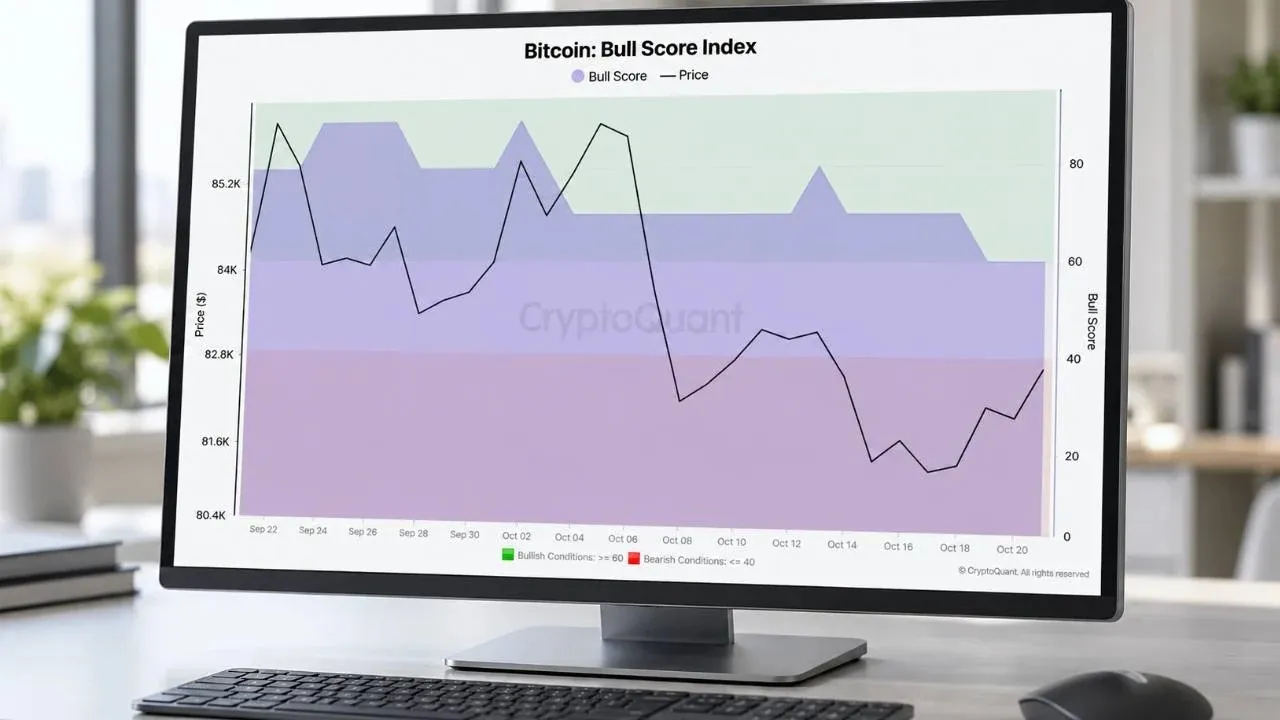
Bitcoins Bull Score Index has dropped from 80 to 60 since late September, a new analysis shows. The decline signals a slowing trend as the index sits at a threshold the analyst associates with positive momentum.  Key TakeawaysBitcoins Bull Score Index has fallen 20 points since late September.Analyst views readings above 60 as consistent with positive momentum.Stronger demand and sustained holder profits are needed for progress.  Bitcoin Bull Score Signals Slower Momentum  Bitcoin‘s market momentum has weakened since late September, with incoming capital and investor profitability presenting obstacles to further progress. Cryptoquant contributor Darkfost highlighted those conditions in an Oct. 21 assessment of bitcoin’s Bull Score Index on X. BTC was trading at $81,345 at the time of writing.  The analyst stated:  “Since late September, the Bull Score Index has fallen from 80 to 60, signaling a slight slowdown in the trend.”  “Since late September, the Bull Score Index has fallen from 80 to 60, signaling a slight slowdown in the trend.”  The index combines 10 indicators covering demand, investor profitability, network activity, and liquidity to assess the market environment. Its earlier increase from 30 to 80 in August reflected eight components turning bullish. That improvement accompanied a price recovery, with spot and futures demand rising together

10-23انڈسٹری

Bitcoin ETFs sold through 7 of 8 crashes even as Wall Street makes BTC selloffs less violent

Bitcoin ETFs recorded outflows during seven of eight major selloffs, challenging expectations that Wall Street investors would support prices during downturns.  Related Asset Bitcoin #1 BTC · $81,244.97 24-hour change: down 3.97% Loading price history… 24H Down 3.97% 7D Down 1.49% 30D Down 5.74%  A new DWF Labs report shared with CryptoSlate found that US spot Bitcoin exchange-traded funds consistently lost money during market declines of at least 15% since their January 2024 launch, while attracting inflows throughout all nine major rallies.  The findings challenge the belief that institutional adoption has created a dependable source of buying during market stress. They also expose a paradox in Bitcoins changing market structure: selloffs have become slower and less frequent, even as ETF investors continue withdrawing billions during downturns.  Related Company DWF Labs Digital asset market maker  The research, covering 694 trading days through Oct. 16, found that investors withdrew a record $8.2 billion during Bitcoins 28.8% decline between May and June 2026. That followed $6.9 billion in withdrawals during the October 2025 to February 2026 downturn, when the cryptocurrency lost nearly half its value.  The two episodes represented the largest ETF withdrawals since the products launched, surpassing the $3.4 billion investors redeemed during the January-April 2025 correction.  Wall Street

10-23انڈسٹری

Is the Internet Safe Again After the PHP Nightmare? What You Need to Know

In briefPHPs October 21 releases remain the only fix for PHP2Shell, and they protect a server only once its owner installs them and restarts PHP.Cloudflares CEO said exploit attempts climbed into the millions, while Germanys BSI and Japans government said they had not confirmed any successful break-ins.The PHP Foundation said it spotted signs of one flaw in 2024 and called the delay in fixing it “a structural failure.”  A day after two bugs in PHP sent governments scrambling to unplug their websites, the fix is out, attackers are hammering away, and a lot of people are asking the same thing: Can I use the internet without worrying, or should I hide under the bed until next week?  The short answer is that the internet didnt break, and for most people the risk sits with the websites they visit, not with their own phones or laptops. The longer answer has a few caveats worth knowing.  Quick recap: PHP is the software that runs behind the scenes on about 70% of websites whose server-side language is known, and the two flaws, nicknamed PHP2Shell, let a stranger take control of a vulnerable server without logging in.  Is it fixed?  So, is the exploit fixed? Yes, mostly. PHP released

10-23انڈسٹری

Circle shareholder sues Trump, World Liberty and Steve Witkoff over crypto deals

A shareholder for Circle Internet Financial, the company behind the USDC (USDC) stablecoin, filed a lawsuit against US President Donald Trump, his familys crypto company World Liberty Financial, affiliate entities, and US Special Envoy to the Middle East Steve Witkoff over a $2 billion deal between a foreign government entity and Binance.  In a Thursday filing in the US District Court for the District of Columbia, Circle shareholder J. Benjamin Greenberg alleged that Trump, Witkoff and World Liberty caused harm to Circle by creating a pathway for foreign governments to funnel money using the Trump family crypto companys USD1 stablecoin. This “brazen corruption,” according to Greenberg, leaves Circle “unable to compete” in the stablecoin market with its USDC.  Central to the Circle shareholders allegations is an Abu Dhabi entity, MGX, tied to the United Arab Emirates royalty, which invested $2 billion into cryptocurrency exchange Binance using the USD1 stablecoin in 2025. The Wall Street Journal reported in February that another investment vehicle backed by Sheikh Tahnoon bin Zayed Al Nahyan agreed to purchase a 49% stake in World Liberty for $500 million.  “By accepting hundreds of millions of dollars from a foreign government, the President and his companies have diverted business from [Circle],”

10-23انڈسٹری

OCC drops proposed affiliate rewards presumption, but stablecoin yield ban stays

The Office of the Comptroller of the Currency (OCC) dropped a proposed presumption against certain stablecoin rewards routed through affiliates or related third parties in its Oct. 21 final GENIUS Act rule. The rule retains the prohibition on issuers paying holders interest or yield solely for holding, using or retaining a payment stablecoin, with older rewards programs facing the same scrutiny as newer ones.  For exchange-run rewards, CryptoSlate‘s reading is that removing the proposed test leaves the legality of individual arrangements unsettled. The change follows CryptoSlate’s earlier coverage of exchange stablecoin rewards.  CryptoSlate separately examined the rule‘s reserve changes and banks’ deposit-flight concerns.  How the OCC will assess rewards  The proposal would have presumed that certain linked arrangements amounted to prohibited issuer yield: an issuer would pay interest or yield to an affiliate or related third party, which would in turn arrange payments to holders solely for holding, using or retaining the issuers stablecoin.  The proposed presumption would have applied to those specified payment relationships. The final rule removes it and retains the statutory yield prohibition.  The agency said the proposed test could have caught permissible arrangements while suggesting that impermissible arrangements outside its triggers were acceptable. Requiring a rebuttal in those circumstances risked imposing burdens

10-23انڈسٹری

Claude AI Cracks Satoshis 17-Year Bitcoin Mystery

For 17 years, a small mystery surrounded Bitcoin‘s creation. Satoshi Nakamoto published the cryptocurrency’s original code, but nobody had managed to recreate the exact Windows program he released in 2009.  Now, a developer has reportedly cracked it with AI  The developer, known as T4T5, used Anthropics Claude Opus 5.5 to reconstruct the computer setup Satoshi used.  Sponsored  Sponsored  The result was remarkable. The rebuilt bitcoin.exe matched the original files SHA-256 hash exactly, and every byte matched.  Source: GitHubAI Uncovers How Satoshi Built Bitcoin  The problem was surprisingly complicated.  Bitcoins original software was never designed to be reproducible. A different compiler, software library or even a single line ending could change the final file.  Sponsored  Sponsored  T4T5 had to reconstruct an entire development environment using software packages from 2006 to 2008.  The GitHub project now reveals details about Satoshis working habits.  Satoshi apparently used Windows XP with MinGW GCC 3.4.5. He compiled most of Bitcoin in debug mode but enabled maximum optimization for the hashing code used in mining.  He also upgraded part of his development toolchain midway through the project.  But the investigation uncovered something more surprising.  Is Bitcoins Original 2009 Software Still Missing?  The executable widely known as Bitcoin 0.1.0 was actually version 0.1.1, compiled on January 10, 2009, at 23:16 UTC.  That was two days after

10-23انڈسٹری

JPMorgan's Tokenized Money Market Funds Go Live on Solana

The investment management arm of Wall Street banking giant JPMorgan Chase has formally launched its money market funds on the Solana blockchain.  Two of them (My OnChain Net Yield Fund (MONY) and JPMorgan OnChain Liquidity–Token Money Market Fund (JLTXX)) are now accessible to qualified U.S. investors, per an October 22 press release. Investors can access the funds via JPMorgans Morgan Money.  JPMorgans launch on Solana follows its initial tokenized fund launch on the Ethereum network, marking further progress on the banks blockchain-based financial products.  Morgan Money is JPMorgans liquidity management solution. Eligible investors can use it to subscribe for or redeem shares of the funds and receive tokens at their blockchain addresses.  It enables institutional investors to manage tokenized investments through one platform, without the need to use various platforms for different blockchains.  JPMorgan continues tokenization efforts  MONY and JLTXX cater to different groups of institutional investors.  Launched on Ethereum in December 2025, MONY is a private placement fund that offers eligible investors U.S. dollar yields.  JLTXX is a U.S.-registered government money market fund meant to facilitate stablecoin issuers reserve management needs under the GENIUS Act.  Ethereum received its first tokenized JLTXX launch in May 2026, when JPMorgan invested $100 million of its own money into it.  With the two

10-23انڈسٹری

TRON settles $2.21T in Q3 stablecoins as payment split stays unclear

TRON has processed $2.21 trillion in stablecoin settlement during the third quarter of 2026, up 5.1% from the previous quarter, Nansen has reported.  Summary$2.21 trillion in quarterly stablecoin settlement represents 5.1% growth from the previous three months.1.07 billion successful transactions were recorded across the network during July through September.Binance and OKX led labeled transaction activity, but the report provides no payments-versus-exchange dollar split.TRONs settlement figures do not include a matching quarterly comparison with Ethereum and Solana.  Nansens Oct. 21 report puts successful network transactions at 1.0748 billion for July through September, averaging 11.68 million a day. Its exchange rankings identify Binance and OKX among the busiest labeled entities, although the report does not provide a dollar breakdown separating payments from exchange-related transfers.  TRON stablecoin settlement rises from Q2  TRON DAOs quarterly research lists settlement at $2.2126 trillion, compared with $2.106 trillion in Q2. Subtracting the published totals gives a gain of $106.6 billion, or approximately 5.06%, consistent with the rounded 5.1% growth rate.  The same research puts average daily settlement at $24.05 billion, up from $23.14 billion. The quarterly and daily growth rates differ because July through September contained 92 days, compared with 91 days in April through June.  You might also like:  TRON handles trillions in

10-23انڈسٹری
1
...
119121
...
1000