Circle expands Alliance Program with eight new partner benefits

Circle has expanded its Circle Alliance Program (CAP) with eight new or improved membership benefits and a private Alliance Hub, offering partners closer access to its products, support teams and business network.  SummaryCircle has expanded its Alliance Program with eight new or improved benefits and a private community platform.The Alliance Hub replaces Discord, giving members access to discussions, resources and dedicated industry groups.Partners can seek early product access, improved technical support and closer engagement with Circle Ventures.Circle plans to introduce a partner-focused podcast in early 2027, with guest applications already open.Circle did not disclose CAP membership figures, participation fees or financial incentives associated with the expansion.  According to Circles October 22 announcement, the changes followed feedback from existing members seeking better industry connections, product engagement and opportunities to showcase their businesses. The company introduced the updated program without disclosing its membership size or participation costs.  The Circle Alliance Program is expanding.  CAP now gives members more ways to connect, build, and grow with Circle, including new benefits, expanded product engagement, and the Alliance Hub, a private home for the community.  One of the main changes is the introduction of Alliance Hub, a members-only platform bringing together community discussions, educational resources and partner activities. Existing members


10-23انڈسٹری

NEAR proposal slashes yield by 36%, dividing network validators

The NEAR blockchains total supply grew by about 2.69 million tokens in the 30.62 days to Oct. 22, while a proposed 36% cut in the issuance cap would slow future dilution and reduce token income for stakers.  The networks supply rose from 1,306,946,399.1749655 NEAR at block 216701043 on Sept. 22 to 1,309,640,572.7751897 NEAR at block 221111299 on Oct. 22, an increase of 2,694,173.6002242 NEAR (0.20614%) over 31 days.  Net selling and liquid supply available to trade are separate measures. Purchases can support demand while acquired tokens remain part of total supply.  HSP-029, an Oct. 7 proposal in NEARs House of Stake governance system, would reduce maximum annual issuance from 2.5% to 1.6%. Slower dilution comes with fewer newly issued rewards, but the effect on price depends on demand and valuation.  NEAR supply grew by 2.69 million tokens in a month, while a proposal would gradually cut the annual issuance cap from 2.5% to 1.6%.What the proposed cut changes  As of Oct. 22, NEARs protocol configuration still showed a 2.5% maximum annual issuance rate on version 86. The observed setting remained above the proposed 1.6% target.  HSP-029 would retain its stated allocation of 90% of issuance to staking participants and 10% to the treasury. It proposes a

10-23انڈسٹری

Peter Brandt's EUR/JPY Short Is His Firm's Largest Position as Yen Gains

Trader Peter Brandt said on X that a EUR/JPY short is now his firm‘s largest futures and currency position. The pair has fallen from an April high near 187.5, yet euro rates sit at twice Japan’s.  EUR/JPY, the price of one euro in yen, sat at 175.65 in futures on Brandts chart. Still, the European Central Bank (ECB) pays 2.5% on deposits versus 1.25% at the Bank of Japan (BOJ).  Why Is the Yen Gaining Against a Higher-Yielding Euro?  Washington has intervened directly. On July 31, the US Treasury sold euros for yen alongside Japan. The ECB learned of the trade only afterward, the Financial Times reported.  Sponsored  Sponsored  The action helped lift the yen to 157.57 per dollar from a 163.73 low, CNBC reported.  Meanwhile, Japan‘s core inflation reached 2.1% in September. That tops the BOJ’s 2% target for the first time since December, Statistics Bureau data show.  Overnight swaps, which track rate expectations, imply an 80% chance of a December BOJ hike, the Japan Times reported. A hold is expected on October 30.  Likewise, the ECB lifted its deposit rate from 2.25% to 2.5% on September 10, its second hike this year. An energy shock tied to the Iran war has pushed eurozone inflation higher, Euronews reported.

10-23انڈسٹری

Tom Lee Says Yields Below 5% Mean the AI Selloff Is Nearly Over

Tom Lee of Fundstrat says the artificial intelligence (AI) selloff is near its end. He cites rates back below 5% and a crowded short trade in tech, even as the Nasdaq slides.  The Dow sat more than 6% below the record it set earlier this month, according to the CNBC segment.  Sponsored  Sponsored  What Does Lee Think Comes After the AI Selloff?  Lee is managing partner and head of research at Fundstrat, a Wall Street research firm. He told CNBCs Closing Bell that two headwinds have eased.  The Federal Reserve (Fed) may be flipping from hawkish to dovish, he said. Meanwhile, rates that had markets fearing 6% are back below 5%.  Lee named his preferred buys as Nvidia, memory chips, the Magnificent 7 megacap tech stocks, software, and crypto. He is also bullish on a broad cyclical rally, since financial stocks have lagged while rates fall.  He made a similar case last week, when he called Fridays drop a crypto and chip buy. Separately, Lee chairs BitMine, a company that holds Ethereum (ETH).  Sponsored  Sponsored  Can Debt Markets Reopen Before the Next Leg Down?  Still, Lee named two remaining obstacles. Debt markets are partly shut, and uncertainty over the war lingers.  Instead, he called the funding chill healthy, because it limits a runaway

10-23انڈسٹری

Is the S&P 500 No Longer the Economy? DataTrek's Nick Colas Weighs In

DataTrek co-founder Nick Colas says tech and big tech now account for about 50% of the S&P 500. He argues that makes the index a weaker proxy for the economy than it has ever been.  Colas spoke on CNBCs Closing Bell Overtime on Thursday, as the 10-year Treasury yield slipped below 5%. The drop reads as relief to some and as a sign of slowing growth to others.  Sponsored  Sponsored  Why Are Yields Ignoring Oil, According to Nick Colas?  Colas said oil and bond yields moved together for roughly 10 years. However, he said that link broke in mid-September, as oil fell and yields kept climbing.  Instead, he ties the moves to AI. He says expectations of less AI funding are easing real rates, meaning yields adjusted for inflation.  Meanwhile, investors are also weighing a possible AI spending slowdown.  Separately, he said the K-shaped economy, where higher earners thrive while others lag, still holds. He said withdrawn initial public offerings (IPOs) could thin the ranks of the wealthy at the top of the K.  Sponsored  Sponsored  Is Techs Grip on the Index Permanent?  Colas credited Moores law, the observation that chip capability rises steadily while costs hold, for the shift.  By his count, tech‘s share now tops both oil’s roughly 28% in 1980

10-23انڈسٹری

Bitcoin Faces 2 December Rate Hikes as Japan‘s Inflation Clears the BOJ’s Target

Japan‘s core inflation rose above the Bank of Japan’s (BOJ) 2% target in September for the first time in nine months. That strengthens the case for a rate hike in December, when the Federal Reserve (Fed) is also expected to move.  The BOJ is expected to hold next week. Its guidance on further hikes, though, could set the tone for an already sliding Bitcoin (BTC).  Sponsored  Sponsored  Price Pressure Spreads Past the Fuel Pump  Core CPI, which excludes fresh food, rose to 2.1% from 1.7% in August, according to Reuters. An index that also strips out fuel rose to 2.4% from 1.9%.  Goods prices rose 2.8%, up from 2.6% in August, even as rice prices fell 20.6%, CNBC reported. Services inflation picked up to 1.5% from 1.2%.  The BOJ will weigh these figures when it updates its forecasts at the next two-day policy meeting ending on October 30.  Follow us on X to get the latest news as it happens  December Puts 2 Rate Decisions in Bitcoins Path  The BOJ raised its policy rate to 1.25% in September, a 31-year high. Many analysts in a Reuters poll expect a hike to 1.50% in December and a peak around 1.75% or 2%.  Sponsored  Sponsored  Marcel Thieliant, head of Asia-Pacific at Capital Economics, expects the

10-23انڈسٹری

Grayscale Reveals Top 10 Crypto Assets for Yield and Profits

Grayscale has named the top 10 crypto assets by tokenholder yield and adjusted earnings yield. HYPE leads the first ranking at 8.0%, while CAKE tops the second at 14.4%.  The report argues that investors can value many crypto assets, unlike Bitcoin, using their cash flows.  Sponsored  Sponsored  Which Crypto Tokens Actually Reward Their Holders?  Hyperliquid (HYPE) leads Grayscales ranking with an 8.0% tokenholder yield. Lighter (LIT) follows closely at 7.9%.  PancakeSwap (CAKE) comes third at 2.6%, followed by Aerodrome (AERO) and Uniswap (UNI).  But the rankings reveal something more troubling.  Five of the top 10 tokens have negative holder yields.  Sponsored  Sponsored  Curve Finance (CRV) sits at the bottom with -5.5%, while Jupiter (JUP) records -2.6%.  The reason is dilution.  Grayscale calculates tokenholder yield by adding staking rewards and buybacks, then subtracting newly issued tokens. When issuance outweighs those benefits, holders face dilution despite the protocols economic activity.  Can Crypto Be Valued Like Stocks?  Grayscales second ranking reveals another surprise.  PancakeSwap leads adjusted earnings yield at 14.4%, followed by Lighter at 14.1% and HYPE at 9.8%.  Jupiter offers an interesting example. Its adjusted earnings yield reaches 3.5%, yet its tokenholder yield remains negative.  A profitable crypto protocol does not automatically make its token rewarding to hold.  Grayscales research head, Zach Pandl, argues that Bitcoin resembles digital gold, while many

10-23انڈسٹری

a16z drops crypto branding, expands $2.2B fund into AI and frontier tech

Andreessen Horowitz announced on Oct. 22 that it is renaming a16z Crypto to a16z Frontier and expanding the scope of its $2.2 billion fifth fund beyond crypto startups to companies developing emerging technologies and creating new markets.  The announcement from managing partner Chris Dixon followed a report from The Information earlier that day about plans to drop “crypto” from the investment brand.  Dixon confirmed that the expansion would encompass technologies beyond blockchain, with particular attention to artificial intelligence, autonomous machines and emerging networks connecting people and software agents.  Related Company a16z Venture capital firm  “This is an expansion,” Dixon wrote, adding that the firm would continue investing in crypto ventures and advocating for sensible crypto regulation.  The announcement clarifies the direction of a fund that was presented as exclusively crypto-focused when it launched five months earlier.  From crypto-only to frontier investing  On May 5, a16z crypto announced its $2.2 billion Crypto Fund 5, focused on stablecoins, on-chain finance, decentralized infrastructure and applications involving autonomous software agents.  At the time, a spokesperson told Fortune that Fund 5 was “100% dedicated to investing in crypto entrepreneurs.”  Dixons October statement explicitly broadens that mandate.  He argued that the growing integration of blockchain infrastructure into conventional financial services has made the crypto label increasingly

10-23انڈسٹری

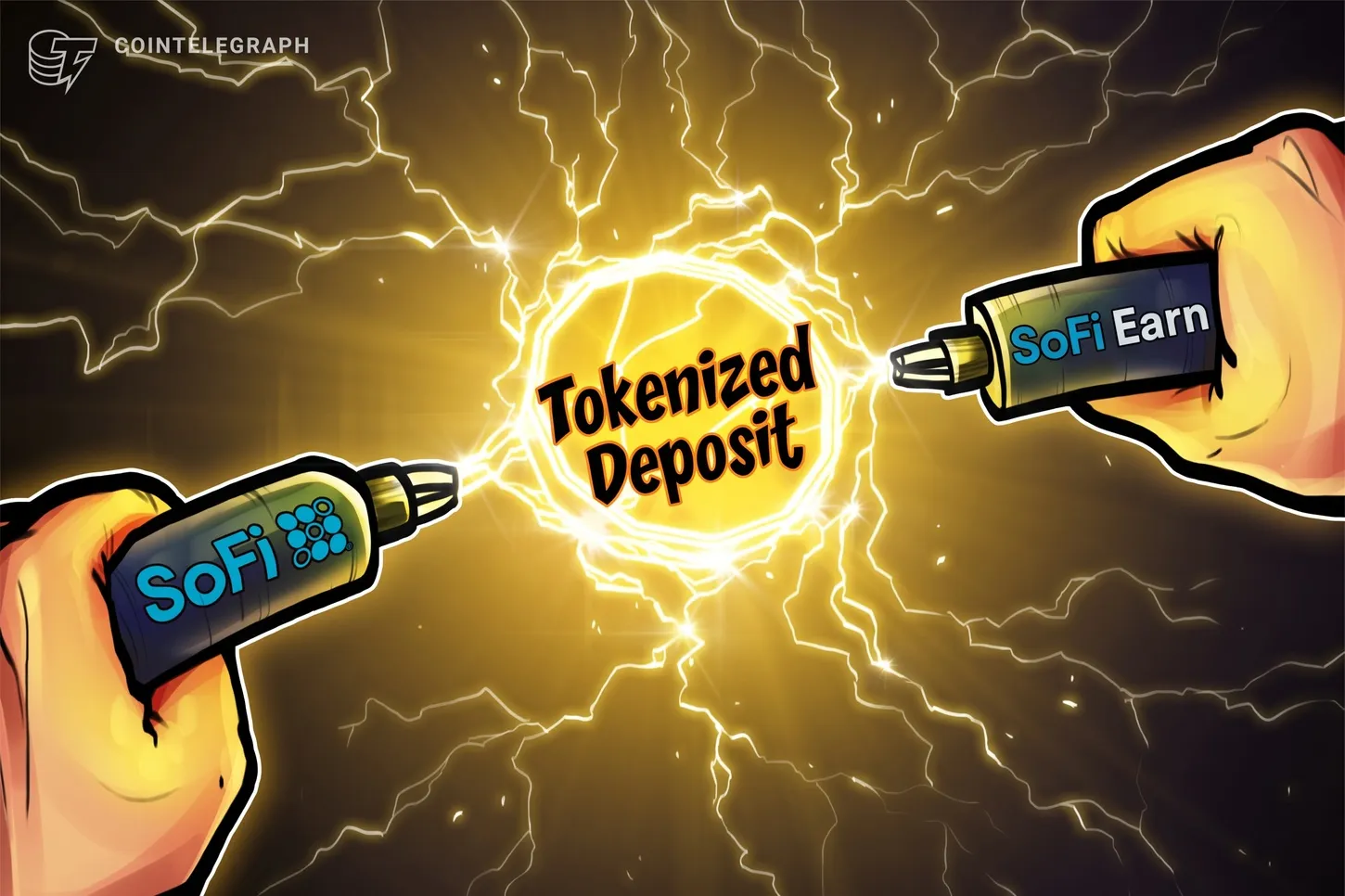
SoFi unveils bank-issued tokenized deposit for yield-bearing crypto funds

SoFi Technologies launched SoFi Earn (SOFIE) on Thursday, offering a variable 4.4% annual percentage yield on tokenized bank deposits.  SOFIE has no minimum balance requirement, according to the company‘s announcement. Each SOFIE represents $1 deposited at SoFi Bank. Customers can convert it one-for-one into SoFiUSD, the bank’s dollar-pegged stablecoin, to buy crypto in its app or send funds to supported external wallets.  SOFIE deposits qualify for Federal Deposit Insurance Corporation coverage up to $250,000 per depositor, per insured bank, for each account ownership category. SoFiUSD carries no FDIC insurance.  On Wednesday, the US Office of the Comptroller of the Currency issued a final rule covering payment stablecoin issuance and some custody activities, with the GENIUS Act framework taking effect in mid-January.  Cointelegraph reported in May that SoFi planned to introduce interest-bearing tokenized deposits when it made SoFiUSD available through its consumer banking app. At the time, the company said the feature would follow in the coming weeks.  The bank said SOFIE is rolling out to SoFi Crypto members through November. Members access the separate SOFIE deposit account through their SoFi Crypto account.  Magazine: 5 alternatives to Ledger to store your Bitcoin

10-23انڈسٹری

Fidelity's Timmer Blames Sticky Inflation and Fiscal Risk for Rising Bond Yields

Bond yields pulled back last week, with the 10-year Treasury yield down 14.6 basis points. Fidelitys Jurrien Timmer says a range may be forming, but he blames sticky inflation and fiscal risk for the climb.  Still, the drop followed a hotter Consumer Price Index (CPI) reading, with annual inflation at 3.7% against 3.6% expected. The Federal Reserve (Fed) meets October 27-28, when it will decide whether to raise rates again.  Sponsored  Sponsored  Why Timmer Thinks the Bond Yields Story Is Too Neat  Timmer rejects the tidy version of events, he wrote on X. In that version, growth lifted yields and AI capital spending (capex) worries pulled them down.  His explanation is broader.  “in my view the rise in yields this year has been multi-factorial, including sticky structural inflation and mounting fiscal risk.”  Jurrien Timmer, Director of Global Macro at Fidelity Investments, in a post  The 10-year yield briefly touched 5.33% after the October 14 report, XTB Research data shows. Core CPI, which strips out food and energy, rose 2.6% annually against 2.5% expected.  Sponsored  Sponsored  Then yields reversed. The reversal was called it the largest weekly decline in seven months. Investors sought safety in Treasuries during a chip stock sell-off tied to AI spending doubts.  Can Yields Settle While the Pressures Behind Them

10-23انڈسٹری
1
...
118120
...
1000