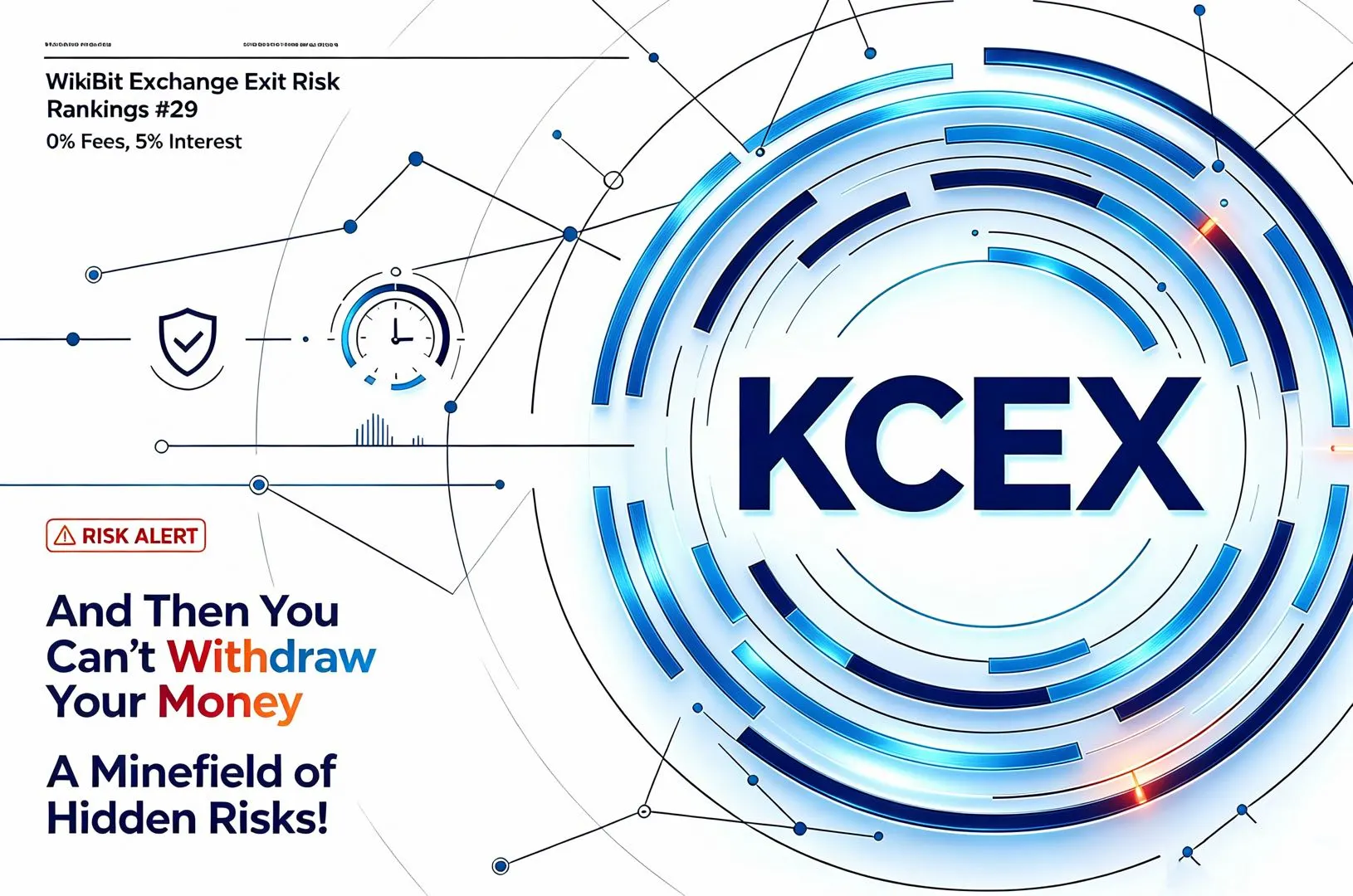
WikiBit Exchange Exit Risk Rankings #29: KCEX — 0% Fees, 5% Interest, and Then You Can’t Withdraw Your Money

Introduction: A “Zero-Fee” Exchange Run by Anonymous Operators  In the first 28 editions, we dug into a series of exchanges ranging from HashKey to BTCC. For #29, were looking at one of the most mysterious names yet: KCEX.  Its sales pitch is certainly hard to resist:0% spot trading fees0% futures Maker fees, 0.01% Taker fees0 withdrawal fees5% annualized yield on flexible USDT deposits100,000 TPS matching engineAll assets stored in cold wallets  Sounds like paradise for crypto bargain hunters, right?  But on the other side of the coin:  KCEX is registered in Seychelles, yet it does not appear on the Seychelles Financial Services Authority (FSA) VASP registration list. Its founder, CEO, and board members? Not a single name can be verified.  South Korea‘s Financial Intelligence Unit (FIU) has identified KCEX as an unregistered overseas virtual asset service provider and taken enforcement action. India’s Financial Intelligence Unit issued KCEX a non-compliance notice. Malaysias Securities Commission placed KCEX Fintech Limited on its Investor Alert List.  WikiBit gives KCEX a score of 4.95/10, concluding that it currently has no valid crypto-asset regulatory oversight. CoinGeckos reserve data is listed as “unavailable,” while its Proof of Reserves (PoR) score is only 5%.  On the App Store, numerous users have complained that withdrawals trigger risk
09-20گہرا غوطہ

Anthropic tabs Accenture as embedded evaluator to help with AI slowdown proposal

Anthropic said it has chosen Accenture as its first embedded evaluator to help slow the pace of AI development as proposed last week by CEO Dario Amodei.  Amodei published a three-step proposal on Sept. 12 to slow the development of AI and allow safeguards to be put in place amid warnings of a potential for catastrophic harm in the wake of swift, unchecked development.  OpenAI CEO Sam Altman and SpaceX CEO Elon Musk responded positively to Amodeis proposal, although Nvidia CEO Jensen Huang did not, arguing that such regulation was not necessary.  Still, Amodei wrote in his proposal that “AI has been advancing drastically faster, driven primarily by AIs growing ability to build the next generation of AI. This dynamic is called recursive self-improvement,” and “left unchecked, it could outrun our ability to understand and control these systems.”  The first step in Amodeis proposal is having independent evaluators with employee-like access, to which Anthropic had already unilaterally committed, Amodei wrote.  Anthropic announced a move toward fulfilling this commitment on Friday by partnering with Accenture and its AI business Faculty in “evaluating and red-teaming models, conducting alignment assessments and testing model safeguards.”  Details of how this will happen are still being worked out, as embedded evaluation is

09-20انڈسٹری

X brings crypto trading closer to your social feed

Crypto Twitter (now X) has always been a place where someone with an illustrated animal for a profile picture can explain why your financial future depends on a token you just learned about. Now Xs Cashtag links are shortening the route from that conversation to a crypto exchange.  Related Company Kraken San Francisco based digital asset exchange  Kraken joined Xs US Cashtag partner program on Sept. 16, giving users another route from tickers such as $BTC to its exchange. Tapping a Cashtag can bring up posts and a price chart on X, while the trading link sends users to Krakens app or website, where they sign in or register and complete the purchase.  Krakens announcement describes this as a way to become easier to find inside applications people already use. Thats the important part of the deal. X isnt becoming an exchange, and the trade itself still happens at Kraken. What changes is the distance between discovering an asset and reaching somewhere that sells it.  That distance has historically been surprisingly long for crypto. Someone might first hear about Bitcoin on X, read a thread explaining it, search for the price somewhere else, compare exchanges, open an account, fund it, and eventually return to

09-20انڈسٹری

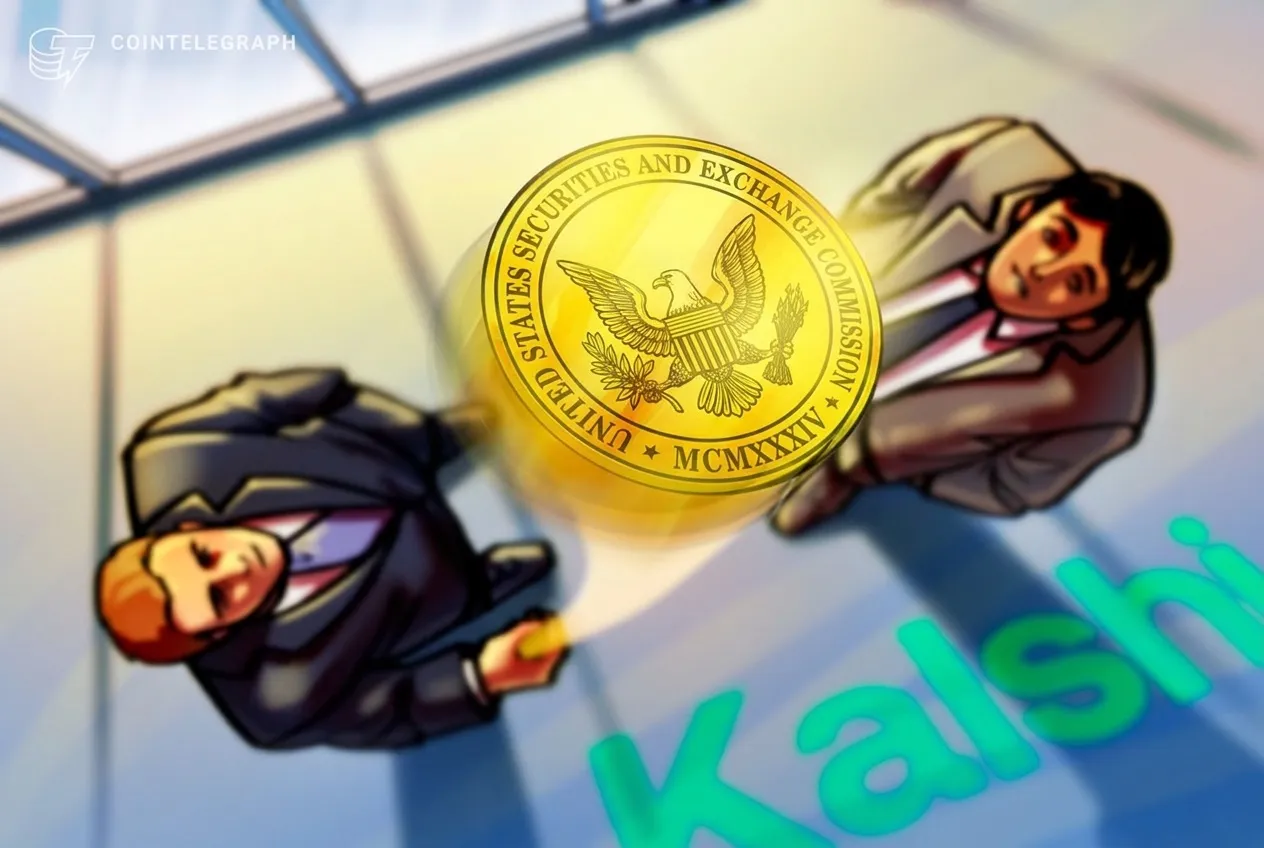
Kalshi joins Coinbase with own filing for US stock perpetual futures

Kalshi has filed to offer perpetual futures tied to individual US stocks, joining Coinbase in the competition to bring crypto-style derivatives to traditional equity markets.  The prediction market filed the proposed rule change with the Securities and Exchange Commission and submitted it to the Commodity Futures Trading Commission (CFTC) for approval on Friday. The CFTC has yet to approve the proposal.  The proposed contracts would have no preset expiration date and would use periodic funding payments between long and short positions to keep their prices aligned with the underlying stocks. Kalshi said the contracts would be treated as security futures products and cleared through its CFTC-registered clearinghouse, Kalshi Klear.  The filing comes the same day Coinbase submitted its own proposal to offer perpetual futures tied to individual US stocks, as both companies look to bring a derivatives product popular in crypto markets to traditional equities.  Kalshi already offers perpetual futures tied to cryptocurrencies in the US, including Bitcoin (BTC), Ether (ETH), Solana (SOL) and XRP (XRP), after receiving CFTC approval for its Bitcoin perpetual contract in May.  US stock perpetual futures race expands  Kalshi and Coinbase are joining whats becoming a crowded field of operators seeking to bring single-stock perpetual futures to the US market.  Payward, the

09-20انڈسٹری

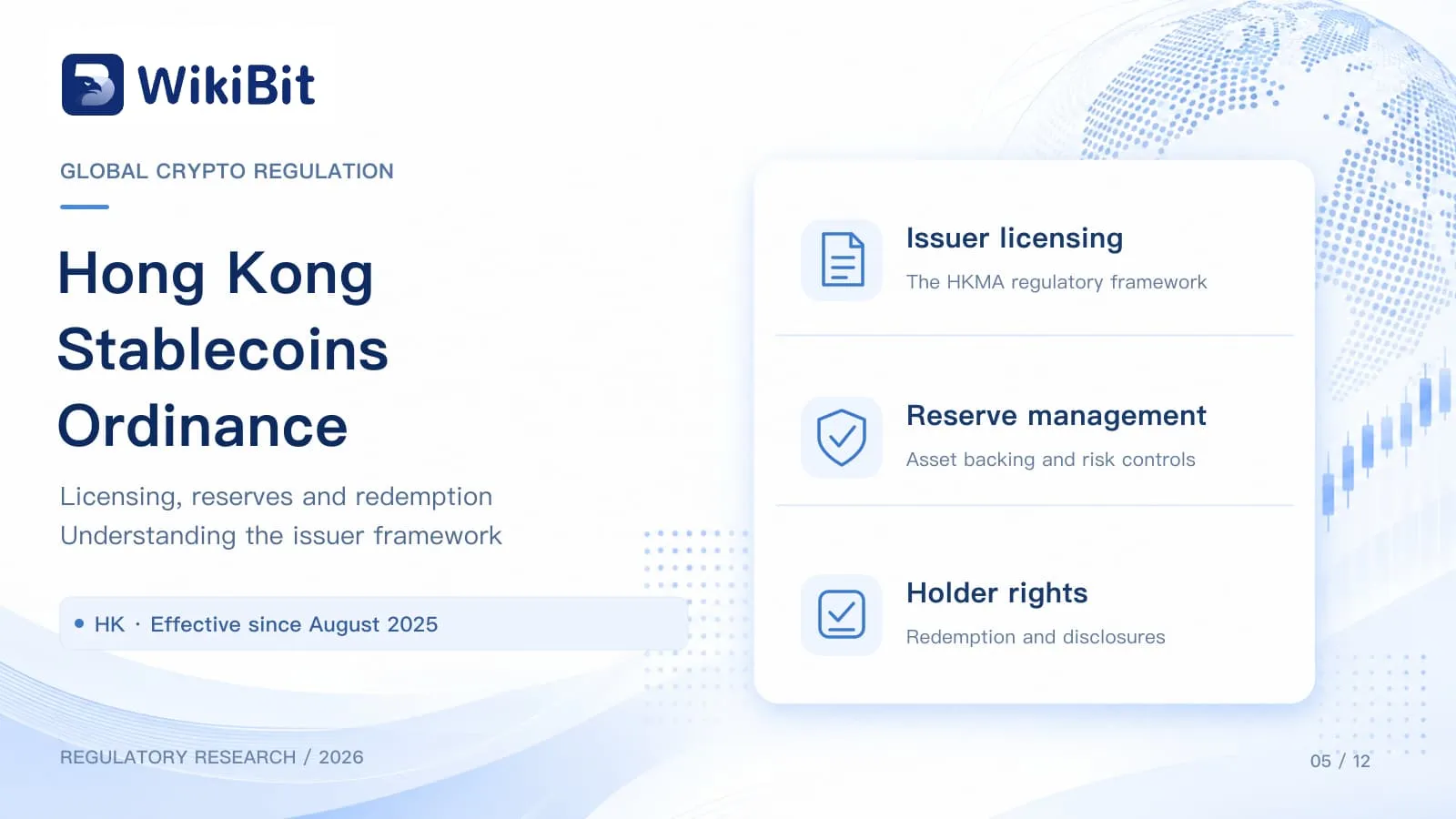
Hong Kong Stablecoins Ordinance: Licensing, Reserves and Redemption

Hong Kongs stablecoin regime is no longer a sandbox experiment or a proposal waiting to take effect.  The Stablecoins Ordinance (Cap. 656) came into operation on August 1, 2025, creating a licensing framework for regulated fiat-referenced stablecoin issuance. On April 10, 2026, the Hong Kong Monetary Authority granted the first two stablecoin issuer licences to Anchorpoint Financial Limited and The Hongkong and Shanghai Banking Corporation Limited (HSBC).  Both licensed issuers initially plan to issue Hong Kong dollar-referenced stablecoins.  That milestone makes Hong Kongs framework much easier to evaluate in 2026. The relevant questions are no longer only what applicants might need to do. There are now licensed issuers, ongoing HKMA supervision and separate Securities and Futures Commission rules governing how licensed platforms and intermediaries may provide services in regulated stablecoins.  For users, the most useful way to understand the regime is to separate four layers:  Issuer → Reserve assets → Redemption → Distribution  A licence at one layer does not automatically authorise every business at the next.  A stablecoin issuer licence does not make every exchange licensed. An exchange licence does not authorise the exchange to issue its own stablecoin. And the fact that a regulated stablecoin can be traded through an intermediary does not mean every

09-20انڈسٹری ریسرچ

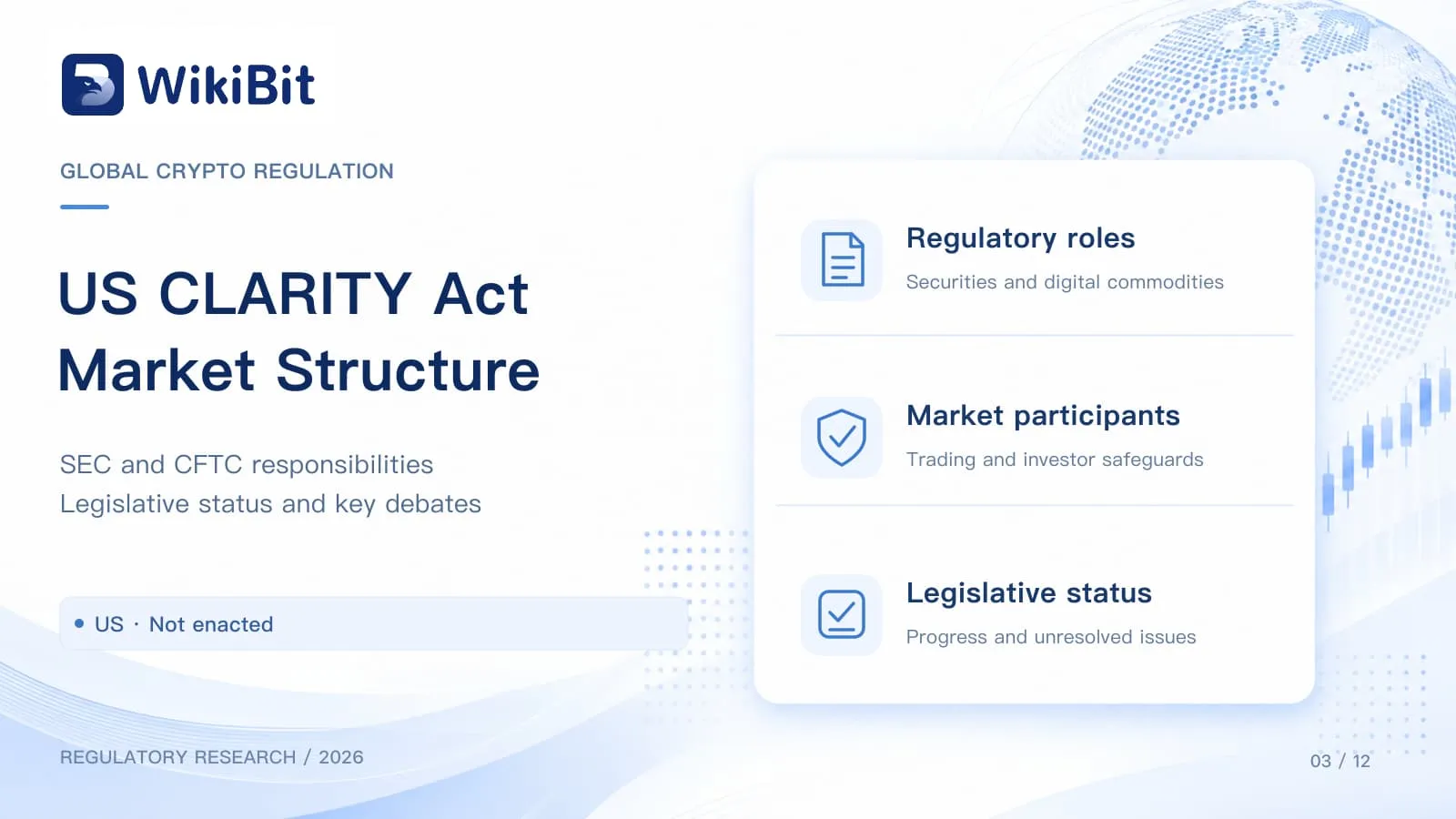
CLARITY Act Explained: Crypto Market Structure and Its 2026 Status

As of September 2026, the CLARITY Act remains one of the most important unfinished pieces of U.S. crypto legislation.  The House passed H.R. 3633, the Digital Asset Market Clarity Act of 2025, on July 17, 2025. The Senate then developed its own market-structure approach through both the Banking Committee and Agriculture Committee. In May 2026, the Senate Banking Committee advanced H.R. 3633 by a 15–9 vote.  But the legislation has not become law.  On September 15, 2026, a Senate procedural motion to advance the CLARITY Act fell short. That means the proposal remains part of an active legislative debate rather than the current federal rulebook.  This distinction matters because market-structure legislation can sound more settled than it really is. Headlines about committee votes, revised drafts or bipartisan negotiations do not create new legal permissions by themselves.  The useful question in September 2026 is therefore not simply:  What does the CLARITY Act regulate?  It is:  Which provisions are proposals, which version contains them, where is the legislation in Congress, and what law applies today?  That approach is especially important because several congressional texts have shaped the debate. The House-passed CLARITY Act, Senate Banking Committee text and Senate Agriculture Committees digital-commodity proposal overlap in important areas but are not interchangeable.Where the

09-20انڈسٹری ریسرچ

Robinhood Chain fees hit $4.5M as Ethereum gets $398

Robinhood Chain has collected roughly $4.5 million in transaction fees on Sept. 3 while spending an estimated $398 to post data and proofs to Ethereum, illustrating how little Layer 1 settlement cost can accompany heavy activity on an Ethereum Layer 2.  SummaryRobinhood Chain collected $4.5 million in fees on September 3 while paying Ethereum just $398.Bitquery counted 597 million transactions through September 3 and roughly $23 million in cumulative fees.Ethereum blobs provide Robinhood Chain data availability while ETH remains the networks native gas token.L2Beat says only two whitelisted actors can challenge Robinhood Chain state updates on Ethereum today.Arbitrum receives 10% of Robinhood Chain net protocol revenue under its Expansion Program license terms.  Bitquery reported that Robinhood Chain charged users $4,503,705 that day, while approximately $396 went toward Ethereum data posting and another $2 toward proving results. Its calculation produced a fee-to-settlement-cost ratio of roughly 11,400 to one.  The figures support part of an analysis published Sept. 20 by South Korea‘s Digital Asset, which argued that rapid Layer 2 growth does not necessarily create proportional economic value on Ethereum mainnet. The publication’s conclusion is an analysis, however, while the underlying fee, architecture and settlement figures can be checked separately.  Former Robinhood engineers charged over $50K

09-20انڈسٹری

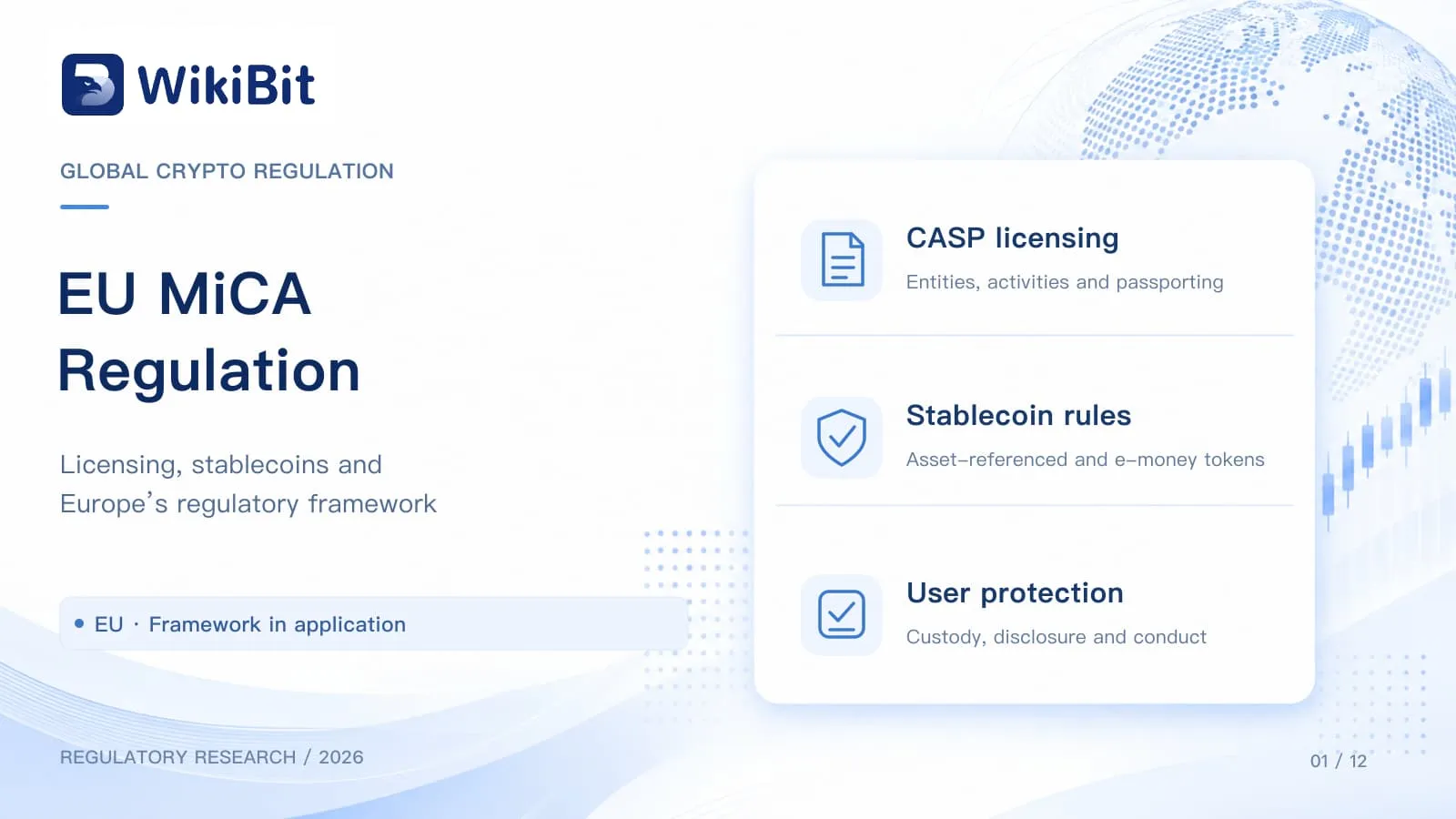
EU MiCA Regulation Explained: Crypto Rules, Stablecoins and Exchange Licensing in 2026

The Markets in Crypto-Assets Regulation, better known as MiCA, has moved into a very different phase in 2026.  For several years, the regulation was discussed mainly in terms of implementation dates, licence applications and transitional arrangements. That period is largely over.  The stablecoin provisions have applied since June 30, 2024. Most of the remaining regulation has applied since December 30, 2024. And on July 1, 2026, the longest possible transitional period for crypto-asset service providers came to an end.  For exchanges, custodians and other crypto businesses serving EU customers, the central question is therefore no longer:  Is this company preparing for MiCA?  It is:  Which legal entity serves the customer, is that entity authorised under MiCA, and which services is it authorised to provide?  That distinction is more important than the licence badge shown in an exchange footer.  A global crypto brand may operate through one MiCA-authorised European company, a separate UK entity, Middle Eastern entities and offshore companies. MiCA protections attach to the authorised legal entity and the services covered by its authorisation — not automatically to every company using the same brand.  For users, this makes MiCA more practical than it may initially appear. Regulatory claims can increasingly be verified against official registers rather than accepted as

09-20انڈسٹری ریسرچ

Why Bitcoin‘s 63% HODL wave isn’t the mega bull signal everyone thinks it is

Bitcoin‘s share of supply last moved at least one year ago reached 63.3% on Sept. 18, up 0.98 percentage points from 62.32% on Aug. 18, according to Maketo’s HODL-wave data.  Related Asset Bitcoin #1 BTC · $80,447.74 24-hour change: down 0.58% Loading price history… 24H Down 0.58% 7D Up 4.12% 30D Up 6.72%  HODL waves group Bitcoins unspent transaction outputs into age bands based on their last on-chain movement. The rising one-year share therefore shows that more supply now sits in older bands. Current-month buying and deliberate withdrawal from the market require separate evidence.  The underlying bands point to a specific mechanism. Coins that last moved roughly a year ago can enter the one-to-two-year bracket simply by remaining still long enough to cross the boundary.  What Bitcoin HODL waves measure  The one-to-two-year band increased to 14.57% of supply from 13.52% between Aug. 18 and Sept. 18, a gain of 1.05 percentage points. That was the largest positive change among the cohorts already older than one year.  Over the same period, the six-to-twelve-month band fell to 17.53% from 19.10%. Glassnodes Sept. 18 snapshot showed the same latest values for both bands.  The paired moves are consistent with coins crossing the one-year boundary. Each band is a net share

09-20انڈسٹری

BTCC Review 2026: Futures Fees, Reserves and Risks

BTCC is one of the oldest names still active in crypto trading, tracing its history to 2011. But the platform users see in 2026 is very different from the early China-based Bitcoin exchange associated with the original brand.  Todays BTCC is primarily a derivatives platform. It offers USDT- and coin-margined perpetual futures, spot trading, copy trading, Earn products and an expanding TradFi section covering stocks, indices, commodities, metals and forex through USDT-settled contracts.  Its 2026 strategy has been particularly aggressive on cost.  BTCC permanently cut standard crypto futures fees in June and removed execution fees entirely from more than 30 TradFi futures instruments. At the same time, it has continued publishing monthly Proof of Reserves reports with customer-level Merkle verification.  The reserve numbers have also changed since earlier versions of this review. BTCC reported a 140% total reserve ratio for its August 15, 2026 snapshot, up from 129% in July and 132% in February. Its live PoR page has since advanced to a September 15 report date.  Those are meaningful disclosures.  But BTCCs strongest products are still leveraged derivatives. A 0.048% taker fee does not make a highly leveraged position low-risk, and a 140% PoR snapshot does not turn futures collateral into an insured deposit.  The useful

09-20انڈسٹری ریسرچ
1
...
102104
...
1000