Coinbase users can now borrow USDC against bitcoin at a fixed rate

Nasdaq-listed exchange Coinbase COIN$200.54·Market Closed now allows its users to borrow dollar-pegged stablecoin $USDC agains their bitcoin  $BTC$86,037.36  holdings with no surprises on what theyll pay in interest.  The exchange has rolled out fixed-rate, bitcoin-backed $USDC loans, with the interest rate and repayment date set at the time of borrowing, an alternative to the floating-rate loans Coinbase already offers.  “The move takes onchain borrowing beyond the predominantly variable-rate model, giving users greater certainty over the cost and duration of their borrowing,” according to an announcement on Tuesday.  The fixed-rate offering runs on Morpho Midnight, a decentralized, non-custodial lending protocol for fixed-rate and fixed-term crypto loans launched in July this year. It settles transactions on Coinbases Ethereum layer 2 network Base.  It marks a meaningful shift from how Coinbase‘s lending has worked until now. It’s existing loans run on the Morpho Blue protocol, where rates change, determined by demand and supply conditions and can climb when borrowing demand spikes. The new fixed-rate option sits alongside this floating one, which has more than $1.4 billion in active loans backed by nearly $3 billion of collateral.  Fixed-rate bitcoin-backed loans arent new, with lenders like Ledn and SATL Lending offering them for years. What Coinbase has done stands out because it

09-23

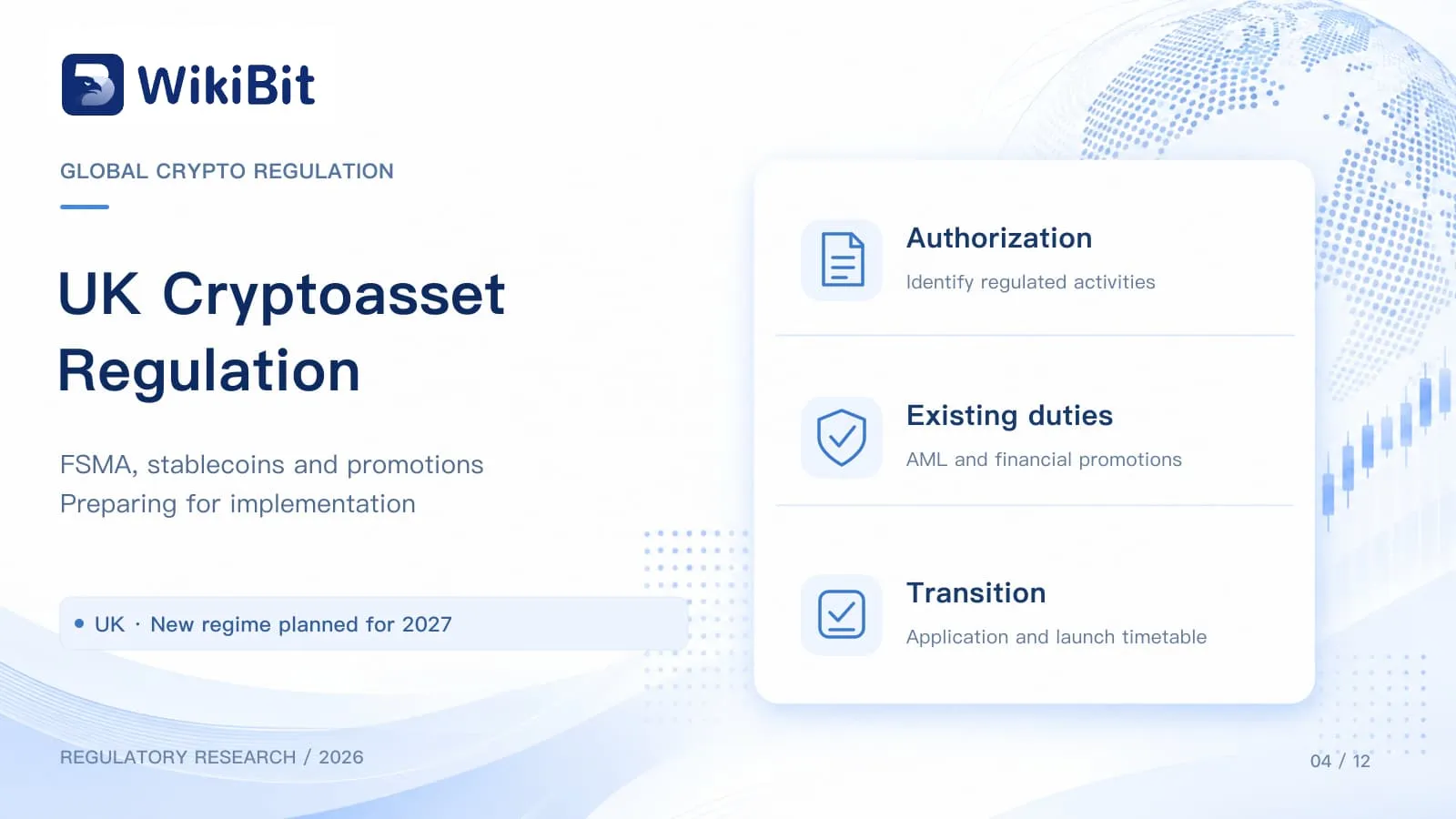
UK Cryptoasset Regulation: The 2026 Rules and 2027 Implementation

The United Kingdom has now created the legal foundation for a comprehensive cryptoasset financial-services regime, but the new framework is not yet fully in force.  The Financial Services and Markets Act 2000 (Cryptoassets) Regulations 2026 were made on February 4, 2026. They create new regulated activities covering areas such as operating cryptoasset trading platforms, dealing and arranging, safeguarding, staking and issuing qualifying stablecoins.  The main regime is scheduled to come into force on October 25, 2027.  Before then, firms face an important implementation period. The FCA will accept applications for the new cryptoasset permissions from 7:00am on September 30, 2026 until February 28, 2027.  At the same time, todays rules have not disappeared.  Cryptoasset firms can already face:anti-money-laundering registration requirements;financial-promotion rules;Travel Rule obligations;existing FSMA requirements where another regulated financial product or service is involved.  This creates one of the most important distinctions in UK crypto regulation:  FCA registration, lawful crypto advertising and future FSMA crypto authorisation are not the same thing.  A platform saying it is “FCA registered” may currently mean that the entity is registered under the Money Laundering Regulations for relevant cryptoasset activity.  That does not automatically mean the firm already holds the future permissions required to operate a regulated cryptoasset trading platform, safeguard qualifying cryptoassets, issue

09-23انڈسٹری ریسرچ

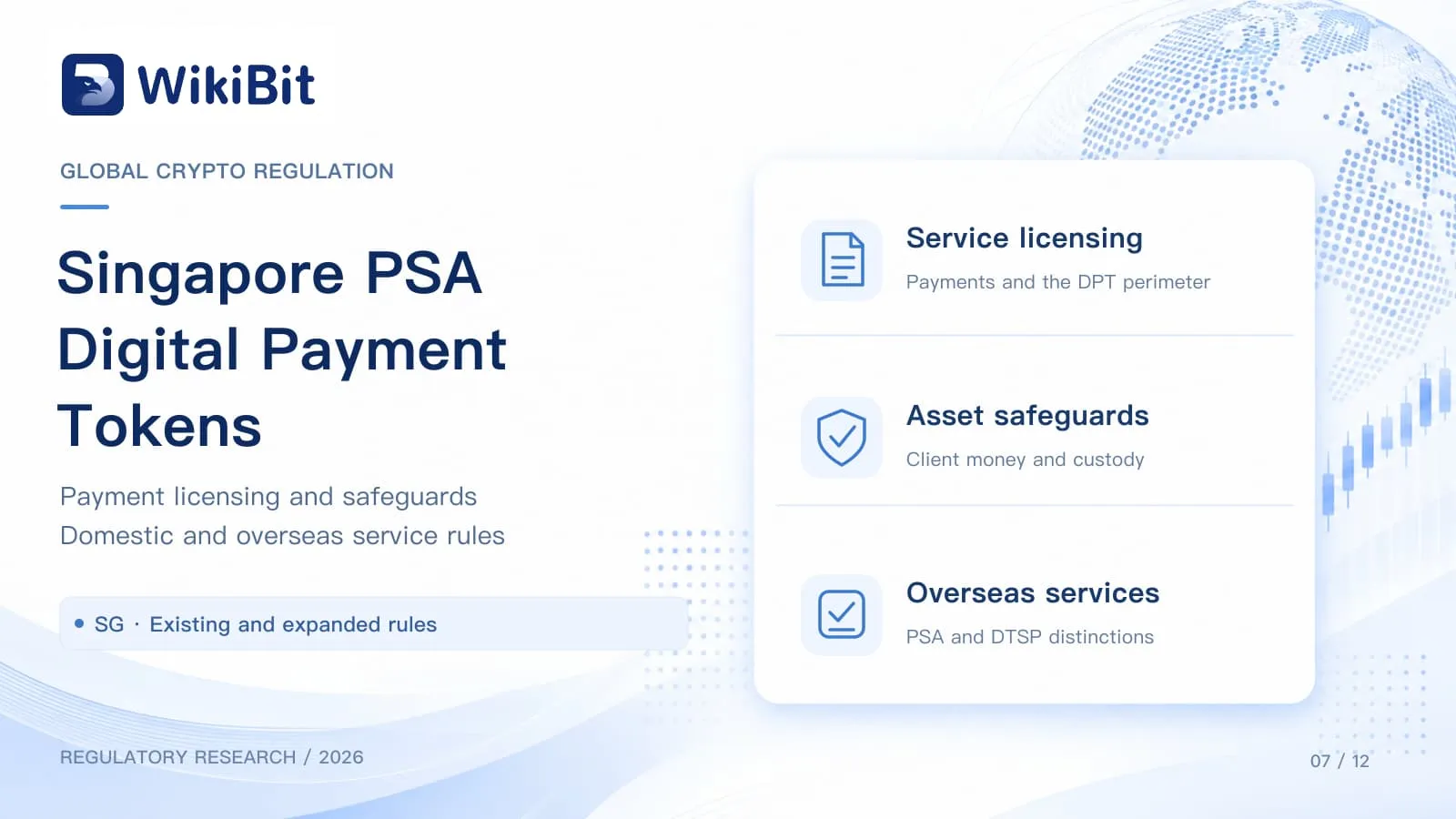
Singapore Payment Services Act: DPT Licensing and Asset Protection

Singapores crypto regulatory framework is best understood as an activity-based licensing system rather than a single “crypto licence.”  The Payment Services Act 2019 (PSA) regulates Digital Payment Token, or DPT, services alongside other payment activities. Its scope was materially expanded on April 4, 2024 to capture custody, token transfers and exchange-arrangement activities that previously could fall outside the perimeter.  Customer-asset safeguards followed in October 2024, requiring relevant DPT service providers to place customer assets into trust arrangements or return them within the prescribed timeframe, maintain proper records and separate safeguarding functions from trading and investment decisions.  A second framework then became important in 2025.  From June 30, 2025, Singapore introduced a separate Digital Token Service Provider regime under the Financial Services and Markets Act for specified Singapore-linked businesses that provide digital-token services only to customers outside Singapore. MAS has said the licensing bar for that model is high and that it will generally not issue such licences.  These two regimes should not be combined.  For a crypto platform operating from Singapore in 2026, the useful questions are:  Which legal entity provides the service?  Does it serve customers in Singapore, customers overseas, or both?  Which regulated activity does it perform?  Does its MAS permission actually include Digital Payment Token Service?  Those questions

09-23انڈسٹری ریسرچ

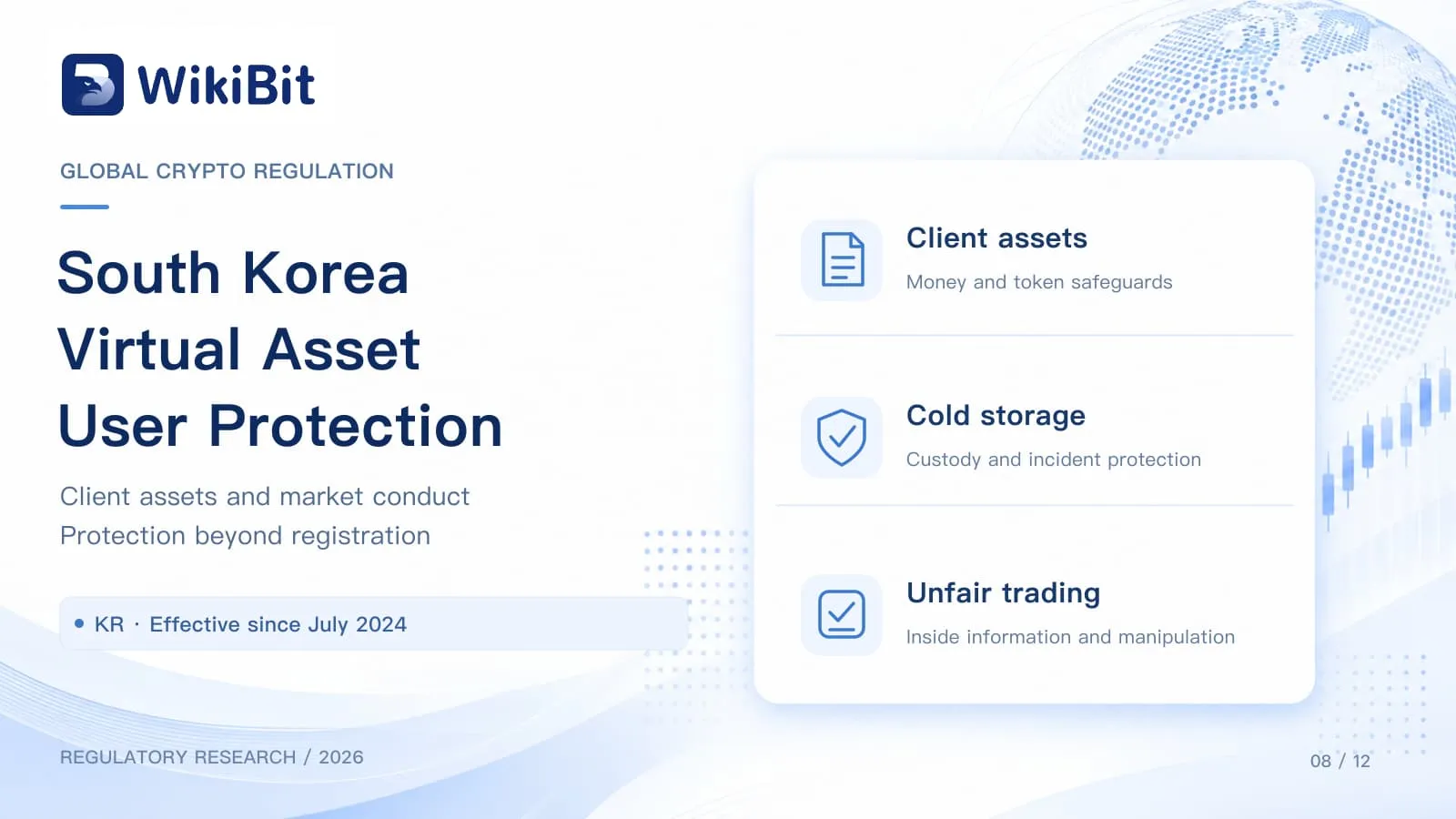
South Korea Virtual Asset User Protection Act: Safeguards and Market Abuse

South Koreas Virtual Asset User Protection Act has moved well beyond its launch phase.  The law took effect on July 19, 2024 and added a dedicated user-protection and market-conduct layer on top of the countrys earlier virtual asset service provider registration and anti-money-laundering framework.  Its core protections are concrete.  Customer cash deposits must be managed separately through banks. Virtual asset service providers must actually hold the types and quantities of crypto entrusted by users. At least 80% of the economic value of customer virtual assets must be maintained in cold storage. Providers also need insurance, mutual-aid arrangements or reserves for specified incidents such as hacking and system failures.  The law also created a much stronger market-abuse regime covering conduct such as insider dealing, price manipulation and fraudulent transactions.  By July 2026, those provisions were no longer theoretical. Korean financial authorities reported that they had completed investigations into more than 40 suspected unfair-trading cases since the law took effect and had referred or reported more than 30 cases to investigative authorities.  That enforcement record makes the 2026 question different from the one investors asked in 2024.  It is no longer:  Will South Korea enforce the User Protection Act?  It is:  How do the custody rules work in practice, what does the

09-23انڈسٹری ریسرچ

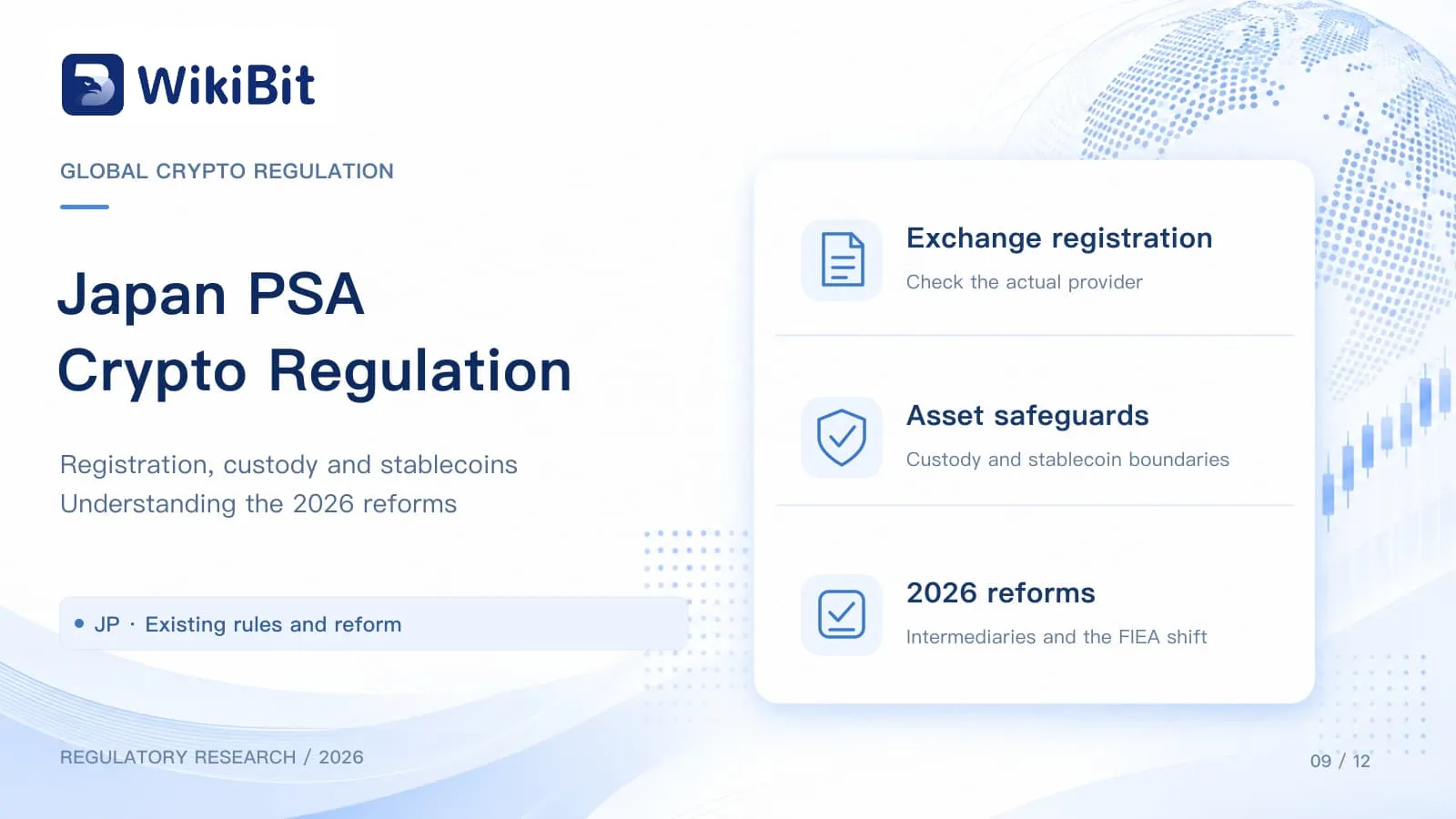
Japan Payment Services Act: Crypto Registration, Custody and 2026 Reform

Japan has one of the longest-running crypto exchange registration systems among major financial markets, but its regulatory structure is changing again in 2026.  The Payment Services Act (PSA) remains the current foundation for cryptoasset exchange registration, custody and customer-asset protection. Amendments adopted in 2025 took effect on June 1, 2026, introducing a new intermediary category and additional measures affecting customer assets and stablecoin-related services.  A second reform followed only weeks later.  On July 15, 2026, Japan enacted amendments to the Financial Instruments and Exchange Act (FIEA) and Payment Services Act that are designed to move much of the regulation of cryptoasset trading into the FIEA framework.  That later reform has passed, but it has not yet replaced the existing PSA regime as of September 2026.  The Financial Services Agencys implementation materials state that the cryptoasset regulatory changes are scheduled to take effect within one year from April 1, 2027. Until the relevant provisions commence, existing PSA registration and custody rules remain operational.  That creates a two-layer question for users and businesses:  What rules apply to the provider today?  and:  What will change when the 2026 FIEA reform takes effect?  Those questions need to be kept separate.Japans crypto framework is broader than the Payment Services Act  The PSA is central, but it

09-23انڈسٹری ریسرچ

AI potential to drive crypto demand remains ‘underappreciated’: BlackRock

The worlds largest asset manager, BlackRock, says broad AI adoption could represent an underappreciated source of demand for digital assets.  In its latest research paper, “The Machine-Native Economy,” BlackRock said the rise of AI and machine-to-machine payments could increase demand for blockchains and other programmable payment infrastructure, including stablecoins and other on-chain assets. It also sees a potential opportunity for digital assets to support the compute market, allowing claims on computing capacity to be tokenized, traded and used as collateral.  “Together, these developments position AI as a structural catalyst for digital asset adoption and digital assets as a potential facilitator of the AI economy,” BlackRocks Will Su, Robert Mitchnick, Jay Jacobs and William Helm wrote. “This relationship remains underappreciated and could expand the role of digital assets as core infrastructure for an increasingly autonomous digital economy.”  The crypto industry has long argued the potential link between AI and digital assets, but BlackRocks research could bring that thesis to its broader audience of institutional investors.  AI could drive need for machine-native payment rails  One of BlackRocks arguments is that the rise of agentic AI could increase the demand for machine-native payment instruments.  While existing payment rails can support some degree of automation, account setup, credentialing, and authorization

09-23

Why Is Bitcoin Price Going Up Today? Rally Defies Every Bearish Catalyst

Bitcoin is trading at $86,767.30, up 1.1% over 24 hours and 14.6% over the past week, following a rally that pushed it to $87,000, its highest level in eight months. Over $1 billion in positions were liquidated in a single 24-hour stretch on the way there.  Every Bearish Catalyst Fired At Once  Three things happened this month that were each expected to break the rally. The CLARITY Act, cryptos one shot at federal market structure rules, failed on the Senate floor 49-50, ten votes short of the 60 needed, after two years of lobbying. Coinbase stock fell about 8% that day, Circle fell roughly 10%.  The next day, the Federal Reserve delivered a unanimous 25 basis point rate hike under new chair Kevin Walsh, its first hike since 2023, as the 10-year Treasury yield sat above 5% and the Bank of Japan raised rates to a 31-year high in the same window.  On top of that, the AI trade started cracking too, after Anthropics Dario Amodei published an essay warning the industry was outpacing its own safety work, quickly echoed publicly by Sam Altman and Elon Musk. The semiconductor index dropped over 5% by the following Monday, its worst session since July, with Nvidia,

09-23

21Shares launches Zcash ETP after U.S. ETF debut

21Shares has launched physically backed exchange-traded products tracking Zcash and ether.fi across Euronext Paris and Amsterdam, extending regulated European access to $ZEC weeks after Grayscale introduced a U.S.-listed Zcash ETF.  21Shares announced the two products on Sept. 22, identifying them as the 21Shares Zcash ETP, ticker ZCASH, and the 21Shares ether.fi ETP, ticker $ETHFI. Both carry annual product fees of 2.5% and trade in euros in Paris and U.S. dollars in Amsterdam.  The issuers product pages list Sept. 21 as the inception date for both securities. Each product began with 5,000 securities outstanding, while early reported assets under management stood near $100,000 apiece.  21Shares Zcash ETP gives investors physically backed $ZEC exposure  The Zcash product uses ISIN CH1608218801 and provides indirect exposure to $ZEC through a traditional brokerage account. Unlike buying Zcash directly, investors do not need to open a crypto exchange account or manage private keys.  21Shares states that ZCASH is physically backed, meaning the product structure holds $ZEC corresponding to the securities issued. Its documentation identifies institutional custody providers that can include Coinbase Custody, Zodia Custody, Anchorage Digital and BitGo entities, while the current key-information section names BitGo as custody provider.  The ETP does not give investors direct possession of the underlying $ZEC. Investors

09-23

Coinbase CEO Brian Armstrong Challenges Banks as Stablecoin Rewards Fight Grows

Coinbase CEO Defends $USDC Rewards  Coinbase CEO Brian Armstrong is pushing back against the idea that crypto platforms offering stablecoin rewards should face the same capital and liquidity rules as banks.  In a Sept. 19 interview with Money Rehab, Armstrong argued that $USDC rewards largely pass through part of the economic return generated by the assets backing the stablecoin, including short-term U.S. Treasuries.  “If you want to hold a stablecoin, you could actually earn reward,” Armstrong said. “Why shouldnt consumers be able to benefit from that?”  The distinction matters because stablecoin rewards have emerged as a major battleground in Washington, with banks warning that higher-paying digital dollars could pull deposits from the traditional financial system.  Armstrong Says Stablecoins Are Not Bank Deposits  Armstrong drew a sharp line between $USDC rewards and deposit interest.  “We‘re not engaging in fractional reserve lending,” he said. “That’s what you need a bank license for.”  The GENIUS Act, signed into law in July 2025, requires permitted payment stablecoin issuers to maintain at least one-to-one reserves using eligible liquid assets. The law also prohibits issuers themselves from paying interest or yield, while leaving debate around rewards provided by exchanges and other third parties.  Armstrong said Coinbase is not a stablecoin issuer—$USDC is issued by Circle,

09-23

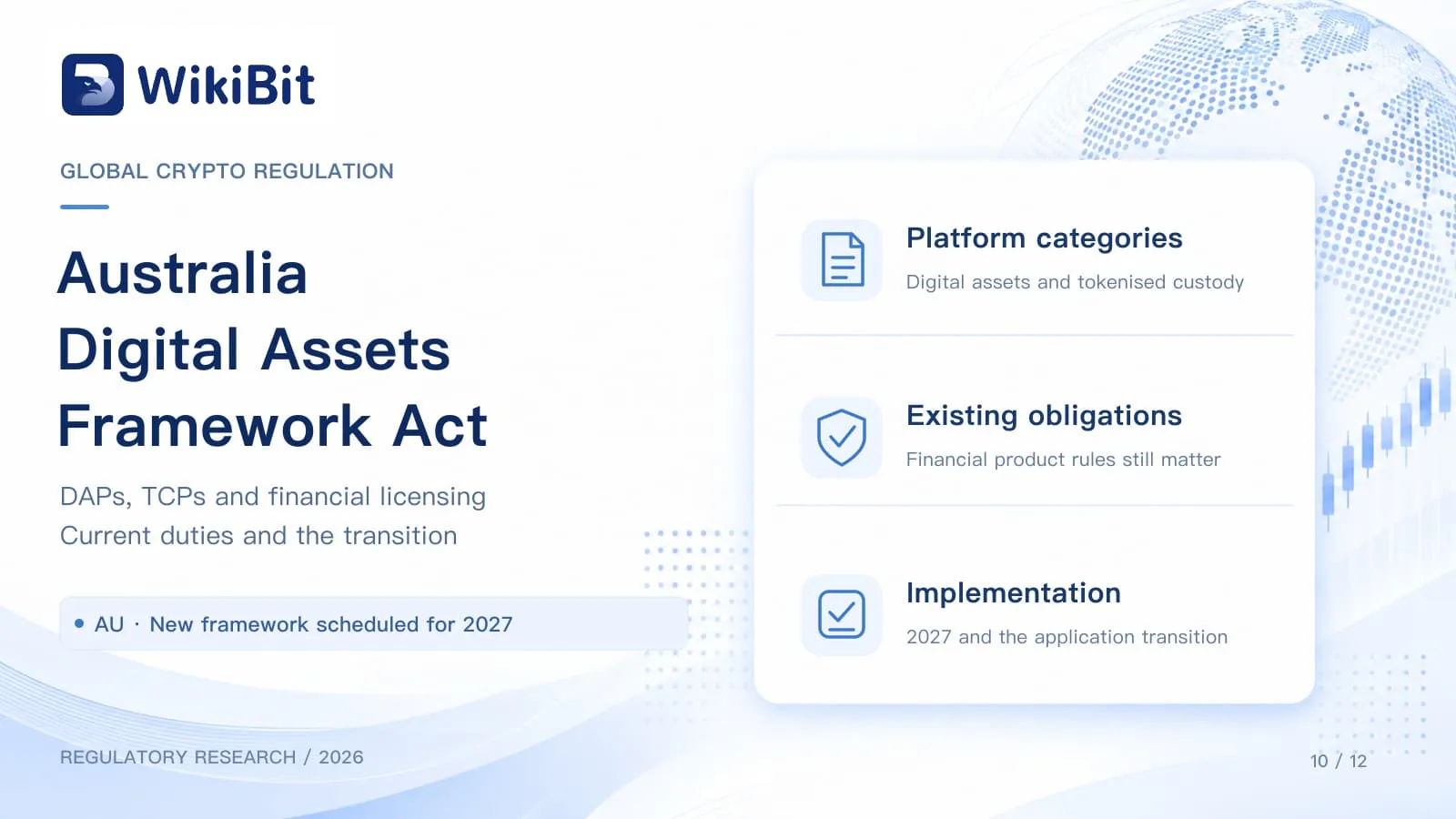
Australia Digital Assets Framework Act: Platform Licensing and the 2027 Transition

Australias digital-asset regulatory framework changed materially in 2026, but the most important new platform rules are not yet fully operational.  The Corporations Amendment (Digital Assets Framework) Act 2026, Act No. 38 of 2026, received Royal Assent on April 8, 2026. It creates a new financial-services framework for digital asset platforms (DAPs) and tokenised custody platforms (TCPs) under the Corporations Act.  The reform is significant because it regulates the platform arrangement itself rather than simply trying to classify every crypto token as a traditional financial product.  But enactment should not be confused with commencement.  ASICs current implementation roadmap says the new DAP/TCP framework will commence in April 2027, followed by a licensing transition. At the same time, Australias existing financial-services laws already apply where a digital-asset product or service falls within existing financial-product definitions.  That creates two parallel questions for businesses in 2026:  What law applies to my product today?  and:  What additional DAP or TCP obligations will apply when the new framework commences?  For users, the same distinction matters when an exchange says it is “preparing for Australias new crypto licence.” Preparation for a future regime does not establish that every service it provides today is already properly authorised.The Act is law, but the new framework starts in 2027  The

09-23انڈسٹری ریسرچ
1
...
7678
...
1000