Ethereum Foundation Unstakes $50M ETH Amid Treasury Shifts

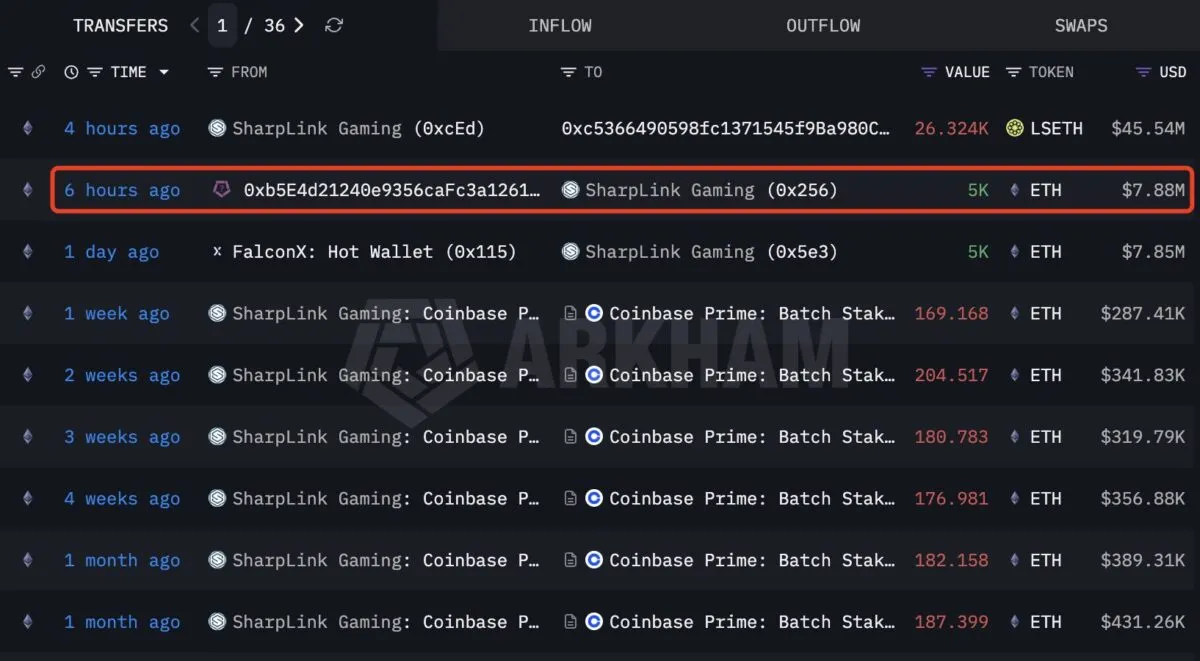
The Ethereum Foundation (EF) has withdrawn 21,270 Ether (ETH), valued at approximately $50 million, from Lidos liquid staking protocol, according to blockchain analytics firm Arkham. This marks the second significant unstaking move by the foundation in recent weeks, raising questions about its treasury strategy.  The withdrawal, initiated on Monday, shifts these funds out of Ethereum‘s Beacon Chain, where they had been locked to earn staking rewards. While the move doesn’t necessarily signal an imminent sale of the unstaked ETH, it does represent a recalibration of how the nonprofit manages its assets. Withdrawals through Lido enter a queue system, allowing claimants to redeem ETH once the process is finalized.  This unstaking follows a similar action in late April when the EF withdrew 17,000 ETH. Shortly after, on May 1, the foundation reportedly sold 10,000 ETH in an over-the-counter (OTC) deal to Bitmine, the largest corporate holder of Ethereum. Its unclear if this latest move is part of a broader strategy to free up liquidity or reposition treasury holdings.  Strategic Treasury Adjustments  The Ethereum Foundation updated its treasury policy in mid-2025, emphasizing increased staking as a mechanism to fund protocol development. Since then, it has progressively allocated more ETH to staking, with significant deposits made in

05-13

JPMorgan files for tokenized money market fund on Ethereum

JPMorgan Chase has once again filed to launch a tokenized money market fund on the Ethereum blockchain with the SEC. This fund would be JPMorgans second such product, designed to be a reserve asset for stablecoin issuers pending approval from the SEC.  The money market fund is called the JPMorgan OnChain Liquidity-Token Money Market Fund and it will trade under the ticker JLTXX.  The fund will invest in U.S. Treasury securities and repurchase agreements backed by either treasuries or cash, according to the SEC filing. The exact timeline for full operation and acceptance of investors was not specified in the filing.  JPMorgan also stated that the funds blockchain infrastructure will be operated by Kinexys Digital Assets, its in-house digital assets unit.  Ethereum is “currently the only available blockchain for use by investors, although expansion to other blockchains is anticipated in the future,” the statement mentioned.  Built for stablecoin backing  The tokenized MMF has been well structured to meet requirements in the Guiding and Establishing National Innovation for U.S. Stablecoins Act, also known as the GENIUS Act.  This act requires stablecoin issuers within the U.S. jurisdiction to back their tokens with highly liquid assets, including cash, treasuries, and insured bank deposits.  “The Fund invests in a manner intended to

05-13

JPMorgan Files Ethereum-Based Tokenized Money Fund as ETH Foundation Launches Clear Signing Standard

Ethereum  JPMorgan Files Ethereum-Based Tokenized Money Fund as ETH Foundation Launches Clear Signing Standard  JPMorgan has filed with the U.S. Securities and Exchange Commission to launch a tokenized money market fund built on the Ethereum network, marking one of the largest traditional banking entries into onchain finance to date. The product, named the JPMorgan OnChain Liquidity-Token Money Market Fund and ticker JLTXX, will invest exclusively in U.S. Treasury bills, bonds, and notes. The fund will operate through Kinexys Digital Assets, JPMorgans blockchain unit, which deploys a permissioned layer on top of Ethereum. The filing flags potential expansion to additional networks in the future. Shares of JPMorgan closed 1.63% higher at $304.88 following the disclosure.  The Ethereum Foundation, alongside hardware wallet makers Ledger and Trezor and software wallet providers MetaMask and WalletConnect, unveiled a new open standard called Clear Signing aimed at eliminating one of crypto‘s most costly attack vectors. The framework targets blind signing, the practice of approving raw, machine-readable transaction data that has contributed to losses estimated in the billions, including last year’s $1.5 billion Bybit breach. Clear Signing relies on ERC-7730 for human-readable transaction descriptors and ERC-8176 for attestation. A decentralized off-chain registry will distribute the descriptors, with the Foundations Trillion

05-13

JPMorgan joins reserve fund race with Ethereum-based JLTXX

JPMorgan has filed to launch the JPMorgan OnChain Liquidity-Token Money Market Fund, a tokenized government money market fund with the ticker JLTXX. JPMorgans JLTXX fund targets stablecoin issuers needing Treasury-backed reserves and blockchain-based share transfer tools.Morgan Stanleys MSNXX launch shows Wall Street banks are competing for stablecoin reserve management mandates.Earlier coverage linked JPMorgan to an XRPL settlement pilot with Mastercard, Ripple, and Ondo Finance.  The filing lists Token Class Shares dated May 13, 2026, and says the fund seeks current income while keeping liquidity and principal stability.  The fund is built for stablecoin issuers that need reserve assets under the GENIUS Act. JPMorgan says JLTXX will invest in a way intended to meet eligible reserve asset rules. Its portfolio will focus on U.S. Treasury securities and overnight repurchase agreements backed by Treasurys or cash.  Ethereum becomes the current blockchain rail  The filing says Ethereum is the only public blockchain currently available for investors, though JPMorgan expects to add more networks later. Investors must use approved blockchain addresses before they can buy, redeem or transfer token balances linked to fund shares.  JLTXX keeps official ownership records in traditional book-entry form. The blockchain layer records token balances and can help investors send transaction requests. The fund also

05-13

Copper Hits an All-Time High: Here’s Why It Matters for Altcoins

Tech  Copper Hits an All-Time High: Heres Why It Matters for Altcoins  Copper futures surged to a record $6.69 per pound, up 16.98% in 2026 alone, outpacing gold futures 8.38% gain this year.  Behind the price move sits a tight global supply picture, with mine output still hampered by ongoing disruptions.  Copper Price Hits All-Time High. Source: TradingViewCopper‘s YTD Gain More Than Doubles Gold’s 2026 Performance  The Kobeissi Letter highlighted that the base metal is up more than 40% over 12 months. The post noted that tight supply, falling Chinese inventories, and rising data center demand are driving the move.  “Grasberg in Indonesia, the worlds second largest copper mine, remains underutilized after a fatal mudslide triggered a force majeure in September; elsewhere, production guidance at the Quebrada Blanca mine in Chile has been downgraded due to operational challenges, further compounding the global shortage,” JPMorgan stated.  Demand pressure is also intense. Data centers, electric vehicle factories, power grids, and artificial intelligence (AI) infrastructure all rely on copper wiring.  Chinas April exports jumped 14% year over year, led by clean-tech shipments, per the Kobeissi Letter. These components are copper-intensive, further squeezing global availability.  Analysts See Historical Pattern Tying Copper to Altcoins  Analysts are now tying coppers rally to a possible delayed move

05-13

OKX To List PROS Token For Spot Trading Today

Tech  OKX To List PROS Token For Spot Trading Today  OKX, one of the worlds leading cryptocurrency exchanges by trading volume, has announced it will list the PROS token for spot trading. The PROS/USDS trading pair is scheduled to go live at 11:00 a.m. UTC today, providing users with a new market for the token.  Listing Details and Timeline  The listing will be available on OKXs spot trading platform, allowing users to trade PROS directly against USDS, a stablecoin pegged to the US dollar. The announcement did not specify any additional promotions or deposit bonuses tied to the listing, indicating a standard market addition. Deposits for PROS have likely been opened ahead of the trading start to ensure liquidity at launch.  What Is PROS?  PROS is the native utility token of the Prosper ecosystem, a decentralized finance (DeFi) platform focused on yield optimization and automated trading strategies. The token is used for governance, staking, and fee discounts within the protocol. Its listing on a major exchange like OKX typically increases liquidity and accessibility for retail and institutional traders alike.  Market Implications  Exchange listings often lead to increased trading volume and price volatility for the listed token in the short term. For PROS holders, the OKX listing opens up

05-13

Hyperliquid ETF Sees Strong Debut, But HYPE Price Pulls Back

Tech  Hyperliquid ETF Sees Strong Debut, But HYPE Price Pulls Back  Bloomberg ETF analyst James Seyffart described the debut as stronger than the average ETF launch, despite trailing the larger openings seen from XRP- and Solana-based funds. Meanwhile, Bitwise and Grayscale are also pursuing Hyperliquid-based investment products in the United States.  Hyperliquid ETF Opens Trading  Trading of the first-ever exchange-traded fund () officially began on Tuesday when crypto asset manager 21Shares launched its THYP ETF. According to James Seyffart, the ETF generated approximately $1.8 million in trading volume during its first day on the market.  While the debut was not considered explosive compared to some of the larger crypto ETF launches, Seyffart the performance as a strong start that exceeded the average ETF debut. The fund is important because it provides exposure to Hyperliquid, which is currently considered to be the largest on-chain perpetual futures decentralized exchange.  The launch came during a period of increasing competition among asset managers looking to introduce crypto-based investment products tied to blockchain ecosystems. Recent altcoin ETF launches linked to XRP and Solana generated much larger first-day volumes, with spot XRP products recording roughly $58 million and attracting around $57 million in opening-day trading activity.  Seyffart also suggested that another Hyperliquid-focused investment

05-13

US imposes sanctions on companies aiding Irans oil shipments to China

Tech  US imposes sanctions on companies aiding Irans oil shipments to China  The US Treasury Department sanctioned 13 vessels and 8 entities on May 7, facilitating what officials describe as a sprawling network shipping Iranian oil to China. The targets include companies tied to the Islamic Revolutionary Guard Corps, Irans most powerful military and economic institution.  The oil pipeline and its digital shadow  Irans oil exports to China reached roughly 1.2 million barrels per day during Q1 2026. That volume generated an estimated $35 billion in revenue over the prior year, money that largely flowed through channels designed to dodge international restrictions.  Those channels include so-called “ghost fleets,” vessels that obscure their ownership and cargo through layers of shell companies and flag-swapping. Crypto experts have warned that tightening traditional financial enforcement pushes sanctioned actors toward stablecoins, particularly Tethers USDT.  Tethers market capitalization has surpassed $100 billion. Since 2019, Iran has reportedly mined over 10,000 Bitcoin as part of a deliberate strategy to fund imports without touching dollar-denominated banking networks. More recently, reports indicate partnerships between Iranian and Chinese firms exploring decentralized finance platforms for oil trade settlements.  Market reaction: Bitcoin dips, questions mount  Bitcoins price fell roughly 2% on May 8, the day after the sanctions announcement.  What this

05-13

Quality Technology Services used 30 million gallons of water without payment in Georgia

Tech  Quality Technology Services used 30 million gallons of water without payment in Georgia  While residents of Fayette County, Georgia were being told to conserve water during a state-declared drought emergency, a massive data center next door was gulping down nearly 30 million gallons of the stuff without a working meter, and without paying a dime.  The facility in question belongs to Quality Technology Services, better known as QTS, which is owned by private equity giant Blackstone. The companys Project Excalibur development consumed an estimated 29 to 30 million gallons of unmetered water over a 15-month construction period. When the county finally caught the issue and ran the numbers, QTS owed a grand total of $147,474 in retroactive charges. That works out to roughly $0.005 per gallon, a rate significantly lower than what local residents pay for their own water.  A metering failure during a drought  The oversight wasn‘t malicious hacking or corporate scheming. It was, by all accounts, a procedural error. County officials attributed the failure to problems that arose while migrating to a cloud-based metering system. During that transition, the data center’s water usage simply wasnt being tracked.  The timing could not have been worse. Georgia was under a declared drought emergency. Residents in

05-13

Schwartz: Ripple Doesnt Control Consensus

First of all, when the XRPL was being developed, Proof of Stake “hadn‘t been invented yet, and we weren’t clever enough to think of it.”  More importantly, as Schwartz has noted, using XRP to drive the consensus mechanism “would have left Ripple in control of the consensus mechanism whether people wanted that or not.”  The XRPL relies on what Schwartz calls “shareholder choice.” Network participants choose to come to a consensus with validators they believe are doing a good job.  The best incentive is no incentive  In his 2020 lecture, Schwartz argued that artificial financial rewards actually harm the networks actual users. He noted that the primary technical hurdle is that “eventual consistency is needed for blockchains to be useful,” but argued that paying exorbitant fees to solve this problem is inefficient.  Schwartz fundamentally views built-in mining or staking rewards as a net negative: “artificial incentives are attacks on the natural stakeholders, and they represent friction left in the system.”  As he explained, “natural incentives decentralize the only reason to participate in the system is because you want the system to work reliably there is nothing for you to take from the system.”

05-13
1
...
566568
...
1000