EU faces September 30 clock to decide future of DeFi loans

The European Banking Authority has asked the European Commission to examine new MiCA rules for crypto firms that connect customers to DeFi loans.  Its September 24 response calls for a cost-benefit analysis of possible duties for intermediated borrowing and lending, and for crypto-asset service providers (CASPs) that give clients access to DeFi lending through interfaces or products.  A loan can run on an on-chain protocol while a company supplies the app that brings a customer to it. The EBA‘s recommendation puts that company-controlled route within the Commission’s review, and it is a request to assess legislation, so the EBAs response itself changes no lending rule.  The regulator said consumer risks prompted its call to examine the issue.  The EBAs MiCA review maps potential CASP roles in DeFi lending, while direct smart-contract use remains unresolved and no new rule is enacted.  The EBA identified two possible changes. The first would add intermediating crypto borrowing and lending to MiCAs list of CASP services, while the second would set requirements for CASPs facilitating access to DeFi lending protocols, whether through an interface or a product offering exposure to DeFi.  The Commission would need to weigh the scale of these activities, retail participation and the seriousness of the risks before

1 ہفتوں کے اندرانڈسٹری

AI Agents Opt for Ripple USD Not XRP, While BlackRock Makes Stunning New Prediction

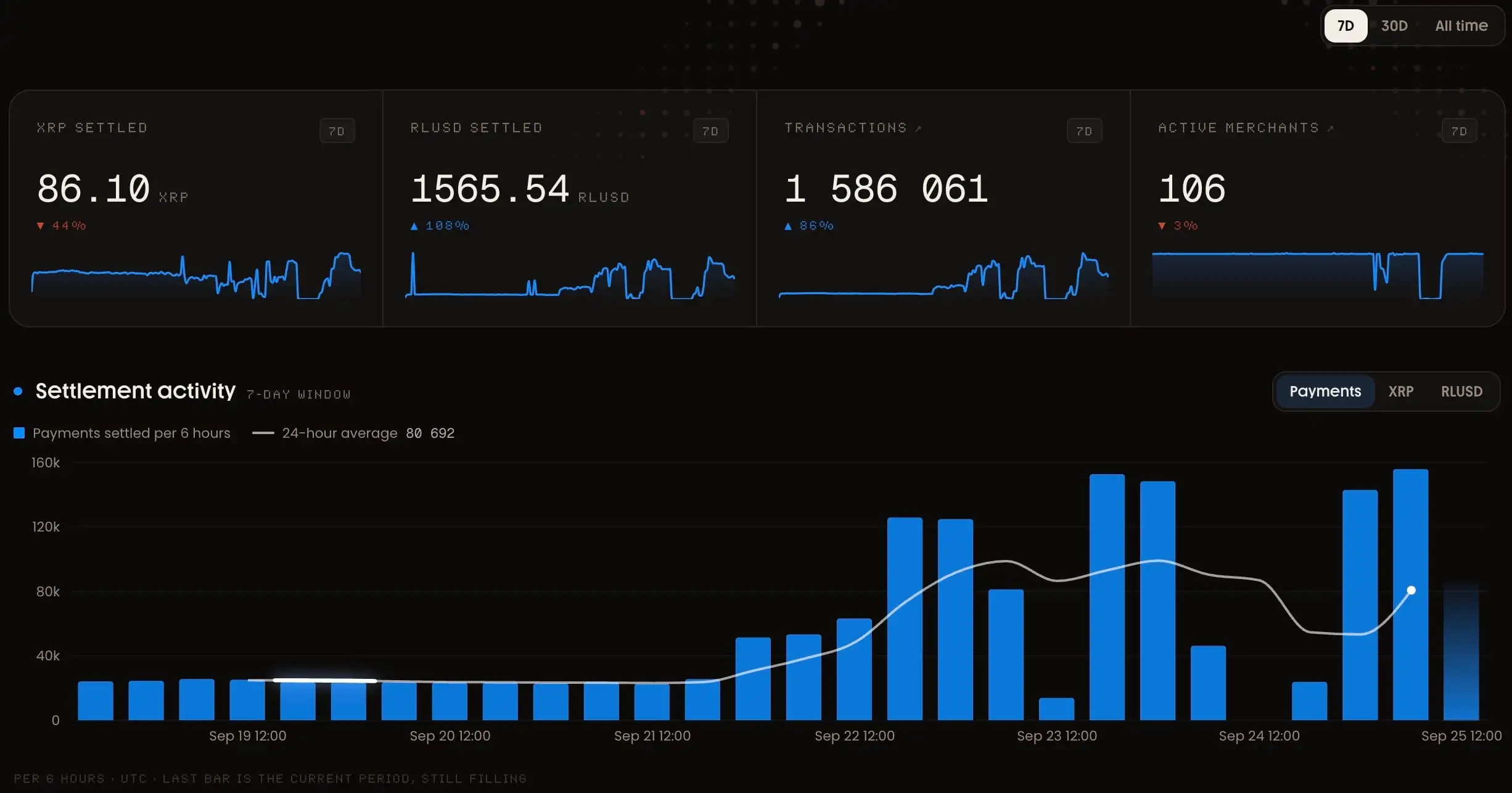
Autonomous AI agents using $XRP Ledger infrastructure for around-the-clock settlements have begun to favor regulated stablecoins over native crypto assets on a large scale, according to XRPL AI Hub data.  According to on-chain payment activity data, an analysis of all-time highs and the 30-day trend in direct clearing settlements shows the sustained dominance of Ripples stablecoin, while transaction volumes in the networks native cryptocurrency, $XRP, have stagnated over the past week.  BlackRocks new forecast: AI agents will build the economy of the future  This trend highlights the relevance of BlackRocks research note, “The Machine-Native Economy.” The financial giant points to a tectonic shift: the traditional banking system, tied to human schedules, is technically unable to handle millisecond micropayments made by autonomous software.  According to BlackRock, the global stablecoin market has already surpassed $300 billion, while its annual transaction volume of $11.6 trillion has turned this asset class into a basic unit of account for AI. This circulating liquidity allows machine networks to reliably run high-frequency micropayments without causing friction or systemic blockages.  Rising demand for stablecoin clearing on $XRP Ledger over a 7-day period, Source: XRPL AI Hub Dashboard  Robots need to purchase computing power around the clock and pay for API access, making tokenized GPUs

1 ہفتوں کے اندر

Fed Moves to Tighten Stablecoin Rules With Two New GENIUS Act Proposals

The Federal Reserve has proposed two rules to help establish oversight for stablecoin issuers under the Guiding and Establishing National Innovation for US Stablecoins ($GENIUS) Act.  The proposals were announced by the central bank on Thursday and opened for public comment.  Stricter Stablecoin Oversight  The first proposal would require payment stablecoin issuers supervised by the Fed to fully back their tokens with approved reserve assets. These include short-term US Treasury bills and other high-quality liquid assets. The proposal also sets capital requirements for credit and operational risks. It would add risk management standards for stablecoin activities.  The institution also proposed rules for firms that hold assets backing stablecoins. The rules would clarify which stablecoin activities are allowed for banks supervised by the Fed. The second proposal, meanwhile, focuses on applications from supervised banks seeking to issue payment stablecoins. Banks would need to provide business plans, financial information, and other documents. The proposal also covers appeals and hearings for applications.  The public comment period will close 60 days after the proposals are published in the Federal Register. Fed Governor Michael Barr said stablecoins can only remain stable if users can quickly redeem them at full value. This should hold even during market stress or when the

1 ہفتوں کے اندر

Polygon price rises 12% since 100M POL burn—can it hold above $0.11?

Polygons POL token has gained nearly 12%since the network permanently removed 100 million tokensfrom circulation on September 23.  The price has climbed to around $0.113, but its next challenge is holding above the $0.11price level and overcoming resistance near the $0.115price area.  Polygon permanently removes 100M POL  Polygon Foundation CEO Sandeep Nailwal confirmed that the network had completed the burn, which removed about 1% of POLs total supply.  The on-chain transaction shows that 100 million POL, worth around $10.22 millionat the time, was destroyed on September 23.  When there is a burn, it permanently removes crypto from circulation. The idea is that if the available supply is reduced, the remaining tokens will become more scarce, but this is if demand is steady or increases.  The tokens that were burned were from network fees that had accumulated inside Polygons fee-collection system.  The burn also introduces a process that allows the community to trigger future fee-funded burns. This connects the amount removed from circulation more closely to activity on the Polygon network.  POL approaches an important price barrier  POL was trading near the $0.113price area at the time of this writing. It was up by about 11.6%from its level around the burn date.  It briefly reached the $0.11497 price area during the

1 ہفتوں کے اندرانڈسٹری

Brazil targets self-custody crypto with $10K reporting rule, 24-hour transfer delay

Brazil crypto rules are set to get tougher in Q4 2025 and get even stricter from next year.  The Central Bank of Brazils order this week formally expands reporting requirements for crypto transfers above $10K across self-custody wallets.  Here, its worth noting that the new reporting regime is not strictly on crypto transfers. Any payments or funds transfers via foreign exchange or local cash above R$50,000.00 (about $10K) must be reported.  In the statement, the Central Bank of Brazil said the move is aimed at “preventing the use of the financial system for money laundering, concealment of assets or financing of terrorism.” The rule will be effective from 1st October.  However, the scrutiny over crypto assets has intensified.  Brazil imposes 24-hour delay for crypto transfers  Last month, Brazil imposed a mandatory 24-hour delay for crypto transfers. According to the countrys central bank, the move is aimed at minimizing harm to victims of fraud, while also helping law enforcement rein in anti-money laundering (AML) or illicit flows.  It argued that the instant settlement nature of crypto transfers makes it challenging to catch fraudsters and block illicit flows in time. The rule will go into effect in January 2027.  The surprising part, however, is the countrys plan to integrate with

1 ہفتوں کے اندرانڈسٹری

Galaxy Digital Puts $100M of sUSDS Into Corporate Treasury

Key TakeawaysGalaxy put $100M of Skys sUSDS into its treasury and approved it as institutional loan collateral.The move brings DeFi yield into a $1.4B loan book, expanding sUSDS as institutional infrastructure.Sky must show sUSDS can scale with public-company treasuries as supply tops $5.52B.  Galaxy Puts DeFi Yield on Its Balance Sheet  Galaxy Digital is putting real treasury capital behind one of DeFis largest savings products.  The Nasdaq-listed digital-asset firm has added $100 million of sUSDS, Sky Protocols yield-bearing savings token, to its corporate treasury. Galaxy also approved sUSDS as eligible collateral across its institutional trading business, which serves more than 1,600 counterparties.  Galaxy funded the position using its own balance sheet. It also acquired an undisclosed amount of SKY, the governance token of Sky Protocol, according to the announcement.  The deal is significant because it moves sUSDS beyond crypto-native savings and into the treasury operations of a public company.  Galaxy Turns sUSDS Into Institutional Collateral  Under the arrangement, Galaxy clients can post sUSDS against loans while continuing to earn the Sky Savings Rate on the full amount for the duration of the loan.  That creates a potentially more efficient use of capital. Instead of choosing between earning yield and using an asset as collateral, institutional clients can do

1 ہفتوں کے اندرانڈسٹری

Swiss bank shields Bitget institutions while retail funds freeze

Bitget says about $387.5 million in assets was transferred to attacker-controlled addresses during a Sept. 24 wallet breach. Its withdrawals remained suspended in notices issued through Sept. 25, even as deposits and trading continued.  Related Company Bitget Trading platform for crypto products  On the day of the breach, Sygnum announced that Bitgets institutional clients could trade against collateral held at the Swiss bank instead of placing that collateral in Bitgets wallets.  The juxtaposition puts a question behind the promise of off-exchange custody: which assets sit beyond an exchange wallet breach, and what still depends on the exchange when trading or withdrawals are disrupted?  Sygnums route is for eligible institutional clients who onboard with its bank. The companies have not disclosed how many Bitget clients use it or whether any Sygnum-held collateral was connected to this incident.  A breach alongside a new custody route  Bitget said its systems detected unauthorized transfers at 18:31 UTC on Sept. 24. Its initial notice placed the affected funds at about $351.6 million and said the breach reached portions of its hot and warm wallet layers, while cold wallets remained secure.  In a Sept. 25 update, Bitget raised the estimated assets transferred to attacker-controlled addresses to about $387.5 million after including Zcash and

1 ہفتوں کے اندرانڈسٹری

Why is Backpack [BP] crypto up? RWA rebound, 73x short liquidations & more…

Backpack [BP] rallied more than 43% in the past 24 hours, bringing its weekly gains above 121%. During this period, the price of BP went on to make a new peak value of about $1.3994.  Even in trends, BP led all other coins in social sentiment. Other factors that contributed to this sharp uptick in price were volume and total assets deployed.  Analyzing resurgence in RWA-themed coins  First, there was a market-wide resurgence in the real-world asset (RWA) sector, with BP leading all in daily gains, according to CoinGecko. Other RWA-themed coins that came close were Ondo Finance [ONDO] and Quant [QNT], of which both grew over 25%.  The uptrend was amplified by a spike in perpetual liquidations of shorts, which was 73 times bigger than that of longs.  Further analysis of the protocol, which is built on Solana [SOL], unmasked more metrics.  For instance, Total Assets deployed on BP reached a new high of $604.75 million. Over the past week, the average daily asset transfer count reached 1 million.  As a result, asset holders surged by 204%, surpassing the 242K mark, as per Token Terminal.  Additionally, the monthly token trading volume surged by 175%, to about $157 million. But from a daily perspective, the volume had quadrupled

1 ہفتوں کے اندرانڈسٹری

EBA Urges Crypto Lending Rules In MiCA Review

The European Banking Authority (EBA) has asked Brussels to strengthen its crypto rulebook, publishing its response to the European Commissions targeted consultation on the review of the Markets in Crypto-Assets Regulation (MiCA) on September 24. MiCA has been in full effect since December 30, 2024, but the regulator argues the sector is evolving too quickly for the framework to stand still, and it lists lending, stablecoins, asset classification and reporting among the areas that need work.  Crypto lending and DeFi in scope  The EBAs most concrete request is for the Commission to consider regulating crypto-asset lending, including where crypto-asset service providers give customers access to decentralised lending protocols. It frames the move as a consumer-protection measure, warning that lending risks currently sit outside the perimeter MiCA was designed to cover and that borrowers and lenders have little of the disclosure and safeguards applied elsewhere in the market.  Multi-issuer stablecoins and reserve rules  On stablecoins, the EBA points to third-country multi-issuer schemes as a source of significant to very significant risk and recommends regulatory changes to contain them. It also wants a fresh look at reserve requirements, in particular the minimum amount of reserves issuers must hold as bank deposits, while preserving effective risk management.

1 ہفتوں کے اندرانڈسٹری

ECB Seeks to Link TIPS Payment System With Brazil's Pix

Key TakeawaysThe ECB is exploring a link between TIPS and Brazils Pix to enable faster, cheaper EU-Brazil payments.Connecting the systems creates a low-cost alternative to SWIFT, reducing reliance on US dollar networks.The ECB plans further links with Indias UPI and Swiss networks to expand global euro payment reach.  Europe to Test Interlinking Its Payment System With Brazils Pix  The ECB is taking the first steps to expand its payments infrastructure by linking its systems to other international payment networks.  On Thursday, the bank announced that it was evaluating the feasibility of interlinking the TARGET Instant Payment Settlement (TIPS) platform with Brazils Pix, a national rapid payment network, as part of the G20 cross-border payments roadmap. In a press release, the institution declared it would “explore the potential for interlinking TIPS and Pix by assessing technical, operational, legal, and business considerations”in close collaboration with the Central Bank of Brazil.  As economic flows between the EU and Brazil grow, the ECB highlighted that this connection could enable faster, lower-cost instant payments for both retail and institutional users in the two regions. Brazil is the EUs tenth-largest partner, with over €87 billion (nearly $100 billion) in bilateral trade registered in 2025.  While TIPS currently settles real-time payments in

1 ہفتوں کے اندرانڈسٹری
1
...
5557
...
1000