Ether, solana, dogecoin in the green after Warsh comments push bitcoin above $60,000

The bigger move was in stocks. A selloff in semiconductor shares spread to South Korea on Thursday, where the Kospi index fell almost 7% before paring losses. Samsung Electronics and SK Hynix each dropped more than 6%, and Kioxia fell 13% in Japan after a rally that had lifted the stock more than 650% this year.  The declines revived worries that this years blistering run in artificial-intelligence stocks has outpaced reality.  Two reports fed the unease. Meta is building a cloud business to sell access to spare AI computing power, Bloomberg reported, which raised concern the company had overbuilt. Apple is in talks to buy chips from two Chinese semiconductor makers, a move that would hurt Korean suppliers.  The AI trade is where money has flowed all quarter while bitcoin fell, giving the asset a rare back-to-back quarterly loss for only the third time in history. Capital rotated steadily into chipmakers and AI infrastructure as crypto closed a losing first half, so cracks there could ease the pull that has weighed on the market.  Elsewhere, Brent crude fell to about $70.60 a barrel, its lowest since late February, before the Middle East war began, as traffic through the Strait of Hormuz recovered.

07-02انڈسٹری

Kalshi and Polymarket's combined volume surges 75% to $45 billion in June amid World Cup fever

Quick TakeKalshi, Polymarket, and Polymarket US have reported $44.8 billion in combined monthly volume in June, a 75% growth from Mays $25.66 billion.The notable surge in volume can be attributed to the ongoing World Cup, which has attracted millions of dollars in bets on prediction markets.Among the three, Kalshi saw the largest month-over-month increase in volume, growing 87.4% to $31.5 billion from $16.81 billion.  Kalshi and Polymarket saw their combined trading volume soar last month as the FIFA World Cup 2026 continues to drive bettors into prediction markets.  According to The Blocks data dashboard, Kalshi, Polymarket, and Polymarket US recorded $44.8 billion in combined monthly trading volume in June, marking a 75% surge from Mays $25.66 billion monthly volume.  Among the three, Kalshi saw the largest month-over-month increase in volume, growing 87.4% to $31.5 billion from $16.81 billion.  Polymarkets main, non-U.S. platform attracted $10.26 billion worth of volume last month, up 45% from the previous months $7.08 billion.  Polymarket had seen a steady decline in monthly volume from March through May, while its U.S.-regulated platform sustained an upward trend. Polymarket US reported $3.04 billion in monthly volume last month, up from $1.77 billion in May.  World Cup fever  The sharp volume increase can be attributed to the

07-02انڈسٹری

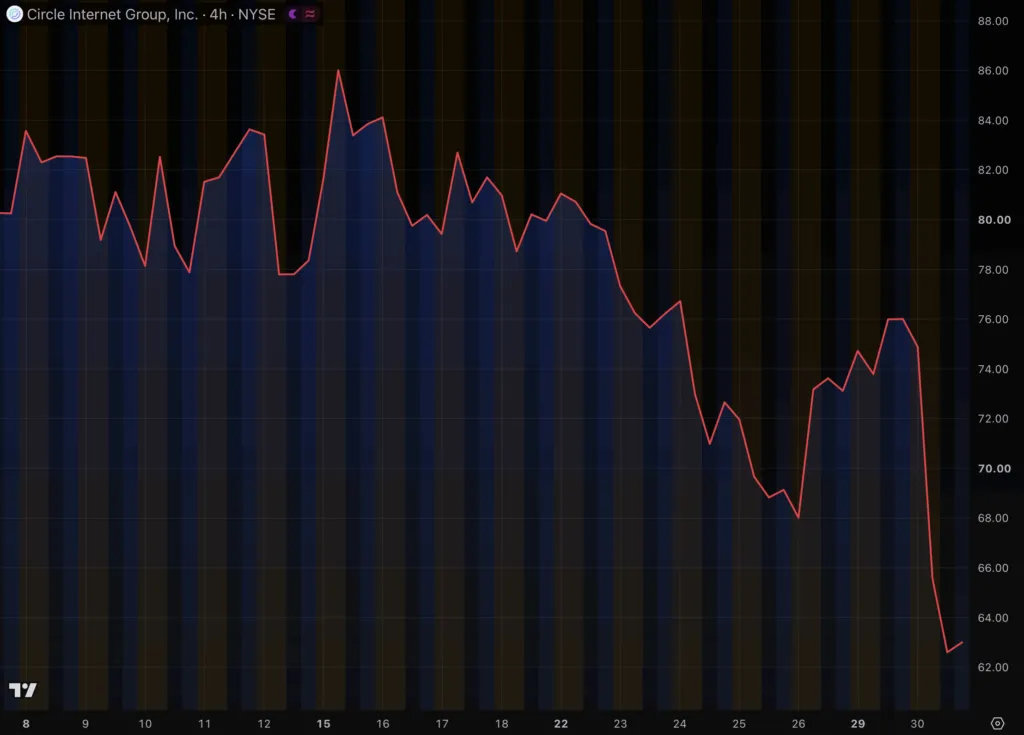
Ark Invest scoops up $18 million in Circle shares as stock dips 41% over past month

Quick TakeCathie Wood-led Ark Invest bought $17.8 million worth of Circle shares on Wednesday.Circle closed down 1% today after falling nearly 18% on Tuesday following the launch of the rival stablecoin project OUSD.  Cathie Woods investment firm Ark Invest snapped up more shares of Circle Internet Group on Wednesday as the USDC stablecoin issuers stock slipped further.  The firms latest trading disclosure shows that Ark bought a total of 287,609 shares of Circle across three of its exchange-traded funds — ARKK, ARKW, and ARKF. At todays closing price of $61.95, Ark Invest added roughly $17.8 million worth of the stock.  Circle (CRCL) closed down 1.1% today after it plunged by nearly 18% during Tuesdays trading session, which marked its worst single-day decline in recent months. It is down 41% over the past month.  The sharp fall was widely attributed to Open Standard announcing Open USD (OUSD), a new stablecoin backed by more than 140 companies including Visa, Stripe, Mastercard, BlackRock and Coinbase.  Investors assessed potential competitive threats to Circles USDC, and Coinbases involvement in the new stablecoin project, as the exchange earns roughly 50% of USDCs reserve income under its distribution agreement with Circle.  No immediate threat  While CRCL took a heavy hit and extended its decline

07-02انڈسٹری

Large XRP Outflows From Coinbase Signal Aggressive Whale Accumulation

Large $XRP transfers above 1 million tokens from Coinbase increased from about 10% to 25.7% of total outflows between mid-June and July 1, based on CryptoQuant data.Whale accumulation signals intensified sharply, while Binance remained stable near 49.6% in large withdrawals.The data suggests shifting behavior across exchanges, while destination of funds remains unconfirmed, keeping the focus on accumulation patterns rather than selling pressure.  $XRPoutflows from Coinbaseshow a sharp rise in large transfer activity recorded on-chain during late June and early July. The movement, tracked through CryptoQuant, reflects higher participation from large holders while price action remains stable around the one dollar level across major exchanges. Exchange flow divergence is becoming more visible, especially between Coinbase and Binance. Large wallet activity continues to dominate the marginal flow increase, even as retail participation remains relatively flat.  $XRP Outflows From Coinbase And Whale Accumulation Dynamics  On Coinbase, transfers exceeding 1 million $XRP expanded sharply during the second half of June, according to CryptoQuant readings. The share of these large transactions climbed from roughly 10% on June 16 to 25.7% by July 1, highlighting a clear shift toward higher-value withdrawals. Whale participation increased significantly within a short window, suggesting coordinated or structured accumulation behavior. Mid-tier flows also adjusted,

07-02

'XRP Ledger Was 15 Years Ahead': Ripple's Ex Chief Engineer Reacts to New Visa-Mastercard Stablecoin

The announcement of the Open USD (OUSD) stablecoin by a consortium of 140 financial giants, including Visa, Mastercard, Stripe and BlackRock, sparked discussion about the historical roots of this technology. Former Ripple principal engineer Matt Hamilton noted that the structure of the new project effectively repeats the architectural solutions embedded in the $XRP Ledger (XRPL) back in 2012.  The comment was prompted by an ironic post on X about the emergence of yet another “universal standard,” which only increases the number of competing coins on the market.  The 2012 concept  According to Hamilton, the original idea of the $XRP Ledger creators was based on the prediction that, in the future, every bank would want to issue its own stablecoin. To ensure their interoperability, the developers integrated two core functions into the network at the dawn of the industry: the free issuance of custom tokens and a built-in decentralized exchange (DEX) with an automated order book.  Fifteen years ago, the traditional financial sector showed no interest in this model. However, current events show that major players eventually arrived at exactly this approach.  “The original concept behind the $XRP Ledger and the reason it allows anyone to issue stablecoins and has a built-in DEX was because they

07-02

Attackers deliver infostealer to Polymarket trading bot users, DeFi devs through npm packages

Hackers created a fake trading bot for Polymarkets prediction markets on GitHub. The bot was used to spread malware that steals credentials like wallet keys and browser passwords.  30 malicious packages were found across several npm accounts, reportedly targeting developers and traders who use automated strategies. At least 53 developers fell for the trap before it was flagged.  How did a fake bot spread to over 53 developers?  On July 1, 2026, the security firm SlowMist flagged a fake trading bot that promised big profits on Polymarket but was actually just a delivery vehicle for malware. SafeDep found 30 malicious npm packages spread across multiple accounts and tied to one fake GitHub repository.  The criminals posted a “polymarket-arbitrage-bot” that claimed to make over $80,000 per year. It got 36 stars and 53 forks before the scam was exposed. Every developer who downloaded and installed it ran the malware.  The attackers were aware of the fact that real trading bots have made huge money on Polymarket.  One bot profiled by prediction-markets analyst Dexters Lab turned $313 into $414,000 in just one month, while another, analyzed by researcher Igor Mikerin, made $2.2 million over two months. This track record made the fake bot look believable to traders chasing

07-02

Ark Invest Bought Over $75M in Crypto Shares During June

ARK Investment Management LLC (ARK Invest), led by Cathie Wood, bought more than $75 million worth of crypto stocks, including shares of Coinbase, Circle, and Bullish, during June 2026s brutal market bloodbath. The firm bought the dip as Bitcoin ($BTC) posted its worst monthly performance in four years.  Ark Invest Buys Over $75M in Crypto Shares During June Bloodbath  According to sources, Ark Invest loaded up on shares of major cryptocurrency companies as the sector experienced a sharp downturn in June 2026. The St. Petersburg, Florida-based investment manager has a well-established tendency to “buy the dip” in crypto-related equities during periods of market weakness.  These buys occurred across ARKs flagship Exchange-Traded Funds (ETFs), primarily the ARK Innovation ETF (ARKK), along with the ARK Next Generation Internet ETF (ARKW) and ARK Fintech Innovation ETF (ARKF). Purchases were spread across multiple trading days in late June, capitalizing on depressed prices.  How $BTC‘s Worst Month in Four Years Triggered ARK’s Buy-the-Dip Move  $BTCs worst monthly performance in four years triggered a broad selloff across the crypto market, pushing digital asset stocks lower. $BTC prices dropped by about 20% over the month, as $BTC rallied from near $73,000 at the end of May to the $58,000 – 60,000 level

07-02

USDT Exits EU Markets Today as MiCAs Final Curtain Falls on Tether

In recent news waves, the EUs $USDT MiCA ban is currently taking effect. July 1, 2026 marks the hard deadline for the blocs Markets in crypto-assets rules, and Tether, with its $186 billion $USDT, has officially lost the spot on regulated European exchanges. Coinbase, Kraken, and Crypto.com, which are MiCA licensed, have already pulled $USDT out of their EU order books. The worlds largest stablecoin by market cap now has no compliant pathway onto any EU-regulated platform.

07-02

OUSD stole Hyperliquids homework — then hit Circle with it

Yesterday, a massive new competitor, Open USD (OUSD), arrived to displace Circle Internet Group, issuer of the world‘s second-largest stablecoin, $USDC. Behind its glamorous roster of financial titans was a stablecoin inspired by Hyperliquid’s USDH.  The list of OUSD backers is long and powerful; a who‘s who of the world’s largest payments conglomerates.  It reads as though a crypto investor wished on a star and every dream came true.  Visa, Mastercard, Discover, American Express, Stripe, BlackRock, BNY, Google, Samsung Electronics, IBM, Shopify, Western Union, MoneyGram, Coinbase, OKX, Ripple,and MetaMaskall appeared on the press release.  The consortium will cooperatively benefit from the interest on reserves backing OUSD. HyperLiquid popularized this idea of shared revenue from stablecoin reserves when it launched its USDH.  Circles common stock collapsed by 17% on Tuesday, erasing $3.3 billion in market capitalization in less than seven hours.  Behind it all was a Hyperliquid-inspired stablecoin model.  How OUSD cost Circle $3.3 billion in one day  Hyperliquid is an upstart competitor of Binance and other crypto exchanges.  It made a media splash in 2025 due to controversial features like influencer-backed copytrading funds, highly leveraged trading pairs, and a leaderboard of degeneracy.  As Hyperliquid grew, it decided to launch its own blockchain and stablecoin, USDH.  Embracing an unconventional go-to-market strategy, Hyperliquid

07-02

Ripple President Reveals What's Next for XRP in Global Payments Race

Ripple President Monica Long recently shared a vision for the future of digital payments. “The future of payments will be multichain, interoperable, and built on institutional-grade blockchain infrastructure,” said the Ripple President.  The future of payments will be multichain, interoperable, and built on institutional-grade blockchain infrastructure.  Our focus is simple: continue making the XRPL the leading blockchain for institutional payments – and a natural home for the next generation of key regulated… https://t.co/8Pc5Yleskr  — Monica Long (@MonicaLongSF) June 30, 2026  Long was reacting to recent developments, including Ripple joining the Open USD stablecoin as a day-one integration partner, highlighting the companys commitment to open, multichain infrastructure that supports institutional adoption across the digital asset ecosystem.  Open USD, a dollar-pegged stablecoin, was launched by a consortium of more than 140 financial and technology companies, including Visa, Mastercard, Stripe and Coinbase, on Tuesday.  The roll call of backers resembles a cross-section of Wall Street and Silicon Valley. Ripple, BlackRock, BNY, Standard Chartered, Google and Shopify are all listed as founding partners.  With financial institutions showing growing interest in blockchain-based settlement and regulated stablecoins, Ripple President Long highlights the companys long-term strategy for expanding the role of the $XRP Ledger, $XRP and $RLUSD in institutional finance.  $XRP, XRPL and $RLUSD vision

07-02
1
...
557559
...
1000