Zerohash files second OCC trust bank application

Zerohash submitted a second application for a U.S. national trust bank charter on Aug. 19, approximately one month after the Office of the Comptroller of the Currency returned its original filing.  The OCCs record lists the proposed institution as Zerohash National Trust Bank. It would be based in Asheville, North Carolina, and operate under a holding company structure if approved.  The regulator opened public comments on Aug. 18. Comments must arrive by Sept. 17, giving interested parties 30 days to respond. The public record currently lists the application as received. It does not show an approval, denial or other regulatory decision.  Zerohash narrows its second OCC application  The OCC received Zerohash‘s first charter application on March 2 and returned it on July 17. The agency’s public database does not explain which parts of the proposal prompted the return.  A returned application is not the same as a denial on its merits. It generally means the filing did not advance through the OCCs review process in its submitted form. The regulator assigned the second application a new control number and proposed charter number.  Zerohash previously said the initial return occurred “in coordination with the OCC” and was “not a substantive decision on the merits.” Those statements represent


08-26انڈسٹری

US bank lobby wants stablecoin holders to open an account before cashing out

The American Bankers Association is pressing US regulators to require anyone who buys or redeems a payment stablecoin directly with its issuer to open an account and complete customer identification.  For a holder coming from self-custody, that would turn a direct cash-out into an issuer-onboarding event.  The Blockchain Association accepts identity checks for direct primary-market account customers but says an optional one-off redemption or a redemption routed through another regulated intermediary should not automatically make the underlying holder an issuer customer.  The disagreement surfaced in comments on a joint federal proposal for stablecoin issuer customer identification programs, known as CIPs.  The Federal Reserves public index lists the ABA comment as posted that day and the Blockchain Association comment as posted Aug. 24, alongside other R-1885 responses.  The agencies eventual choice will determine whether asking an issuer for dollars always opens an account or whether some holders can redeem without establishing that relationship.  The proposal leaves the cash-out boundary unresolved  The June proposal would require permitted payment stablecoin issuers to operate a CIP for customers who open accounts. A CIP is the account-opening process used to collect and verify a customers identifying information.  Directly issuing or redeeming payment stablecoins are among the activities the proposal says can establish an

08-26انڈسٹری

Kalshi raises $1.12 billion after securing $22 billion valuation

Kalshi has raised about $1.12 billion through an equity offering since April, with a new U.S. securities filing showing roughly $380 million remains available under the nearly $1.5 billion offering.  SummaryKalshi has sold $1.12 billion in equity since April, according to an SEC filing.About $380 million remains available under the nearly $1.5 billion offering.The total may include Kalshis $1 billion Series F, which valued the company at $22 billion.Kalshi is reportedly discussing another $750 million raise at a $40 billion valuation.July trading volume reached about $40 billion, well above Polymarket and Polymarket US combined.  The Securities and Exchange Commission filing submitted on Aug. 25 shows Kalshi Inc. has sold $1.12 billion of equity since the first sale took place in April, providing a new figure for the prediction market operators fundraising during a year in which its private valuation and trading activity have climbed sharply.  Filed through Form D, the notice lists the total offering at nearly $1.5 billion and records about $380 million as remaining unsold. Form D is used by companies to report securities offerings that rely on exemptions from full SEC registration requirements.  The filing does not break down which financing rounds make up the $1.12 billion already sold. The Block,

08-26انڈسٹری

WikiBit Exchange Exit Risk Ranking #9 — Deepcoin: Can El Salvador’s “Compliance New Clothes” Cover the Endless “Withdrawal Problems”?

Preface: A “Schrödinger‘s Compliance” Exchange  In previous episodes, we dug into HashKey (the “compliance top student”), HTX (a sanctions hotspot), UZX (a DAO penny-stock style project), Phemex (the Wall Street elite team), Tapbit (the MSB license “sticker collector”), and Upbit (South Korea’s national exchange). Todays subject is even more surreal — Deepcoin.  On paper, this platforms résumé looks impressive:  “Ranked third in CoinGecko‘s derivatives rankings,” “serving more than 10 million users,” “covering 30+ countries,” “COBO custody + bank-level security” — doesn’t that sound like the profile of a top-tier exchange? (Deepcoin)  But on the other side of the story:  WikiBit gives it a score of 6.67; Seychelles regulators allegedly issued a warning stating that they had “never received a license application from Deepcoin”; on Trustpilot, accusations such as “SCAM” and “fraud” appear frequently, while user complaints have reportedly increased in recent years, including withdrawal difficulties, account freezes, and high-volume trading traps.  Today, we will tear apart Deepcoin‘s surface packaging and conduct a complete analysis of the platform’s real security foundation from seven key dimensions.1. Regulatory Compliance: How Much Is the “Gold Content” of Deepcoins El Salvador BSP License Worth?  Deepcoin Compliance Status (Source: WikiBit)  El Salvador BSP: The “Compliance New Outfit” of 2026  In June 2026, Deepcoin made a

08-26گہرا غوطہ

From a “European Established Compliant Exchange” to a “Withdrawal Hell”: Zondacrypto Collapse Exposes the Most Dangerous Illusion — A License ≠ Safety

As more and more small and mid-sized crypto exchanges disappear or collapse, many investors choose trading platforms based on a few simple questions:  Is it compliant?  Does it have a license?  How long has it been operating?  How many users does it have?  However, the widely discussed Zondacrypto collapse has taught the crypto industry a painful lesson:  The most dangerous exchanges are often not the small platforms that suddenly appear overnight — because users already know they look suspicious. The real danger comes from platforms hiding behind the image of “compliance, reputation, and a large user base.”  After BitMart and BitMEX, two once-established crypto exchanges that faced shutdowns and major controversies, the spotlight has now turned to Zondacrypto — a long-standing European exchange once considered a compliant industry player.  This means the worlds three major crypto markets — China, the United States, and Europe — have now all experienced major exchange failures.  But Zondacryptos collapse introduced a new and disturbing twist:  The founder allegedly disappeared years before the exchange collapsed.  The platform continued operating as usual for years. Only when the massive funding gap became impossible to cover did the second-in-command CEO also disappear.  This $650 million scandal, affecting tens of thousands of investors, has exposed major weaknesses in Europes crypto regulatory

08-26گہرا غوطہ

How Ethereums new 2,048 ETH staking rule could lock up user rewards longer than expected

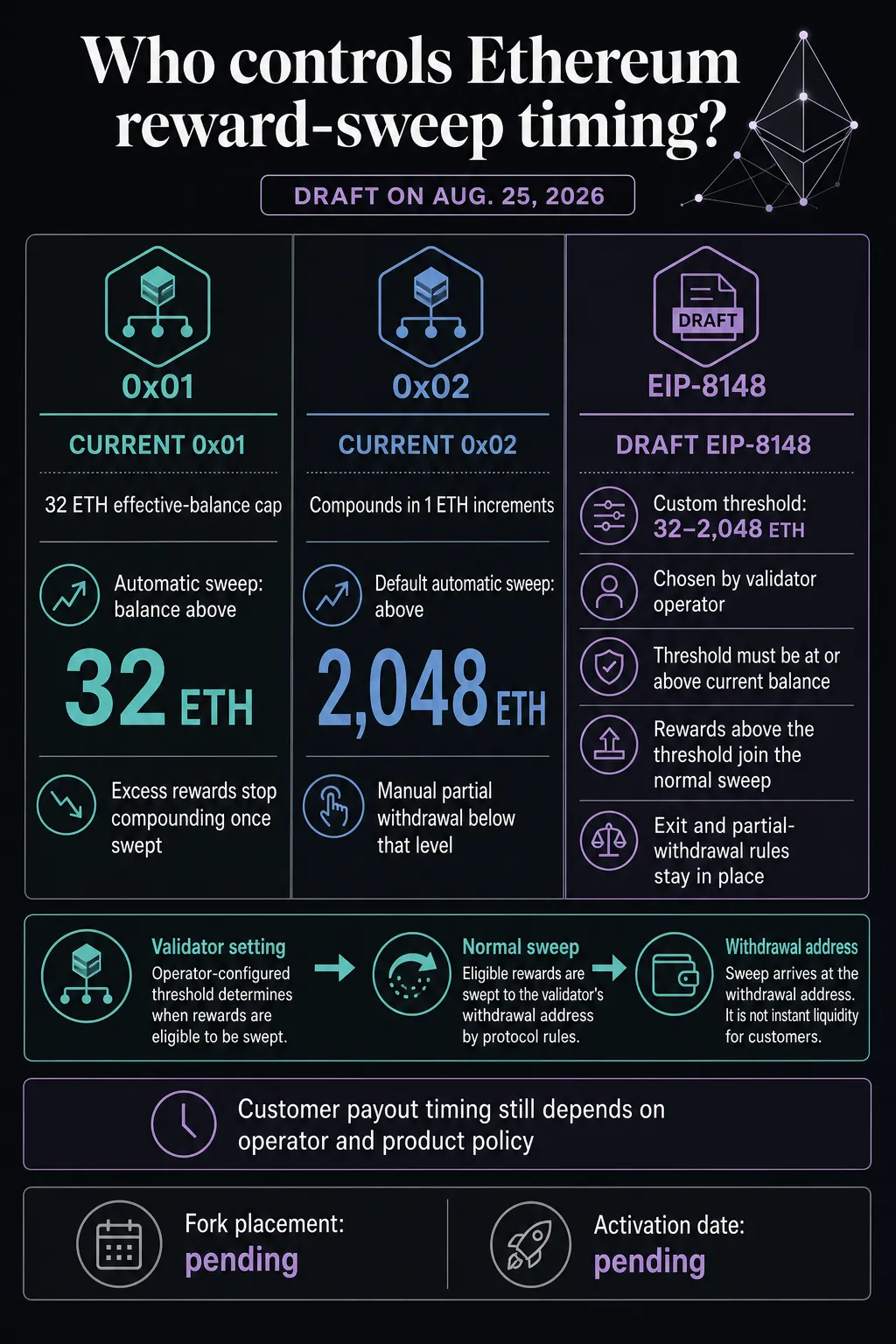
Ethereum is considering a change that would let compounding validators set how much $ETH should remain on a validator before excess rewards enter the networks automatic withdrawal sweep.  An Aug. 20 edit to draft EIP-8148 lowered the proposals minimum custom threshold from 33 $ETH to 32 $ETH and added a way to set the initial threshold when a new validator is created. If activated, the proposal would let 0x02 validators select a level between 32 $ETH and the current 2,048 $ETH default. The change would affect reward-sweep timing while Ethereums existing exit rules continue to govern principal withdrawals.  Ethereums 32 $ETH change controls reward-sweep timing  Ethereum currently treats its two execution-address withdrawal credentials differently.  Validators using legacy 0x01 credentials have a 32 $ETH effective-balance cap. Any balance above 32 $ETH is periodically swept to the withdrawal address, so those rewards stop compounding on the validator.  Compounding 0x02 validators can increase their effective balance in 1 $ETH increments up to 2,048 $ETH. Under Ethereums current withdrawal-credential rules, their balance is automatically swept only after it exceeds 2,048 $ETH. Accessing $ETH below that level requires a manually requested partial withdrawal.Validator setupWhat happens to rewardsAutomatic sweep thresholdCurrent 0x01Excess rewards stop compounding once sweptAbove 32 $ETHCurrent 0x02Rewards compound in

08-26

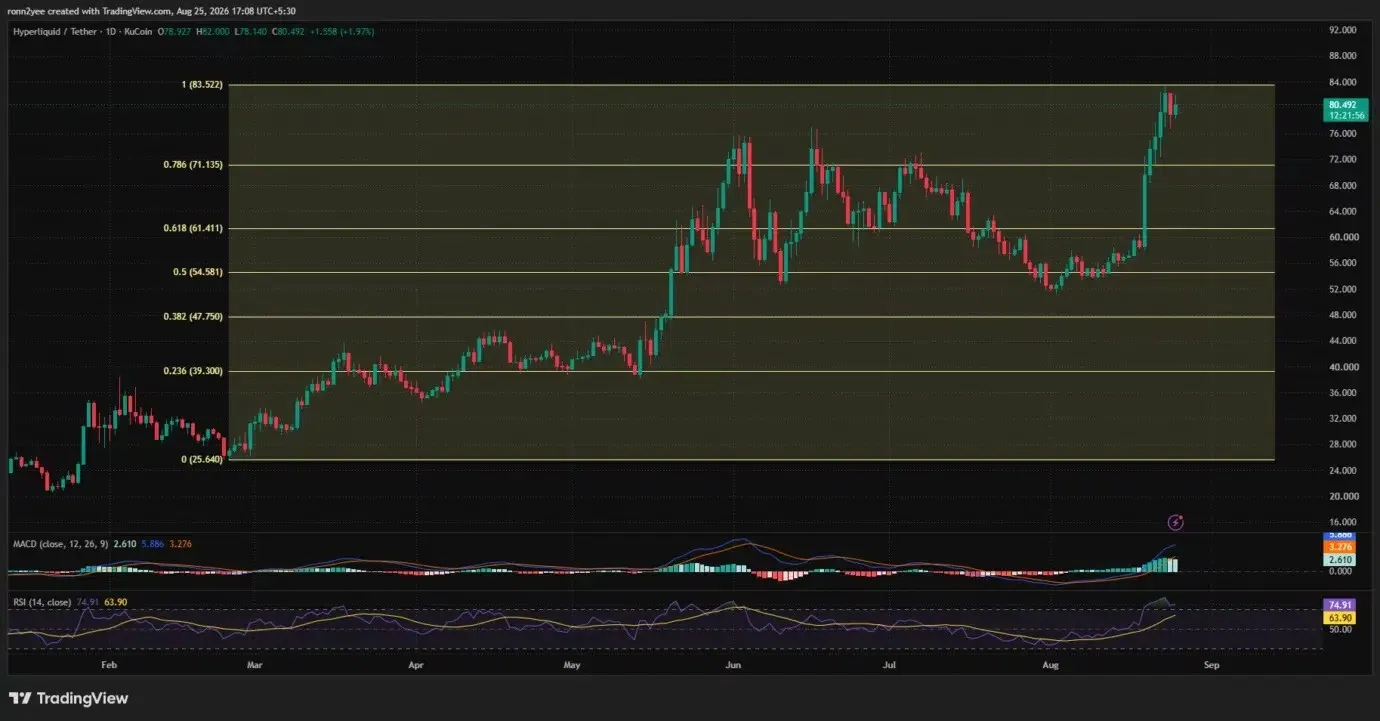
Hyperliquid price eyes $97 as HYPE holds above $80

Hyperliquid price rose to a record high above $83 after a sharp weekly rally, with strong momentum and positive capital flows supporting the move. However, an overbought daily reading and dense liquidation clusters on both sides of the market could produce wider price swings.  Hyperliquid price holds near its record high  According to data from crypto.news, Hyperliquid ($HYPE) price traded near $80.50 on Aug. 25 after reaching an all-time high of approximately $83.27 over the weekend. The token opened the seven-day period around $69.60, leaving it with a double-digit weekly gain even after traders took profits near the record.  The rally accelerated on Aug. 19, when $HYPE jumped from below $60 to around $70. Buyers extended the move over the following sessions, pushing the price through its previous June and July peaks near $75.  $HYPE briefly traded above $83 before retreating toward the $78 area and recovering. The 4-hour chart shows that buyers have repeatedly entered during declines toward $77–$78, but sellers continue to defend the area between $82 and $83.50.  The rally coincided with reports of further adoption of Hyperliquids trading infrastructure, including integration work involving Coinbase and the unveiling of Elysium L2 for the ecosystem. Broader strength across the cryptocurrency market also supported

08-26

Gemini plans to distribute crypto prediction markets through Apex brokerages

Crypto exchange Gemini and Apex Fintech Solutions have signed a non-binding letter of intent that would make Gemini Titan the exclusive regulated venue for crypto event contracts offered by brokerage firms through Apexs Futures Commission Merchant (FCM).  Under the proposed arrangement, participating brokerages would use Gemini for execution and clearing, giving Gemini a new distribution channel for its prediction-market business.  Apex provides trading and clearing infrastructure to hundreds of financial firms serving tens of millions of investors, according to the company. Gemini, meanwhile, has been building out its regulated prediction-market business since receiving approval by the US Commodity Futures Trading Commission to operate a designated contract market in December 2025 and clear derivatives in-house in April.  The companies already work together on stock trading, with Apex Clearing providing custody and clearing for Geminis zero-commission US equities offering launched in July.  The proposed partnership comes as prediction markets face mounting legal challenges at the state level in the US. Most recently, a Washington state judge ordered Kalshi to stop offering a broad range of event contracts in the state, rejecting the companys argument that federal commodities law preempts state gambling law.

08-25انڈسٹری

Coinbase tokenized stocks go live on Base with Chainlink price feeds

Coinbases tokenized US stocks went live on Base Monday, alongside a Chainlink integration providing price data to support their use across decentralized finance applications.  Chainlink Data Feeds will provide continuous pricing for Coinbases tokenized stocks, including Nvidia, Apple, Meta and Alphabet. The data allows DeFi protocols to integrate the assets into lending markets, decentralized exchanges and structured products, including as collateral for borrowing.  According to Chainlinks documentation, the feeds value each token using the underlying stock price and a Coinbase-supplied multiplier that accounts for dividends and corporate actions.  The stocks are issued as B20 tokens natively on Base, Coinbases layer-2 blockchain, and are available to non-US users in eligible jurisdictions. Each token represents a direct claim on an underlying share held with regulated broker and custodian Alpaca under an Abu Dhabi Global Market-supervised structure, according to Base. The tokens can be held in self-custody wallets and traded around the clock.  Base said the stocks can be integrated with existing DeFi infrastructure, including using tokenized Nvidia shares as collateral for loans on Aave or supplying tokenized Apple shares to decentralized exchanges. More Coinbase tokenized stocks are expected to launch on Base in the coming weeks.  The news comes as the broader market for tokenized equities continues

08-25انڈسٹری

Arcus launches tokenized perp positions on Robinhood Chain

Arcus, a decentralized exchange (DEX) built by the team behind dYdX, has launched a protocol on Robinhood Chain that converts perpetual futures positions into transferable ERC-20 tokens and allows tokenized stocks to be used as collateral for leveraged trading.  The launch includes products such as pBTC3x and pHOOD3x, offering 3x exposure to Bitcoin and Robinhoods HOOD stock token, respectively, the DEX announced in a Tuesday press release shared with Cointelegraph.  Its multi collateral feature initially supports SPY, QQQ and MAG7 Stock Tokens, each with a 50% loan-to-value ratio, allowing users to use tokenized equities as collateral for perpetual positions.  “Traditional markets have spent decades making sophisticated investment strategies easier to access through products like leveraged ETFs. We believe the next step is making those strategies native to blockchain infrastructure,” Arcus CEO Eddie Zhang said.  Arcus said it has recorded more than $250 million in trading volume since launching on Robinhood Chain, with average daily volume exceeding $33 million.  Robinhood Chain has grown to $596 million in total value locked since its July 1 launch, ranking among the top 15 chains by DeFi TVL, according to DeFiLlama data.

08-25انڈسٹری
1
...
304306
...
1000