Hyperliquid (HYPE) Price Has One Line Left to Defend. The Last Test Ended in a Rally
Hyperliquid (HYPE) has been one of the few large-cap tokens to hold up through the crypto downturn. HYPE price is still up sharply year to date, while Bitcoin trades roughly 15% lower. That resilience is now being tested. HYPE trades near $72, about 26% below its September 23 all-time high of $97.99, and traders are asking whether the bull trend is over. Sponsored Sponsored Bearish Structure Takes Shape The daily chart has turned bearish. HYPE made a lower high on October 30, when a spike after Intercontinental Exchanges (ICE) futures announcement stalled just below the record. It has now made its first lower low since the August breakout. The token also lost the 0.382 Fibonacci retracement near $75, which had held as support twice since September. Volume has been shrinking since peaks in April and June. The Relative Strength Index (RSI) has fallen to around 35, its lowest reading since August. HYPE daily chart Source: Tradingview Good news has not reversed the slide. HYPE kept falling after the ICE plan, the Upbit and Bithumb listings on November 10, and Binance reopening HYPE withdrawals on November 8. Two large holders sold about $109 million worth of HYPE on October 31. With the Crypto Fear & Greed Index at 20, risk

Crypto market sees brief relief after cooler US PPI data
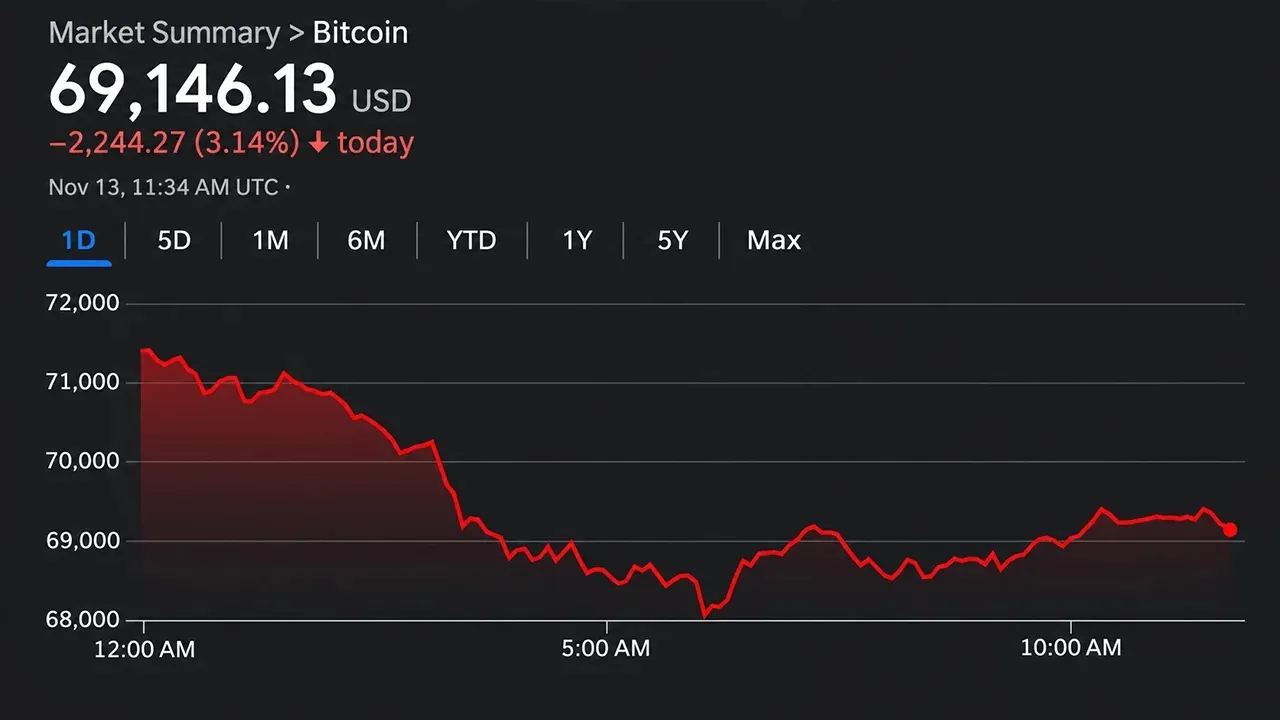
The crypto market has seen a brief recovery following Fridays softer than expected US producer inflation report, with Bitcoin rebounding toward $70,000 after heavy selling pushed it below $69,000 earlier in the day. According to the US Producer Price Index report, wholesale prices rose 0.3% in October, below economists forecast of 0.4%, while annual producer inflation reached 6.5%, compared with expectations of 6.6%. Bitcoin initially moved higher following the November 13 release, triggering roughly $39 million in short liquidations within an hour, according to CoinGlass data. The recovery followed a difficult trading session for cryptocurrencies, with Bitcoin falling to its lowest level since August and Ethereum slipping below $2,000. Across the market, more than $1.4 billion in leveraged positions had been liquidated over the preceding 24 hours. Although the monthly inflation figures offered some relief, annual producer prices continued rising faster than in September, leaving investors focused on whether the Federal Reserve could raise interest rates again in December. US PPI data gives crypto market some relief The latest inflation report showed producer prices rising at a much slower monthly pace than September, when the index climbed a revised 1.4%. Goods prices rose 0.5% in October, driven largely by food and basic organic chemicals, while services prices

China Is Running Low on Copper. So Why Are Prices Falling?
Copper prices have fallen to their weakest level since July. The futures market is pricing in AI fears and a hawkish Federal Reserve, but the physical market is pointing the other way. Benchmark three-month copper on the London Metal Exchange (LME) fell to $13,515 per ton on Thursday. An early rebound on Friday faded, leaving the metal about 9% below Septembers record of $14,875. Sponsored Sponsored Why Paper Prices Are Falling The selling has come from financial markets, not from a surplus of metal. Copper has been trading as a proxy for AI infrastructure, and the latest tech selloff dragged it lower. News that Nvidia CEO Jensen Huang is stepping down added to doubts about data-centre spending. “Every time AI takes a hit, copper demand and prices come under pressure too,” said Tom Price, analyst at Panmure Liberum. Monetary policy is adding pressure. A hotter-than-expected US inflation print revived bets on rate hikes, and Fed officials have not ruled out a 50-basis-point hike at the December 8–9 meeting. The stronger dollar triggered selling by model-driven funds. Meanwhile, Deutsche Bank sees lower odds of US tariffs on refined copper, which is unwinding the trade that had pulled metal into the US. The Physical Market Tells a Different Story China‘s market is

Microsoft 365 outage hits Outlook email and Teams calendars worldwide
A global Microsoft 365 outage continued into Friday, disrupting Outlook email and some Teams features. Microsoft said in a 7:25 am UTC update that a patch had improved stability on some servers and that it was working to deploy the fix more widely. The update, republished by the University of Pennsylvania, gave no timetable for restoration. The outage began Thursday, leaving some users unable to access their Exchange Online mailboxes. Microsoft said a process that handles secure connection became overloaded, causing affected servers to stop processing requests. The company said it attempted to restore services by restarting infrastructure, redirecting network traffic and expanding server capacity. Microsoft said there was no indication of a security breach. The outage also affected features in Microsoft Copilot and Defender for Office 365. In Teams, users had trouble scheduling meetings and sending invitations. Microsoft said most Teams calls and chats continued to work. Businesses and government agencies worldwide use Microsoft 365 for email and scheduling. Microsoft reported more than 450 million paid commercial seats for the suite in an October filing. Exchange Online hosts the mailboxes and calendars those organizations use, and outside apps, including AI assistants, rely on the same service to retrieve that data when users connect their

Nakamoto shares fall 6% premarket after Q3 revenue turns negative
Shares in Nasdaq-listed Bitcoin treasury company Nakamoto fell 6.5% in premarket trading on Friday after the company reported that losses on Bitcoin options pushed third-quarter operating revenue below zero. Nakamotos shares traded at $5.40 at 12:02 pm UTC on Friday, according to Yahoo Finance. At that price, the stock was down about 62% year to date. Nakamoto reported its third-quarter results after the market closed on Thursday. The company generated $3.9 million in revenue from its businesses. A $5.8 million net loss on Bitcoin options brought total operating revenue to negative $1.9 million, according to its quarterly filing. Analysts had expected about $17.4 million in revenue, according to estimates compiled by Yahoo Finance. Nakamoto reported $85.5 million in net income and a $15.8 million adjusted operating loss for the quarter. A $110.4 million gain from revaluing its digital assets, chiefly Bitcoin (BTC), drove the profit. The adjusted operating loss excludes that gain. Nakamoto held 4,283 BTC worth $357.9 million as of Sept. 30, down from 4,467 BTC at the end of June.

The catch in cryptos Anthropic IPO rush: lock up your money and you could still miss out
Crypto investors seeking Anthropic IPO tokens can commit money and still get a refund instead of an allocation. Related Company Anthropic AI models and research Kraken, Bitget, and BigONE disclose subscription terms that make delivery dependent on available shares, while successful fills carry additional costs. The issue became more immediate on Nov. 12 when BigONE opened indications of interest and warned users they could receive a full allocation, a partial allocation, or none. Krakens Anthropic IPO access terms carry the same three possible outcomes, while Bitget says its commitment caps do not represent the shares it has secured. Related Company Kraken San Francisco based digital asset exchange Those warnings come ahead of Anthropics expected Nov. 18 US-time pricing and Nov. 19 Nasdaq debut. Bloomberg News reported on Nov. 11, citing people familiar with the matter, that orders already exceeded the available shares multiple times. Related Company Bitget Crypto, derivatives and multi-asset trading The venues terms make clear that money can become unavailable while an allocation is determined, and receiving tokens can mean paying above the offering price without acquiring direct shareholder rights. Related Company BigONE Spot and derivatives exchange A commitment can become tokens, a refund, or both Allocation decides what investors receive. Select a venue to see how money

Bitcoin Price Taps $67,500 Intraday Low as Bears Tighten Grip
Bitcoin‘s price has deteriorated sharply, with the leading cryptocurrency trading near $69,140 after touching an intraday low of $67,500 per unit. Despite the decline, several oscillators suggest selling pressure has reached stretched levels, raising the possibility of a temporary rebound. The daily timeframe’s technical assessment registers 16 bearish signals against just one bullish signal, while all 15 tracked moving averages sit above the prevailing price, leaving bulls with considerable ground to recover. Key TakeawaysBitcoins intraday low of $67,500 low sparked a recovery, but something is missing from the comeback.16 bearish signals tell one story, while bitcoins oscillators suggest another.Bitcoin bulls face a critical test near $70,000, with an even bigger obstacle waiting above. Bitcoin Bulls Confront $70,000 Wall as Technical Signals Flash Red Bitcoins price dump has left traders confronting an intriguing contradiction: the cryptocurrency is deeply oversold by several technical measures, yet the broader market continues to exhibit unmistakable bearish characteristics. At approximately 6:35 a.m. Eastern time on Friday, Nov. 13, 2026, bitcoin traded near $69,140 after briefly descending toward $67,500 on Bitstamp, while statistics recorded a 5.4% daily decline. Although bargain hunters have managed a modest recovery, the daily technical readings remain overwhelmingly negative, with 16 negative signals, nine neutral readings, and
Ethereum treasury firm BTCS sells ETH at a loss to manage $64M Aave loan
Ethereum treasury company BTCS has sold ETH below its purchase price to manage a $64.1 million loan on Aave, as falling Ethereum prices reduce the value of the cryptocurrency backing its debt. In its November 12 quarterly filing with the U.S. Securities and Exchange Commission, the Nasdaq-listed company disclosed that 46,676 ETH secured its borrowings as of November 9. The collateral was worth approximately $99.3 million at an ETH price of $2,127, covering about 155% of the outstanding debt, including accrued interest. JUST IN: Ethereum treasury firm BTCS sells ETH at a loss to protect its $64M Aave loan from liquidation The Nasdaq-listed company has 46,676 ETH backing its $64.1M debt, with liquidation risk emerging if ETH falls to around $1,717, based on its November 9 position. pic.twitter.com/S0bcDHRai2 — crypto.news (@cryptodotnews) November 13, 2026 The company said it monitors its borrowing positions and adjusts collateral or repays debt when market conditions require additional protection against liquidation. BTCS sells Ethereum below cost to protect Aave collateral BTCS acknowledged realizing losses on Ethereum sales while managing its decentralized finance borrowing arrangements. The company said, “Sales of ETH were executed at prices below their original cost basis,” explaining that the transactions formed part of its collateral management strategy. The filing did

CFTC, DOJ sue Arkansas to stop Kalshi gambling lawsuit
The U.S. Justice Department and Commodity Futures Trading Commission (CFTC) have sued Arkansas to stop its enforcement case against prediction-market operator Kalshi and prevent similar state action against other federally regulated exchanges. The federal complaint, filed November 12 in the U.S. District Court for the Eastern District of Arkansas, names the state and Attorney General Tim Griffin as defendants. Federal lawyers argue that the Commodity Exchange Act gives the CFTC exclusive authority over derivatives traded on designated contract markets, including the event contracts targeted by Arkansas. Federal lawsuit seeks protection beyond Kalshi The government wants the court to declare that Arkansas cannot apply its gambling and consumer-protection laws to the disputed transactions on CFTC-regulated exchanges. Its request for preliminary and permanent injunctions covers investigations and enforcement against registered markets, their affiliates and business partners. Kalshi is not a defendant in the new federal case. The complaint challenges Arkansas‘s attempt to proceed against the company through a separate state lawsuit filed eight days before. The federal agencies maintain that Kalshi’s event contracts qualify as swaps under the Commodity Exchange Act, placing their regulation within the CFTCs jurisdiction. The government is relying on federal preemption, the principle that federal law can override state requirements when Congress has

DOJ moves to seize $1.2B from Binance hack, disrupts FaceStealer scam
The US Department of Justice said Thursday it had obtained court authorization to seize or restrain more than $1.2 billion of the $6.3 billion in cryptocurrency stolen from Binance. The authorization covers part of the more than $2.7 billion in stolen assets that US authorities and private-sector partners have frozen since the Oct. 29 hack. Investigators are still working to recover additional funds, the department said in its announcement. The FBI attributed the Binance hack to North Korea‘s TraderTraitor group in a cyber alert. Kim Yo Jong, the sister of North Korean leader Kim Jong Un, denied North Korea’s involvement. Binance said it had covered the affected assets with its own funds and that a new proof-of-reserves snapshot showed at least one-to-one backing for customer assets, according to its Thursday post on X. In November 2025, the DOJ announced a separate enforcement action targeting about $15 million in cryptocurrency linked to North Korean hackers known as APT38. Related: Crypto hack losses equal 57 cents per $1 earned onchain: Arks Valente FBI warns of FaceStealers deepfake video calls In a separate case, US authorities seized cloud infrastructure used in FaceStealer, a North Korean social engineering campaign that stole more than $400 million in cryptocurrency over the past 18