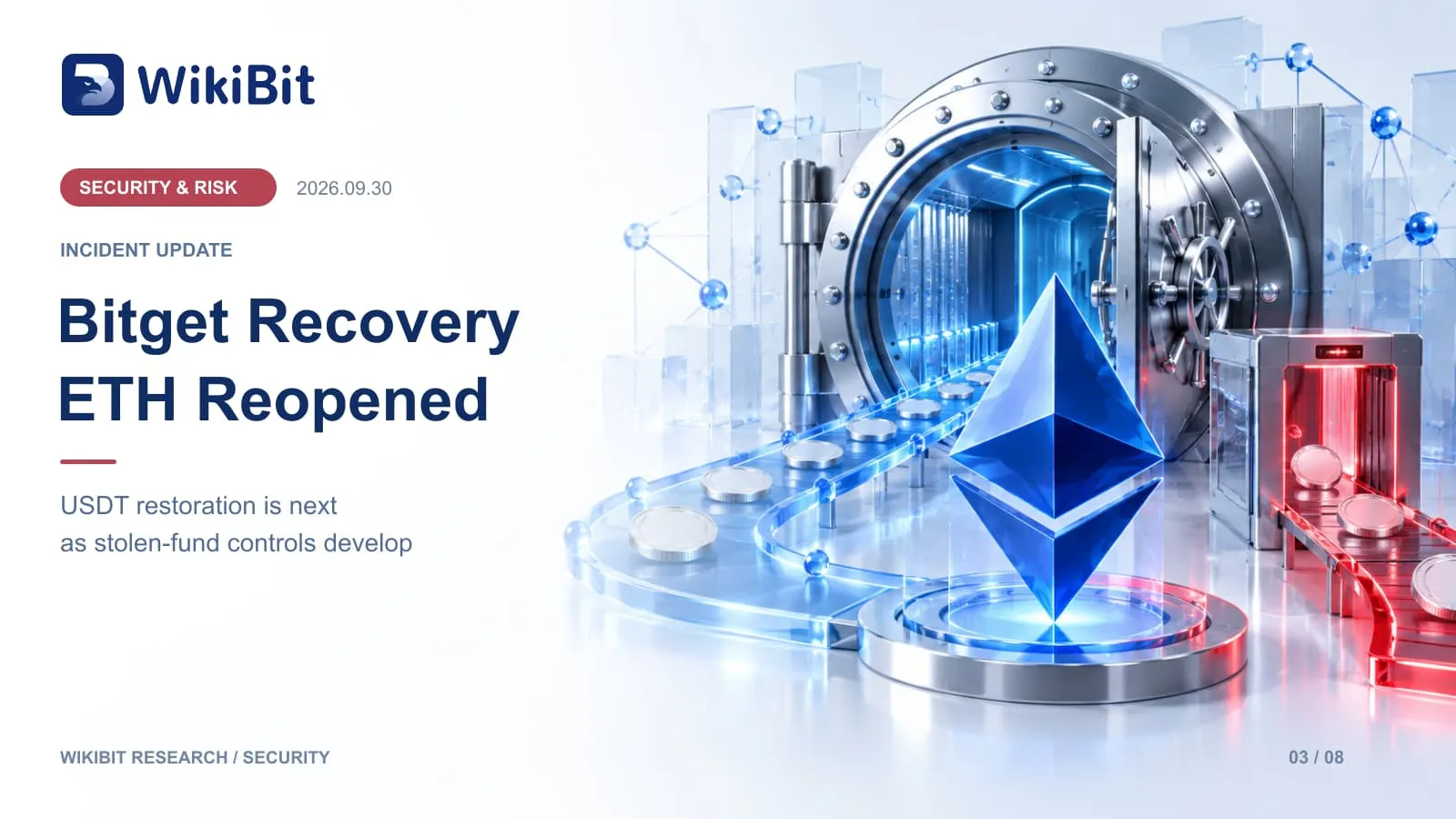
Bitget Hack Update: ETH Withdrawals Reopen and NEAR Intents Holds Hacker-Linked Funds

Bitget has completed the second stage of its phased withdrawal recovery.  After BTC withdrawals reopened on September 28, Bitget confirmed:  ETH withdrawals reopened at 08:00 UTC on September 29  across:Ethereum;BNB Smart Chain;Arbitrum One;Base;Optimism.  The next planned stage is USDT at 08:00 UTC on September 30, which is later than this reports publication cutoff.First-hour ETH flow  Bitget reported that by 09:00 UTC—one hour after ETH withdrawals reopened—it had recorded approximately:9,674 ETH inflows9,023 ETH outflows  for a net inflow of approximately:  651 ETH  This is an exchange-reported operational snapshot.  It is not:an independent reserve audit;full-day withdrawal volume;proof that every chain/asset has recovered.  It does show that the reopened ETH withdrawal system was processing meaningful two-way flows rather than merely displaying an enabled button.Current recovery schedule  Confirmed/planned sequence:September 28  BTC withdrawals restored on Bitcoin and BSC.September 29  ETH withdrawals restored on Ethereum, BSC, Arbitrum One, Base and Optimism.September 30  USDT scheduled on Ethereum, BSC, Solana and Tron.October 2  Other tokens, fiat and P2P scheduled to return.  The recovery remains partial until the later phases execute.The incident amount remains approximately $388M  Bitgets current official estimate is approximately:  $388 million  in affected assets transferred from hot/warm wallet infrastructure.  Bitget says:12 wallet addresses were associated with the incident;11 blockchains were involved;cold wallets were not compromised;private keys were not compromised.Leading attack path  Bitgets latest explanation says hackers may
1 ہفتوں کے اندرانڈسٹری ریسرچ

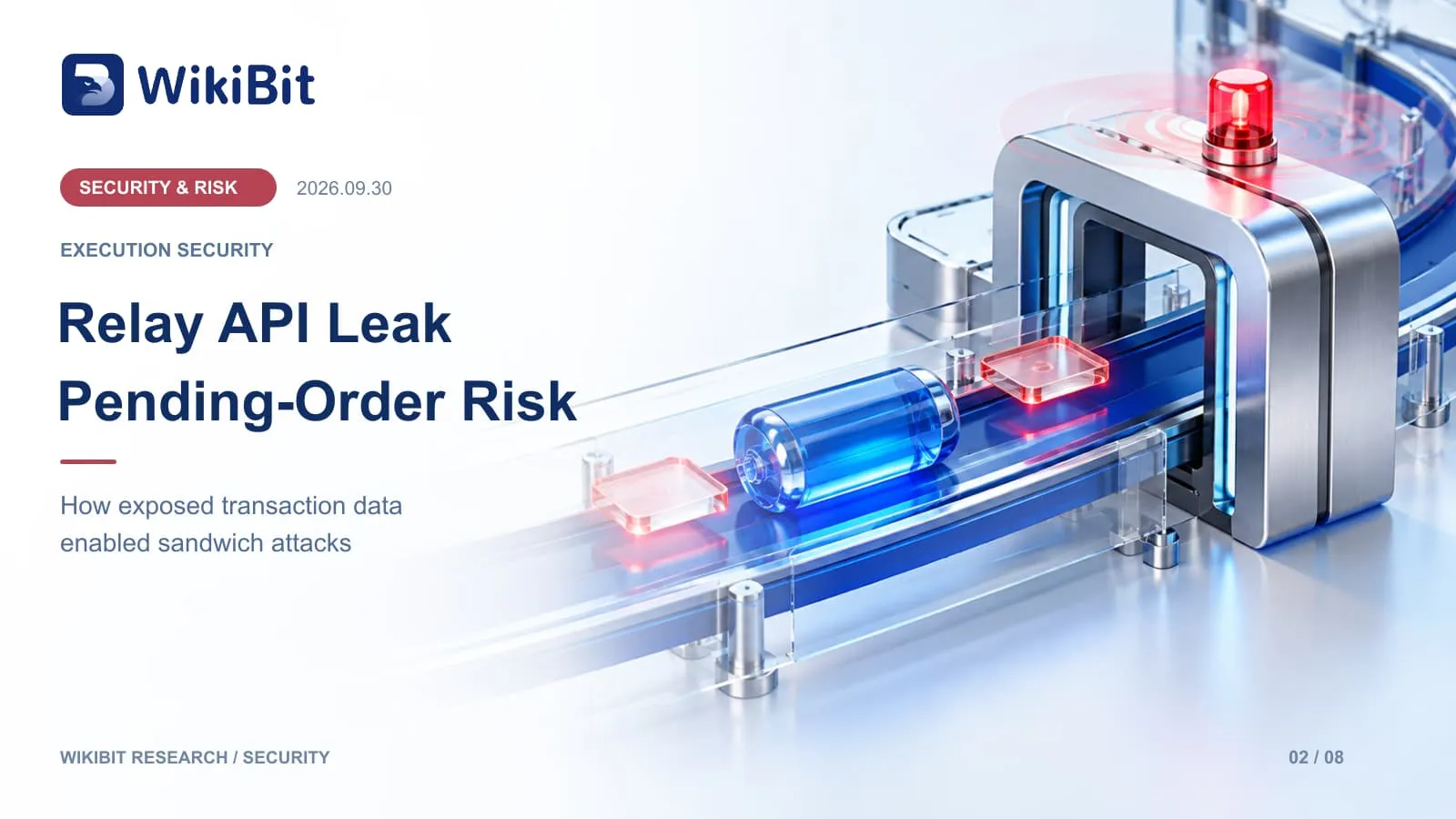
Relay API Vulnerability: 5,600 Users Hit by Sandwich Attacks, $312K Reimbursement Planned

Cross-chain execution protocol Relay has disclosed an API security issue that exposed information about pending user transactions before they completed.  The disclosure is important because the incident did not require an attacker to drain a treasury, compromise private keys or break a bridge contract. Instead, the exposed information let MEV searchers infer the route and timing of user transactions, trade around them and worsen users execution.  Relay says approximately:  5,600 users  were affected.Incident window  Relay says the affected activity occurred between:  September 12 and September 26, 2026  with most of the exploit activity concentrated between:  September 23 and September 26  The team discovered the issue over the weekend before the September 29 public disclosure.What the API exposed  The vulnerable API exposed pending transaction information before execution.  Current disclosures describe exposed information around:pending order state;route status;execution path.  MEV searchers could use those signals to infer what a user was about to do on-chain.  That gives an adversary a timing advantage before the users transaction reaches final execution.Why this enables a sandwich attack  A classic sandwich pattern works like this:attacker sees or infers a pending user trade;attacker trades first in the direction that worsens the users price;user trade executes at a less favorable price;attacker trades again after the user to capture the price movement.  Relays incident is

1 ہفتوں کے اندرانڈسٹری ریسرچ

Prediction-Market Insider Trading: Why Identity and Surveillance Are Becoming Core Infrastructure

Prediction markets have spent most of 2026 fighting over a basic legal classification:  Are they derivatives or gambling?  A new congressional inquiry highlights another question that may matter just as much:  Can these markets detect trading based on nonpublic information?  On September 29, House Oversight Committee Chair James Comer expanded an investigation into trading controls at platforms including Hyperliquid Labs, Crypto.com and Aristotle Exchange, the owner of PredictIt.  The requests seek records around customer identity verification, employee trades, suspicious trading, referrals to regulators and controls around material nonpublic information.  The inquiry follows earlier requests involving Kalshi and Polymarket.  The committee has not established that the platforms committed wrongdoing.  The significance is structural.  As event markets become larger and more financialized, they increasingly need the same market-integrity infrastructure expected from securities and derivatives venues.Public Events Can Still Have Private Information  Prediction markets are often described as markets on public events.  That can create the impression that insider trading is irrelevant.  It is not.  Many events are public only at resolution.  Before that point, information can be highly asymmetric.  Examples include government policy announcements, regulatory decisions, corporate earnings, product launches, personnel changes and geopolitical decisions.  A government employee may know an announcement before publication.  A company employee may know earnings before release.  A platform employee may know a token listing

1 ہفتوں کے اندرانڈسٹری ریسرچ

NEAR Intents vs. the Bitget Hacker: Why “Permissionless” Does Not Mean “Neutral”

The Bitget hack has produced two opposite answers to the same question.  When stolen funds reached THORChain, the protocol refused Bitgets request to block known attacker wallets and defended its permissionless design.  When similar funds reached NEAR Intents, NEAR intervened.  NEAR Intents said its SHIELD system identified more than $50 million in attempted transfers linked to the Bitget attacker. Most were rejected before execution. Roughly $166,000 passed through the system, while approximately $503,000 was frozen during execution and remains restricted pending legal and recovery procedures.  NEAR co-founder Illia Polosukhin defended the decision with a useful phrase:  permissionless does not mean neutral.Intents Are Not the Same as Direct Blockchain Transactions  A user interacting directly with a base-layer blockchain broadcasts a transaction that validators process according to protocol rules.  An intent system works differently.  The user specifies an outcome, such as converting asset A into asset B.  Independent solvers compete or coordinate to fulfill that request.  That architecture can simplify cross-chain trading.  It also creates an execution layer between the user and the final settlement.  If solvers or routing infrastructure can refuse a request, the system is permissionless at one layer and selective at another.  This is why simple labels such as “censorship resistant” become less useful.  The correct question is:  which layer has the power to

1 ہفتوں کے اندرانڈسٹری ریسرچ

Robinhood’s 24/7 Brokerage: AI Agents, Crypto Perps and Weekend Stocks

Robinhood is borrowing the market structure of crypto and applying it to the rest of brokerage.  At its HOOD Summit on September 29, the company unveiled a broad expansion around three themes:  automation, leverage and continuous trading.  Robinhood is pushing AI-agent trading further into the consumer interface.  It plans to offer crypto perpetual futures with leverage of up to 10x.  And it plans to enable weekend trading for a selected group of U.S. stocks and ETFs, subject to regulatory approval.  Individually, none of those ideas is entirely new. Together, they point toward a different brokerage model:  a multi-asset market interface that is always available and increasingly operated by software agents.Cryptos 24/7 Model Is Spreading Into Equities  Traditional U.S. equities have defined trading sessions.  Crypto does not.  Robinhood introduced extended and overnight equity trading years ago and is now pushing further toward weekend availability.  Reuters reported that the new weekend product will initially cover a curated list of stocks and ETFs through Bruce ATS and remains subject to regulatory approval.  That distinction matters.  Weekend stock trading does not mean the primary U.S. exchanges are suddenly open seven days a week.  It means an alternative trading venue is creating additional sessions.  That introduces familiar off-hours issues:thinner liquidity;wider spreads;less reliable price discovery;greater gap risk when primary markets reopen.  Access

1 ہفتوں کے اندرانڈسٹری ریسرچ

Bitwise NEAR ETF: What Staking Changes in a Single-Asset Crypto Fund

Bitwise has brought NEAR into the U.S. spot crypto ETP market.  The Bitwise NEAR ETF, ticker NRR, began trading on NYSE Arca on September 29. Bitwise describes it as the first U.S. spot exchange-traded product offering direct exposure to NEAR.  The fund charges a 0.75% management fee and intends to stake a significant portion of its NEAR holdings through Bitwises institutional staking operation.  That second feature matters. NRR is not simply a wrapper around token price. It also creates a regulated investment product around protocol participation.Staking Changes the Return Profile  A non-staking spot crypto fund has a simple structure: the fund holds the asset, the asset price moves, and fees gradually reduce the amount represented by each share.  A staking fund adds another source of return.  Bitwise said NEARs annualized staking reward rate was about 5% as of September 25, although the rate can change and rewards are not guaranteed.  The fund therefore has a return profile closer to:  token price return + staking rewards - fees - operating costs - staking risks  That is a more complete comparison than looking only at the 0.75% management fee.Staking Also Adds New Risks  Yield does not arrive for free.  Staking can create validator risk, slashing risk, operational risk, delayed liquidity and tax complexity.  Bitwise

1 ہفتوں کے اندرانڈسٹری ریسرچ

zk.money Returns: What Private Stablecoin Payments on Aztec Actually Hide

Three years after shutting down its original product, Aztec has brought zk.money back.  The new version is a self-custodial payments wallet built on Aztec Network, the privacy-focused Ethereum Layer 2. Users can deposit supported stablecoins, claim readable handles such as name.zk.money, and send payments without publishing balances, payment amounts or counterparties on a public ledger.  The important change is product design. Aztec is not asking users to understand zero-knowledge proofs or manage a specialist privacy protocol manually. It is trying to make private payments look like ordinary consumer payments: readable names, payment links and simple wallet access.What zk.money Hides  Aztec says activity inside the wallet does not publicly reveal wallet balances, payment amounts or payment counterparties. That is materially different from ordinary Ethereum activity, where anyone who knows an address can inspect its balance and transaction history.  A private payment system breaks that link. A supplier does not automatically learn a company‘s treasury balance. A friend receiving a payment does not automatically see the sender’s other activity. A payroll payment does not automatically expose the employers broader payment graph.What zk.money Does Not Hide  The privacy boundary is just as important. Deposits from Ethereum into Aztec remain visible on Ethereum.  CoinDesk reported that users can deposit DAI,

1 ہفتوں کے اندرانڈسٹری ریسرچ

SKY crypto price prediction: Can SKY hold its breakout above $0.084?

SKY extended its September recovery on Tuesday, gaining 8.39%to trade near the $0.0854 price level at the time of this writing. It briefly touched $0.0875, which is its highest price in many months.  The move took SKY beyond two important barriers. But after the climb it saw, holding those new levels it just reached is more important than reaching another short-lived high.  SKY clears another price ceiling  SKY started trading near the $0.0787price level before buyers pushed it above $0.084. Since it broke beyond the 0.078 price level, that level has been its obstacle.  There was also an increase in trading activity during the move. Around 14.18 million SKYwas traded, meaning the advance saw a lot of participation and did not rely on a few trades.  The current rally continued a recovery that started around the $0.056price level earlier this month. Since then, SKY has seen more than 50%in gains and is trading above its average prices from recent weeks and months.  Source: TradingView  For buyers, keeping it above $0.084is the challenge. But if they are able to do so, $0.09becomes the next target. If it sees a stronger advance, the $0.10level could come into view.  SKY has climbed quickly, and this has allowed some holders to take

1 ہفتوں کے اندرانڈسٹری

OpenAI valuation could hit $1.4T in new funding round: Report

ChatGPT developer OpenAI is reportedly eyeing another $30 billion raise that could value it at $1.4 trillion, making it one of the worlds most valuable companies even before it goes public.  Citing people familiar with the matter, Bloomberg reported Tuesday that OpenAI is in the early stages of discussions for the new funding round, with investor demand driving the talks.  The proposed valuation would be roughly 64% higher than OpenAIs $852 billion valuation in March, when it raised $122 billion.  The fundraising discussions come as OpenAI pushes its long-awaited public debut into 2027 at the earliest. CEO Sam Altman said earlier this month that going public in 2026 would be “ill-advised” as the company focuses on AI safety. OpenAI confidentially filed paperwork for an initial public offering with the US Securities and Exchange Commission in June.  On the topic of safety, Altman spoke before the United Nations Security Council earlier this month about the potential risks posed by increasingly powerful AI systems.  Meanwhile, rival Anthropic, the developer behind Claude, is moving ahead with plans to go public this year in an IPO that could value the company at more than $2 trillion.

1 ہفتوں کے اندرانڈسٹری

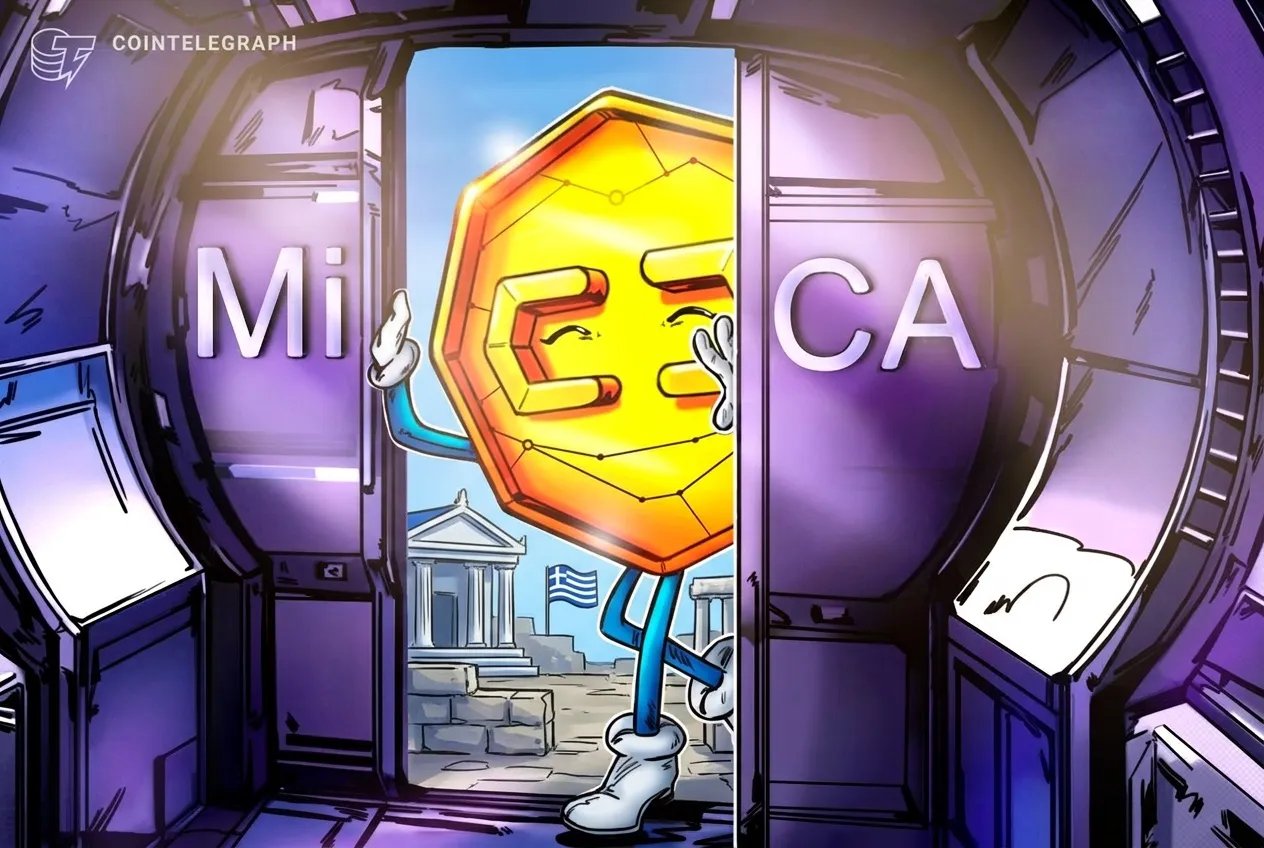
Greece gets first MiCA entrants as watchdog denies Binance-Lagarde claim

Greece has entered the European Unions crypto regulatory register for the first time, with four providers added.  Four Greek providers — BCash, Xenios Blockchain Group, Capital Wallet Greece and Piraeus Bank — appeared on the European Securities and Markets Authoritys (ESMA) Markets in Crypto-Assets (MiCA) register updated Thursday.  Six other crypto-asset service providers from Germany, France and Slovenia were added, bringing the register to 359 unique providers.  The distinction of becoming Greece‘s first MiCA-authorized provider could instead have gone to Binance, the world’s largest crypto exchange by trading volume. A Greek authorization would have allowed Binance to offer services throughout the EU under MiCAs passporting system, but the exchange withdrew its application on June 24 before the Hellenic Capital Market Commission (HCMC) issued a formal decision.  Nearly three months later, the Wall Street Journal reported that European Central Bank (ECB) President Christine Lagarde had intervened to block the application. The Journal said HCMC denied that its officials made the comments attributed to them but did not elaborate. The regulator has now expanded on that denial in comments to Cointelegraph.  Greece splits MiCA oversight  Greeces first MiCA entries show how the country divides crypto oversight between the HCMC and its central bank.  The HCMC is listed as the

1 ہفتوں کے اندرانڈسٹری
1
...
3638
...
1000