US senators seek SEC answers on tokenized stock money laundering risks

Four Democratic senators pressed the US Securities and Exchange Commission (SEC) to clarify financial crime safeguards under its tokenized stock exemption, warning that tokenized shares bought by verified investors could reach offshore or unverified wallets.  In a letter released Monday, Senators Angela Alsobrooks, Catherine Cortez Masto, Mark Warner and Ruben Gallego questioned how Anti-Money Laundering and Know Your Customer rules apply to tokenized securities venues, which can trade certain US stocks without registering as securities exchanges.  The senators said the SECs Sept. 17 Innovation Exemption requires venues to control trading access but does not mandate restrictions on subsequent transfers. They asked who would be responsible for tokens moved outside of regulated platforms and whether the SEC could recover or freeze them.  The lawmakers also questioned issuers‘ rights to object, retail investors’ access to best execution protections and custody safeguards. They asked SEC Chair Paul Atkins 13 questions, urging more transparent rulemaking and requesting answers within 30 days.  When announcing the exemption in September, Atkins said federal anti-fraud and anti-manipulation rules would continue to apply in full.  OKXICE, a venture between crypto exchange OKX and New York Stock Exchange parent Intercontinental Exchange, has also faced issuer objections. Its Nov. 5 public notice listed 67 companies that
1 ہفتوں کے اندرانڈسٹری

Google says hackers use AI agents to find and exploit software flaws

Google Threat Intelligence Group (GTIG) said it had, for the first time, identified attackers using AI large language model (LLM) frameworks to automate software vulnerability discovery and exploitation without step-by-step human direction.  In a report published Monday, the researchers described a tool found on an exposed staging server that compared software versions, identified potential flaws, and generated and executed exploit code.  “In the past quarter, GTIG identified threat actors using LLM frameworks to fully automate vulnerability discovery and exploitation without a human in the loop for the first time,” the researchers said.  GTIG identified an exposed staging server hosting a multi-agent vulnerability research and weaponization framework, set up to conduct continuous differential analysis comparing code before and after patch announcements on popular web applications. The model would autonomously discover and exploit software vulnerabilities.  Google warned that these automated workflows give organizations less time to apply security patches before attackers develop ways to exploit vulnerable systems.  In its September report, GTIG said it had “not yet observed threat actors deploying fully autonomous pipelines against targets in the wild.”Evolution of threat actors using LLMs for exploits. Source: Google  AI agents shorten patching windows  Attackers are leveraging AI agent frameworks to automate patch reverse engineering via differential analysis and weaponizing

1 ہفتوں کے اندرانڈسٹری

BlackRocks Bitcoin ETF snaps $2.35B outflow streak amid extreme fear

BlackRocks spot Bitcoin exchange-traded fund (ETF) returned to inflows Monday, ending an 11-session outflow streak totaling roughly $2.35 billion.  The iShares Bitcoin Trust (IBIT) attracted $76.5 million on Nov. 16, helping US spot Bitcoin ETFs record $7.9 million in net inflows despite withdrawals from several other funds, according to Farside Investors data.  The inflows came as Bitcoin (BTC) traded near multimonth lows of $64,000, while the Crypto Fear and Greed Index, which tracks cryptocurrency market sentiment, fell to 10 out of 100 on Monday, its lowest reading since June 2026.  Nick Pitto, head of marketing at blockchain analytics company CryptoQuant, cautioned against interpreting the inflows as a broader market recovery.  “One day of inflows doesn‘t change the picture too much,” Pitto said. He noted that Monday’s inflows recovered only about 3% of IBITs withdrawals over the previous 11 sessions, while US Bitcoin ETFs had shed more than 31,000 BTC over the past month.  Source: CryptoQuant  “It‘s too early to call this dip buying,” he said, adding: “We’d need to see several days of inflows in a row, and from more funds than just BlackRocks.”  Monday also marked the deadline for most institutions to file their third-quarter Form 13F disclosures, revealing Bitcoin ETF holdings as of Sept. 30.

1 ہفتوں کے اندرانڈسٹری

Ethereum Co-Founder Vitalik Buterin Urges Canadians to Oppose Bill C-22

Ethereum co-founder Vitalik Buterin has urged Canadians to contact senators about Bill C-22, comparing the proposed law to the European Unions “Chat Control” debate.  In a November 17 post on X, Buterin wrote that “Canada is going through its own version of the Chat Control mess with the C-22 bill.” He urged Canadians to support “backdoor-free, no asterisks” end-to-end encryption, which he called important to a “secure, free and open society.”  He urged governments to “minimize all backdoors and mass data collection” as AI changes cybersecurity risks. He linked to an October 8 Mozilla paper warning about Bill C-22s effect on encryption.  Canada is going through its own version of the Chat Control mess with the C-22 bill:https://t.co/bqdpOMdGRj  Highly encourage fellow Canadians to contact senators and make clear how you feel about the importance of (backdoor-free, no asterisks) end-to-end encryption, and its…  — vitalik.eth (@VitalikButerin) November 17, 2026  Meanwhile, the Lawful Access Act, 2026, has not become law. The House of Commons passed it on June 18, and the Senate approved second reading on October 22 before referring it to the Standing Senate Committee on National Security, Defence and Veterans Affairs.  The committees November 16 hearing included Meta, Signal, privacy advocates and legal experts. The bill remains

1 ہفتوں کے اندرانڈسٹری

Gary Gensler warns AI bubble could burst before Bitcoin's 2028 halving

Former SEC Chair Gary Gensler has warned that the artificial intelligence investment boom could end in a recession before the November 2028 US presidential election, a period that includes Bitcoins next scheduled halving.  In a November 16 CNN interview, Gensler described AI investment as a bubble fueled by enormous spending on data centers and advanced computing. He expects a correction resembling the early-2000s dot-com collapse, although he believes the economic damage would be less severe than the 2008 financial crisis. His forecast concerns the wider economy, not a specific prediction for Bitcoin.  Gensler Expects AI Valuations to Weaken Before the 2028 Election  “Its already a bubble,” Gensler said, pointing to estimates of $800 billion in annual AI infrastructure investment. He argued that companies are spending faster than they can demonstrate sustainable returns, while complicated financing arrangements can make their financial risks difficult to assess.  “History tells us that when you have a new technology and a significant investment…you come to a point where it plateaus. It retrenches,” he said.  Gensler compared the current investment cycle with earlier expansions involving railroads, electricity and the internet, when investment eventually outpaced demand.  He was particularly concerned about specialized cloud companies, known as neoclouds, that borrow heavily to provide computing

1 ہفتوں کے اندرانڈسٹری

Safe wallet reportedly loses $6.5M as Zodiac suspects key compromise

A Safe wallet reportedly lost about $6.45 million in cryptocurrency Monday, with Zodiac‘s co-founder pointing to a likely compromised key and the wallet’s permissions settings rather than a flaw in Zodiacs contracts.  Blockchain security firm PeckShield reported the suspected theft, citing onchain investigator Specter. Ethereum blockchain records reviewed by Cointelegraph show that approximately 4.39 million USDC (USDC) and 1.72 million syrupUSDC tokens were transferred from the wallet in a single transaction on Monday.  Johannes Moormann, co-founder of Zodiac, told Cointelegraph that his team reviewed the transaction and confirmed it passed through the wallets Zodiac Roles Modifier, which checked the transfer against its configured permissions policy and allowed it. “There is no vulnerability in the module. The contracts worked correctly. The transaction came from the key of a long-standing role member, which was most likely compromised,” he said.  Moormann added that the wallet‘s custom permissions policy permitted the transaction, almost certainly unintentionally. He said the wallet’s operators controlled its keys and permissions, and that Zodiac had neither access to them nor involvement in the setup. Zodiac has not been in contact with the affected team.  Specter first flagged the Zodiac Roles module as part of the suspected attack. PeckShield also said the attacker used approximately

1 ہفتوں کے اندرانڈسٹری

US judge clears brothers in $25M Ethereum MEV case after mistrial

A US federal judge acquitted two brothers accused of extracting $25 million from Ethereum trading bots, ruling that prosecutors failed to prove they made material misrepresentations during the alleged exploit.  In a Monday ruling, Judge Jessica Clarke acquitted Anton and James Peraire-Bueno on wire fraud and related charges. Prosecutors alleged that the MIT-educated brothers exploited a flaw in maximal extractable value (MEV)-boost software in April 2023 to lure sandwich-trading bots into transactions they then disrupted, securing $25 million in about 12 seconds.  The judge said the transactions did not amount to false promises or constitute criminal fraud, and that the case was not about whether the brothers actions were ethical or potentially violated other laws.  Their first trial ended in a mistrial when jurors failed to reach a verdict in November 2025.  Coin Center executive director Peter Van Valkenburgh called the acquittal “excellent news,” saying prosecutors honest validator theory risked allowing the government to impose its own standards of conduct on Ethereum validators through wire fraud laws.  “Anyone participating in an open network would have to wonder whether prosecutors might later declare their behavior ‘dishonest’ and haul them into court,” Valkenburgh said.  The ruling also cited a 2025 decision involving Mango Markets trader Avraham Eisenberg, where

1 ہفتوں کے اندرانڈسٹری

Tethers Bitcoin Firm Bought the Dip While Its Own Stock Sank

Twenty One Capital bought 154.32 Bitcoin (BTC) for about $10 million as the price slid toward $65,000. The Tether-controlled firm paid in cash and now holds about 43,668 BTC, one of the largest public Bitcoin treasuries.  It is the companys first Bitcoin purchase since its SPAC deal closed last year. CEO Rapha Zagury presented the buy as a deliberate bet on the slump.  Sponsored  Sponsored  Twenty One Capital Buys the Dip With Cash  The average price came to about $64,801 per coin, the company says. Before the purchase, Bitcoin briefly dropped below $62,000, its lowest level since July. Strategy (formerly MicroStrategy), by contrast, halved its Bitcoin buying as prices fell.  Zagury said on X that the team saw an opportunity in the volatility and bought the dip.  Zagury also tied the buy to the firms broader strategy in the announcement.  Bitcoin is our benchmark for every investment decision we make. Any business we acquire has to beat simply buying more Bitcoin.  Rapha Zagury, CEO of Twenty One Capital  The buy also caps a turbulent year for Twenty One Capital. Zagury took over in July after co-founder Jack Mallers stepped down as CEO. At the same time, Tether started to rethink XXIs Bitcoin treasury model and shifted the focus toward cash

1 ہفتوں کے اندرانڈسٹری

Why Is Ripple-Backed Evernorth Writing Down Its XRP Again?

Evernorth Holdings (XRPN), the XRP treasury company backed by Ripple, has lost about $505 million on paper since it began buying the token. According to its latest quarterly filing, the companys 346.3 million XRP are now worth just $342 million.  The market told a different story. At XRPs price of $1.49 at the end of September, the same tokens were worth roughly $516 million. That gap comes from accounting rules. The losses are real, though, as Evernorth paid about $847 million for the tokens, or roughly $2.44 each.  Sponsored  Sponsored  XRP has since slipped below $1 as well. XRPN stock, meanwhile, has lost more than half its value since its Nasdaq debut.  Why a Ripple Tie Keeps Evernorth XRP at Cost  A 2023 US accounting rule lets most crypto holders value their tokens at market prices, so gains flow straight into earnings. Evernorth can‘t use it, the company says. The rule excludes tokens created or issued by a company’s related parties. Since Evernorths SPAC merger, Ripple counts as one.  Management therefore concluded that its XRP fails the scoping test. As a result, the tokens stay at historical cost minus impairment. Each write-down also resets that cost basis lower.  The charges came in two waves. Evernorth booked $233.7 million

1 ہفتوں کے اندرانڈسٹری

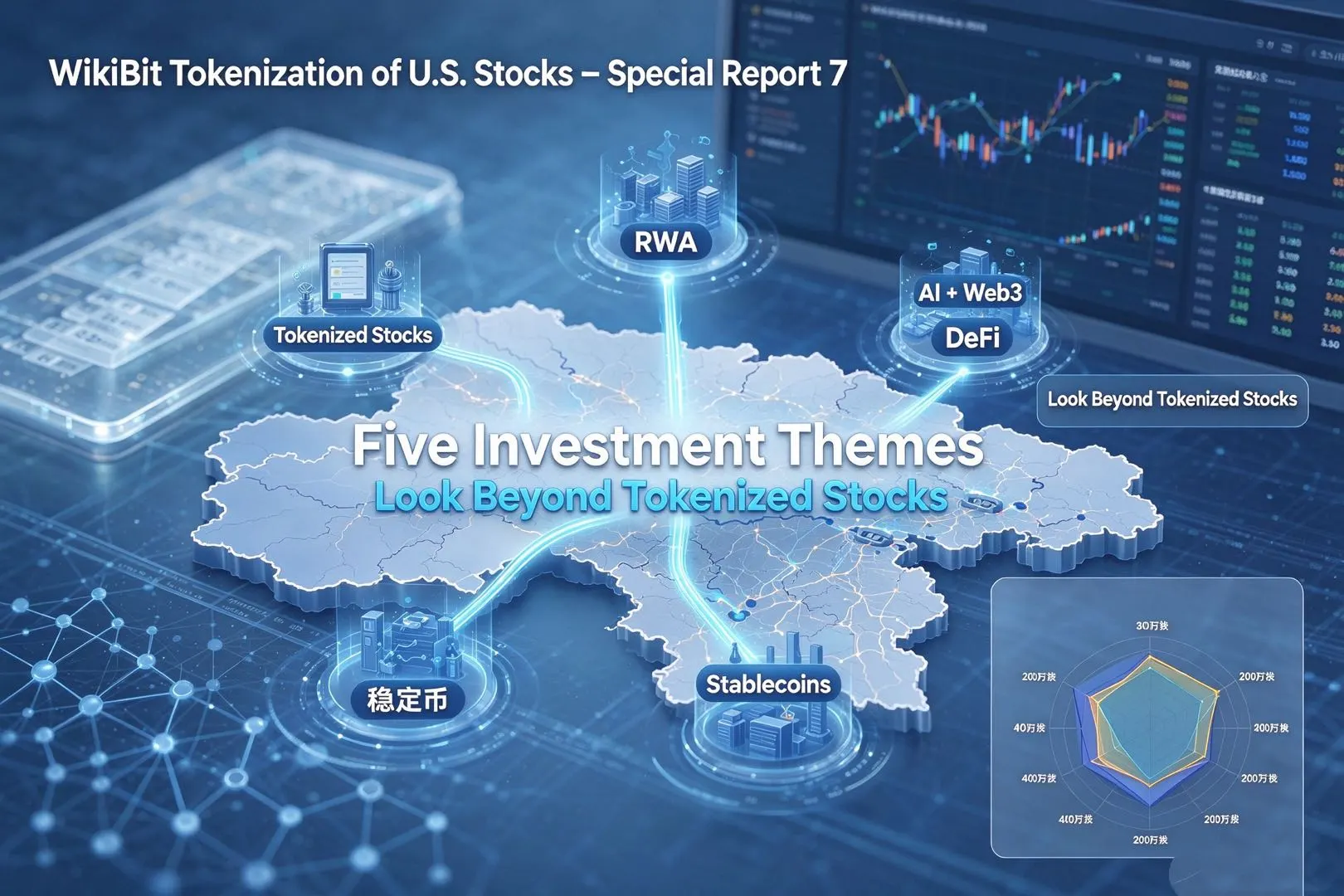
WikiBit Tokenization of U.S. Stocks – Special Report 7: Five Investment Themes — Look Beyond Tokenized Stocks

If U.S. stocks are eventually brought onto the blockchain on a massive scale, and traditional equities such as Apple, NVIDIA, and Tesla become digital tokens, what should ordinary investors actually invest in?  The first instinct for many people is to rush out and buy tokenized stocks, or search for the next project issuing Real-World Asset (RWA) tokens.  But that may mean looking at only the most superficial layer of the entire industry.  Imagine a city experiencing a property development boom. Some people are busy buying houses, others are building them, some are constructing roads, others are providing electricity and water, while still others are managing properties or controlling payment systems and transaction gateways.  Eventually, you may discover that while rising property prices can certainly make homeowners money, companies controlling infrastructure, property management, and customer access can also generate stable, long-term income.  The same principle applies to tokenized U.S. stocks.  Moving a stock from traditional financial markets onto the blockchain is not simply a matter of turning a ticker symbol into a token. The process requires companies to issue the underlying assets, blockchain networks to support transactions, oracles to deliver price data, stablecoins to provide dollar liquidity, and exchanges, wallets, and financial apps to put these products

1 ہفتوں کے اندرگہرا غوطہ
1
...
3335
...
1000