Polygon to burn 100M POL as revenue hits $24.5M, but will this help the token?

Polygon is prepping for the next crypto market bull cycle with an aggressive POL deflationary plan. In a post on X on Friday, Polygon Foundation CEO Sandeep Nailwal announced the project will permanently burn 100M POL tokens, citing impressive protocol revenue.  Polygon is printing revenue. $24.5m YTD. We are deploying a change that lets anyone in the community trigger its burn.  Nailwal noted the proposal is now awaiting the final Security Council sign-off to be implemented. Following the same, there will be manual quarterly burns.  Polygons base fees add POL to its collector wallet.  According to Nailwal, the collector currently holds 121M POL, worth about $1.2M. If the 100M tokens are burnt as planned, that will remove 1% of POL circulating supply from the market.  Will Polygon‘s burns boost POL’s value?  Polygon has aggressively repositioned itself for payments, especially stablecoin-based transfers. According to Nailwal, the traction and the generated fees are now 3x that of Arbitrum and 5x that of Near Protocol.  In fact, according to DeFiLlama, Polygons collected annual revenue crossed $25M too, marking a two-year high.  Source: DeFiLlama  Whether the traction will hold steady in the coming months and fuel POLs burn rates remains to be seen though.  In the meantime, POLs price surged by 10% on the

09-20انڈسٹری

The Fed Hiked Rates and Bitcoin Went Up: Heres Why That Matters

The first Fed rate hike in over three years didnt bring BTC down for long.  After the CLARITY Act setback witnessed on September 15, all financial eyes turned to the Fed a day later when the US central bank raised the key interest rates by 25 bps for the first time in over three years.  This development is considered bearish for risk-on assets like BTC, especially when it came with a 12-0 vote by policymakers, and the cryptocurrency‘s price dipped after it became official. However, bitcoin rebounded swiftly, recovered the losses, and is actually велл in the green after the Fed’s move. Whats up with that?  BTC Shrugs Off a Rate Hike  The US Senates failure of the CLARITY Act pushed BTC to a multi-week low of $75,000, and the market anticipated another leg down if the Fed indeed hiked rates as expected on September 16. Although there was indeed a minor pullback, BTC shrugged off the losses almost immediately and turned them into gains as the week progressed.  Nansen Senior Research Analyst Nicolai Sondergaard explained that the regulatory setback produced more significant volatility than the Fed for BTC, which held better than higher-beta assets like ETH and SOL.  “Bitcoin rose on the day the Federal

09-20انڈسٹری

The CLARITY Act Failed — So Who Regulates Crypto Now?

The CLARITY Act was supposed to answer one of cryptos biggest questions: which regulator controls which part of the market?  Instead, the bill stalled in the Senate on Sept. 15 after failing to clear the 60-vote threshold needed to advance. The result leaves the U.S. without the broad market-structure framework the legislation was designed to create.  That does not mean crypto is suddenly unregulated.  The SEC and CFTC were already coordinating on digital assets before the vote. In March, the two agencies signed an official SEC-CFTC memorandum of understanding aimed at clarifying product definitions, modernizing trading rules and developing a more coordinated crypto framework.  U.S. crypto oversight remains split across multiple regulators.SEC vs. CFTC Is Still the Main Divide  The SEC remains responsible for applying federal securities laws when a crypto asset, token offering or transaction falls within securities law.  Earlier this year, the SEC issued new guidance covering areas including staking, mining, airdrops and when a non-security crypto asset can become part of an investment contract. The CFTC joined that interpretation and said it would administer the Commodity Exchange Act consistently with it.  The CFTC, meanwhile, already oversees crypto futures, options and other derivatives.  Its authority over the spot marketis narrower. For non-security commodities such as Bitcoin,

09-20انڈسٹری

Grayscale Zcash ETF Sets 3-for-1 Share Split

Grayscale‘s spot Zcash ETF will split its shares 3-for-1 in late September, cutting the fund’s per-share price while leaving each investor‘s total holding value unchanged. The fund, which trades under the ticker ZCSH on NYSE Arca, disclosed the move in a September 18 filing with the U.S. Securities and Exchange Commission. The announcement is a mechanical change to the fund’s share structure, not a shift in its investment objective or its underlying exposure to Zcash.  Split Mechanics and Key Dates  Shareholders of record at the market close on September 28 will receive two additional shares for every share they own, with the distribution payable after the market close on September 29. The shares are expected to begin trading on a post-split basis before the market opens on September 30, the effective date. The fund will keep trading on NYSE Arca under the same ZCSH symbol, and its CUSIP number will not change. Grayscale said the split is expected to decrease the per-share price with a proportionate increase in the number of shares outstanding.  What the Split Does and Why  A forward split lowers the per-share price by increasing the number of shares outstanding in proportion, so the move does not alter the total value

09-20انڈسٹری

How Fake Job Offers Are Stealing Crypto Developers Wallet Data

Crypto developers face fake job offers that deliver malware and steal wallet data. A joint security alert links these attacks to North Koreas WaterPlum group. Authorities urge stronger checks on recruiters, coding tests, and software used during online job interviews.  The September 18 advisory reports at least 30,000 infected devices across more than 100 countries. Attackers stole funds or login details from more than 7,000 wallets. Web3 developers and blockchain specialists were among the main targets from December 2025 through July 2026. Investigators valued the stolen crypto at 1.7 billion yen, or about $10.71 million.  1. Verify the Recruiter Through a Separate Channel  The FBI recommends checking a recruiters identity through a separate communication channel. Profile photos and career knowledge are insufficient proof of identity. The bureau also flags job offers with unrealistically high pay.  Attackers research public profiles and tailor offers to a targets skills. Some use stolen photos or fake websites. Others build trust before requesting software downloads.  2. Question Requests to Fix Interview Software  A supposed video problem is a documented warning sign. The FBI flags requests to run scripts that allegedly restore interview calls. It also warns about custom applications used for tasks that standard software already handles.  Errors inside an assignment also

09-20انڈسٹری

JPYC Hit South Korea's Upbit at 1 Yen and Traders Sent It Flying Past 3

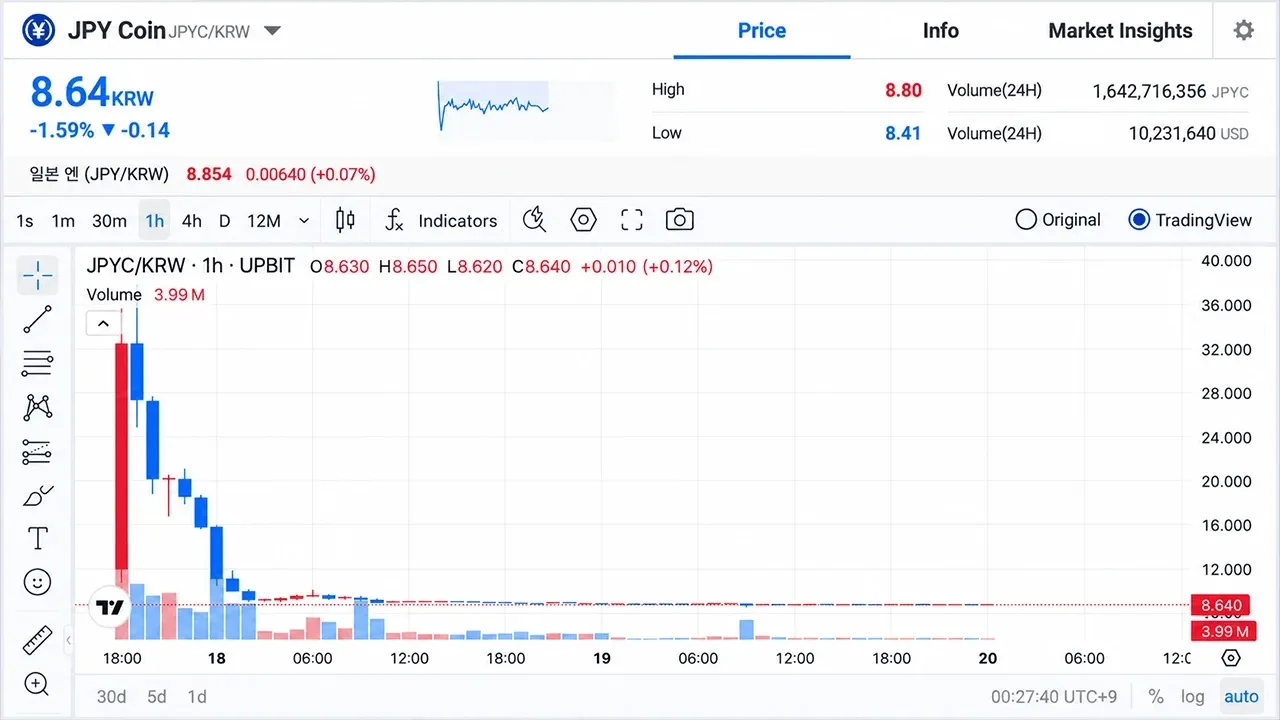
Key TakeawaysJPYC briefly fetched over 3 yen on Upbit as Korean traders piled in after its Sept. 17 debut.JPYC minted ¥1.69B on Sept. 17 as traders raced to cash in on a huge gap from its 1-yen peg.JPYC supply climbed above ¥4.2B in about 48 hours, giving arbitrage mechanics enough tokens to tame the premium.  JPYC‘s 1:1 Yen Peg Meets Upbit’s Retail Rush  Launched under strict national regulations, JPYC is backed by government bonds and bank deposits, designed solely to hold a 1:1 peg with the Japanese yen. Before its Upbit debut, JPYCs busiest trading venue was Uniswap, where it primarily traded against the stablecoin USDC. When trading opened on Upbit at a reference price of 8.81 won, JPYC immediately jumped to 12 won.  It then quickly ripped past 27 won, and within an hour, Korean traders were paying 35.7 won for a single token. Upbits exchange chart shows a candle wick touching the 37 won range, where a token designed to maintain a 1:1 peg with the yen briefly traded at more than three times its intended value. Upbit announced the JPYC listing on the morning of Sept. 17, pairing the stablecoin against the won, tether and bitcoin.  After two separate delays pushed

09-20انڈسٹری

Fuel Shortages Hit 5 Countries on Day 203 of the Iran War: Full List

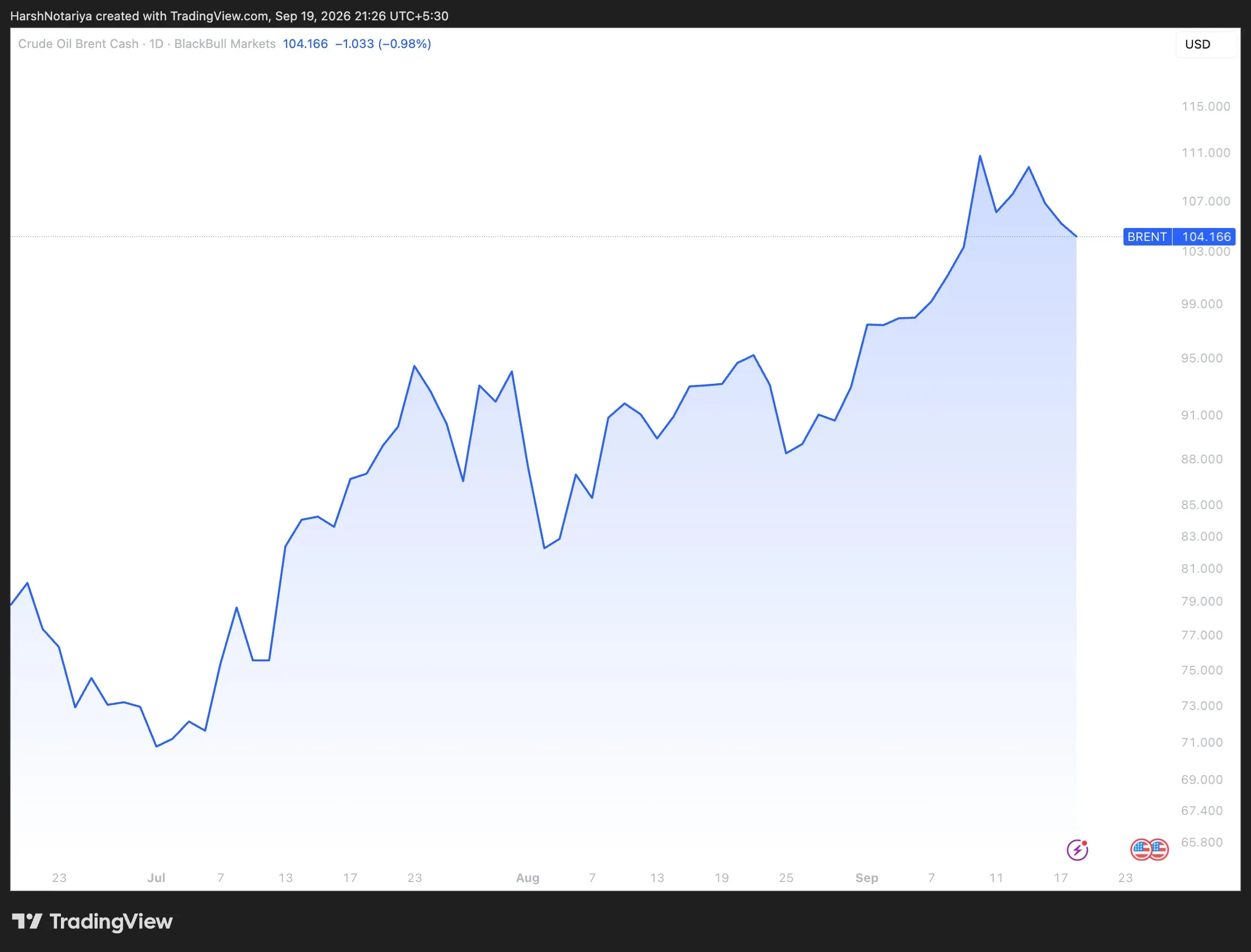
Its day 203 of the Iran war. And, at least five countries are rationing fuel or reporting empty pumps as of September 19. Brent crude traded at nearly $110 this month, its strongest level since spring.  The Strait of Hormuz has been largely shut since Iran retaliated for US and Israeli strikes on February 28. Houthi advances at the Bab al-Mandab chokepoint this month have now squeezed the main bypass route as well.  BRENT Price Performance. Source; TradingView  The crisis is now also a refined-product problem, not just a crude problem. Vitol CEO Russell Hardy said at the Asia-Pacific Petroleum Conference that the market is missing about 2 million barrels a day of products from Russia and almost 2 million more from the Middle East.  The International Energy Agency (IEA) says refined shipments leaving the Gulf still run below half their February pace. Russian diesel exports have roughly halved since June, per the IRU.  The 5 Countries Rationing Fuel or Reporting Stockouts1. France  Between 10% and 12% of French stations were out of at least one fuel from September 13 to 15, according to government prix-carburant data cited by Connexion. Grand Est reached 14%.  SP95-E5 petrol hit an all-time record of €2.17 a litre after six straight

09-20انڈسٹری

AI was supposed to take scammers jobs, but it gave them superpowers instead

For anyone worried that AI would eliminate every profession except the one sending messages about your frozen crypto account, theres unwelcome news for that last bastion of human enterprise. Fraud has found an automation budget.  Scamming has always required a surprising amount of manual labor. Romance scams need someone to keep a conversation going for weeks, investment fraud needs someone to answer questions and maintain a believable identity, and impersonation scams need someone to keep the act together long enough to transfer money. AI can now do more of that work, meaning the same criminal operation can reach far more people without adding more humans.  Thats what FATF president Giles Thomson meant when he told the Financial Times this month that AI could let “one or two people in a basement with a very big server” do work that once required a much larger scam operation. Its a grimly efficient version of the productivity boom every other industry has been promised.  The important change isnt that AI is about to make scammers unemployed. Its that every scam becomes cheaper to run. One person can maintain more fake identities, carry on more conversations, and attempt more fraud at the same time, which means criminals

09-20انڈسٹری

SpaceXs Nasdaq-100 Weight Jumps to 2.82% — What Happens to QQQ Now?

The aerospace companys index weighting has been confirmed at 2.82%, more than double the roughly 1.28% allocation it received after joining the benchmark in July. The change takes effect with the latest quarterly rebalance.  The reason isn‘t another rocket launch or earnings surprise. It’s free float.  Invesco‘s explanation of SpaceX’s Nasdaq-100 entry shows that when SpaceX entered the index, only about 5% of its shares were freely tradable. Under Nasdaqs methodology, that limited the weight assigned to the company despite its enormous overall market capitalization. (  Discover more  FINANCE  Brokerages & Day Trading  Currencies & Foreign Exchange  As post-IPO restrictions expired and more shares became available for trading, SpaceXs index representation could increase.  Why 2.82% Matters for QQQ  Moving from 1.28% to 2.82% is a 1.54-percentage-point increase, or roughly a 120% jump in SpaceXs index weight.  That matters because funds designed to track the Nasdaq-100 need to adjust their portfolios when the benchmark changes.  The biggest example is the Invesco QQQ Trust. Broader estimates cited ahead of the rebalance suggested that the SpaceX adjustment could generate roughly $15.5 billion to $22 billion of passive buying across Nasdaq-100-linked products, although the exact amount depends on assets tracking the index and implementation mechanics.  The event also follows a surprisingly weak response to SpaceXs original

09-20انڈسٹری

Binance News: USD/BRL Perpetual Debuts Monday with 100x Leverage

Key Insights:Mondays USD/BRL debut is trending with Binance news, with leverage capped at 100x.Binance will use orderbook pricing during weekend and holiday FX market closures.Bybit offers up to 100x leverage on FX perpetuals, while Kraken caps leverage at 50x.  Binance news focused on a USD/BRL perpetual contract scheduled to begin trading on Monday with up to 100x leverage. The USDBRLUSDT contract will track movements between the U.S. dollar and Brazilian Real, and settle in Tethers USDT stablecoin.  Eligible traders can take currency positions without owning either currency, while trading will continue through weekends and public holidays. That schedule extends beyond conventional institutional foreign exchange hours, which generally run from Monday through Friday.  Binance will use different pricing sources depending on whether external currency markets remain open. Its approach combines third-party market data during regular hours with orderbook-based pricing during closures.  Binance News Details USD/BRL Trading Terms  The new contract links to Binance Perpetuals and has no fixed expiration date. Traders can keep positions open while meeting margin requirements and paying or receiving applicable funding charges.  Discover more  Public Finance  Finance  Merchant Services & Payment Systems  However, regional restrictions and account requirements will determine who can access the product.  Binance news Monday debut for USD/BRL perpetual | Source: Binance  Binance said users should

09-20انڈسٹری
1
...
143145
...
1000