

Tokenized stocks are not as simple as “taking a screenshot of a stock and putting it on the blockchain.” They are more like a matchmaking event spanning Wall Street and public blockchains.
The matchmakers include listed companies, custodian banks, brokers, exchanges, stablecoins, oracles, wallets, and auditing firms. The dowry consists of custody fees, issuance fees, trading fees, settlement fees, and data fees. In the end, whoever wins the user's business becomes the tollbooth operator collecting the fees.
Imagine there is one share of Apple stock that needs to travel all the way from Nasdaq into your crypto wallet. You might think it is just a matter of clicking a button and putting Apple on-chain.
Not quite. Behind the scenes lies an entire industry chain: the asset layer ensures the underlying shares actually exist; the compliance layer keeps everyone on the right side of the law; the data layer makes sure nobody feeds you a pear when you ordered an Apple; the settlement layer ensures your money doesn't disappear along the way; the technology layer keeps the blockchain running smoothly; and the access layer brings the whole experience to your fingertips.
In a nutshell, tokenized stocks are not a single project, but an entire on-chain financial system.
Take a look at the infographic below.
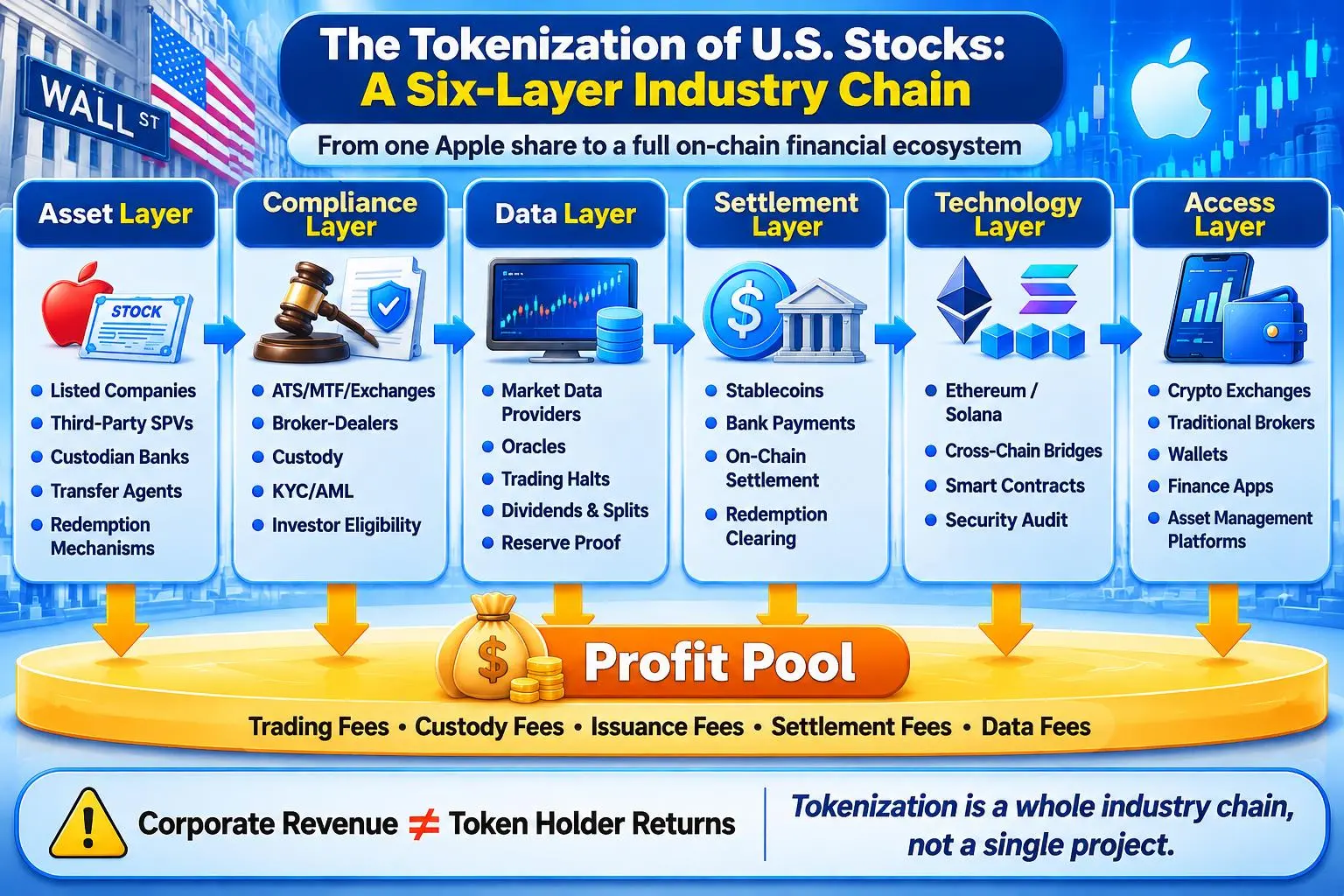
1. Asset Layer: Without Real Shares, Your Tokens Are Just “Digital Hot Air”
Everyone wants to put stocks on the blockchain, thinking it is both trendy and convenient. But at the end of the day, an on-chain token is just the packaging. What matters is what is inside: genuine underlying shares. Without legal protection and a reliable way to redeem tokens for actual shares, these tokens are not much different from skins in a video game.
Right now, the industry is experimenting with three main approaches.
The first approach: Listed companies issue shares directly on-chain.
This is the most legitimate route, but also the slowest. Think about it: established companies with decades of history have rulebooks thicker than dictionaries. Asking them to move their entire share registration, ownership transfers, and dividend distribution processes onto smart contracts is like asking an elephant to breakdance. It is no easy task. So far, most players are still watching from the sidelines. Nobody wants to be the first to jump into the water.
The second approach: Middlemen buy the shares and make money from the spread.
This is currently the most popular model. Institutions first purchase Apple, Tesla, and other stocks in traditional markets, lock them away in custody, and then issue corresponding tokens on the blockchain.
What you actually receive is essentially a beneficial ownership claim issued by an intermediary. And that is where you need to start asking some tough questions: If the underlying shares pay dividends, will the money actually reach you? Do you get voting rights at shareholder meetings? The answers may depend entirely on the intermediary.
The third approach: Full-service custody and redemption.
Once the shares have been purchased, who looks after them? If the company announces a stock split, how will the on-chain token supply be adjusted? Most importantly, if you want to exchange your tokens back for actual shares, can you? Do you need to complete identity verification (KYC)? Is there a minimum redemption threshold?
If you can buy tokens but cannot redeem them, the financial value of the whole arrangement takes a serious hit.
So don't get distracted by project teams boasting about how advanced their technology is. Focus on a few basic questions:
Where exactly are the real shares held?
Who is responsible for maintaining the ownership records?
Who handles dividend distribution?
Who do I contact if I want to redeem my tokens?
If they cannot answer these questions, what you are holding may be little more than a digital souvenir.
2. Compliance Layer: The Blockchain Party Can Go on All Night, but Regulators Never Clock Out
One of blockchain's favorite selling points is that it “breaks down borders and enables free, 24/7 trading.” But sorry, stocks are not memecoins. They come with built-in regulatory obligations.
No matter how much high-tech packaging you put around them, securities are still securities in the eyes of the law. They must comply with securities regulations and answer to the relevant regulators.
Here is the reality: On-chain, it looks like science fiction. Off-chain, it still looks like a traditional bank counter.
You cannot simply create a liquidity pool and call it a U.S. stock trading platform. You need the appropriate licenses, such as an Alternative Trading System (ATS) or Multilateral Trading Facility (MTF) authorization, or a compliant arrangement with an established traditional exchange, before you can legally operate.
The old financial players are still in the game.
The brokers who help you open accounts, the banks that hold your money, and the clearinghouses that settle transactions are still essential. They have not disappeared. They have simply put on a new outfit and moved part of their operations onto the blockchain.
And the compliance questions can come at any time.
The moment your wallet connects, compliance checks may kick in. Regulators and service providers will want to know:
Who are you?
Is your money from a legitimate source?
Are you an eligible investor under the applicable rules?
Are you accessing the service from a sanctioned jurisdiction?
So, the players most likely to make real money and survive long-term in this industry will not necessarily be the developers who write the best code. They will be the seasoned operators who understand both sides of the game: blockchain technology on one side, and securities laws, bank custody, identity verification, and regulatory compliance across multiple jurisdictions on the other.
3. Data Layer: Without Reliable Data, Smart Contracts Are Flying Blind
The blockchain has no idea how much an Apple share is worth. It also does not automatically know whether U.S. markets are halted, whether a stock has undergone a split, or whether a company has declared a dividend.
Someone has to feed real-world financial information into the blockchain. That is where oracles and financial data providers come in.
There are three major categories of data to consider.
First: Price data.
Compliant market data providers supply pricing information, while oracles transmit that data onto the blockchain. They also need to handle heartbeat intervals, deviation thresholds, and emergency circuit breakers. If prices are delayed or incorrectly reported, the result could be an erroneous liquidation or settlement.
Second: Trading status data.
This includes trading halts, pre-market and after-hours sessions, regular trading hours, and overnight trading.
Imagine traditional U.S. markets have halted trading, but tokenized stocks on the blockchain are still being traded. That could create serious problems.
Third: Corporate actions and asset verification.
How are dividends distributed? How are token balances adjusted after a stock split? How are shareholder voting rights transmitted? Are the underlying stock reserves sufficient? Has the number of tokens in circulation exceeded the actual shares held in custody?
All of these require coordination between the data layer and the relevant verification mechanisms.
In August 2025, Chainlink launched data streams covering U.S. equities and ETFs. In January 2026, it introduced 24/5 U.S. equity data streams, covering regular trading hours, pre-market, after-hours, and overnight sessions.
Its tokenized asset data streams are also exploring ways to incorporate pricing, market status, and corporate-action adjustment factors into structured data feeds.
This points to a much bigger role for the data layer in the future. It may evolve beyond a simple price-feeding tool into the financial data infrastructure underpinning on-chain securities markets.
4. Settlement Layer: Stablecoins Bring Speed, Banks Bring Stability
When stocks move onto the blockchain, someone still has to pay for them. The settlement layer handles how money moves, how transactions are cleared, and how assets are redeemed.
Stablecoins are the cash layer of on-chain stock markets.
USDC, USDT, and other stablecoins can facilitate 24/7 fund transfers, reducing friction in cross-border payments and smaller transactions.
Circle's Cross-Chain Transfer Protocol (CCTP), in particular, uses a native burn-and-mint mechanism to support USDC transfers across different blockchains. This could be particularly useful for tokenized stock trading in a multi-chain environment.
But stablecoins are not magic. Behind every stablecoin are dollar reserves, redemption arrangements, and the banking system that supports them.
Institutions issuing tokenized stocks also need traditional securities accounts and fiat payment channels to purchase the underlying shares. Likewise, when users eventually want to convert their investment proceeds into dollars in a bank account, the traditional banking system is still part of the equation.
On-chain settlement offers one major advantage: atomic settlement.
In a typical atomic settlement process, the buyer pays in stablecoins while the smart contract simultaneously transfers the stock tokens to the buyer. Either both sides of the transaction complete successfully, or the entire transaction fails.
This reduces the risk of one party delivering payment while the other fails to deliver the asset.
However, completing an on-chain transfer does not automatically mean that legal settlement, custody records, and fiat redemption have all been completed.
If the underlying shares remain in the custody of traditional financial institutions, their off-chain ownership and accounting records must also be updated and reconciled.
So here is the reality of the settlement layer:
Stablecoins bring speed, banks bring stability, and redemption mechanisms ensure that tokenized stocks do not become one-way tickets.
The real industry opportunity is not simply about making transfers happen in a few seconds. It is about connecting securities, money, custody, clearing, and redemption into one complete and functioning financial loop.
5. Technology Layer: Public Blockchains Build the Stage, but Security and Compliance Are the Real Gatekeepers
Many people assume that whichever blockchain is faster and cheaper will eventually become the home of Wall Street. That is a classic case of outsiders focusing on the wrong things.
Think of it like choosing a marriage partner. Good looks (high transaction speed) are not enough. What really matters in the long run is whether the person is reliable (security and regulatory compliance).
Ethereum is like an established aristocratic family with a long history and deep pockets. It may be a little slow and expensive, but it has a solid reputation and a mature ecosystem. When it comes to complex, high-value financial transactions, many institutions are still willing to work with it.
Solana, on the other hand, is like a young guy riding a skateboard. Its selling points are simple: speed and low costs. It is particularly attractive for younger users who want frequent trading and a more dynamic experience.
Then there are networks like Polygon and Base, each with its own strengths and strategies for carving out a place in the market.
But think about what traditional securities trading actually requires. It demands extremely high levels of security, privacy, and the ability to freeze assets at the push of a button when something goes wrong.
Simply boasting that your blockchain can process tens of thousands of transactions per second means very little. If the network suddenly stalls, or a massive transfer goes through but the accounting records fail to reconcile, institutional investors could have a heart attack on the spot.
And smart contracts in this business are far more complicated than simply issuing another worthless meme coin. The code needs both a pair of “discerning eyes” and a set of “iron shackles” to enforce the rules.
Who can buy and who cannot? The code must automatically recognize approved whitelist addresses.
How much can each investor purchase, and are transfers permitted? The code must strictly enforce these restrictions.
What happens when a company pays dividends or announces a stock split? The code must automatically calculate and process the adjustments.
What if someone's assets are frozen by a court order? The issuer must have the ability to freeze or even burn the relevant tokens when legally required.
If there is even a single coding error, or a cross-chain bridge gets hacked, your tokenized U.S. stocks could instantly become digital message bottles stranded on a deserted island, with no way to recover them.
That is why businesses specializing in smart contract audits, private key management, and emergency security response could become some of the most essential and quietly profitable players in this industry.
6. Access Layer: Whoever Saves Users Three Screen Taps Could Become the Next Tollbooth Operator
Everything we have discussed so far—technology, assets, and compliance—is essentially about building the underlying infrastructure. But whoever can finally deliver these services to ordinary users is the one most likely to become the tollbooth operator collecting the money.
There are several groups currently competing for this position.
Crypto exchanges:
They already have millions of crypto users, along with established wallets and trading habits. Their biggest ambition is to let users finish trading Dogecoin and then casually buy a few Apple shares without ever leaving the app.
Traditional brokerage firms:
They hold some of the most valuable assets in this business: legitimate financial licenses and established relationships with traditional stock investors.
Their vision is to upgrade their existing systems so customers can not only buy stocks but also use those shares as collateral, convert them into tokens, and access on-chain lending services.
Digital wallets:
Wallets used to be little more than digital safes for storing crypto. In the future, they could become your global financial super-account.
Open the app, and you might find BTC on the left, U.S. stocks on the right, and interest-bearing U.S. Treasury products sitting below.
Put simply, users everywhere are basically the same. Nobody wants to study the underlying smart contracts, and nobody really wants to figure out the differences between public and private blockchains.
People care about just three things:
Can I buy it?
Can I sell it easily?
If I make money, can I safely withdraw it into my bank account?
That is why competition in the access layer is not really a technology war. It is an experience war.
Whoever can hide all the complicated financial jargon and backend operations, allowing users to complete transactions smoothly with just three fewer taps on their phones, will be in the best position to build and retain the most valuable customer relationships.
7. The Profit Pool: Corporate Revenue Does Not Automatically Mean Token Holder Returns
Money flows through many pockets along this industry chain: trading fees, custody fees, issuance fees, settlement fees, data service fees, cross-chain fees, gas fees, and security audit fees.
Imagine a future scenario with $10 billion in tokenized U.S. stock assets and $10 billion in daily trading volume. That represents the potential business scale of the entire industry chain.
Different players make money in different ways:
Issuers earn issuance fees, management fees, and redemption fees.
Custodians earn fees for safeguarding assets.
Trading platforms earn transaction fees.
Data providers earn revenue from market data subscriptions and API services.
Stablecoin and payment providers earn income related to the movement of funds.
Public blockchains and infrastructure providers earn network and service fees.
Every layer has its own revenue streams. But here is the key point: Corporate revenue is not the same as token holder returns.
A company providing custody services might generate $100 million in revenue. That does not mean a token issued by that company automatically gets a share of those earnings.
Similarly, if trading volumes of tokenized stocks increase on a particular blockchain, resulting in higher gas consumption, that does not necessarily mean the price of its native token will rise.
You also need to examine whether the token actually has a role in payments, staking, governance, or value capture, as well as how supply and demand interact.
When researching tokenized U.S. stocks, do not focus only on marketing claims or TVL (Total Value Locked). Ask the more important questions:
Who actually controls the underlying assets?
Who holds the necessary regulatory licenses?
Who controls users and liquidity?
Who can generate recurring revenue?
Can that revenue ultimately flow through to shareholders or token holders?
These are the questions that separate genuine investment opportunities from attractive-looking narratives.
8. Who Has the Best Opportunities? Three Areas Worth Watching
First: Institutions that actually control the underlying assets.
Whoever can securely bring real stocks into the on-chain financial system controls the gateway to the underlying assets.
Custodian banks, transfer agents, specialized securities custodians, and traditional securities infrastructure providers are all worth watching closely.
In December 2025, DTCC received an SEC staff no-action letter. On October 28, 2026, it announced the launch of tokenization services supporting the conversion of securities held in custody between traditional and tokenized forms.
This is an important signal: the core infrastructure of traditional securities markets is beginning to participate actively. This is no longer just an experiment being driven by crypto projects.
Second: Companies controlling data and settlement infrastructure.
Stock prices, corporate actions, asset verification, stablecoins, and cross-chain payments are all essential services for on-chain finance.
Data providers and stablecoin infrastructure companies could become the equivalent of businesses selling shovels during a gold rush.
However, you still need to distinguish between their actual business revenue and their ability to capture value through their own tokens.
Third: Trading platforms that control users and liquidity.
Competition in tokenized stocks will not simply be about who lists the largest number of stocks.
It will increasingly come down to trading depth, transaction costs, redemption reliability, and the overall experience for global users.
Crypto exchanges, traditional brokerages, and digital wallets could all become major access points. The real winners will be those capable of bringing compliance, underlying assets, and user experience together.
Conclusion: The Real Opportunity May Be in Building the Next Wall Street
Tokenized U.S. Stocks are not just a story about putting one Apple share on the blockchain. They represent the development of an entire on-chain financial system.
The asset layer provides real shares. The compliance layer establishes the legal framework for trading. The data layer supplies prices and corporate actions. The settlement layer enables the movement of funds. The technology layer provides the infrastructure. And the access layer competes for the end users.
Every layer requires someone to do the work, and every layer creates opportunities for someone to collect fees.
If all a project talks about is putting stocks on the blockchain, without explaining custody, compliance, data, settlement, and redemption, it is basically saying: “Come on, let's fall in love. No need to buy a house!”
What really deserves your attention is who controls the underlying assets, who has the necessary regulatory authorization, who controls the data and settlement infrastructure, who is closest to the end users, and whose revenue can be sustained and ultimately passed on to shareholders or token holders.
During a gold rush, the people digging for gold are not necessarily the ones who make the most money. Those selling the shovels often build the bigger businesses.
The same logic applies to tokenized U.S. stocks.
The biggest winners may not be the companies issuing Apple stock tokens. They could just as easily be the businesses providing custody, data, settlement, compliance, and user access for billions or even hundreds of billions of dollars in on-chain financial transactions every day.
WikiBit is a regulatory and risk intelligence platform built specifically for cryptocurrency investors. It provides real-time access to global exchange regulatory licenses, credit ratings, risk alerts, industry news, and genuine user reviews, helping investors identify potential risks, stay away from problematic platforms, and make more informed trading decisions.
Before investing in crypto, check WikiBit first!
Download the WikiBit App now and add an extra layer of protection to your crypto assets:
https://wikibit.onelink.me/wgfF/1b1dn69b