






Ripple Chief Legal Officer Stuart Alderoty pushed back on the idea that cryptocurrency remains a niche dominated by young men, pointing to survey data showing 67 million Americans now hold digital assets.
Summary
- Alderoty says 67 million American crypto holders show digital assets have moved beyond niche stereotypes.
- NCA research found 42% of recent crypto purchasers were women, compared with 34% earlier adopters.
- 28% of recent holders were 55 or older, versus 18% aged between eighteen and twenty-four.
- The Senate delayed its CLARITY Act floor vote until September as bipartisan negotiations remain unresolved.
- Ripple funded the National Cryptocurrency Association with $50 million, while Alderoty serves as its president.
His Aug. 7 comments responded to a Wall Street Journal editorial that referred to supporters of crypto regulation as “the crypto boys.”
Alderoty argued that the label mischaracterizes a group of users. He cited Americans working in education, construction, health care and small business. His argument comes as Washington debates the CLARITY Act, giving the demographic question a dimension rather than leaving it as a dispute over industry image.
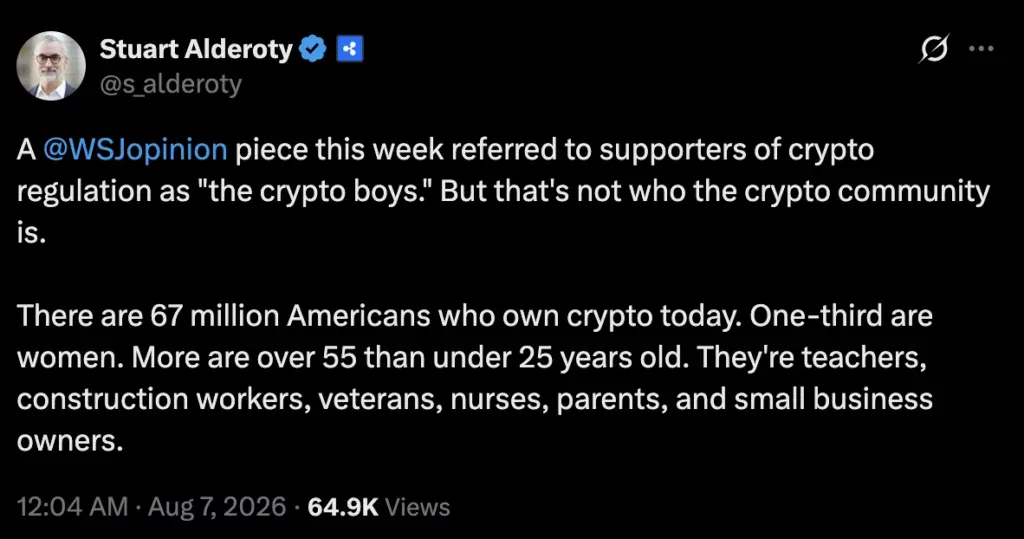
Ripple CLO challenges crypto stereotypes, source: X
You might also like:
Ripple invests in 2 firms to scale XRPL tokenization
Survey data supports a broader crypto demographic
The 67 million estimate comes from the National Cryptocurrency Associations 2026 State of Crypto Holders report, conducted with The Harris Poll. The research surveyed 10,000 U.S. crypto holders between Feb. 12 and March 3 and reported that roughly one in four American adults owns cryptocurrency, up from one in five a year earlier.
The demographic findings are nuanced than the shorthand used in Alderotys post. Among people who first bought crypto in 2025 or 2026, 42% identified as women, compared with 34% among earlier adopters. Meanwhile, 28% of recent purchasers were 55 or older, versus 18% who were between 18 and 24. The report found more than half of holders had household income below $150,000.
Those figures support Alderotys claim that crypto ownership is not confined to one age, gender or profession. However, the report measures people who already hold crypto, and its findings should not be treated as evidence that public opinion toward the industry is equally broad or favorable.
Ripple has a stake in the adoption debate
Alderoty occupies two roles relevant to the argument. He is Ripples chief legal officer and president of the National Cryptocurrency Association. The group launched in March 2025 with a $50 million grant from Ripple and says its mission is to improve crypto education and public understanding across the United States, as detailed in earlier coverage.
That relationship provides context for the surveys use in Washington. The NCA says the 2026 study was conducted with The Harris Poll and carries a 95% confidence level with sampling precision of plus or minus 0.7 percentage points for the surveyed population. Still, the organization is backed by a major crypto company that has advocated for clearer federal rules.
As previously reported, Alderoty made a similar argument in July, saying 67 million holders meant Washington could no longer treat crypto users as a fringe constituency. Ripple has also joined an industry campaign urging Senate leaders to advance the CLARITY Act after months of negotiations.
CLARITY Act fight moves from demographics to policy
The legislation would create a federal digital-asset market structure and clarify how oversight is divided between the Securities and Exchange Commission and Commodity Futures Trading Commission. The Senate Banking Committee advanced the measure 15-9 in May, with two Democrats joining Republicans. Updated merged text was released July 22.
Yet support has become harder to secure. Democratic lawmakers have sought stronger ethics, consumer protection, illicit-finance and market-integrity provisions. Senate Banking Committee Democrats have separately argued in an advisory that parts of the proposal could leave national-security vulnerabilities. Those criticisms remain disputed by Republican sponsors and crypto industry supporters.
The Wall Street Journal editorial that prompted Alderotys response also questioned stablecoin reward provisions and exemptions involving decentralized networks. Blockchain Association CEO Ji Kim rejected parts of that criticism as containing “factual and legal inaccuracies.” The competing arguments show that ownership numbers do not resolve disagreements about how the industry should be regulated.
September becomes the next test for crypto legislation
The political timetable tightened on Aug. 6, when Senate Majority Leader John Thune confirmed that a pre-recess CLARITY Act vote would not happen. He said the measure would be queued when lawmakers return in September, while blaming Democratic resistance for the delay.
That postponement matters because the legislation generally needs 60 votes to invoke cloture and overcome a filibuster before final passage can become realistic. Republicans cannot reach that threshold alone, making Democratic support necessary unless the procedural landscape changes. Ethics provisions and other unresolved sections will therefore remain central during the recess.
For Ripple and Alderoty, the 67 million figure strengthens an advocacy argument that lawmakers are regulating a large and varied constituency. It does not prove that those holders share Ripples preferred policy approach. The next test will come in September, when senators must decide whether negotiations have produced enough bipartisan support to move the CLARITY Act toward a floor vote.