






US-listed spot Bitcoin exchange-traded funds (ETFs) are attracting fresh capital as a high-profile cryptocurrency custody incident puts renewed focus on digital asset security.
Spot Bitcoin ETFs recorded $211.5 million in net inflows on Tuesday, adding to Mondays $170 million, according to data from SoSoValue.
The inflows came as the ongoing Coldcard hack drew attention from analysts, with Galaxy Research estimating that the attack may have affected as many as 7,300 addresses and resulted in about $130 million in suspected Bitcoin (BTC) losses from users of the hardware wallet.
The developments have renewed a long-running debate in crypto over whether institutional custody solutions offered through regulated financial products could become more attractive as investors weigh the risks and responsibilities of self-custody.
Galaxy ETF returns to inflows as Bitcoin funds rebound
BlackRock‘s iShares Bitcoin Trust (IBIT) led the ETF recovery, recording $111 million in inflows on Monday and $170 million on Tuesday, according to Farside Investors data. Fidelity’s Wise Origin Bitcoin Fund (FBTC) followed, adding about $33 million and roughly $20 million on the respective days.
Invesco Galaxy Bitcoin ETF (BTCO) recorded $6.7 million in inflows on Monday, marking its first positive daily flow since July 1. The inflow represented about 3.9% of BTCOs cumulative net inflows of $172 million, according to Farside.
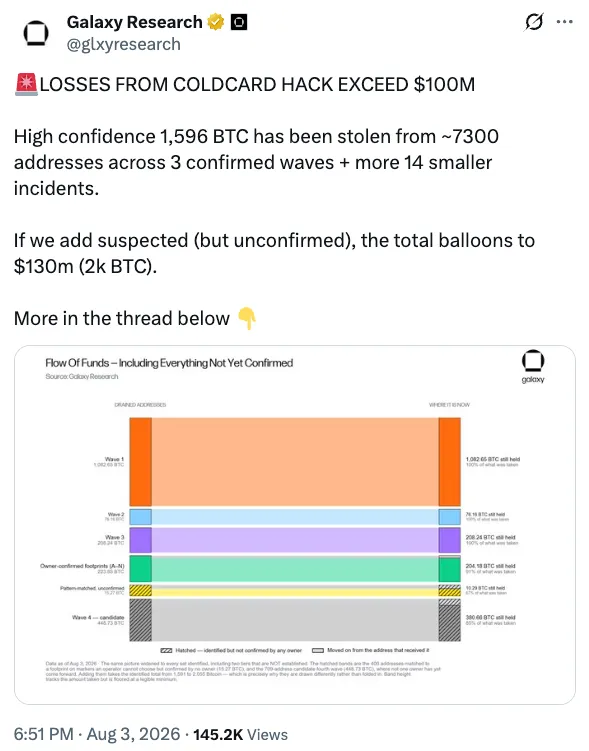
Galaxy Research, the research arm of crypto investment company Galaxy Digital, has emerged as one of the most prominent sources tracking the Coldcard incident. Alex Thorn, Galaxy Digitals head of firmwide research, and his team have regularly published estimates on affected addresses and potential losses linked to the incident.
Coldcard hack gives new weight to Bitcoin ETF custody argument
Eric Balchunas, senior ETF analyst at Bloomberg Intelligence, said the Coldcard hack could encourage greater migration toward Bitcoin ETFs, as investors reconsider the role of institutional custody.
In a post on Tuesday, Balchunas said ETFs reliance on traditional financial institutions to safeguard assets could increasingly be seen as an advantage. He wrote that what was once considered a “bug” by some crypto users may “all the sudden seem like a feature” as investors compare institutional custodians with smaller crypto companies.
Related: Boltz pauses service after wave of AI-assisted hacking attempts
Separately, Balchunas also pointed to broader changes in the ETF market, including the closure of Hashdex‘s spot Bitcoin ETF and BlackRock’s planned reverse split for its Ethereum ETF.
BTC steady as traders weigh custody concerns
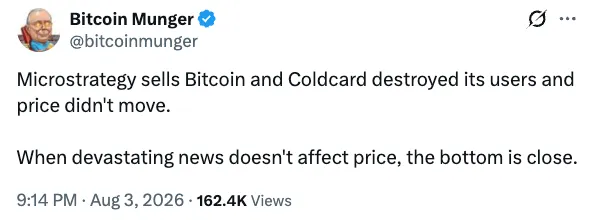
Bitcoin remained relatively stable as traders assessed the Coldcard incident and other sources of selling pressure, including the latest 1,638 BTC sale by Michael Saylors Strategy.
At publishing time, BTC traded at $64,113, down around 0.8% over the past seven days, according to CoinGecko. The assets lowest price during that period fell below $62,500.
Some observers argued that those behind the Coldcard incident may face challenges moving or converting the affected funds because Bitcoin transactions can be publicly tracked. Crypto commentator Shagun wrote in an X post on Sunday that large fund movements would likely attract scrutiny from blockchain researchers, exchanges and other market participants.