Bitcoin closed July with an approximate 7.26% gain (according to Binance data), injecting a much-needed boost of confidence into a market that had remained sluggish for an extended period. However, as the calendar turns to August, a long-standing “curse” in the crypto market begins to resurface — August has historically been one of Bitcoins worst-performing months. As shown below:
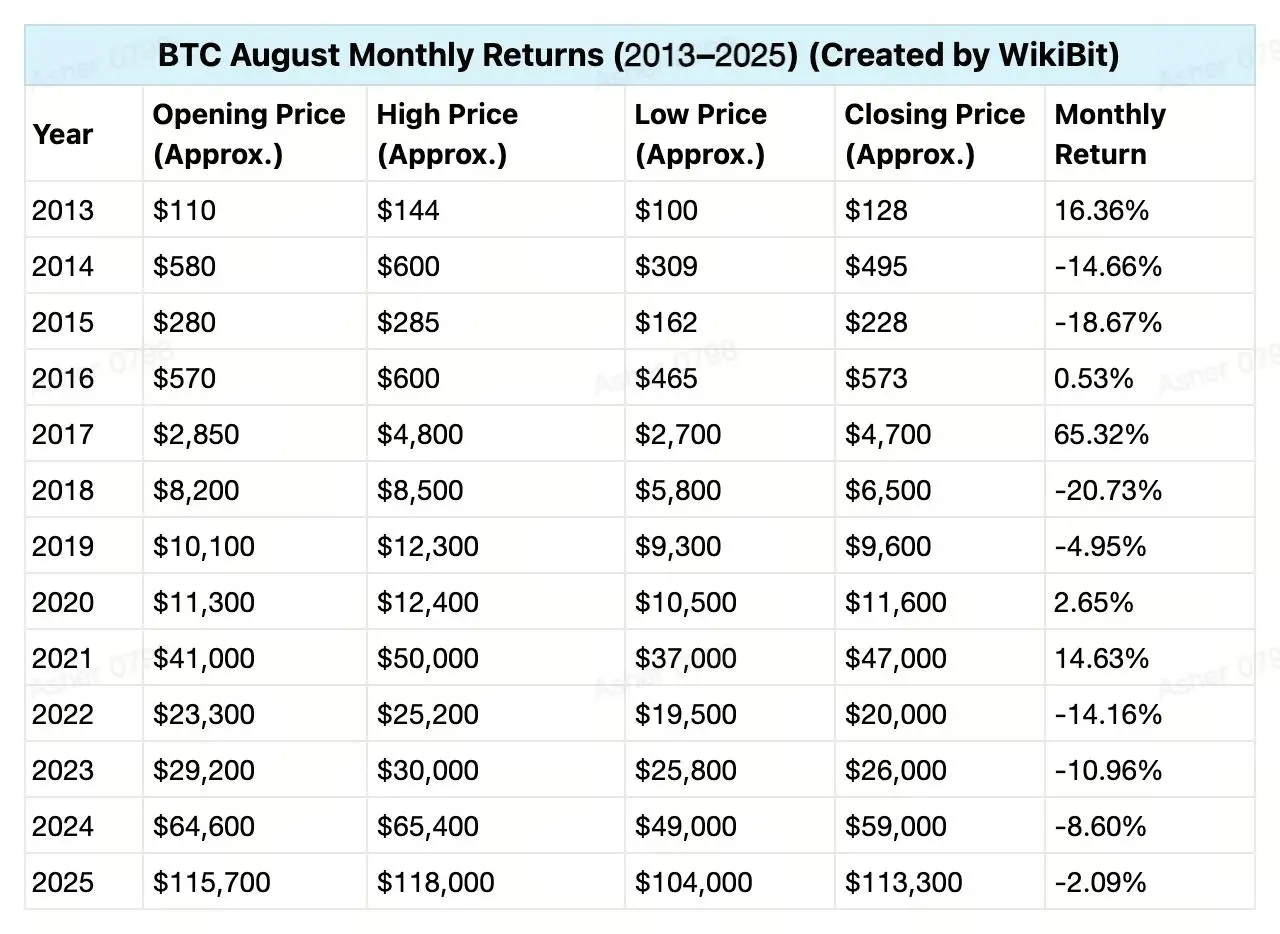
Summary:August has historically been one of Bitcoins weakest-performing months. Over the past 13 years, BTC recorded 5 monthly gains and 8 monthly declines in August. The median return was -6.99%, making August the only month with a negative median return among all calendar months.
Looking back at historical data, July has long been regarded as one of Bitcoin‘s stronger-performing months, often featuring a pattern of an early-month pullback followed by a rapid recovery. However, for investors, the key question is: after July’s rally, will August become a month of profit-taking and market correction?
A market saying that has circulated for years is: “July pumps, August dumps.”
Will this seasonal pattern repeat itself in 2026? Can Bitcoin continue pushing toward new highs, or will it face another round of deep correction?
The more direct question is: By the end of August, will Bitcoin hold above the $50,000 level, or will it fall below $50,000 and slide back into the “$40,000 range”?
This is not simply a game of price levels — it is a comprehensive test of the current market liquidity, macroeconomic policies, and capital structure. Although there is no official Federal Reserve rate decision scheduled in August, it does not mean the market will remain calm. Key economic data ahead of the Feds September meeting — including CPI, PCE inflation data, and Nonfarm Payrolls — as well as the Jackson Hole Economic Policy Symposium, could become major catalysts for market repricing.
Key August Economic Events: The Core Drivers Behind Market Moves
The detailed August Crypto Market Calendar is as follows:
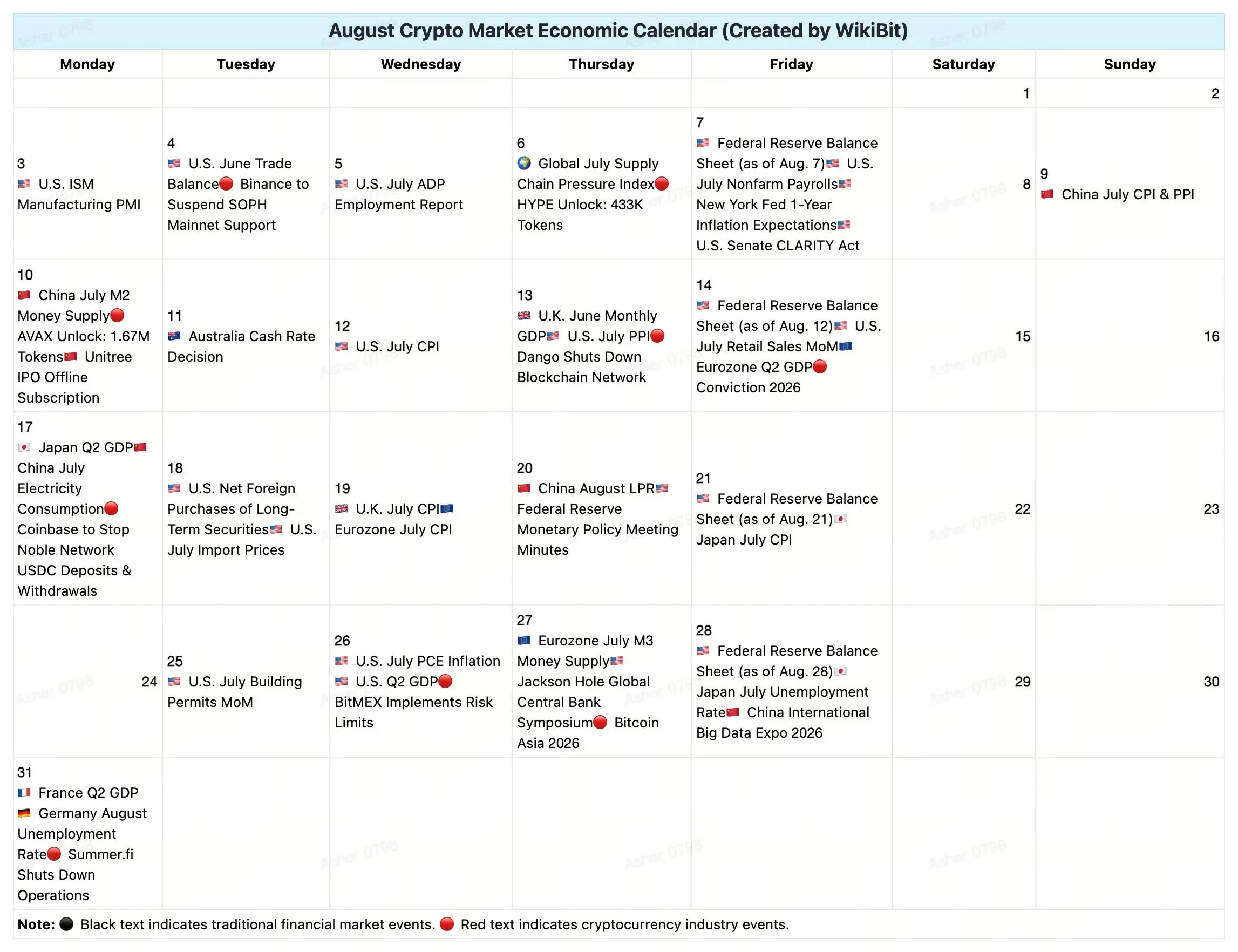
Event 1: August 7 — U.S. July Nonfarm Payrolls Report
On Friday, August 7, at 20:30 (UTC+8), the U.S. Bureau of Labor Statistics will release the July Nonfarm Payrolls (NFP) report. The market generally expects July job growth to come in at around 83,000–90,000 new jobs, while the unemployment rate is forecast to rise from 4.2% to 4.3%.
The most likely scenario is that the data comes in line with expectations, with job gains of around 80,000–90,000. This would reinforce the “soft landing” narrative, leading to a relatively mild market reaction. Bitcoin could continue consolidating within the $60,000–$66,000 range.
The second most likely scenario is a stronger-than-expected labor market, with job creation significantly exceeding the forecast of 80,000–90,000. This would be negative for Bitcoin, as concerns over prolonged higher interest rates could intensify. According to current CME data, the market is pricing in a 64.5% probability of a 25-basis-point rate hike by the Federal Reserve in September. If the employment data significantly beats expectations, Bitcoin could fall below the $60,000 support level.
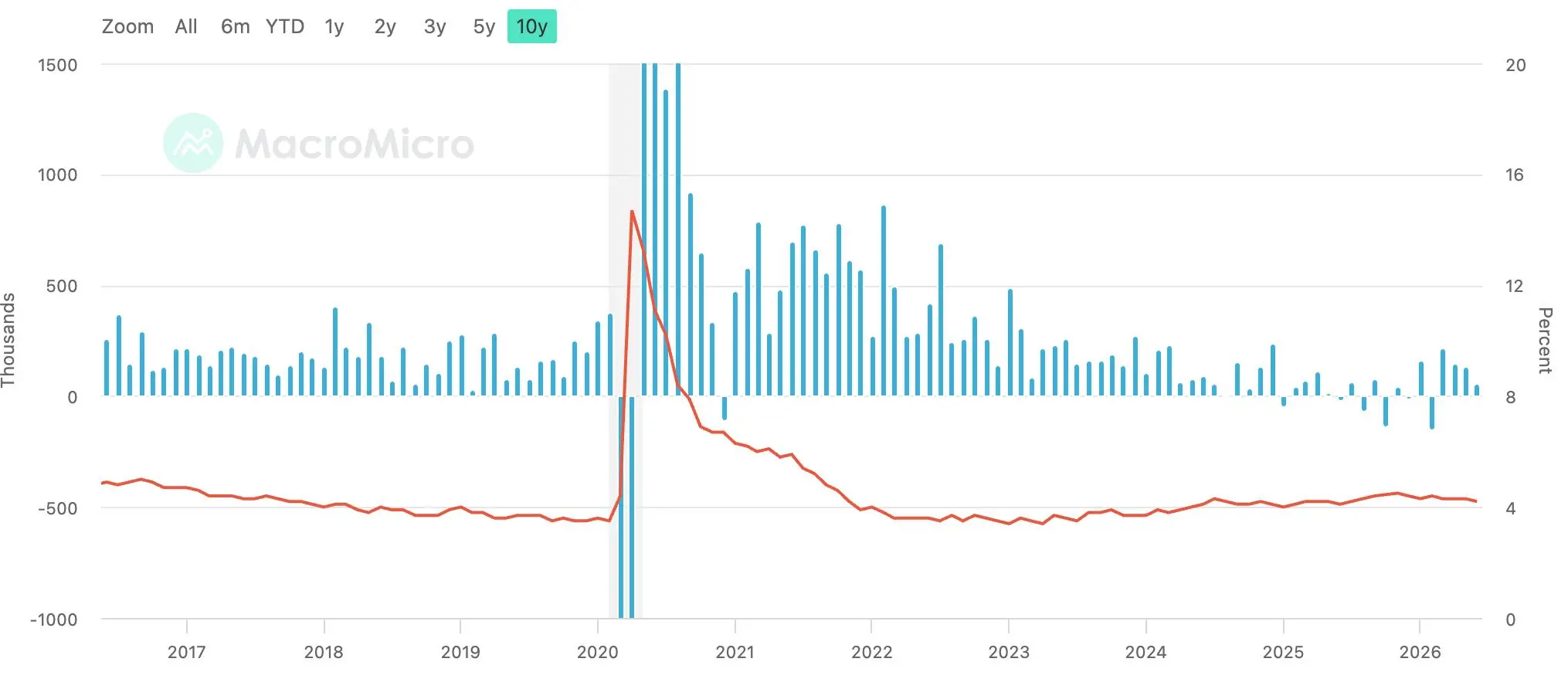
U.S. Nonfarm Payrolls Data Over the Past 10 Years (Source: MacroMicro)
The employment data released on June 6 this year, covering May, showed 172,000 new jobs added, more than double the market expectation of 85,000. This triggered a sharp 15% drop in Bitcoin, highlighting the need to pay close attention to the possibility of a similar scenario occurring again.
The low-probability scenario is a significant deterioration in the labor market, with job growth falling below 60,000. This would be positive for Bitcoin, potentially allowing BTC to retest the $66,000 resistance level and even challenge the region around $70,000.
Event 2: August 12 — U.S. July CPI Data
On Wednesday, August 12, at 20:30 (UTC+8), the U.S. Bureau of Labor Statistics will release the July Consumer Price Index (CPI) report. This will be the market‘s second major inflation update following June’s “historic” cooling in CPI data.
The most likely scenario is: a moderate decline in inflation, but with month-over-month CPI growth returning to positive territory.
According to forecasts from major institutions, July headline CPI is expected to remain around 3.5% year-over-year, roughly unchanged from June. Core CPI is also expected to stay near 2.6% year-over-year.
However, from a month-over-month perspective, July inflation is likely to turn positive again. The sharp 0.4% monthly decline in June CPI was largely driven by a 5.7% single-month plunge in energy prices. However, the recent U.S.-Iran tensions at the beginning of July pushed oil prices higher again, meaning this “one-time benefit” has disappeared.
If WTI crude oil prices do not rebound sharply, inflation could continue cooling in August and September, providing further support for expectations of future Fed policy easing.
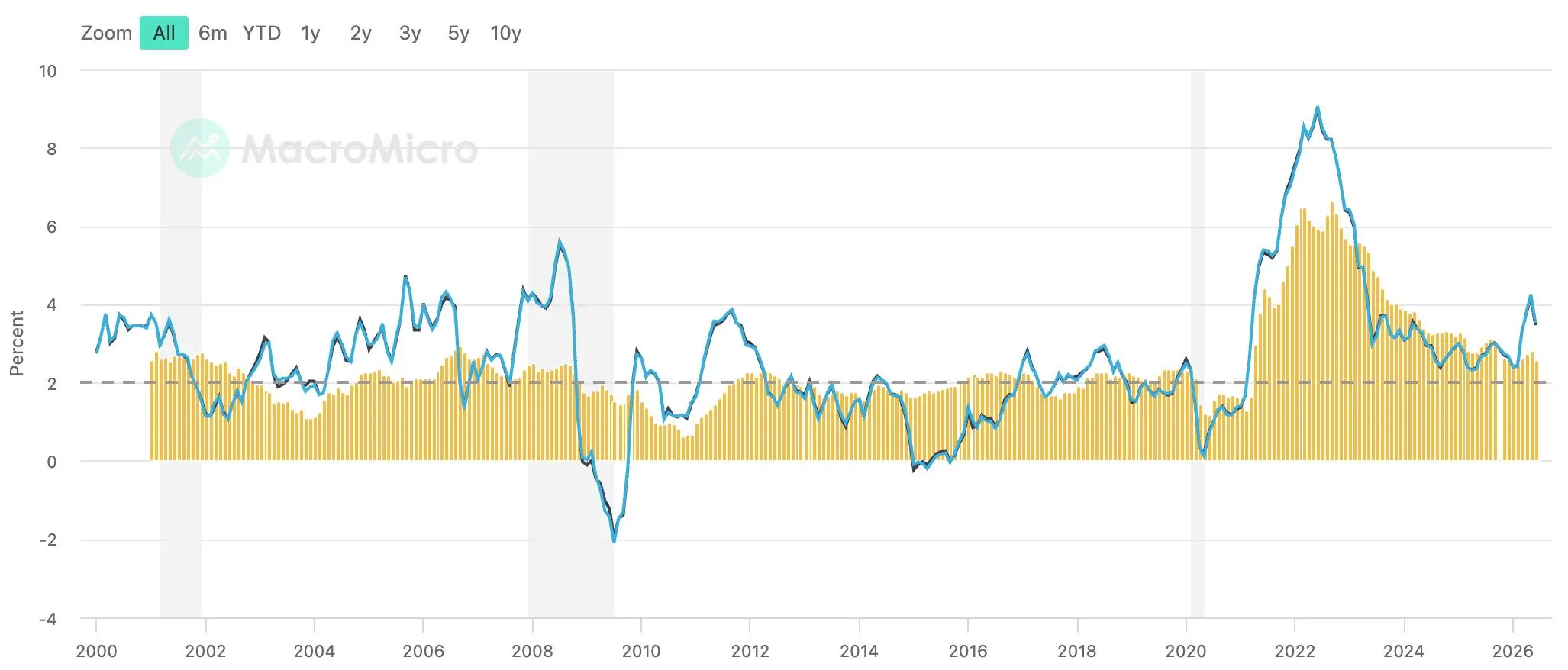
U.S. CPI Data Since 2000 (Source: MacroMicro)
In simple terms: year-over-year inflation may slightly decline or remain stable, while month-over-month CPI could rebound slightly, meaning the pace of inflation cooling is slowing.
If the data comes in line with expectations (headline CPI at 3.4%–3.5% YoY, core CPI around 2.6%), it would indicate that inflation continues to cool but at a slower pace. The market would likely interpret this as confirmation that the “soft landing” scenario remains intact, strengthening expectations that the Federal Reserve may maintain current interest rates in September. Bitcoin could experience short-term volatility but remain range-bound.
A stronger-than-expected cooling in inflation (headline CPI below 3.3%, core CPI below 2.5%) would be bullish for Bitcoin. Conversely, a hotter-than-expected rebound (headline CPI above 3.6%, core CPI above 2.8%) would be negative for Bitcoin.
Event 3: August 19 — Federal Reserve Meeting Minutes
At 2:00 AM Beijing Time on Thursday, August 19, the Federal Reserve will release the detailed minutes from the July 29–30 FOMC meeting. Investors will focus on three key areas:
1. What did the three dissenting “hawkish” officials argue?
The July meeting resulted in a 9–3 vote to keep interest rates unchanged. Three regional Fed presidents dissented and called for an immediate 25-basis-point rate hike. This was the Feds most divided meeting in nearly a decade. The minutes will reveal why these officials strongly supported further tightening.
2. How “dovish” is the majority camp?
The majority, led by Chair Powell, chose to remain patient and continue monitoring economic data. However, the minutes will provide more insight into their true views on inflation and employment — whether they genuinely believe inflation is continuing to cool, or whether they remain uncertain about the outlook.
3. What is the “threshold” for a September rate hike?
The minutes may reveal what conditions would need to be met for the majority of Fed officials to shift toward supporting another rate hike. This will directly influence the direction of the September 15–16 FOMC meeting.
The market is currently pricing in roughly a 60% probability of a September rate hike. The hawkish or dovish tone of the minutes could significantly change this probability:
- Hawkish minutes (more officials supporting further rate hikes): Bitcoin could continue declining.
- Dovish minutes (the majority emphasizing patience and waiting for more data): Bitcoin could see a rebound.
Event 4: August 26 — U.S. July PCE Inflation Data
The U.S. Bureau of Economic Analysis (BEA) will release the July Personal Consumption Expenditures (PCE) Price Index at 20:30 Beijing Time on Wednesday, August 26.
PCE is the Federal Reserve‘s preferred inflation gauge. In June 2026, U.S. core PCE inflation increased 3.3% year-over-year, remaining above the Fed’s 2% inflation target for 64 consecutive months.
Whether July PCE can continue the cooling trend will directly influence market expectations for the probability of a September rate hike and could become a key driver for Bitcoins next major move.
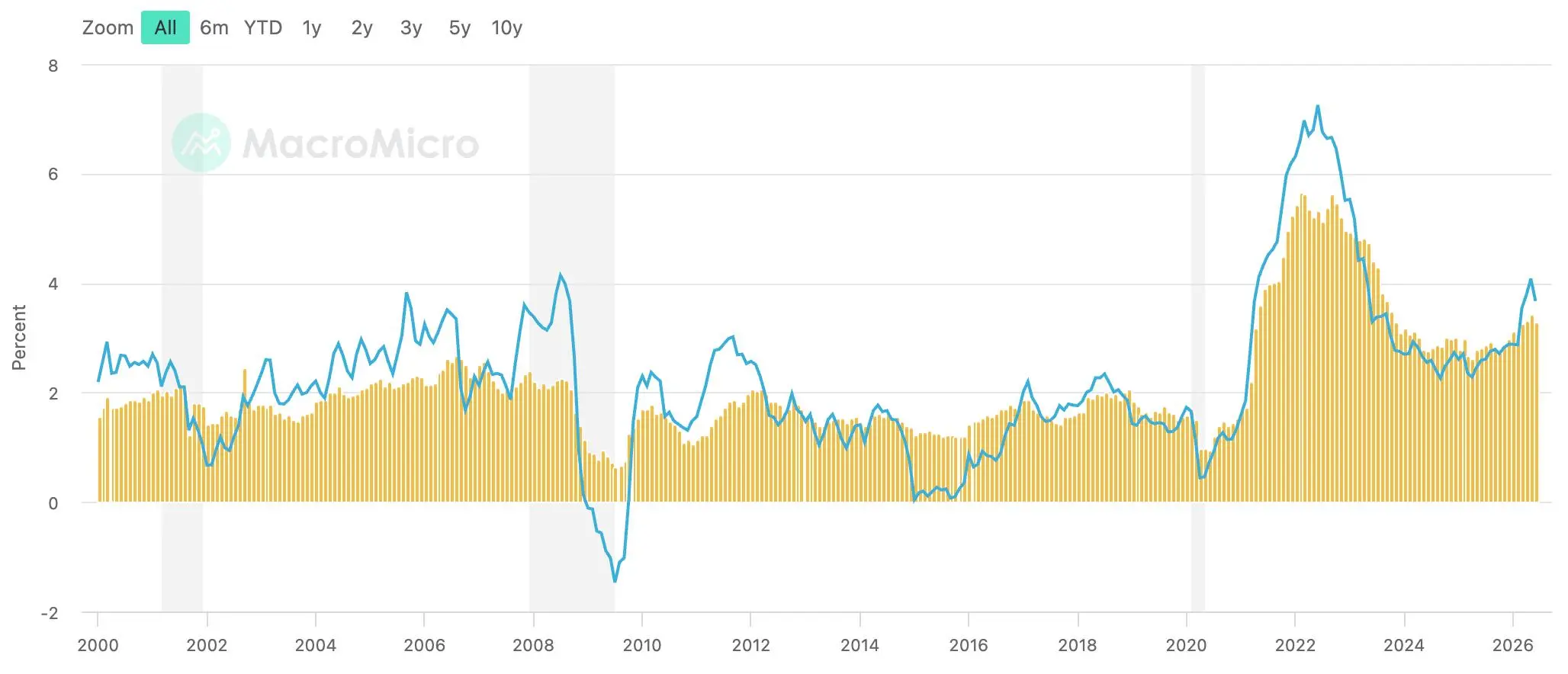
U.S. PCE Data Since 2000 (Source: MacroMicro)
Scenario 1: Core PCE Meets Expectations (YoY 3.2%–3.3%) — Most Likely
If July core PCE declines slightly from Junes 3.3%, in line with market consensus expectations, the marginal improvement in inflation would provide additional support for the Federal Reserve to maintain its current interest rate policy.
The market reaction would likely be relatively mild, with Bitcoin potentially continuing to consolidate within its current trading range.
Scenario 2: Core PCE Comes in Above Expectations (YoY ≥3.4%)
If inflation proves to be more persistent than expected, it would suggest that monetary tightening has not yet effectively contained price pressures.
Markets would likely quickly increase expectations for further rate hikes, pushing the U.S. dollar and Treasury yields higher, while Bitcoin and other risk assets could face short-term selling pressure.
Scenario 3: Core PCE Comes in Below Expectations (YoY ≤3.1%)
A lower-than-expected PCE reading would send a stronger-than-expected dovish signal.
Following the release of PCE data, Bitcoin has historically tended to show a pattern of “cooling inflation → market rebound”, as investors price in the possibility of looser monetary conditions.
Event 5: August 27–29 — Jackson Hole Global Central Bank Symposium
The Jackson Hole Economic Policy Symposium, hosted by the Federal Reserve Bank of Kansas City, will take place from August 27–29 in Jackson Hole, Wyoming. The annual event is one of the most closely watched gatherings for global central banks.
This years theme is “Financial Innovation: Implications for Payments and Policy.” Federal Reserve Chair Waller is scheduled to deliver a keynote speech on August 28. Investors should focus on three key points:
1. What will Waller say in his first Jackson Hole appearance?
This will be Wallers first Jackson Hole speech since taking over as Fed Chair in May.
The key question for markets is whether Waller will signal support for a September rate hike, or whether he will continue to advocate a wait-and-see approach.
2. How unclear is the “clear target, uncertain path” approach?
Morgan Stanley noted that Waller has deliberately adopted a communication strategy focused on emphasizing:
Persistent inflation risks;
The Feds 2% inflation target;
Maintaining market confidence;
while avoiding specific guidance on the policy path.
He has moved away from traditional forward guidance, leaving markets to interpret each economic data release independently. Investors will watch whether this speech provides a clearer picture of the Feds reaction function.
3. Could a September rate hike exceed expectations?
The July FOMC meeting resulted in a 9–3 vote to keep rates unchanged, which markets interpreted as a “hawkish pause.”
Currently, markets have largely priced in a 25-basis-point rate hike in September.
If Waller suggests at Jackson Hole that the Fed could deliver more than a 25-basis-point increase, or pursue a more aggressive tightening path, it could become a true “black swan” event for markets.
Crypto Industry Events: Unlocks on One Side, Airdrops on the Other
1. Major Crypto Industry Events in August
August 4,Binance ends support for the Sophon (SOPH) mainnet
August 13,Dango shuts down its Layer 1 blockchain
August 17,Coinbase suspends USDC deposits and withdrawals on the Noble network
August 31,Summer.fi officially shuts down — the final chapter following a $6.1 million hack
The accelerating pace of industry consolidation is becoming increasingly evident.
From Dango shutting down less than four months after launching its mainnet, to Summer.fi ending seven years of operations following a $6.1 million exploit, and Sophon abandoning its independent Layer 2 strategy in favor of Base, these cases point to a broader trend:
The crypto industrys “bubble cleanup” process is still ongoing, with projects lacking real users and sustainable business models gradually being eliminated.
2. August Token Unlocks: A Supply Wave Arrives
According to Tokenomist data, the total value of cryptocurrency token unlocks in August 2026 is estimated at approximately $323 million, involving 141 blockchain projects.
Key token unlock projects are listed below:
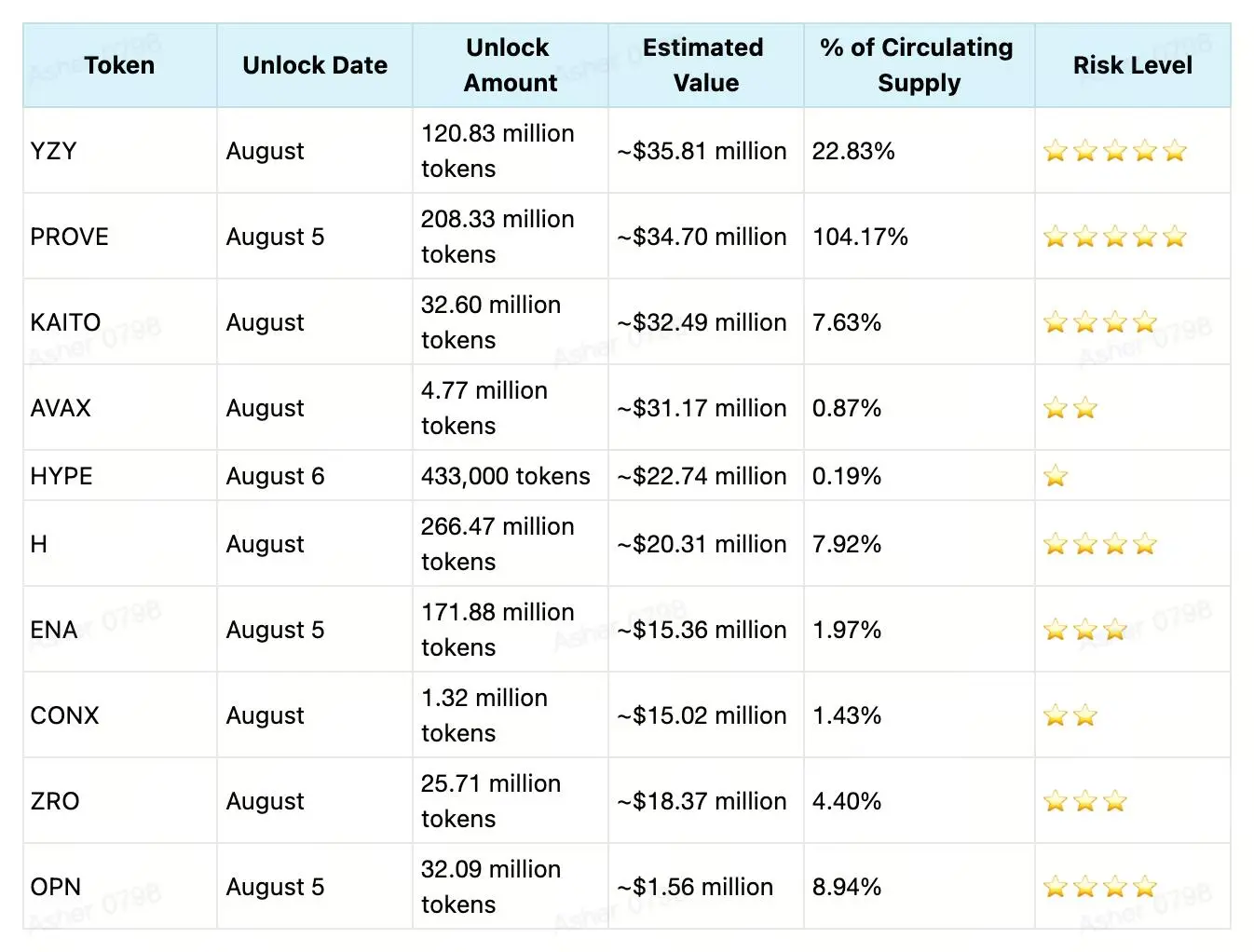
Data Source: Tokenomist
In addition to the above one-time token unlocks, August will also see a large number of daily linear unlocks, with the major projects listed below:
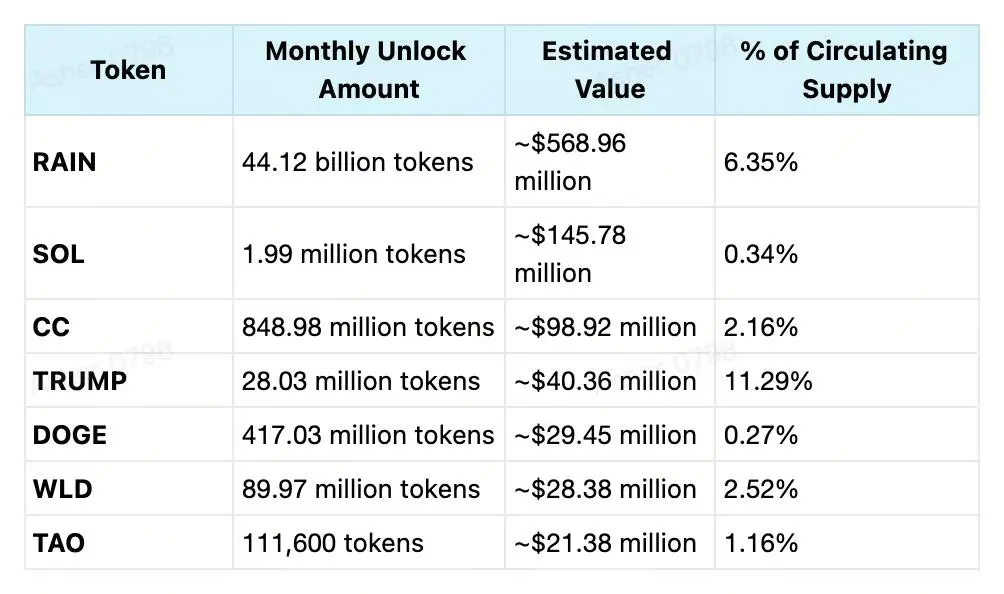
Data Source: Tokenomist
Summary:
First, the real risk lies not in the absolute unlock value, but in the percentage of circulating supply affected.Large supply releases such as PROVE‘s 104% circulating supply unlock, YZY’s 93% market capitalization unlock, and TRUMP‘s 11.29% circulating supply unlock represent genuine “supply shocks.” In comparison, HYPE’s 0.19% unlock may create significant attention but has relatively limited actual market impact.
Second, actual selling pressure is often lower than theoretical estimates.HYPEs historically low claim rate demonstrates that a token unlock announcement does not necessarily translate into immediate selling pressure. The actual impact depends largely on the destination of unlocked tokens — whether they are allocated to contributors, investors, or ecosystem funds — as well as the willingness of recipients to continue holding.
Third, August marks the third consecutive month of declining unlock volumes.The total unlock value has decreased from $580 million in June to $376 million in July, and then to $323 million in August, indicating that the peak unlock pressure is gradually fading.
However, even with the decline, an additional $323 million in token supply entering the market during Augusts tightening liquidity environment remains a pressure factor that cannot be ignored.
3. August Airdrop Opportunities: Capturing the “Free Lunch”
Overview of Key Airdrop Opportunities
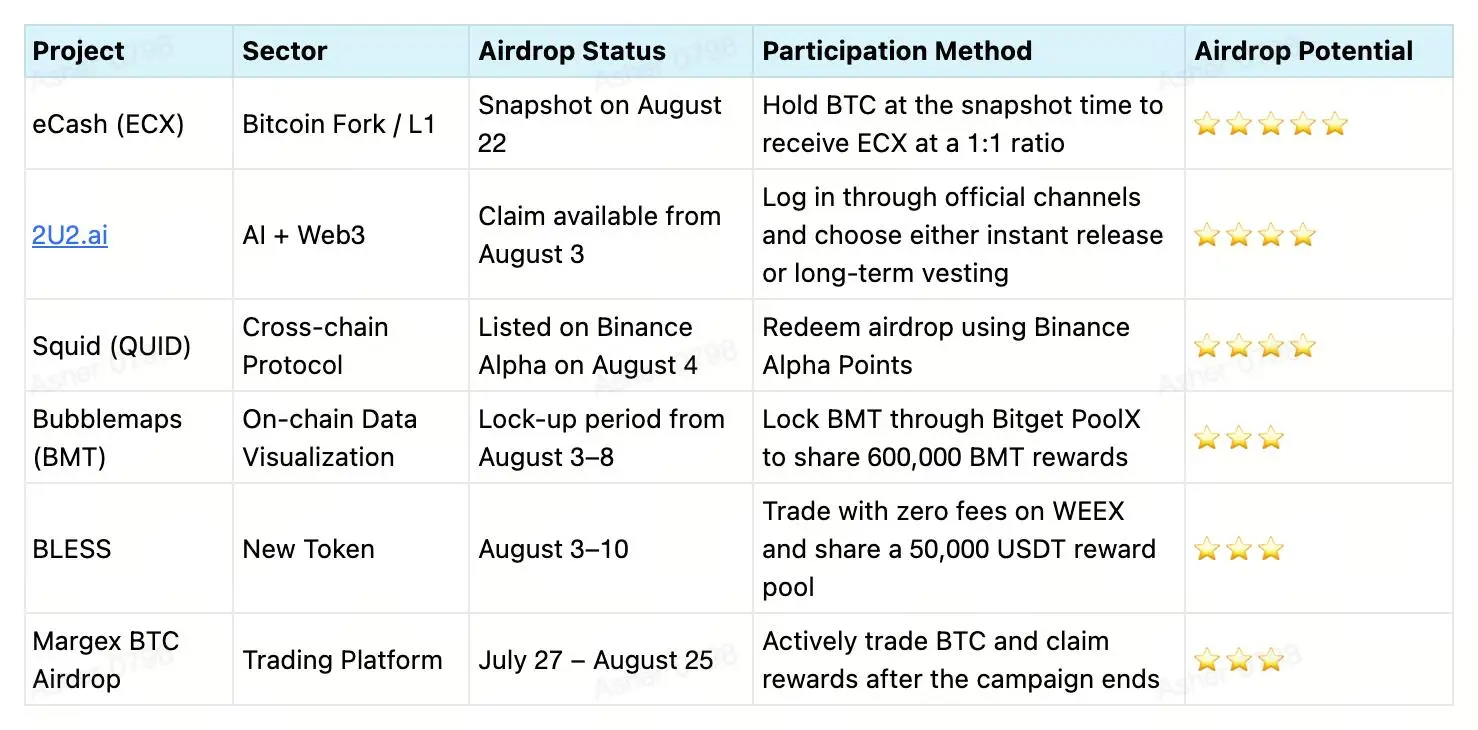
Risk Warning:Although airdrops are “free,” investors should still remain aware of project risks. The level of community support for the eCash hard fork remains uncertain. Newly listed tokens often experience extreme price volatility, and users should independently determine the optimal timing for selling after claiming rewards.
Investors are advised to focus primarily on preparing for the eCash BTC holding snapshot, as this represents the airdrop opportunity with the highest level of certainty.
Will the “July Up, August Down” Curse Return? Will Bitcoin Really Start with a “4”?
Historical data appears to support the “curse.” As mentioned above, over the past 13 years, Bitcoin has recorded 8 declines and 5 gains in August. August has been one of Bitcoins weakest-performing months, with a median return of -6.99%, making it the only month with a negative median return among all calendar months.
What is even more concerning for bulls is that from 2022 to 2025, Bitcoin suffered losses in August for four consecutive years, with an average decline of approximately 10%.
In July 2026, Bitcoin ended the month with a gain of around 7.26%, perfectly matching the historical “July rally” pattern. The next question is:
Will the “August decline” pattern arrive as expected?
The biggest argument supporting the “curse” is the looming risk of higher interest rates.
The July Federal Reserve meeting revealed a significant 9–3 split, with three regional Fed presidents voting in favor of a rate hike. This marked the largest number of dissenting votes at a Fed meeting in a decade.
Currently, markets are pricing in a 60%–68% probability of a September rate hike. If either the August 7 Nonfarm Payrolls report or the August 12 CPI data comes in significantly hotter than expected, the probability of a rate hike could rise toward 80%.
Under a prolonged high-interest-rate environment, Bitcoin could face continued downside pressure.
From a market perspective, profit-taking pressure is also worth watching.
After July‘s rally, some investors may choose to reduce positions and lock in profits while waiting for clearer signals from the Fed’s September policy meeting.
Meanwhile, August is traditionally the summer holiday season in Europe and the United States, causing institutional traders to reduce activity and leading to lower market liquidity.
In a low-liquidity environment, any unexpected economic data can trigger sharp price swings — and historical patterns suggest these moves are often skewed toward the downside.
The broader crypto market environment remains challenging.
Looking at the current market backdrop, the crypto industry has remained in a prolonged downturn for more than half a year. The ongoing bear market has forced many industry participants to exit, potentially creating a domino effect.
In July, the shutdowns of long-established exchanges such as BitMEX and BitMart became symbolic events highlighting the industrys ongoing consolidation.
According to publicly available data, during the first half of 2026 alone, approximately 70 crypto projects announced shutdowns, filed for bankruptcy, or ceased operations, and the number continues to rise.
It can be said that 2026 has become one of the most concentrated years for crypto project shutdowns in the industrys history.
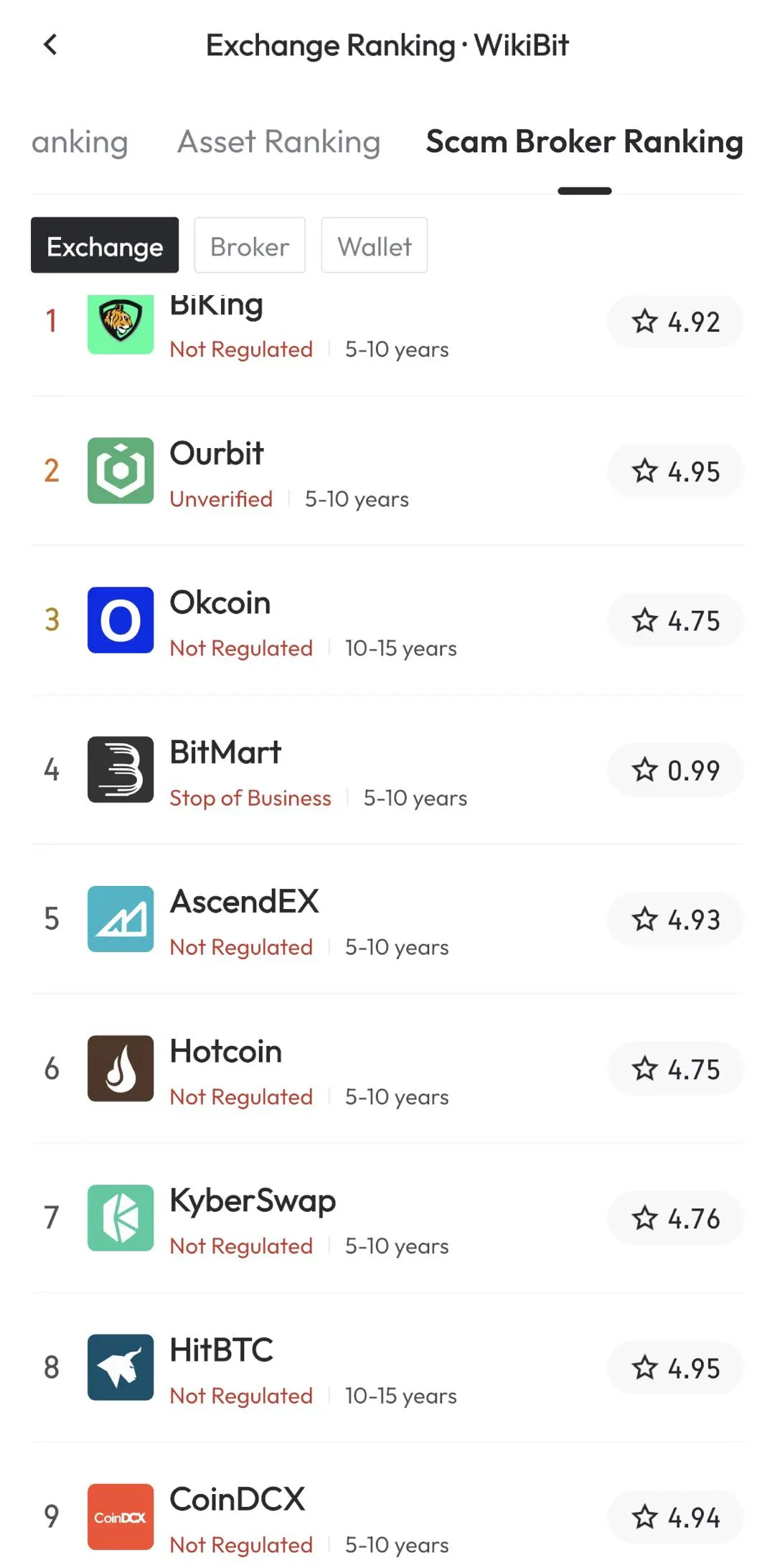
Risk Exchange Ranking (Source: WikiBit)
Of course, despite the significant headwinds, the “July Up, August Down” curse is not an absolute rule. The three major variables that could break this pattern are:
Whether August economic data such as Nonfarm Payrolls, CPI, and PCE show unexpected cooling;
Whether Fed Chair Waller delivers a dovish signal at the Jackson Hole Symposium;
Whether the “extreme fear” contrarian indicator takes effect.
Currently, market sentiment is in the extreme fear zone. Historically, such conditions have often marked temporary market bottoms. If Bitcoin can hold above the $60,000 level in August, a rebound could emerge in September.
Worst-Case Scenario: Multiple Negative Factors Combine
The worst-case outcome would be a combination of several bearish catalysts:
July Nonfarm Payrolls significantly exceed expectations (>150,000 jobs added);
July CPI rebounds sharply (>3.6% YoY);
Waller clearly signals a September rate hike or even a more aggressive tightening approach at Jackson Hole.
Under this scenario, Bitcoin could potentially fall toward the $40,000–$46,000 range. While the probability of this outcome is relatively low in the short term, it cannot be completely ruled out.
According to Galaxy Researchs bottom-monitoring framework released in June, only 4 out of 13 indicators have fully triggered bottom signals, 2 indicators partially meet bottom conditions, while the remaining 7 indicators have not yet been activated. The neutral baseline bottom estimate also points to the $40,000–$46,000 range.
Base Scenario: Mixed Economic Signals
If August data delivers mixed signals — for example:
Nonfarm Payrolls meet expectations;
CPI is slightly hotter than expected;
Fed meeting minutes remain hawkish;
Wallers comments remain ambiguous;
Bitcoin could potentially test the $50,000–$57,000 range. This scenario currently appears more likely.
Overall Outlook
Overall, the probability of the August decline pattern returning in 2026 remains relatively high. However:
The “$50,000 range” is likely to serve as Bitcoins bottom zone in August;
The “$40,000 range” represents a lower-probability but higher-impact scenario.
The real answer will not come from any analysts forecast, but from every economic data release and every policy speech throughout August.
ConclusionFor investors, the best strategy for August can be summarized in four words:
Stay Light, Stay Alert.
Stay light — not because of a bearish outlook, but to preserve capital and have the ability to buy the dip if Bitcoin enters the $50,000 or even $40,000 range.
Stay alert — not to encourage excessive trading, but to respond quickly when major economic data and policy signals are released.
Remember:
Augusts market is not testing how much money you can make — it is testing whether you can survive.
The answer is being shaped on August 7, August 12, August 19, August 26, and August 28 — through every economic report and every policy speech.
All we can do is fasten our seat belts before the storm arrives.
Disclaimer:The information provided in this article does not constitute investment advice. Please conduct thorough research, evaluate market conditions independently, consider multiple sources of information, and make your own investment decisions.