






US spot Bitcoin exchange-traded funds (ETFs) recorded about $6.34 billion in net inflows in the third quarter, marking their strongest quarter of 2026 as Bitcoin rebounded from the first half.
The funds closed September with $2.65 billion in net inflows, down around 25% from $3.52 billion in August and following $172 million in July, according to SoSoValue data.
The quarterly flows reversed about $5 billion in net outflows recorded in the second quarter. Bitcoin gained 42.71% in the third quarter, its strongest quarterly gain since Q4 2024 and its best third-quarter performance since 2017, according to CoinGlass.
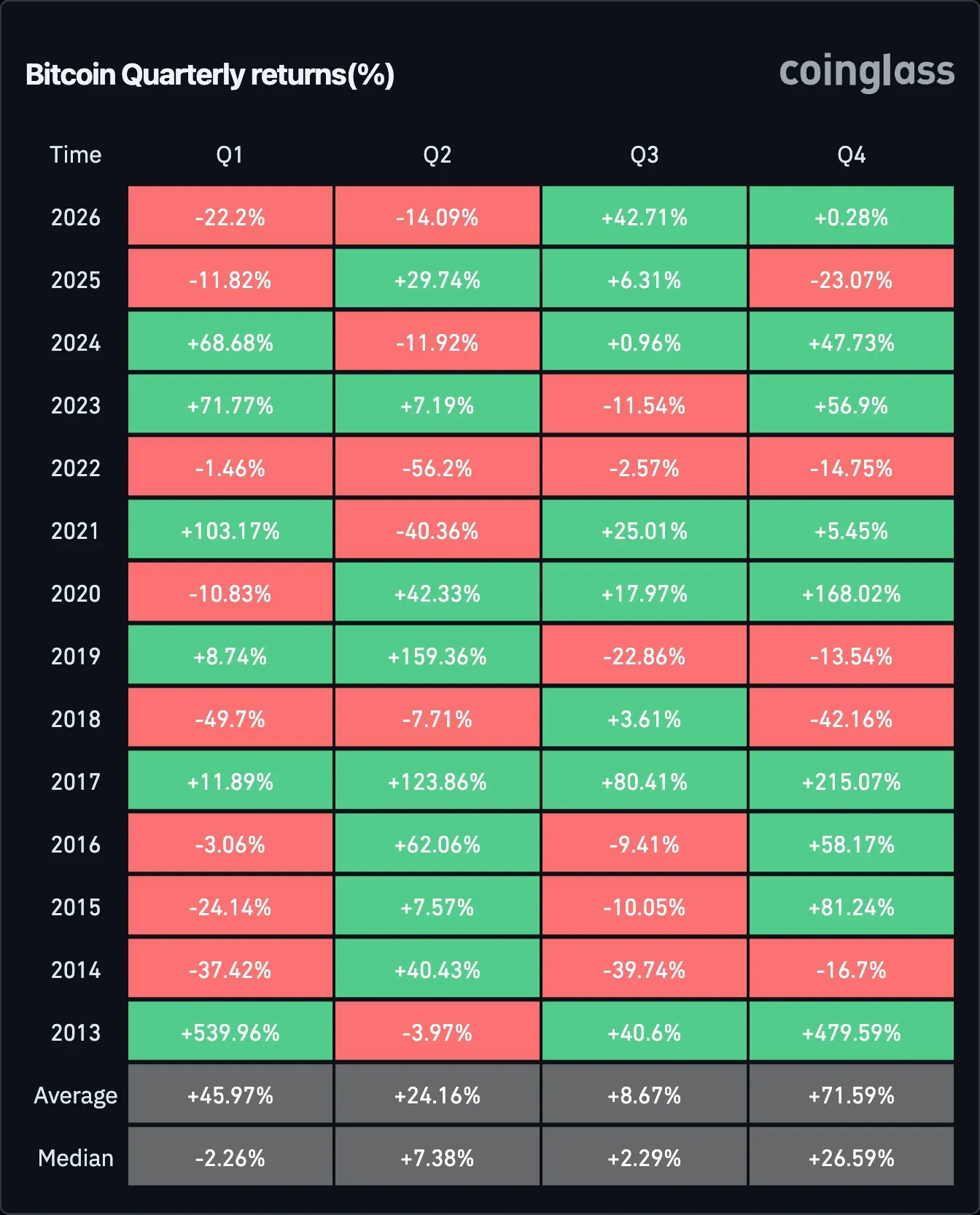
Bitcoin quarterly returns. Source: CoinGlass
September inflows ended on a weaker note, with Bitcoin ETFs recording roughly $149 million in net outflows on Wednesday, snapping a nine-day inflow streak that attracted about $3.1 billion.
US spot Ether ETFs attracted about $3.05 billion in Q3 after roughly $714 million in net outflows in Q2, while Ether gained about 71% during the quarter.
Among other altcoin funds, XRP ETFs attracted $308 million in Q3, lifting cumulative net inflows to $1.79 billion. Solana and Zcash ETFs also recorded net inflows in September, drawing $272 million and $246 million, respectively.
Related: Altcoin exchange deposit count jumps 160% in 2 weeks