






Yield-bearing stablecoin supply fell by more than $3.5 billion in the second quarter of 2026, reversing nearly three years of quarterly growth as crypto-native products contracted and Treasury-backed tokens expanded.
Crypto exchange CEX.IO reported Thursday that the category declined by 15% during Q2. Ethena‘s sUSDe lost 52% of its supply, shedding nearly $2 billion, while Sky’s sUSDS declined by 16%.
Treasury-backed products moved in the opposite direction. BlackRocks BUIDL grew by 2%, Circle's USYC increased by nearly 16% and Ondo Finance's USDY rose by over 66%, highlighting a widening divide between crypto-native yield assets and products backed by traditional assets.
The divergence came as the broader stablecoin market recorded its first quarterly contraction since the third quarter of 2023, according to CEX.io. Total supply fell to $312 billion in Q2, while adjusted transaction volume declined by 5.5%.
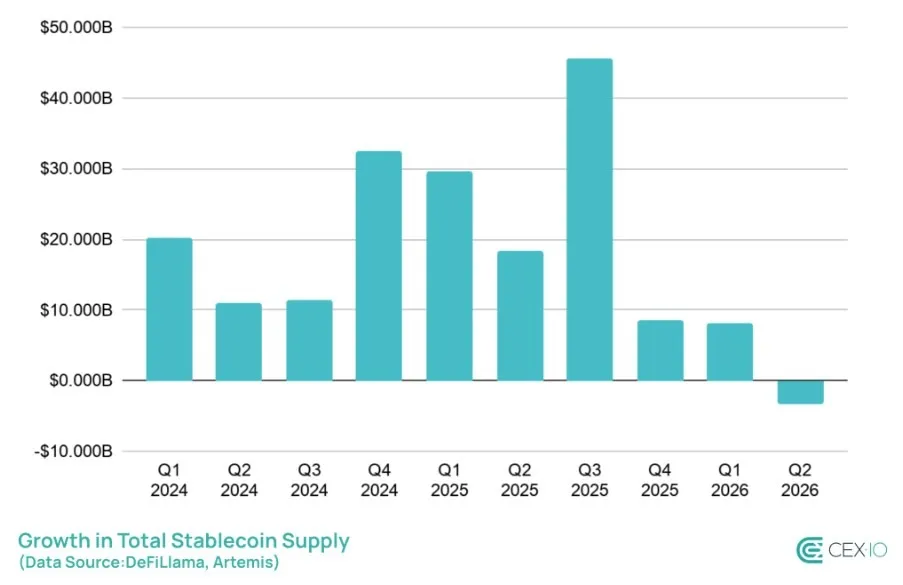
Supply growth per quarter, compiled by CEX.io. Source: CEX.io
Stablecoin slowdown deepens after weaker Q1 signals
The Q2 decline marks a sharp reversal from the start of 2026. In Q1, stablecoin supply increased by about $8 billion to a record $315 billion, with yield-bearing products among the main growth drivers.
However, signs of weakening organic demand had already emerged early in the year. During the first quarter, retail-sized transfers fell by 16%, while automated activity accounted for roughly 76% of stablecoin transaction volume.
The slowdown continued through Q2. According to CEX.io, total stablecoin transaction counts fell by 530 million to 4.48 billion, the largest quarterly decline on record. However, transfers below $250 increased by 5% to $19.39 billion, suggesting that smaller peer-to-peer payments were more resilient than larger automated and trading flows.
Contraction comes amid weaker crypto market activity
The stablecoin contraction also adds to broader concerns about weakening activity across crypto markets. On Wednesday, institutional data provider Talos identified declining stablecoin supply alongside spot Bitcoin (BTC) exchange-traded fund (ETF) outflows and slower Bitcoin purchases by Strategy as three key demand channels that weakened in Q2.
Tanay Ved, senior research associate at Talos, told Cointelegraph that a recovery in stablecoin supply would signal “fresh capital coming back into the ecosystem more broadly” and help support onchain liquidity.
Ved said spot ETF flows remain the most important demand channel to watch because they tend to reflect more durable shifts in institutional appetite. However, he added that ETF flows, corporate Bitcoin purchases and stablecoin supply often move together when market momentum changes.