






In August 2026, the crypto world was thrown into chaos.
The worlds largest cryptocurrency exchange, Binance, filed a lawsuit against the three co-founders of leading crypto payment card company RedotPay in Hong Kong, seeking $472.8 million in damages. At the same time, Binance launched another legal action in Singapore against entities affiliated with RedotPay, with the hearing having concluded this morning.
On one side is Binance, the world‘s largest crypto exchange. On the other side is RedotPay, a rising star in Hong Kong’s stablecoin payment sector, widely known in the crypto community as the “Little Red Card”.
This is not an ordinary business dispute. In its lawsuit, Binance used a highly serious term: “fraudulent scheme.”
And at the center of this battle lies a question that every crypto user should pay attention to:
In the crypto world, who really owns the users?
A $470 Million “Revenge of the Ex” Saga: Two Agreements, Two “Betrayals”?
The story begins three years ago...
In 2023, Visa stopped issuing Binance-branded cards in Europe, followed by Mastercard announcing the termination of its partnership with Binance. Binance‘s card service was gone, but users’ demand for spending crypto assets remained.
That was when RedotPay entered the scene.
Its product was simple: a crypto debit card connected to the Visa network. Users could deposit USDT, BTC, and other crypto assets, then use the card for payments and cash withdrawals worldwide, or even link it to Apple Pay.
Within the crypto community, it became known as the “Little Red Card.”

RedotPay Physical Card
In November 2023, the two parties reached a partnership agreement: Binance opened up its user traffic and payment network to RedotPay, while RedotPay helped Binance expand crypto payment scenarios to a wider range of retail merchants. Each side got what it needed — at least on the surface, it looked like a win-win partnership.
But less than six months after the partnership began, problems emerged.
The original agreement only allowed Binance users to conduct crypto-to-fiat conversions, in-app transfers, and other operations on the RedotPay platform. However, RedotPay allegedly began quietly allowing users to directly deposit funds from Binance Pay into their RedotPay cards.
To put it simply: imagine WeChat opened its payment interface to an e-commerce platform. The agreement was that users could only use WeChat Pay to complete purchases on that platform. But the platform secretly added a hidden channel in the backend — allowing users to directly transfer money into its own wallet, effectively diverting WeChats users and funds into its own ecosystem.
That became the reason the first partnership broke down.
In March 2025, the two sides signed a new agreement. This time, Binance made sure everything was clearly written in black and white: Binance Pay funds had to remain completely segregated and could only be used for fiat conversions, in-app transfers, and purchases of RedotPay-branded products — they could never be used to top up RedotPay cards.
RedotPay promised that this time it would strictly maintain fund segregation.
But how could a promise from someone who had already “cheated once” be trusted?!
In March 2026, Binance discovered that RedotPay was still allowing — and even encouraging — users to use Binance Pay funds to top up RedotPay cards. The funds were never truly segregated.
Binance did the math: through this channel, RedotPay obtained approximately $304 million in user funds from Binance Pay.
What angered Binance even more was that more than 470,000 users who originally belonged to Binance Card were redirected to RedotPay.
Binance estimated the lifetime value (LTV) of each user at $925:
470,000 × $925 = $472.8 million.
On April 3, 2026, Binance completely shut down the partnership channel, marking the end of the second attempt at cooperation.
Four months later, a lawsuit was filed against RedotPays three co-founders: Gao Zhangpeng, Chan Wa Choi, and Yao Chao.
RedotPay Handed Over Its Own “Evidence” — Will Its $4 Billion IPO Dream Collapse?
Believe it or not: RedotPay may have handed Binance the “evidence” itself.
In RedotPays confidential investor materials for its 2024 Series A financing, the company reportedly highlighted “direct Binance Pay deposits into RedotPay cards” as a key feature accelerating user growth.
However, in the public fundraising announcement released during the same period, Binance was not mentioned at all.
On one side, RedotPay allegedly told Binance:
“We wont do this.”
On the other side, it told investors:
“Look, this is exactly what helps us grow.”
That operation looks like a classic case of “saying one thing publicly and another privately.”
Even more ironically, RedotPays public press releases made no mention of its cooperation with Binance. Yet in private investor presentations, the partnership was reportedly presented as a major growth driver.
In the same month that RedotPay signed the “fund segregation” agreement with Binance in March 2025, the company announced the completion of a $40 million Series A round led by Lightspeed, with more than 3 million users.
Nine months later, RedotPay raised another $107 million, pushing its user base beyond 6 million.
Binance claims that approximately one out of every six new users during this period came from Binance Card — more than 470,000 users.
In other words, a significant portion of RedotPay‘s growth may have been fueled by Binance’s “financial oxygen.”
No wonder some commentators said RedotPays user acquisition strategy was “extremely aggressive”, and that Binance was “genuinely angry this time.”
Facing Binances aggressive legal action, RedotPay responded quickly.
The company issued a statement saying it would “vigorously defend” itself against all allegations. It denied the claims made against the company and its co-founders, stating that the accusations were without merit.
A spokesperson also emphasized that the lawsuit would not affect the companys daily operations.
But whether the capital markets believe that is a different question — and that is the most delicate part of this entire dispute.
Shortly before the lawsuit emerged, RedotPay was reportedly preparing for a U.S. IPO.
According to reports, the company had begun discussions with major investment banks including JPMorgan Chase, Goldman Sachs, and Jefferies, planning to raise more than $1 billion and target a valuation of around $4 billion.
Now, however, the IPO has not even started — and the lawsuit arrived first.
Binance used an extremely serious phrase in its complaint:
“Fraudulent scheme.”
For any company preparing to go public, being accused of “fraud” can be devastating. When investment banks compliance teams see that word, their risk alarms are likely to go off immediately.
A major question now sits in front of JPMorgan, Goldman Sachs, and Jefferies:
How much of RedotPays growth actually came from Binance?
If that question cannot be answered convincingly, the $4 billion valuation story may need to be rewritten.
Of course, the case has only just begun. The Hong Kong lawsuit and Singapore hearing are still in their early stages, and legal proceedings could continue for months.
But one thing is already clear:
RedotPays path to an IPO will not be smooth.
The Ultimate Question in Crypto: “Who Really Owns the Users?”
On the surface, this lawsuit is a contract dispute.
But behind it lies a much deeper question:
In the crypto world, do users belong to platforms — or do they belong to themselves?
Binances argument is straightforward:
These users were generated through Binance Card transactions. They came through Binance‘s traffic, brand, and distribution channels. Therefore, they should have remained Binance’s users.
From Binance‘s perspective, RedotPay effectively “intercepted” Binance’s customers.

Physical Binance Card
RedotPays argument may be:
Users voluntarily chose to use RedotPays card. They are independent individuals with the right to choose the services they prefer.
So, who is right?
In the traditional internet industry, this question already has an established answer: platforms invest traffic, technology, and brand resources to acquire users, and partners cannot use those resources to “steal” users away.
Similar battles have taken place between companies such as Meituan and Alipay, as well as Tencent and Huawei.
But in the crypto industry, the situation is far more complicated.
One of the core principles of crypto is “user sovereignty” — your assets belong to you, your data belongs to you, and your choices belong to you. Platforms should not “own” users.
However, the reality is that platforms invest enormous resources to acquire and maintain users.
Binance invested its brand, traffic, and payment infrastructure. If partners can freely redirect these users away, who would still be willing to open up their ecosystem and cooperate?
This case could become a landmark event in defining “user ownership” in the crypto industry.
From the Users Perspective: What Should We Actually Do?
After all this discussion, the most important question remains:
As users, what should we do while these industry giants are fighting?
First, we need to understand one thing:
Users are “resources,” not “family members.”
In the business world, users are resources that platforms compete for.
Binance valued each user at $925, while RedotPay used user growth as a key selling point for fundraising.
There is nothing inherently wrong with that — this is simply how business works.
But for users, it means:
Do not develop the illusion of loyalty toward any platform.
Today, you may be redirected from Binance to RedotPay. Tomorrow, you could be redirected from RedotPay to somewhere else.
From a platforms perspective, you are a “data point,” not a friend.
Stay clear-headed and maintain your freedom to move.
Then, users need to understand another reality:
Your data sovereignty is far more fragile than you think.
RedotPay reportedly highlighted “Binance user acquisition” in private investor presentations, while publicly making no mention of it.
What does this kind of “two-faced” approach reveal?
It shows that, when commercial interests are involved, user data can become a bargaining chip — and users may not even know they are being “traded.”
South Korean exchange Bithumb was previously fined 210 million Korean won for transferring users personal data overseas without consent.
Meanwhile, KASTs terms of service reportedly define certain stablecoin deposits by users as a “sale” transaction rather than a “deposit” from a legal perspective.
Read the terms of service.
Although nobody enjoys reading them, at minimum you should understand where your money and your data are going.
More importantly, in the crypto industry, information asymmetry is the biggest enemy of users.
Is the platform you are using actually reliable?
Does it have regulatory licenses?
Does it have a history of complaints or public risk exposure?
This is where tools become extremely important.
Before using a platform, take a moment to check whether it has a “dark history”, whether it has been exposed for security incidents, or whether users have reported serious problems.
Spending five extra minutes researching a platforms background could help you avoid a major trap.
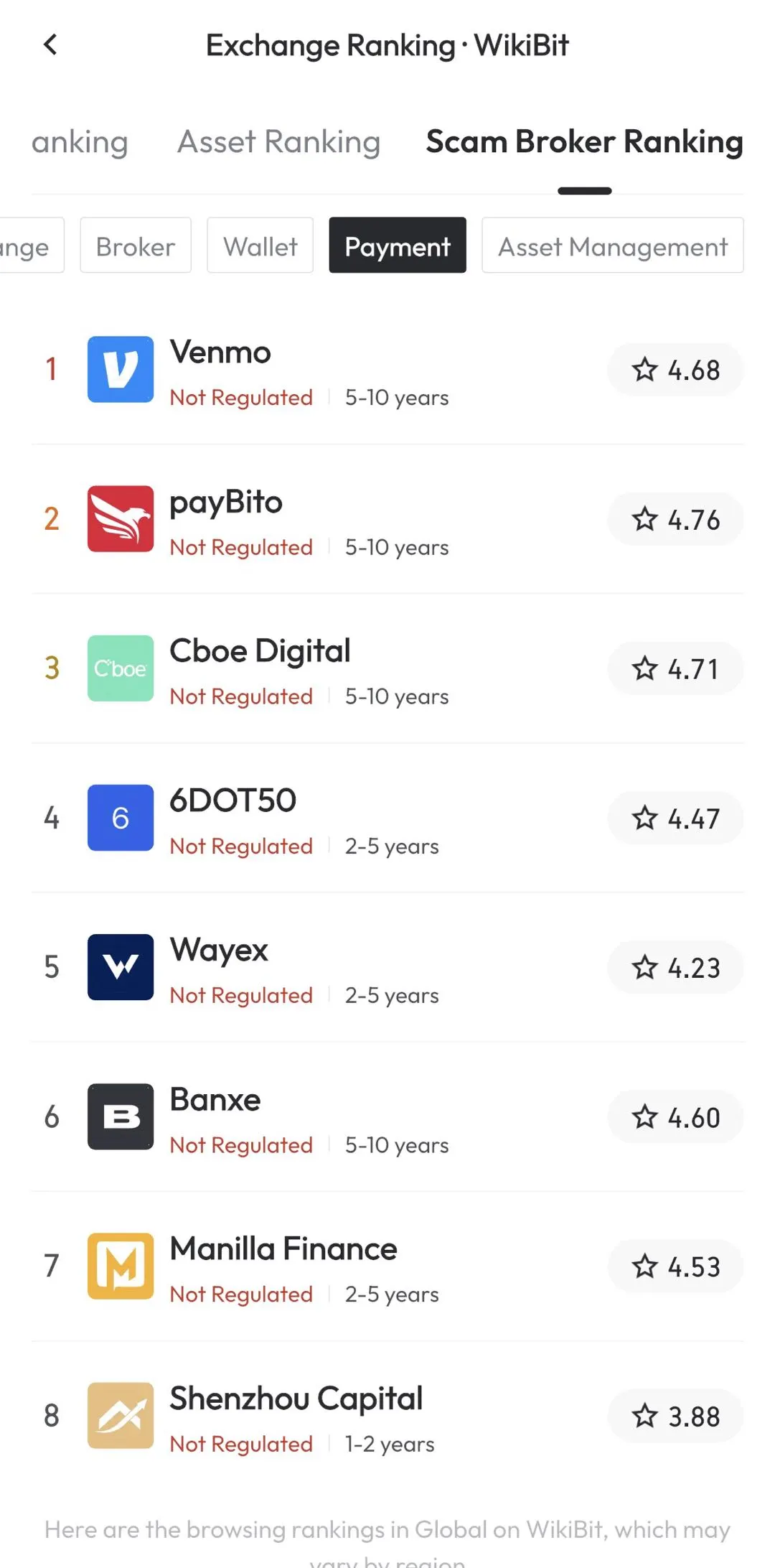
Payment Platform Risk Ranking (Source: WikiBit)
Once we understand the two points above, we need to put two principles into practice:
Do not put all your eggs in one basket.Pay attention to your “exit costs.”
RedotPay currently holds more than 50% of the crypto U-card market, with over 8 million users. Binance, meanwhile, is the worlds largest cryptocurrency exchange.
When these two companies clash, the impact extends to millions of users daily lives.
If RedotPay faces frozen funds, restricted services, or business contraction following a failed IPO due to the lawsuit — who will be affected the most?
Not Binance.
Not RedotPays founders.
It will be you — every single user.
Diversify Your Risks
Do not store all your crypto assets on one platform.
Do not rely on a single card for all your payment needs.
Having multiple cards and multiple wallets is not an inconvenience — it is a form of self-protection.
Pay Attention to “Exit Costs”
You choose RedotPay because it is convenient.
But if one day you decide to leave:
- Can you withdraw your funds smoothly?
- Can your data be deleted?
- Can your account be closed?
These questions often seem unimportant during normal times.
But when something goes wrong, you realize how important they actually are.
Before registering for any crypto service, think about how you will exit.
Final Thoughts
The Binance vs. RedotPay lawsuit may appear to be a $470 million compensation dispute on the surface.
But at its core, it is a deeper philosophical question:
Who do users actually belong to?
Binance says they belong to Binance — because Binance spent money, traffic resources, and brand value to acquire them.
RedotPay says they belong to users themselves — because users have the freedom to choose.
But those caught in the middle — you and me — may care about a much more practical question:
Regardless of who wins, are my funds safe?Can I still use my card?Where did my data go?
In the crypto world, there is no free lunch.
Behind every “convenient” service lies a hidden battle over user ownership.
As users, the best strategy is not to pick a side.
It is to stay alert, diversify your risks, and always maintain the ability to leave.