Introduction: An Exchange Born with a Silver Spoon
In our first 38 installments, we investigated a range of exchanges, from HashKey to Websea. For Episode 39, we turn our attention to a platform that appears to have one of the most legitimate pedigrees in the industry: Tokocrypto.
Its credentials look impressive on paper: founded in 2018; Indonesia‘s first crypto exchange registered with Bappebti; awarded a full PFAK license in 2024; placed under the direct supervision of Indonesia’s Financial Services Authority (OJK) starting in January 2025; fully acquired by Binance in 2022; more than 5 million users; dual ISO 27017 and ISO 27001 certifications; Proof of Reserves using Merkle trees and zk-SNARKs; and user assets totaling $345 million.
Sounds like a gold-standard example of regulatory compliance in Southeast Asia, right?
But there is another side to the story. Tokocrypto has a Trustpilot rating of just 1.9 out of 5, with users repeatedly complaining about slow withdrawals and unresponsive customer support. Gridinsoft gives the website a trust score of only 35 out of 100 and flags it as a “suspicious website.” Multiple Chinese-language anti-fraud articles have accused Tokocrypto of being involved in a futures-trading Ponzi scheme scam. Academic research also indicates that 46.2% of sentiment toward the platform is negative, with complaints primarily concerning withdrawal difficulties, KYC verification errors, and system freezes.
How can an exchange fully acquired by Binance and directly supervised by the OJK still receive a user rating of just 1.9 out of 5?
Lets examine the evidence layer by layer.
1. Regulatory Compliance: Direct OJK Supervision and Indonesia‘s Compliance Gold Standard
License Overview: One of Indonesia’s Most Comprehensive Compliance Frameworks
Tokocrypto has an unusually strong regulatory profile compared with many other crypto exchanges operating in Indonesia.
Bappebti registration: Registered in 2019 as a Prospective Crypto Asset Physical Trader (CPFAK), under license number 03/BAPPEBTI/PFAK/092024.
Full PFAK license: Granted in September 2024, making Tokocrypto one of the relatively small number of platforms holding a full license as a physical crypto asset trader in Indonesia.
Direct OJK supervision: Beginning in January 2025, regulatory oversight of Indonesias crypto industry shifted from Bappebti to the OJK. Tokocrypto became one of the first 29 Crypto Asset Physical Traders (PAKDs) subject to direct OJK supervision.
How significant is this combination of licenses?
Indonesia is one of the countries with the highest rates of cryptocurrency adoption worldwide, yet the number of crypto exchanges legally authorized to operate there remains limited. Tokocryptos PFAK license indicates that it has undergone regulatory scrutiny covering areas such as capital adequacy, customer asset segregation, and anti-money laundering controls.
But Regulatory Compliance Does Not Guarantee a Good User Experience
First, OJK supervision brings stricter KYC requirements and more complicated procedures.
Under Indonesias new regulatory rules for 2026, platforms operating without the required authorization may face prison sentences of five to ten years and fines of up to IDR 1 trillion. As a compliant platform, Tokocrypto must implement stringent KYC standards. These requirements may contribute to the verification errors and account rejection issues reported by users.
Second, Gridinsoft gives the website a trust score of just 35/100.
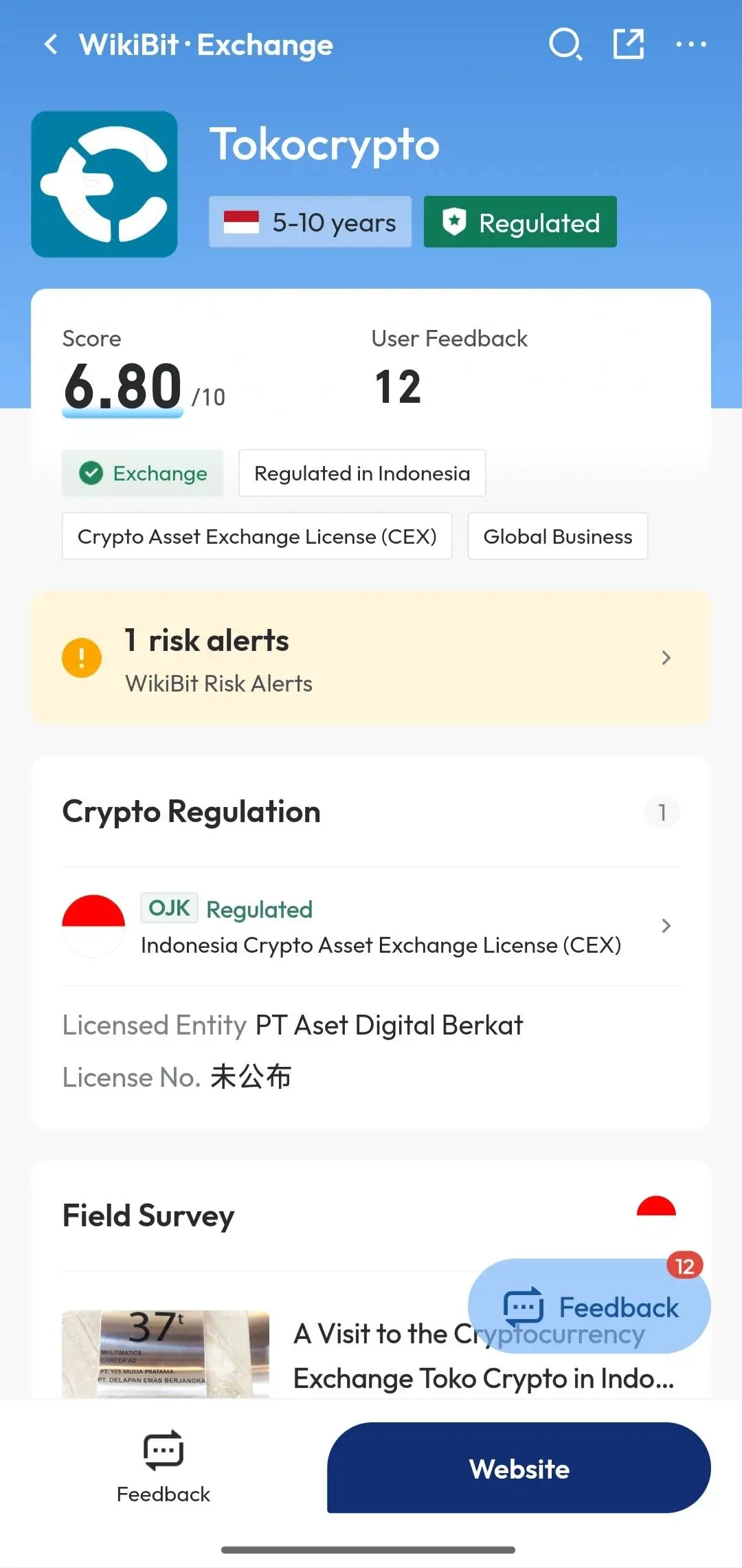
WikiBit rates Tokocrypto at 6.8, a score that is only marginally above the passing threshold.
Despite the platform‘s regulatory credentials, Gridinsoft’s assessment of tokocrypto.com still classifies it as a “suspicious website,” assigns it a trust score of just 35/100, and flags blacklist-related warnings.
This points to a noticeable gap between the platforms regulatory standing and the assessments provided by third-party website security and trust evaluation services.
Account Security and Withdrawals: A 1.9 Trustpilot Rating, with Complaints About Slow Withdrawals and Unresponsive Support
Third, its licenses are valid only within Indonesia. The PFAK license and OJK regulatory framework do not automatically extend to mainland China, Hong Kong, Europe, the United States, or other jurisdictions. Users who register and trade without being based in Indonesia may fall outside the scope of protections provided by these local licenses. If an account dispute arises, overseas users may not have access to the same consumer protection and complaint channels available to users under Indonesian jurisdiction.
Risk Rating: Low Risk (Regulatory Compliance)
2. Account Security and Withdrawals: A 1.9 Trustpilot Rating, with Complaints About Slow Withdrawals and Unresponsive Support
Tokocryptos Trustpilot rating has fluctuated between 1.9 and 2.9 out of 5. User complaints are concentrated around two main issues: slow withdrawals and unresponsive customer support.
“Withdrawal Delays, with No Clear Answers from Customer Support”
User feedback indicates that some customers have experienced complicated KYC procedures, delayed withdrawals, and a lack of clear responses from customer support. Other users have also complained about missing assets.
“Withdrawal Difficulties Leave Users Regretting Their Deposits”
One user on the Followme platform bluntly described Tokocrypto as a “scam,” expressing regret over repeatedly depositing funds because they were unable to withdraw them.
Academic Research: 46.2% Negative Sentiment
An academic sentiment analysis study focusing on Tokocrypto reported the following results:
Positive sentiment: 53.8%
Negative sentiment: 46.2%
Negative comments primarily concerned withdrawal difficulties, KYC verification errors, and system freezes.
Nearly half of the analyzed comments were negative. This raises questions beyond isolated cases of poor user experience and points to potentially recurring service issues.
Risk Rating: High Risk
3. Proof of Reserves Transparency: Merkle Trees and zk-SNARKs Offer a Technically Robust Approach
PoR Data: $345 Million in User Assets
Tokocrypto has published Proof of Reserves (PoR) reports since 2023. As of January 1, 2026, its reported figures were as follows:
Total user assets: Approximately $345 million (IDR 5.8 trillion), nearly double the amount reported in its initial disclosure.
BTC: 1,246.80 BTC
ETH: 10,005.62 ETH
BNB: 12,272.90 BNB
USDT: 75,520,184 USDT
Tokocrypto uses Merkle trees and zk-SNARKs to enable users to independently verify whether their balances are included in the exchanges total liabilities without disclosing sensitive information publicly.
So, Where Are the Gaps?
First, PoR is a snapshot, not a real-time audit.
The $345 million figure reflects data as of January 1, 2026, nearly ten months ago. Are customer assets still adequately backed today? Without more recent publicly available data, that question remains unanswered.
Second, PoR demonstrates asset coverage, not a willingness or ability to process withdrawals promptly.
A user experiencing withdrawal delays could still have an account balance that is fully covered in the exchanges PoR report. Proof of reserves does not, by itself, establish that withdrawals will be processed quickly or without restrictions.
Third, CoinGecko lists reserve data as unavailable.
There is a disconnect between Tokocryptos official PoR disclosures and the reserve data available through CoinGecko.
Risk Rating: Medium Risk (Transparency)
Tokocrypto performs relatively well in this category. Its use of Merkle trees, zk-SNARKs, independent user verification, and periodic reporting represents a meaningful effort toward transparency.
However, even a technically sophisticated PoR system does not guarantee fast withdrawals. These are two entirely different issues.
4. Financial Strength: A Wholly Owned Binance Subsidiary, but Trading Volume Remains Relatively Small
The Impressive Credentials
Acquired by Binance: The acquisition was completed in late 2022, establishing Tokocrypto as Binances strategic foothold in Indonesia.
User base: More than 5 million users.
Reported customer assets: $345 million.
Market coverage: 321 cryptocurrencies and 393 trading pairs.
But Trading Volume Raises Concerns
According to CoinGecko, Tokocryptos 24-hour trading volume was approximately $12 million, even after reportedly increasing by 56.3% the previous day. CoinVictor reported a 24-hour trading volume of approximately $5.31 million.
For an exchange claiming more than 5 million users, daily trading volume of just $12 million works out to approximately $2.40 per registered user per day.
This calculation is only a rough illustration, not a measure of actual average user trading activity. Nevertheless, the figures suggest that the registered user base may substantially exceed the active trading population.
Tokocrypto ranks among the prominent exchanges in Indonesia, but its scale remains far smaller than that of major global exchanges.
Risk Rating: Medium Risk
Binance‘s acquisition provides substantial institutional backing, but daily trading volume of approximately $12 million suggests that Tokocrypto’s liquidity and market activity remain limited relative to major global platforms.
This is not necessarily a security risk; it is primarily a liquidity risk. Large orders may encounter significant slippage, particularly in less actively traded markets.
5. Internal Operations and Management: Calvin Kizanas Journey from PicMix to Crypto Exchange CEO
CEO: Calvin Kizana
Calvin Kizana became Tokocryptos CEO in February 2025, succeeding Yudhono Rawis.
His professional background is particularly interesting.
Graduated from BINUS University with a degree in computer science in 1995.
Worked at Apple Indonesia early in his career.
Founded PT Inovidea Magna Global in 2012, developing PicMix, a photo-editing application that reportedly attracted 21.2 million users worldwide within two years.
Previously served as the head of WhatsApps operations in Indonesia.
Received EY‘s Entrepreneur of the Year award in the digital category in 2014 and Forbes’ Global Rising Star award in 2015.
Moving from founding a photo-editing app to leading a cryptocurrency exchange is a significant career transition.
However, Calvins technology entrepreneurship background and experience operating in the Indonesian market may be precisely what Tokocrypto needs to strengthen its local position.
Management Transparency
CoinGecko‘s assessment suggests that Tokocrypto’s management information is relatively transparent. Its CEO has a publicly documented professional history, has participated in media interviews, and has appeared at industry conferences.
This contrasts sharply with exchanges such as UZX and Azbit, where publicly verifiable information about the core management team is more limited.
Risk Rating: Low Risk (Management and Team)
Calvin Kizana has a verifiable career history, a record of entrepreneurial success, and experience operating in the local market. These credentials place him above many exchange executives whose professional backgrounds are difficult to verify.
Binances position as the parent company also provides additional technical and compliance support.
6. Product Experience and Trading Depth: Feature-Rich, but “Slow” Is the Recurring Theme
Product Offering
Tokocrypto offers a broad range of products and services, including:
Spot trading: More than 400 cryptocurrencies.
Futures trading: Derivatives trading for users seeking leveraged exposure.
Staking: More than 80 cryptocurrencies, with rewards paid in crypto.
IDR fiat deposits and withdrawals: Supports local bank transfers and payment services such as GoPay and OVO.
In terms of fees, spot trading is charged at 0.10%, including tax, while futures trading fees range from 0.02% to 0.04%.
Where Users Run into Problems
First, withdrawals are the biggest pain point.
“Slow withdrawals and unresponsive customer support” are recurring themes in Trustpilot reviews and academic research.
Second, the KYC process can be cumbersome.
Some users report that after their KYC applications were rejected, they were unable to reapply. Others claim their accounts were disabled after the platform collected their personal information.
Third, withdrawal fees are relatively high.
The Bitcoin withdrawal fee is 0.0005 BTC. For small withdrawals, this charge can represent a substantial percentage of the amount being transferred.
Risk Rating: Medium Risk
7. Real Community Feedback: Overseas Users Flood Discussions with Withdrawal Complaints
Positive Feedback — Primarily from Indonesian Users
Convenient fiat deposits and withdrawals: Integration with local banks makes transfers relatively straightforward.
Greater confidence in a licensed platform: Compared with the many small, unlicensed exchanges operating in Indonesia, Tokocrypto offers a stronger sense of security.
Reliable small withdrawals: Some users report that small crypto withdrawals work smoothly and that the app performs well.
Negative Feedback — Concentrated Among Overseas Users
Strict KYC requirements: Logins from different locations or mismatches in identity documents may trigger account restrictions, while customer support can be slow to respond.
Occasional delays in staking redemptions: The platform reportedly attributes some delays to queues in underlying smart-contract settlement processes.
Poor liquidity in smaller cryptocurrencies: Large buy or sell orders may incur substantial slippage.
Limited complaint channels for overseas users: OJK oversight primarily operates within Indonesias regulatory framework. Overseas users may find it more difficult to pursue complaints through local regulatory channels.
Overall Community Sentiment: Deeply Divided
Tokocrypto receives relatively strong recognition from compliant local users in Indonesia. By contrast, complaints about account restrictions, withdrawal difficulties, and locked funds appear more pronounced among overseas users who do not meet local KYC requirements.
Risk Rating: High Risk (Community Feedback)
8. Comprehensive Exchange Exit Risk Assessment
| Risk Dimension | Risk Level | Assessment |
| Regulatory compliance | Low | Bappebti PFAK license and direct OJK supervision place Tokocrypto among Indonesias more comprehensively regulated exchanges. |
| Account security and withdrawals | High | Trustpilot rating of 1.9/5; recurring complaints about slow withdrawals and unresponsive support; 46.2% negative sentiment in the cited study. |
| Proof of Reserves transparency | Medium | Merkle trees, zk-SNARKs, and reported PoR of $345 million, although the timeliness of the available data remains a concern. |
| Financial strength | Medium | Wholly owned by Binance, with more than 5 million users, but reported daily trading volume of only $12 million. |
| Management and operations | Low | CEO Calvin Kizana has a verifiable professional background, while Binance provides additional technical and compliance support. |
| Product experience | Medium | Broad product offerings, but complaints concern slow withdrawals, cumbersome KYC, and relatively high withdrawal fees. |
| Community feedback | High | Trustpilot rating of 1.9/5, 46.2% negative sentiment in the cited study, and recurring complaints about withdrawal difficulties. |
Overall Rating: Medium Exit Risk
Tokocrypto is a distinctive case in this series: a contradiction between exceptionally strong regulatory credentials and a deteriorating user experience.
Its risk profile differs fundamentally from the questionable, poorly regulated platforms examined in our previous 38 installments.
1. It has a genuine regulatory moat.
The combination of a Bappebti PFAK license and direct OJK supervision is a valuable and relatively scarce advantage in Indonesia. Binances full acquisition also provides meaningful institutional backing.
2. Its Proof of Reserves framework has substantial technical merit.
Merkle trees, zk-SNARKs, and periodic PoR disclosures represent a more sophisticated transparency framework than many exchanges offer.
3. But its user experience appears to be under considerable strain.
A Trustpilot rating of 1.9/5, negative sentiment accounting for 46.2% of comments in the cited study, and recurring complaints about slow withdrawals and unresponsive customer support raise serious concerns. The severity of these complaints is comparable to the customer service issues highlighted in our earlier analysis of bitFlyer.
4. The primary concern is not necessarily a high risk of an exit scam, but a potentially high risk of service deterioration.
Tokocrypto appears less likely to simply disappear with customer funds than poorly regulated platforms such as UZX or Azbit, given its OJK supervision, Binance ownership, and PoR disclosures. However, users may still find themselves in a frustrating situation: their funds remain visible in their accounts, but withdrawing them becomes difficult, and customer support is hard to reach.
This is not simply a question of whether an exchange will disappear overnight. It is a question of whether a platform with strong regulatory credentials can deliver the service quality its users expect.
9. Recommendations for New and Existing Users
For New Users
1. Enter cautiously.
Tokocrypto is not an obscure, unregulated exchange. It has OJK oversight and Binance backing. However, its reported Trustpilot rating of 1.9/5, the 46.2% negative sentiment reported in the cited study, and recurring complaints about slow withdrawals and unresponsive support raise three important concerns. Are you comfortable accepting those risks?
2. If you are based in Indonesia, understand both the benefits and the limitations.
Tokocrypto is among Indonesias more comprehensively regulated exchanges. However, be prepared for potentially cumbersome KYC procedures, withdrawal delays, and difficulty reaching customer support.
3. If you are outside Indonesia, exercise additional caution.
Tokocrypto primarily serves the Indonesian market. Overseas users may encounter more complications with KYC verification, withdrawals, and access to local complaint channels.
4. Start with a small test transaction.
Deposit a modest amount and complete the entire process: deposit, trade, and withdraw. Only consider increasing your exposure after confirming that the process works as expected and that you are comfortable with the experience.
For Existing Users
1. Reassess your exposure.
If more than 10% of your total assets are held on Tokocrypto, consider gradually reducing that concentration. This is not a prediction that the exchange will fail tomorrow. Rather, withdrawal delays could affect your ability to access funds when you need them.
2. Test a withdrawal now.
Attempt a small withdrawal to confirm that the process is working for your account. A successful transaction provides useful evidence of current functionality, although it does not guarantee that future withdrawals will be processed without problems. If a withdrawal fails, identifying the issue early is preferable to discovering it when you need access to a larger amount.
3. Preserve all relevant evidence.
Keep transaction records, KYC correspondence, support tickets, screenshots, and withdrawal histories. Users who report being unable to reapply after KYC rejection may find that comprehensive documentation is essential when escalating complaints publicly or through the appropriate channels.
4. Monitor OJK regulatory developments.
As a platform under direct OJK supervision, Tokocrypto may be affected by changes in Indonesian regulatory policy. Such changes could directly influence account requirements and the user experience.
Final Recommendations
Who is Tokocrypto best suited for?
Indonesian residents who value OJK supervision, local IDR payment channels, and localized services, as well as longer-term users who place significant weight on Binances institutional backing and can tolerate potential withdrawal delays.
Who should think twice?
Users who need frequent access to their funds or regularly make withdrawals, given that withdrawal delays are a major reported pain point. Users who depend on fast, responsive customer support should also proceed cautiously.
Tokocrypto finds itself in an unusual position. It has built one of Indonesias more comprehensive regulatory frameworks, yet the compliance processes that help protect the market may also contribute to a slower and more cumbersome user experience. It has Binance as its parent company, yet that backing has not translated into a Trustpilot rating above 3 out of 5 in the ratings cited here.
Tokocrypto does not necessarily appear destined for an exit scam. It has OJK oversight, Binance backing, and a PoR framework. But it could face a different kind of long-term problem: a gradual erosion of user confidence, customer attrition, deteriorating reputation, and persistent service shortcomings.
In other words, the key risk may not be a sudden disappearance, but a slow decline in service quality and user trust.
Coming Next: WikiBit Exchange Exit Risk Rankings #40 — XT.com. Stay tuned!
Risk Disclaimer: This article reflects the author's analysis and does not constitute investment advice. Cryptocurrency investments involve significant risks. Please exercise caution before investing.
Information in this article was updated on October 9, 2026. Please cross-check the latest information against multiple sources before making any decisions.
WikiBit, a regulatory app co-building protection with over 1 billion crypto investors.
More crypto exchange real-time regulation info, please feel free check and download WikiBit App at:https://www.wikibit.com/
Apple Store: https://apps.apple.com/sg/app/wikibit-crypto-reg-check/id1541570520
Google Play: https://play.google.com/store/apps/details?id=com.wikifx.wikibitglobal