

Introduction: An Exchange More Focused on Listing Projects Than Trading
In our first 60 installments, we investigated a wide range of exchanges, from HashKey to BYDFi. For Issue #61, we're turning our attention to a platform with a distinctly B2B-oriented business model: P2B (p2pb2b.com).
P2B is fundamentally different from most retail-focused cryptocurrency exchanges when it comes to its business model. Founded in Lithuania between 2017 and 2018, the platform has a relatively traceable founder, Valerii Solodovnyk. Its core business is not simply serving retail traders. Instead, it focuses on helping crypto projects launch tokens through IEOs and IDOs, secure exchange listings, and establish initial liquidity.
P2B claims to have listed more than 900 trading markets, covering over 200 cryptocurrencies. IEOs and its Launchpad are among its flagship offerings. The platform also provides spot trading, staking, and its native PACT token.
On October 13, 2026, South Korea's Financial Intelligence Unit (FIU) and Financial Services Commission (FSC) announced blocking measures against 27 overseas virtual asset service providers, including P2B, that had failed to register with the FIU. The Korean FIU subsequently requested that the Korea Communications Standards Commission block access to their websites. The measure was approved on October 6–7, 2026, cutting off access to P2B in South Korea.
Meanwhile, on P2B's profile on the third-party platform Blockspot.io, the field labeled “MiCA Licensed” is explicitly marked “No.”
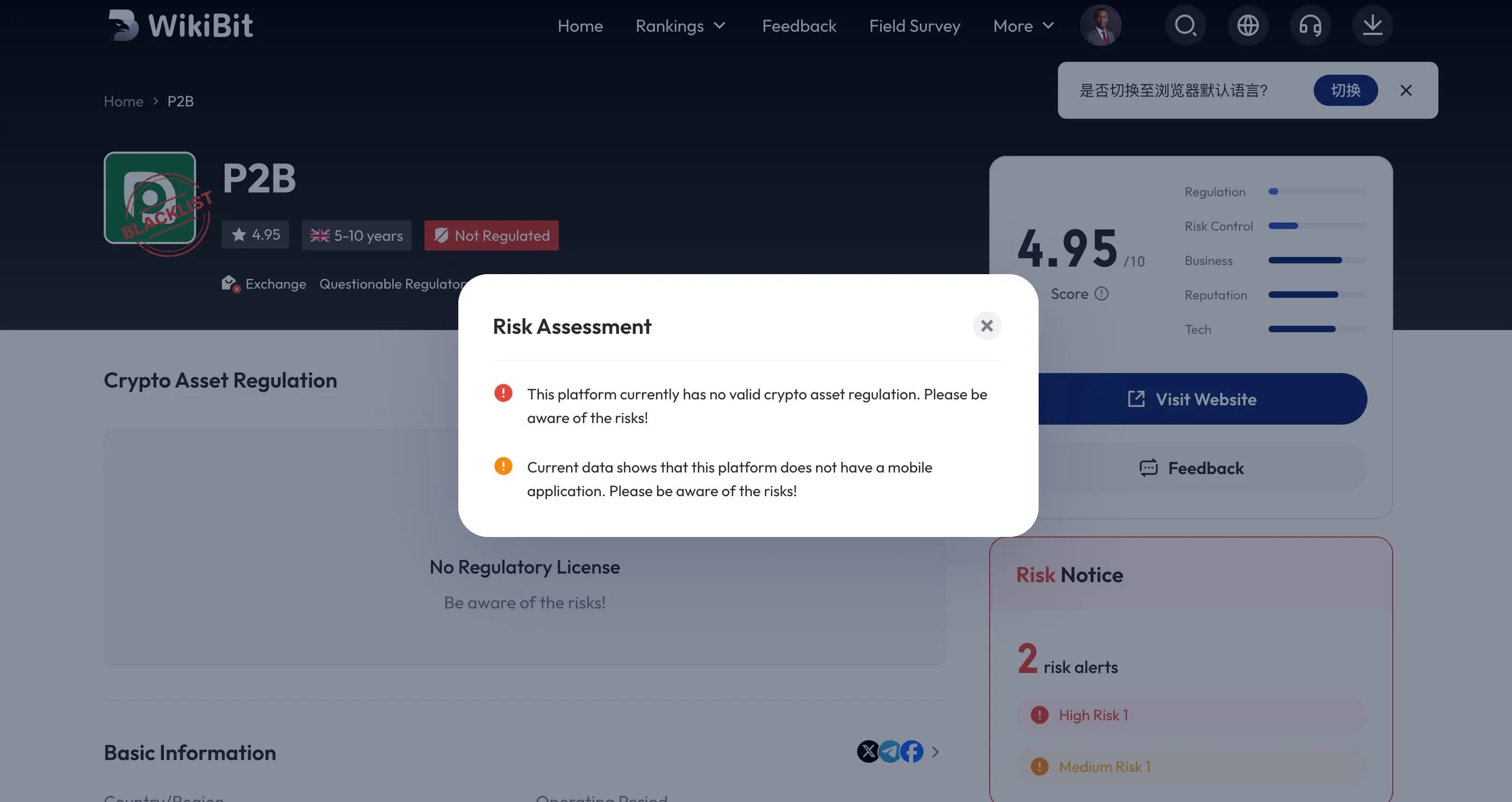
WikiBit's rating for P2B is just 4.95/10, with a direct warning:
This platform currently has no valid cryptocurrency regulatory authorization. Please exercise caution.
South Korea's Financial Supervisory Service (FSS) also has a public Q&A record documenting a user's account of depositing 0.0234 BTC (approximately KRW 4 million), only to find the withdrawal button disabled. The platform allegedly continued blocking withdrawals for an extended period, citing “technical issues.”
On Trustpilot, another user reported being told to deposit an additional $499 to unlock frozen funds.
On the BitcoinTalk forum, a crypto project reportedly accused P2B of failing to deliver promised marketing services after receiving a $15,000 USDT listing fee, while the project's Telegram account was allegedly blocked.
An exchange whose core business revolves around helping projects get listed has been reported in South Korea as an “unregistered operator,” does not appear in the EU's MiCA register, and faces separate allegations from users and project teams involving frozen withdrawals and disputed listing fees.
Today, we'll examine these issues layer by layer.
1. Regulatory Compliance: No. 29 on South Korea's FSC List, Missing from the ESMA Register
South Korea's FSC: Named in the Official List on June 24, 2026
This is one of the most significant regulatory red flags against P2B, backed by official South Korean documentation.
According to a review of records published by South Korea's Financial Services Commission (FSC), P2B was listed as No. 29 among 40 “unregistered operators” announced on June 24, 2026. The corresponding domain was p2pb2b.com/ko, which had already been referred to investigative authorities on June 10.
The FSC classified these entities as operators that had failed to report to the Financial Intelligence Unit (FIU). It also issued an important clarification:
“Operators not included on the list may still be operating illegally.”
This is not simply a case of a platform holding a low-quality license. South Korea's financial regulator explicitly included P2B in an official list of unregistered operators and referred the case to investigative authorities.
For an exchange that claims to serve the Korean-speaking market and operates a Korean-language website, its legal status in South Korea is that of an unregistered operator.
South Korea's FIU: Website Blocking Takes Effect in October 2026
The referral to investigative authorities was followed by website restrictions.
Records published by Revain confirm that, at the request of South Korea's FIU, the Korea Communications Standards Commission decided on October 6–7, 2026, to block access to the websites of 27 unregistered virtual asset operators. P2B was among them.
This means P2B is not merely an exchange that has received a regulatory warning in South Korea. It is a platform whose website access has been ordered to be blocked at the internet-access level.
For users in South Korea, the exchange they are using is regarded by the country's regulators as a platform that should not be accessible.
European Union: Missing from the MiCA Register
Revain's October 29, 2026 review reached a straightforward conclusion:
“P2B has not disclosed any licenses or registration information; the companies it identifies do not appear in ESMA's provisional MiCA register; and the MiCA transitional period ended on July 1, 2026.”
P2B describes itself as “one of Europe's largest digital asset exchanges” and claims to be headquartered in Vilnius, Lithuania.
However, it does not appear in the EU's MiCA regulatory framework. It has also been blocked in South Korea and lists the United States, Canada, the United Kingdom, Australia, France, Japan, and China among its restricted jurisdictions.
There is a striking contradiction between an exchange's narrative of global accessibility and its regulatory standing in major developed markets.
Legal Entities: Multiple Operating Companies, Undisclosed Places of Registration
Revain's investigation also uncovered a governance-related concern.
P2B's Terms of Use involve agreements with several operating companies:
Techtonic Software S.A.
Smart Digital Solutions Limited
Digital One Software Limited
P2B Solutions LLC
However, the terms do not clearly specify where these companies are registered.
P2B founder Valerii Solodovnyk is the CEO of Partida Services, which is identified as one of the legal entities operating the exchange.
When using P2B, a user's contractual counterparty could potentially be any one of these four companies, yet their places of registration are not clearly disclosed in the publicly available terms.
This resembles the fragmented corporate-registration structures we previously identified at platforms such as BTSE and YUBIT.
If something goes wrong, users may struggle to establish which clearly identifiable and verifiable legal entity is actually responsible for holding their assets.
Risk Rating: Extremely High (Regulatory Compliance)
2. Account Security and Withdrawals: Disabled Withdrawal Buttons and the “$499 Deposit to Unlock” Demand
South Korea's FSS Official Q&A: Withdrawal Button Disabled, 0.0234 BTC Trapped
This is one of the relatively rare withdrawal-related cases in our series documented through an official regulatory channel.
South Korea's Financial Supervisory Service (FSS) published Q&A record No. 2025Q5638, documenting a user's complaint.
According to the complaint, approximately two years earlier, the user deposited BTC into P2B and traded on the platform.
At the time of the complaint, approximately 0.0234 BTC, worth around KRW 4 million, remained in the exchange account.
However, the platform allegedly continued to prevent withdrawals for an extended period, citing “technical issues.” The withdrawal request button was directly disabled, while inquiries submitted through the customer service center reportedly received repeated automated responses or no response at all.
The user explicitly stated in the complaint:
“This is not a withdrawal delay, but evidence of deliberate asset locking and misappropriation.”
The user also pointed out that numerous similar cases had reportedly appeared in the community, raising suspicions that the platform operated more like a “private exchange.”
The FSS's official response confirmed that P2B was considered an unreported virtual asset service provider under South Korea's current Act on Reporting and Using Specified Financial Transaction Information.
The FSS further explained that it did not have supervisory inspection authority over unreported operators and therefore did not possess information about their operations.
In other words, this is not a case of regulators saying they are investigating the platform. It is a case of the regulator effectively saying: “We cannot supervise it.”
Trustpilot: 211 Reviews, 2.7/5 Rating, and 46% One-Star Reviews
One Trustpilot reviewer described an alleged experience in which their funds were frozen when they attempted to withdraw after using two different deposit methods.
The platform allegedly told the user that an additional $499 deposit was required to unlock the frozen funds immediately.
The reviewer wrote:
“When I tried to withdraw, they froze my money because I had used two different deposit methods. They told me I needed to deposit another $499 to unlock the funds immediately. I deposited $500 yesterday, and now I have $3,000 that I want to withdraw, but it is still pending. Nobody responds to my emails, and there is no one available through the bot. I just want my money back. Yesterday morning, they told me the pending status would last only 24 hours. It has now been 36 hours, and nobody has responded.”
The demand to “deposit another $499 to unlock the funds” is a specific variation of the so-called pay-to-unlock scheme.
In previous installments of this series, platforms such as KCEX, Biconomy, and BTSE faced complaints involving alleged unlocking fees, verification fees, and activation charges.
At P2B, the alleged justification was that the user had used two different deposit methods and therefore needed to deposit additional money to “unlock” the account.
The user's existing $3,000 withdrawal was effectively subjected to a new financial barrier: putting in even more money before being allowed to recover the original funds.
This is a particularly concerning pattern. A legitimate withdrawal process should not normally require users to make additional deposits simply to release their own frozen assets.
Turkey's Sikayetvar: “My Account Is Locked, I Cannot Withdraw, and I Cannot Find Support”
Multiple complaints targeting P2B have appeared on Sikayetvar, a Turkish consumer complaint platform.
Their titles include:
“Hesabım Kilitlendi, Paramı Çekemiyorum Ve Destek Bulamıyorum!” (My Account Is Locked, I Cannot Withdraw My Money, and I Cannot Find Support!)
“P2B Platformunda Para Çekememe Ve Mağduriyet” (Unable to Withdraw Money and Suffering Losses on the P2B Platform)
One Trustpilot review also alleged that the user's account had been frozen by the company for two years, with funds withheld for unknown reasons.
The reviewer described the experience as fraud, claiming that the company had not returned the money.
Although individual complaints do not independently establish that the platform systematically misappropriates customer assets, repeated allegations involving frozen accounts, failed withdrawals, and inaccessible customer support deserve serious attention.
Two Particularly Concerning Terms: 0.25% Daily Inactivity Fees and Full-Value Charges for Delisted Assets
Revain's review also identified two clauses in P2B's Terms of Use that could directly affect users' funds.
Clause 1: Daily Storage Fees for Inactive Accounts
“An account that has not been used for 12 months or longer may be considered an abandoned account, after which a storage fee of 0.25% per day will be charged on each asset held in the account.”
Clause 2: Full-Value Storage Fees for Delisted Assets
“If a delisted asset is not withdrawn within the notification period, P2B may charge a one-time storage fee equal to the entire amount of that asset.”
Let's look at what these provisions could mean in practice.
At a daily rate of 0.25%, an inactive account's assets could be substantially depleted within less than a year.
Meanwhile, the provision concerning delisted assets effectively reserves the right for the platform to charge the entire quantity of an asset as a fee if the user fails to withdraw it within the specified notification period.
Whether these clauses are legally enforceable depends on the applicable jurisdiction and the specific circumstances. Nevertheless, they create a very clear requirement for users: You cannot simply leave your assets on the platform and forget about them.
Risk Rating: Extremely High (Account Security and Withdrawals)
3. Proof of Reserves Transparency: No Public PoR, the Weakest Link in This Issue's Ranking
No PoR, No Alternative Transparency Mechanism
In previous installments of this series, some exchanges did not publish Merkle Tree-based Proof of Reserves (PoR) but still provided alternative forms of transparency.
For example:
Coinbase: Audited financial statements as a publicly listed company.
Zaif: Asset segregation under Japan's FSA regulatory framework.
BYDFi: Hacken Proof of Reserves reports.
These mechanisms offer users varying degrees of independently verifiable information about an exchange's financial position.
P2B, however, has not publicly provided any verifiable reserve or liability transparency mechanism.
For a platform listed by South Korea's FSC as an unregistered operator, absent from the EU's MiCA register, and facing allegations of disabled withdrawal functions, the lack of PoR is particularly concerning.
Without PoR, users have no independent way to determine whether the platform actually holds sufficient assets to cover their account balances.
When withdrawals are blocked, users cannot rely on PoR to verify that the exchange has sufficient funds. Nor can they necessarily turn to financial regulators for effective assistance, because the regulator has already stated that it lacks supervisory authority over the platform.
Industry Comparison: Leading Exchanges Publish Verifiable Reserve Figures
Leading exchanges have increasingly made their BTC, ETH, and USDT reserve ratios, along with their total reserve holdings, publicly available in figures that users can independently check.
P2B, by contrast, falls into the category of exchanges that disclose virtually nothing about their reserves.
To be clear, a lack of reserve transparency does not automatically prove that an exchange is insolvent or lacks sufficient funds.
However, in exchange risk assessments, it is one of the most important early warning signals.
Before FTX collapsed, the outside world also lacked access to a complete and independently verifiable picture of its reserves and liabilities.
Risk Rating: High (Proof of Reserves Transparency)
4. Financial Strength: Token Listings Are the Core Business, but Trading Depth and Reputation Are Another Matter
Business Model: B2B Listing-Driven, Not Retail Liquidity-Driven
P2B's positioning is fundamentally different from retail trading-driven platforms such as Binance and OKX.
Its core customers are cryptocurrency projects seeking exchange listings and initial liquidity, rather than high-frequency retail traders.
Revain describes P2B as:
“A centralized exchange specializing in listing and launching new cryptocurrency projects, offering spot trading, IEO and IDO Launchpads, and staking.”
Its revenue structure may rely heavily on listing fees, IEO service fees, and market-making or liquidity-launch services.
This business model means that P2B's financial strength does not depend entirely on the size of retail customer deposits. Instead, it depends to a greater extent on whether cryptocurrency projects are willing to pay for listing and marketing services.
If a project pays a listing fee but the platform fails to deliver the promised services, disputes between the project and the exchange become another side of the same coin as retail users' withdrawal problems.
Both point to the same underlying concern: uncertainty over the platform's ability or willingness to fulfill its obligations after collecting fees.
BitcoinTalk: A 15,000 USDT Listing Fee and Allegations of Undelivered Services
Scamnot.me cited a BitcoinTalk forum post documenting allegations from a user identified as JMMP.
According to the post, JMMP paid P2B 15,000 USDT for a token listing, but the exchange allegedly failed to deliver the promised marketing services. The project's Telegram account was also reportedly banned.
The same report mentioned allegations from users that P2B used bots to inflate trading volumes, creating the appearance of being “one of the largest exchanges in the world.”
It is important to clarify that these are allegations made by forum users and have not been established through judicial proceedings.
Nevertheless, the disputes over listing fees and allegations of inflated trading volumes are particularly relevant to P2B's B2B listing-driven business model.
When an exchange relies heavily on project listing fees for revenue, two questions become especially important and require independent verification:
How much genuine value and marketing exposure does the platform actually deliver?
How much of its reported trading volume represents genuine market activity?
Without independent verification, both remain significant areas of uncertainty.
Risk Rating: High (Financial Strength)
5. Internal Operations and Management: Valerii Solodovnyk Is Identifiable, but the Corporate Structure Is a Multi-Entity Puzzle
Founder: Valerii Solodovnyk
Information about P2B's founder is relatively accessible.
Records from BTCC confirm that Valerii Solodovnyk founded P2PB2B in 2018 and serves as CEO of Partida Services, one of the legal entities operating the exchange. P2B is headquartered in Vilnius, Lithuania.
Criffy also identifies Valerii Solodovnyk as the founder and confirms the platform's Lithuanian origins.
In an industry where anonymous founders are still common, having an identifiable founder and a publicly named operating entity, Partida Services, is a relative advantage in terms of information transparency.
However, the Corporate Structure Is a Multi-Entity Puzzle, Not a Single Accountable Legal Entity
Revain's investigation points out that P2B's Terms of Use involve agreements with several companies, including:
Techtonic Software S.A.
Smart Digital Solutions Limited
Digital One Software Limited
P2B Solutions LLC
The terms do not clearly disclose where these companies are registered.
BrokerTribunal has also identified multiple operating entities associated with the platform.
This means that when users interact with P2B, their contractual counterparty is not necessarily one clearly identifiable company. Instead, it may be one of several entities whose places of registration are not fully disclosed.
Being able to identify the founder answers one question: Who is leading the business?
But a fragmented corporate structure leaves another, much more important question unanswered: If something goes wrong, which legal entity should users hold accountable, and in which jurisdiction can they pursue legal action?
For a platform listed as an unregistered operator in South Korea and lacking MiCA registration in the EU, this is precisely the question users most need answered, yet may find hardest to resolve.
Risk Rating: Medium-High (Management and Corporate Governance)
6. Product Experience and Trading Depth: Launchpad Listings Offer Differentiation, but Liquidity Remains Uncertain
Product Differentiation: IEOs and Launchpad Services Offer Genuine Value
From a product perspective, P2B offers a clearly differentiated proposition for cryptocurrency projects and early-stage investors.
Its offerings include:
IEO and IDO Launchpad services
Spot trading
Staking
PACT exchange token
A specialized focus on listing and launching new cryptocurrency projects
For users seeking early exposure to newly issued tokens, or projects looking for exchange listing channels, P2B provides a hybrid B2B/B2C entry point.
However, its weaknesses are also quite apparent:
1. Limited liquidity and higher trading costs for smaller tokens
Major cryptocurrencies have basic liquidity, but long-tail tokens and Launchpad projects may involve substantial bid-ask spreads and slippage risks. They are therefore unsuitable for large market orders.
2. High-tier trading fees are difficult for ordinary users to obtain
The highest VIP fee tier reportedly requires monthly trading volume of 500 BTC, putting it far beyond the reach of most retail traders.
3. Incomplete trading infrastructure
The wealth management module has been discontinued, there is no dedicated mobile app, and fiat currency services rely on third-party providers with relatively high fees.
Overall, the trading experience can be described as functional but far from convenient.
P2B may serve a specific purpose for projects seeking token listings and early-stage investors looking for new assets, but its product differentiation does not automatically translate into reliable liquidity, strong asset protection, or a consistently smooth trading experience.
Risk Rating: Medium-High (Product Experience and Trading Depth)
7. Comprehensive Exchange Exit Scam Risk Assessment
| Risk Dimension | Risk Level | Assessment |
| Regulatory Compliance | Extremely High | Ranked No. 29 on South Korea's FSC list of 40 unregistered operators and referred to investigative authorities; website blocking requested by the FIU; absent from ESMA's MiCA register. |
| Account Security / Withdrawals | Extremely High | South Korea's FSS official Q&A documents a case involving a disabled withdrawal button and prolonged withdrawal restrictions attributed to technical issues; Trustpilot complaint alleging a demand for an additional $499 deposit to unlock funds; inactive accounts subject to a daily 0.25% fee. |
| Proof of Reserves Transparency | High | No publicly available PoR or independent third-party reserve audit. |
| Financial Strength | High | B2B listing-driven business model; BitcoinTalk allegations involving an undelivered service after a 15,000 USDT listing fee; allegations of artificially inflated trading volumes. |
| Team and Operations | Medium-High | Founder Valerii Solodovnyk is identifiable, and Partida Services is one of the operating entities; however, the Terms of Use involve multiple companies whose places of registration are not disclosed. |
| Product Experience | Medium-High | IEO/Launchpad services offer genuine product differentiation, but liquidity remains uncertain. |
| Community Feedback | High | BitcoinTalk “mass-warning” and inclusion on FinTelegram's Red Compliance List. |
Overall Rating: Extremely High Exit Scam Risk
P2B is one of the highest-risk exchanges examined in this series, joining the ranks of Azbit, FameEX, GXT, and YUBIT in what we call the “high-risk club.”
Its risk profile is not defined by a weakness in just one area. Rather, it involves the accumulation of multiple critical risk factors:
1. Official Regulatory Rejection
South Korea's FSC included P2B in its official list of 40 unregistered operators on June 24, 2026. The FIU subsequently requested that its website be blocked, while P2B remains absent from ESMA's MiCA register.
This is not simply a case of regulatory uncertainty. South Korean authorities have officially identified the platform as an unregistered operator and taken action to restrict access to it.
2. Disabled Withdrawals and Pay-to-Unlock Demands
The user experience documented in South Korea's FSS official Q&A is particularly concerning: the withdrawal button was disabled, the platform allegedly used technical issues to justify prolonged withdrawal restrictions, and customer support reportedly responded with automated messages.
The Trustpilot complaint involving a demand for another $499 deposit to unlock frozen funds points to yet another variation of the pay-to-unlock scheme.
The platform's terms regarding a daily 0.25% inactivity fee and full-value charges for unwithdrawn delisted assets further increase the vulnerability of customer funds over time.
3. No Public PoR or Independent Reserve Audit
For a platform whose regulatory status has effectively left users without meaningful supervisory protection, the absence of PoR means there is no independent tool for customers to determine whether the exchange actually holds sufficient assets to cover their account balances.
4. Listing Fee Disputes and Allegations of Inflated Trading Volumes
Allegations involving an undelivered service after a 15,000 USDT listing fee and the use of bots to inflate trading volumes are particularly relevant to P2B's B2B listing-driven business model.
When an exchange relies heavily on listing fees paid by projects, two questions require independent verification: How much genuine service does the platform deliver, and how much of its reported trading volume reflects real market activity?
These questions cannot be answered simply by relying on the platform's own claims.
P2B is not the kind of exchange whose products are completely dysfunctional or whose business model looks obviously fake at first glance.
Its IEO/Launchpad services have genuine product logic. Its founder is identifiable, and its operating entity, Partida Services, can also be traced.
However, the long-term security of an exchange does not ultimately depend on how successful or active its token-listing business appears. It depends on three fundamental factors: whether its regulatory status is legitimate, whether withdrawals are reliable, and whether its reserves are transparent.
On all three fronts, P2B's record points in the same direction:
South Korea's unregistered-operator list and website-blocking measures, disabled withdrawal buttons, the “$499 deposit to unlock” complaint, and the absence of recognized exchange regulatory authorization.
This is not a platform where users can confidently entrust their funds.
8. Recommendations for New and Existing Users
Advice for New Users
1. If you are in South Korea — DoNot Use P2B.
P2B has been listed by South Korea's FSC as an unregistered operator and referred to investigative authorities. The FIU has also requested that its website be blocked.
Using P2B in South Korea means dealing with a platform that regulators have explicitly identified as operating without the required registration. The FSS has also stated that it lacks supervisory inspection authority over such unregistered operators.
2. If you are in the EU, United States, Canada, United Kingdom, Australia, France, Japan, or China — Do Not Use P2B.
P2B's Terms of Use list these jurisdictions as restricted regions, and the platform does not appear in ESMA's MiCA register.
Using P2B in these markets means operating without the protection of local exchange regulation and may also violate the platform's own terms.
3. If You Are Interested in Its IEO/Launchpad — Only Use Money You Can Afford to Lose, and Be Prepared for Potential Withdrawal Problems.
P2B's Launchpad products are genuine offerings. However, complaints involving disabled withdrawal buttons and demands for an additional $499 deposit to unlock funds raise a critical question:
Can tokens earned through Launchpad participation actually be withdrawn without difficulty?
This needs to be independently verified.
Complete the entire process — participation, token allocation, and withdrawal — and confirm that the withdrawal channel works normally before considering any larger commitment.
4. Do Not Be Misled by the Apparent Success of Its Token-Listing Business.
P2B's core business is helping cryptocurrency projects get listed, not primarily serving retail traders.
An exchange that is active in B2B token listings is not necessarily equally reliable when it comes to retail users' withdrawal experience.
Advice for Existing Users
1. Attempt to Withdraw Your Funds Immediately, Regardless of the Amount.
The cases documented by South Korea's FSS and the complaints on Trustpilot indicate that withdrawal restrictions are not merely hypothetical concerns.
Try making a withdrawal now.
If it goes through, your account has not been restricted at this point. If it fails, at least you will know what kind of situation you are facing.
2. If Your Withdrawal Is Rejected or You Are Asked to Deposit More Money to Unlock It — Do Not Deposit Any More.
The complaint involving the additional $499 deposit illustrates why putting in more money may only increase your exposure rather than solve the problem.
Preserve all relevant records and seek assistance through independent consumer protection or legal channels.
3. Pay Attention to the Inactive Account Fee Clause.
If your P2B account remains unused for 12 months, the platform's terms reserve the right to charge a daily storage fee of 0.25%.
If you decide to stop using P2B, do not simply leave your account unattended.
Withdraw your assets or confirm the status of your account to avoid having your holdings gradually depleted by fees.
4. Preserve All Evidence.
The reason the user documented in South Korea's FSS Q&A was able to leave an official record was that the user retained deposit records, screenshots of the disabled withdrawal button, and customer service communications.
Keep every transaction record, interface screenshot, and customer service email. Organize everything chronologically.
Final Verdict
Who is P2B suitable for?
Almost nobody who considers fund security and reliable withdrawals to be essential requirements.
Its IEO/Launchpad products have a genuine B2B business rationale, but a viable product model does not automatically translate into fund security.
Who should avoid P2B?
South Korean users: P2B is on the FSC's unregistered-operator list, and its website has been targeted for blocking.
EU, US, UK, Canadian, Australian, Japanese, and Chinese users: These jurisdictions are listed as restricted regions, and P2B does not appear in the MiCA register.
Anyone who cannot accept the possibility of having their withdrawal button disabled: South Korea's FSS has an official record documenting such a complaint.
Anyone who requires transparent proof of reserves: P2B provides no publicly available PoR.
P2B's situation can be summed up as follows: Its token-listing business is thriving on the surface, but critical regulatory and security foundations remain inadequately secured.
It has genuine IEO/Launchpad products, an identifiable founder, and a traceable operating entity in Lithuania.
But the long-term security of an exchange does not depend on how many projects it helps list. It ultimately depends on whether its regulatory status is legitimate, whether withdrawals are reliable, and whether its reserves are transparent.
On all three fronts, P2B's record — South Korea's FSC unregistered-operator list and website-blocking measures, disabled withdrawal buttons, the “$499 deposit to unlock” complaint, and the absence of recognized exchange regulatory authorization — carries far more weight than its token-listing business.
P2B is like an intermediary specializing in helping companies go public. Its events look impressive, and its client list is substantial.
But when you check its business license, you discover that it has been placed on unregistered-operator lists in several major markets, while users who have already entrusted it with their money are posting on forums with one recurring complaint:
“The withdrawal button is greyed out.”
Coming Next: WikiBit Exchange Exit Scam Risk Ranking #62 — OmniX Exchange. Stay tuned!
Risk Disclaimer: This article represents an independent analytical opinion and does not constitute investment advice. Cryptocurrency investments involve significant risks. Please exercise caution before investing.
Information in this article is updated as of November 17, 2026. Please cross-check the latest information through multiple independent sources.
WikiBit is a regulatory and risk intelligence platform built specifically for cryptocurrency investors. It provides real-time access to global exchange regulatory licenses, credit ratings, risk alerts, industry news, and genuine user reviews, helping investors identify potential risks, stay away from problematic platforms, and make more informed trading decisions.
Before investing in crypto, check WikiBit first!
Download the WikiBit App now and add an extra layer of protection to your crypto assets:
https://wikibit.onelink.me/wgfF/1b1dn69b