






Introduction: A Withdrawal Dilemma for a “Regulatory Compliance Star”
Over the past 53 episodes, we have investigated a series of exchanges, from HashKey to Bybit. For Episode 54, we turn our attention to a platform with one of the most impressive regulatory portfolios in the industry, yet one where users report a strikingly inconsistent withdrawal experience: OKX.
On paper, OKX is among the industry's top-tier players. It has obtained a MiCA license through Malta, joining Coinbase and Kraken as one of the relatively few major platforms legally authorized to continue operating across the European Economic Area after the transitional period ended. Its derivatives trading volume reached $2.19 trillion, ranking second globally behind Binance. It is the only platform besides Binance to maintain customer asset holdings above $10 billion. OKX has published 49 consecutive Proof of Reserves (PoR) reports, with a BTC reserve ratio of 108% and combined reserves worth $27.8 billion across four major assets. Its 24-hour net inflow reached $445 million, ranking first among major exchanges.
But the other side of the story is considerably less reassuring.
In 2025, OKX pleaded guilty to operating an unlicensed money-transmitting business and anti-money laundering compliance violations related to its US operations, agreeing to pay more than $500 million. Back in 2020, OKX suspended user withdrawals for nearly two months after a key private-key holder became involved in an investigation by Chinese police and was temporarily unavailable to the platform. This incident exposed historical weaknesses in both regulatory compliance and internal operations.
User feedback paints another concerning picture. Account freezes and withdrawal restrictions are recurring complaints. One user complaint published on FX110 described how an account engaged in normal trading was flagged by the platform's risk-control system. After filing an appeal, the user was placed under a six-month monitoring period. The platform did not identify the specific transaction considered problematic, stating that the restriction was triggered by automated system detection. It also reportedly said that manual intervention was not supported and early was not possible. Withdrawals, internal transfers, C2C trading, and other related functions were all restricted.
In January 2026, a user known as Captain Bunny reported that four OKX accounts purchased in 2023, all of which had passed KYC verification, were frozen, involving approximately $40,000 in stablecoins. Star Xu personally stepped in to explain the freeze. However, the explanation focused on why the accounts were frozen, rather than why one individual had been able to purchase four KYC-verified accounts in the first place.
On Trustpilot, OKX holds a rating of 2.4/5 based on 1,766 reviews, with 64% giving it one star.
WikiBit gives OKX a rating of 8.76/10, while flagging several regulatory concerns: its Canadian FINTRAC registration (No. M20929749) has an abnormal regulatory status, with the regulator listing it as revoked. Its claimed Japanese FSA regulatory status has not been verified. Users should exercise caution.
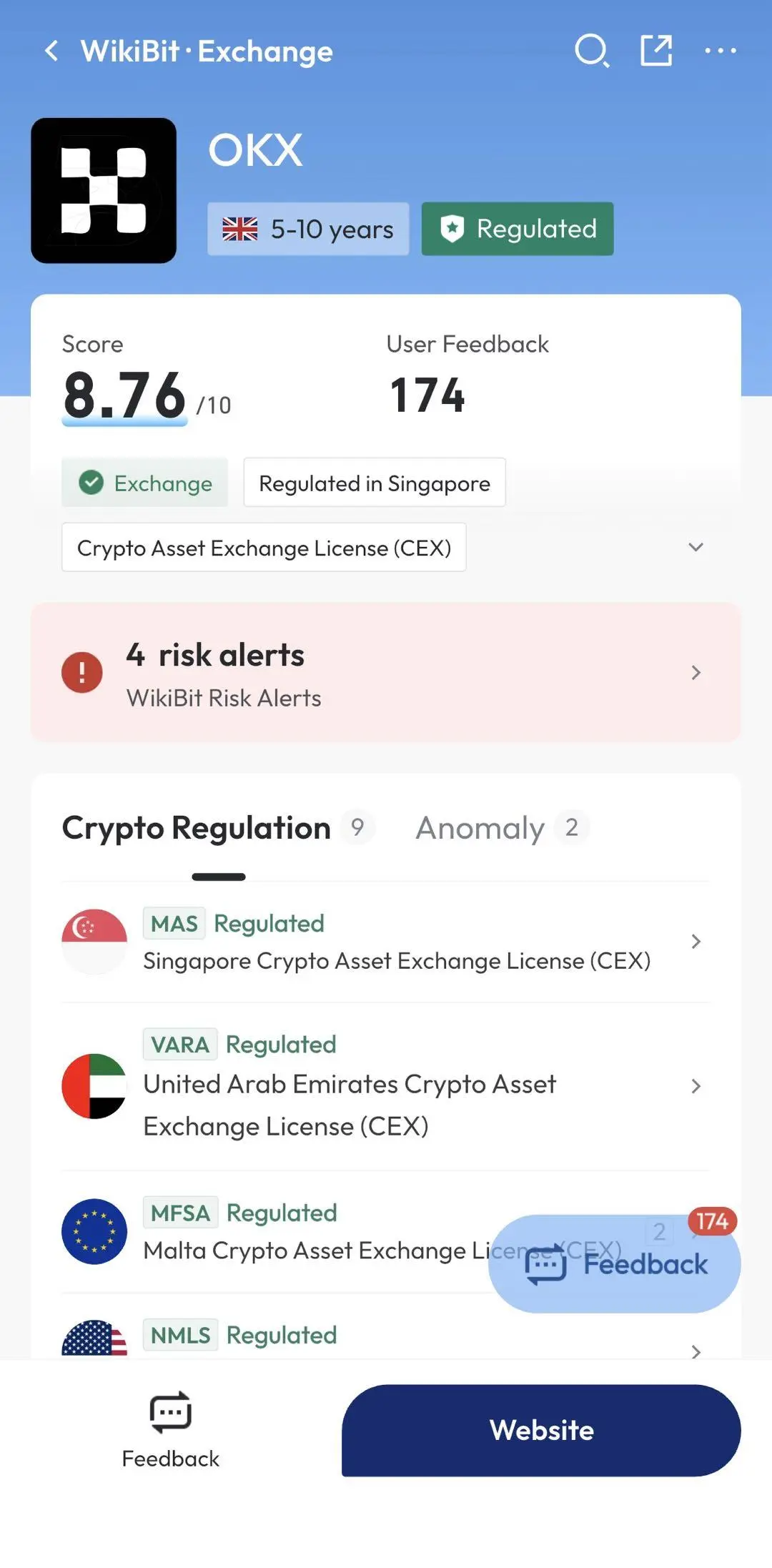
By 2026, OKX had accelerated its global compliance strategy, while seeking to strengthen market confidence through institutional investment, partnerships with traditional financial institutions, and greater transparency in reserve disclosures.
So, is OKX now a mature exchange that has successfully addressed its historical risks, or is it still a massive centralized platform with unresolved regulatory and operational vulnerabilities?
In this episode, WikiBit investigates OKX across multiple dimensions, including regulatory compliance, account security, withdrawal records, on-chain assets, reserve transparency, financial strength, team governance, trading experience, and community reputation.
1. Regulatory Compliance: More Licenses, but the $500 Million US Penalty Remains an Unavoidable Part of Its History
OKX's MiCA License: A Genuine Passport to the European Market
After the EU's MiCA transitional period ended on July 1, 2026, OKX obtained a MiCA Crypto-Asset Service Provider (CASP) license through the Malta Financial Services Authority (MFSA). This made it one of the relatively few major platforms legally authorized to operate across the European Economic Area.
OKX Europe CEO Erald Ghoos publicly warned that approximately 80% of platforms without MiCA authorization would be unable to continue operating. OKX was among those that made it through.
This is a genuine and significant regulatory advantage. It means OKX's European operations are subject to the MiCA framework, giving users access to the protections established under that regulatory regime.
Being Regulated Does Not Mean Operating Without Restrictions
OKX's list of restricted jurisdictions is far from short. US customers are served by a separate entity, OKX US, while the global platform does not accept US users.
Holding a license in one jurisdiction and being compliant in every jurisdiction are two entirely different things.
OKX's MiCA license covers the European Economic Area. The level of protection available to users in other markets depends on whether similar regulatory frameworks exist locally and whether OKX is properly registered under those frameworks.
On February 24, 2025, the US Attorney's Office for the Southern District of New York announced that Aux Cayes FinTech Co. Ltd., OKX's Seychelles-based entity, had admitted to operating an unlicensed money-transmitting business. The company agreed to pay more than $504 million in penalties and forfeiture.
For a leading global exchange to have operated for years without establishing adequate anti-money laundering (AML) and Know Your Customer (KYC) controls reveals significant weaknesses in its earlier compliance and governance systems.
On July 24, 2026, OKX Middle East Fintech FZE held a Virtual Asset Service Provider (VASP) license issued by Dubai's Virtual Assets Regulatory Authority (VARA).
However, it is important to understand that the license comes with specific business restrictions. For example, certain Request for Quote (RFQ) and trade-matching services are available only to institutional and qualified investors. The license should not be interpreted as unrestricted authorization for every type of business.
In 2026, OKX also accelerated its partnerships with traditional financial institutions.
On March 5, the Intercontinental Exchange (ICE), parent company of the New York Stock Exchange, announced a strategic investment in OKX, with both parties establishing a strategic partnership.
However, one distinction must be made clear: institutional investment is not a regulatory license, and a strategic partnership is not regulatory approval. Any cooperation involving US securities or derivatives businesses must still comply with the relevant legal approval and registration requirements.
Risk Rating: Low Risk (Regulatory Compliance)
Compared with the other exchanges covered in this series, OKX has a relatively strong regulatory position, particularly in Europe. However, its historical US enforcement case and differences in regulatory coverage across jurisdictions should not be overlooked.
2. Account Security and Withdrawals: Strong Reserves Do Not Guarantee That You Will Never Get Stuck on the Withdrawal Page
2020: A Nearly Two-Month Withdrawal Suspension – One of the Most Concerning Operational Incidents in OKX's History
The reason was that a key individual holding the platform's private keys was cooperating with an investigation by Chinese public security authorities. During that period, the exchange was temporarily unable to contact this individual.
The most important lesson from this incident is simple:
Even if an exchange has not suffered a hacker attack, and even if it claims to hold sufficient asset reserves, internal management problems can still prevent users from accessing their own funds.
The “Six-Month Monitoring Period”: No Specific Transaction Identified, No Clear Timeline for Lifting Restrictions
In August 2026, a user shared their experience on FX110.
The user had been conducting what they described as normal trading activities on OKX when the platform's risk-control system flagged the account for suspicious trading activity.
After submitting an appeal, the user was directly placed under a six-month monitoring period.
The platform did not identify which specific transaction had triggered the restriction. Instead, it reportedly stated that the decision was based on automated system detection. It also informed the user that manual intervention was not supported and that the restrictions could not be lifted early.
The consequences were extensive:
Cryptocurrency withdrawals were disabled.
Internal transfers were restricted.
C2C trading was suspended.
C2C lending services were also restricted.
In short, the user's assets remained on the platform but could not be freely accessed or transferred.
What does six months mean in the crypto market?
Six months is more than enough time for a trading position to experience an entire bull-and-bear market cycle.
A user could potentially lose control over their own assets for half a year because of a transaction they may not even know has been flagged as problematic. Meanwhile, the platform's only explanation is that the restriction was triggered by an automated system.
This raises an important question: When an exchange freezes an account for risk-control reasons, how much transparency and access to an effective appeal process should users be entitled to?
The $40,000 KYC Account Freeze: Whose Responsibility Is It?
In January 2026, a user known as Captain Bunny publicly stated that four OKX accounts purchased in 2023 had been frozen. All four accounts had reportedly passed KYC verification, and approximately $40,000 in stablecoins was involved.
Star Xu personally responded and explained the reason for the freeze: purchasing KYC-verified accounts violates the platform's rules, and freezing those accounts was an enforcement action taken to ensure compliance.
However, this case reveals two separate issues.
First, purchasing verified KYC accounts is clearly a violation of platform rules. OKX has the right to freeze accounts involved in such activity.
Second, the fact that one individual was able to purchase four KYC-verified accounts on OKX suggests that there may have been weaknesses in the platform's KYC procedures and account controls that allowed such activity to bypass its safeguards.
Star Xu's explanation addressed the question of why the accounts were frozen, but did not fully answer a more fundamental question: How were these accounts able to pass KYC verification and subsequently be bought and sold in the first place?
OKX Shield: A New Account Protection Tool, but Not an Insurance Policy
OKX has introduced its OKX Shield program, offering enhanced account security measures to eligible users.
For losses resulting from unauthorized third-party account takeovers, the program may provide compensation of up to:
$100,000 for regular users.
$500,000 for VIP users.
This is a positive development and a step in the right direction.
However, users should understand that OKX Shield is a voluntary, discretionary goodwill program, not an insurance policy. Eligibility requirements, exclusions, and compensation outcomes are all subject to the specific terms and conditions.
In other words, compensation is possible, but it is not guaranteed.
Risk Rating: Medium-High Risk (Account Security and Withdrawals)
OKX's reserve strength and security initiatives are reassuring, but its historical withdrawal suspension, prolonged account restrictions, and recurring user complaints about frozen funds highlight a significant gap between asset solvency and users' actual ability to access their money.
3. Proof of Reserves Transparency: 49 Consecutive PoR Reports – An Undisputed Industry Leader in This Area
PoR Data: Consistent, Transparent, and Technologically Advanced
Since publishing its first Proof of Reserves (PoR) report in November 2022, OKX has released 49 consecutive monthly reports.
The 49th report shows the following reserve ratios:
BTC: 108%
ETH: 101%
USDT: 106%
USDC: 100%
The combined reserve value of these four major assets stands at approximately $27.8 billion.
The number of publicly disclosed assets has grown from just three initially to more than 20. OKX has also progressively introduced Merkle Trees, Fully Auditable Merkle Trees, and zk-STARK zero-knowledge proof technology, allowing users to independently verify the platform's reserve holdings.
Among the high-risk exchanges covered in this series, OKX ranks near the top in terms of PoR transparency.
Forty-nine consecutive reports, zk-STARK technology, and coverage of more than 20 cryptocurrencies are not just marketing labels. They represent verifiable investments in technical infrastructure and financial transparency.
The Limitations of PoR Still Apply
First, PoR proves that assets are greater than or equal to liabilities. It does not prove that withdrawals will always be processed smoothly.
The user placed under a six-month monitoring period could very well have had an account balance covered at the reported 108% reserve ratio. Whether the platform allows that user to withdraw funds is an entirely separate issue from its reserve ratio.
Second, PoR covering more than 20 cryptocurrencies does not mean it covers every asset.
OKX supports far more assets than those disclosed in its PoR reports. The reserve status of many smaller and less widely held assets remains outside the scope of public disclosure.
Third, PoR is a financial health check, not an operational audit.
It demonstrates that the platform holds sufficient assets. It does not prove that its risk-control system will respond to a user's appeal within a reasonable timeframe.
Risk Rating: Low Risk (PoR Transparency Only)
4. Financial Strength: No. 2 Globally, Tens of Billions in Customer Assets, and Capital Inflows
The Hard Numbers
Q1 2026 derivatives trading volume:
$2.19 trillion, ranking second globally behind Binance ($4.90 trillion). OKX is the closest centralized exchange to Binance in terms of derivatives trading volume.
Customer asset holdings:
After Binance ($152.9 billion), OKX is the only platform maintaining customer asset holdings above $10 billion. Gate, Bitget, and Bybit are all in the $5 billion–$7 billion range.
24-hour net inflows:
$445 million, ranking first among major exchanges during the period. Meanwhile, Binance experienced net outflows of more than $7 billion following its hacking incident.
The timing of these inflows matters:
These figures emerged against the backdrop of a major hacking incident at Binance and substantial capital outflows from the platform. This suggests that some users were moving their assets from Binance to OKX.
Financial strength is one of the least questionable aspects of OKX in this series.
Its second-place global trading volume, customer asset holdings in the tens of billions, and positive net capital inflows collectively provide a financial foundation that makes the platform difficult to bring down easily.
Risk Rating: Low Risk (Financial Strength)
5. Internal Operations and Team: Star Xu's Shift Toward “Stepping Back” and “Focusing on the Business”
Founder and CEO: Star Xu
In April 2026, OKX founder and CEO Star Xu publicly stated that he would gradually distance himself from industry disputes and devote more attention to internal management, corporate strategy, and technology and product development.
He also explained that OKX was moving away from businesses outside its core strengths and focusing on building great products, strengthening compliance and governance systems, and establishing long-term, stable trust with regulators.
At the founder level, this represents a noteworthy shift in priorities.
Moving away from industry disputes toward internal management, compliance, and governance is consistent with OKX's investments in its MiCA licensing and PoR technology.
Star Xu's public identity is verifiable, and the company's strategic direction is relatively clear. This is a stronger position than that of MEXC, where the founder's identity remains difficult to verify, or BingX, where its co-founder has no readily verifiable LinkedIn record.
But the Results of This “Focus” Must Ultimately Be Reflected in the User Experience
A founder's strategic shift is a positive signal. However, users do not evaluate an exchange based on what its founder says. They evaluate it based on how the platform treats them when they try to withdraw their money.
For the user placed under a six-month monitoring period, the experience was not one of improved compliance and governance. Instead, it was essentially this: a transaction they did not even know was problematic left them unable to access their own funds for half a year.
There is still a considerable gap between strategic-level commitment to focus and operational-level transparency.
Risk Rating: Low Risk (Team and Leadership)
Star Xu's identity and public role are verifiable, and the company's strategic direction is relatively clear.
6. Product Experience and Trading Depth: A Comprehensive Product Ecosystem with Genuine Market Depth
OKX has developed a relatively comprehensive product portfolio.
First, its derivatives products are mature.
For professional traders, OKX offers a wide range of derivatives trading tools, including different order types, leverage management, and risk-control features.
Second, its Web3 wallet ecosystem is relatively comprehensive.
Users can connect their wallets to different blockchains and decentralized applications without having to conduct all their trading activities within a centralized exchange.
Third, it offers a broad range of trading tools.
For quantitative traders and institutional users, its API interfaces, order management capabilities, and multi-asset trading tools provide considerable appeal.
Fourth, it offers solid trading depth in major cryptocurrencies.
Based on trading volume data from CoinMarketCap, OKX has a strong market presence in major trading pairs such as BTC and ETH.
More Products Do Not Automatically Mean Lower Risk
For example, a unified trading account may create interconnected margin risks across multiple trading products. Interactions with Web3 wallets may expose users to phishing websites, malicious token approvals, and smart contract vulnerabilities.
One distinction deserves particular attention:
An OKX exchange account and an OKX Web3 self-custody wallet operate under two fundamentally different asset management models.
Centralized exchange account: OKX manages asset custody and withdrawal processing on behalf of users.
Self-custody Web3 wallet: Users are responsible for managing their own private keys or seed phrases.
OKX is highly competitive in mainstream trading products, derivatives tools, and the Web3 ecosystem.
However, for ordinary users, the biggest risk is not a lack of product features. It is treating complex financial products as if they were low-risk investment or wealth-management tools.
Risk Rating: Low Risk (Product Experience)
7. Real Community Feedback: What Is OKX's Reputation Really Like? Don't Just Look at Five-Star Reviews, and Don't Treat a Single Negative Review as Proof of an Impending Collapse
Community feedback is an important supplementary indicator when evaluating exchange risk.
The reason is simple: regulatory licenses and PoR reports provide information about institutional compliance and asset reserves, but the problems users encounter every day—deposits, withdrawals, account reviews, and customer service—often surface first in online communities.
However, community research is also one of the areas most vulnerable to distorted information.
Based on feedback across Trustpilot, WikiBit, FX110, and other platforms, the most common complaints about OKX involve:
Delayed cryptocurrency withdrawals
Frozen accounts
Poor customer service and dispute resolution
Trading execution issues
Losses involving user assets
Typical Positive Feedback
The Web3 wallet experience is smooth, with strong multi-chain aggregation capabilities.
Derivatives trading depth is good, making the platform attractive to professional traders.
Typical Negative Feedback
“After what happened with the withdrawal suspension in 2020, I still don't dare to put all my money on this exchange.”
This reflects one of the most common lingering concerns among long-time crypto investors.
“My Google Authenticator access was locked. I submitted my identity documents, but nothing was processed for three months. I still couldn't withdraw my funds.”
“OKX Web3 allegedly helped North Korean hackers launder $100 million. Could my wallet address be implicated as well?”
This reflects a genuine concern among users who place a high priority on regulatory compliance and avoiding exposure to sanctioned entities.
As one of the world's largest cryptocurrency trading platforms, OKX has a huge user base and trading volume. Service disputes are therefore not particularly surprising.
What deserves long-term monitoring is whether withdrawal complaints become concentrated, persistent, and widespread across different regions, and whether those complaints can be corroborated by unusual on-chain fund movements.
A single user's negative review does not mean an exchange is about to collapse.
However, if complaint volumes, on-chain anomalies, and regulatory developments all deteriorate simultaneously, users should significantly increase their risk vigilance.
8. Overall Exchange Collapse Risk Assessment
| Category | Risk Level | Assessment |
| Regulatory Compliance | Low | The MiCA license is genuine and significant. However, the level of protection varies across global markets, and users should confirm which legal entity operates their accounts. |
| Account Security / Withdrawals | Medium-High | The six-month monitoring period reportedly comes without specific explanations or manual intervention. KYC account freezes expose potential gaps in account controls. OKX Shield offers discretionary compensation, not insurance. |
| PoR Transparency | Low | 49 consecutive PoR reports, zk-STARK technology, coverage of 20+ assets, and $27.8 billion in reserves place OKX among the industry's leaders. |
| Financial Strength | Low | Second-largest derivatives trading volume globally, customer assets exceeding $10 billion, and positive capital inflows. |
| Team and Operations | Low | Star Xu's identity and public role are verifiable, and the company is shifting its focus toward internal governance and compliance. However, operational transparency still lags behind its strategic vision. |
| Product Experience | Low | Competitive fees and genuine market depth. Its core trading functions are well developed. |
| Community Feedback | Medium-High | Withdrawal and account-freeze complaints frequently focus on a lack of transparency, clear timelines, and specific explanations. |
Overall Rating: Low-to-Medium Exchange Collapse Risk
The probability of OKX suddenly disappearing with users' funds is low, but the risk of friction and loss of control over access to funds is real.
OKX is one of the exchanges with the lowest outright collapse risk in this series.
It has a genuine MiCA license, 49 consecutive PoR reports, the world's second-largest derivatives trading volume, customer asset holdings exceeding $10 billion, and a publicly identifiable founder who is shifting the company's focus toward compliance and governance.
It is unlikely to disappear overnight with users' money in the manner of platforms such as UZX or Azbit.
However, not collapsing does not mean your money will always be accessible whenever you need it.
OKX's main risk is concentrated in operational transparency rather than asset solvency.
1. The six-month monitoring period represents a genuine user risk.
The reported case involved no disclosure of the specific transaction, no support for manual intervention, and no available early-release procedure.
This means users can lose control over their assets from a timing perspective, while the platform retains unilateral discretion under a system-driven risk-control process.
2. PoR has achieved financial transparency, but operational transparency in risk control has not kept pace.
An exchange can simultaneously have a BTC reserve ratio of 108% and a user whose account is placed under six months of monitoring.
PoR answers the question, “Does the platform have enough money?”
It does not answer, “Why are your funds frozen, and when will you be able to access them again?”
3. The MiCA license provides genuine protection, but its scope is determined by the relevant legal entity and jurisdiction.
Users in the European Union benefit from the MiCA regulatory framework. Users in other markets need to independently confirm which legal entity operates their accounts and which regulatory rules apply.
9. Recommendations for New and Existing Users
Advice for New Users
1. Confirm which legal entity operates your account and what protection framework applies.
If you are in the EU, OKX holds a MiCA license, and you benefit from the protections provided under that framework.
If you are in another market, first establish which OKX entity operates your account and which regulator oversees it.
Do not assume that being the world's second-largest exchange means you receive the same level of regulatory protection in every country.
2. Test small withdrawals before depositing larger amounts.
The six-month monitoring case demonstrates that risk-control triggers and withdrawal restrictions are genuine possibilities.
Complete the entire process—deposit, trade, and withdraw—with a small amount first. Make sure the withdrawal process and associated timelines are acceptable to you before deciding how much capital to keep on the platform.
3. Never purchase or use someone else's KYC-verified account.
OKX's account freezes demonstrate that the platform actively enforces its KYC rules.
Trading under another person's identity puts your assets in a regulatory gray area where the platform has the right to freeze the account at any time.
4. Consider self-custody for large, long-term holdings.
A BTC reserve ratio of 108% demonstrates that the platform holds sufficient assets. But “the platform has the money” and “you can withdraw your money whenever you want” are two different things.
For substantial long-term holdings, consider using a hardware wallet.
Advice for Existing Users
1. If your account has already been restricted, preserve all records.
The user placed under a six-month monitoring period was able to bring the lack of specific explanations and manual intervention to public attention partly because they retained records of their complaint.
Complete communication records are essential evidence for any subsequent appeal or public dispute resolution.
2. Pay close attention to OKX Shield's eligibility requirements and terms.
Shield offers discretionary compensation of up to $100,000 for regular users and $500,000 for VIP users in qualifying account takeover cases.
However, it is not insurance. Read the eligibility requirements and exclusions carefully, clause by clause.
Do not assume that having Shield automatically guarantees compensation.
3. Do not wait until you urgently need the money before initiating withdrawals.
The timeline of risk-control reviews is not under the user's control.
If you have a specific plan for using your funds, initiate withdrawals in advance and leave sufficient time for potential reviews or delays.
4. Watch whether Star Xu's strategic shift translates into operational improvements.
The founder has publicly stated that he intends to focus more on internal management, compliance, and governance.
If this shift leads to greater transparency in risk-control procedures—such as disclosing specific reasons for account restrictions and providing a clear path for manual reviews—users should see meaningful improvements in their withdrawal experience.
If these commitments remain limited to PoR reports and regulatory licenses, operational friction will likely persist.
Final Verdict: Who Should Use OKX?
Who is OKX suitable for?
Active traders who need top-tier derivatives liquidity, value its MiCA licensing and PoR transparency, and are willing to verify their account's legal entity and regulatory protection framework while accepting some uncertainty around risk-control reviews.
Who is OKX NOT suitable for?
Users who equate being the world's second-largest exchange with guaranteed, hassle-free withdrawals. The six-month monitoring case demonstrates otherwise.
Users who cannot afford to have their accounts restricted for several months.
Users who expect the same level of regulatory protection in every market as EU customers, despite differences in the applicable legal entities and jurisdictions.
The Bottom Line
OKX's position can be summed up as follows:
Its licenses are impressive, its books stand up to scrutiny, but users may not always have immediate access to their funds.
Its MiCA license is genuine. Its 49 consecutive PoR reports are real. Its second-place global trading volume and customer asset holdings in the tens of billions are real. Star Xu's stated commitment to shifting the company's focus toward compliance and governance is also real.
But at the same time, a user's account can be frozen for six months following an automated system detection, without the platform identifying the specific transaction in question or providing any procedure for early解除.
An exchange can simultaneously be a MiCA-licensed, regulated platform in Europe and a platform where an individual user cannot access their funds for half a year.
These two realities are not contradictory.
They can coexist as long as compliance is reflected in licenses and PoR reports, while withdrawal restrictions are handled through individual risk-control procedures.
The biggest question for OKX is no longer simply whether it has enough money. It is whether users can reliably access their own money when they need it.
Coming Next
WikiBit Exchange Runaway Risk Rankings – Episode 55: Coinbase
Stay tuned!
Risk Disclaimer: This article represents an independent analytical opinion and does not constitute investment advice. Cryptocurrency investments involve substantial risks. Please exercise caution and conduct your own research before investing.
Information Update: This article was last updated on November 3, 2026. Please cross-check the latest information against multiple sources before making any decisions.
WikiBit is a regulatory and risk intelligence platform built specifically for cryptocurrency investors. It provides real-time access to global exchange regulatory licenses, credit ratings, risk alerts, industry news, and genuine user reviews, helping investors identify potential risks, stay away from problematic platforms, and make more informed trading decisions.
Before investing in crypto, check WikiBit first!
Download the WikiBit App now and add an extra layer of protection to your crypto assets:
https://wikibit.onelink.me/wgfF/1b1dn69b