In October, Bitcoin fell below the psychologically important $80,000 level, wiping approximately $300 billion off the total cryptocurrency market capitalization. Even Binance, the world's largest cryptocurrency exchange, suffered a $6.3 billion hack toward the end of the month, sending shockwaves through the market.
Now that November has arrived, the market is entering a particularly sensitive phase.
On one side, a series of major events are approaching, including the U.S. midterm elections, nonfarm payroll data, CPI, PPI, and shifting expectations surrounding Federal Reserve policy. On the other, Bitcoin is struggling around the $78,000 level, ETF capital flows are showing signs of divergence, and excessive leverage in the futures market has yet to be fully flushed out.
Meanwhile, the market is also facing substantial token unlocks, portfolio reallocation ahead of year-end, and potential sector rotation opportunities across AI, RWA, stablecoins, Layer 1, and other crypto sectors.
So, the big questions are: Are there still wealth-building opportunities in the crypto market? And how should investors position themselves in November?
1. BTC Prices and Monthly Returns in November (2013–2025)
Before diving into the current market outlook, let's first examine Bitcoin's historical performance in November.
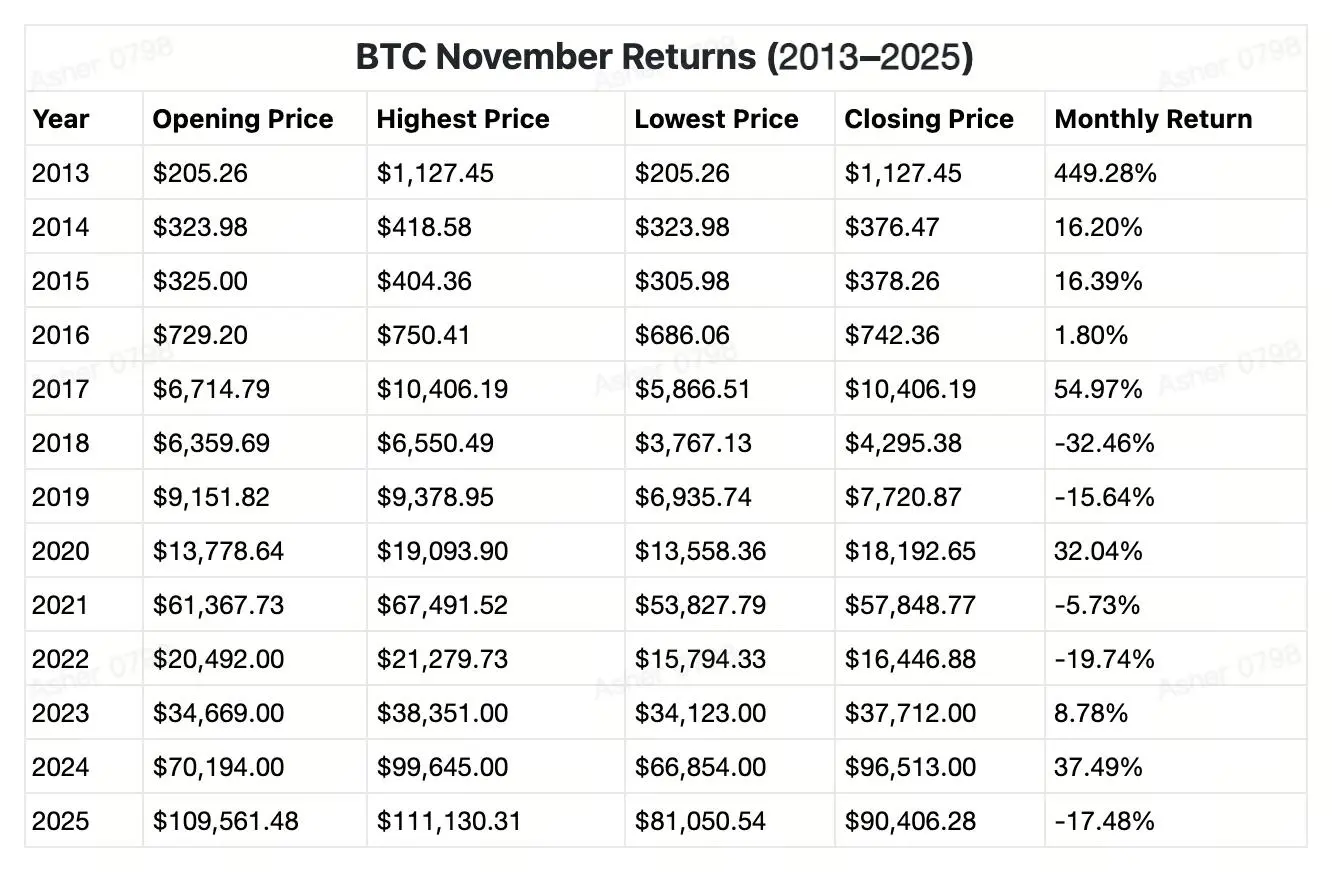
Looking at historical data from the past 13 years, November has been one of Bitcoin's strongest-performing months, but it has also been highly volatile. This certainly does not mean that Bitcoin is guaranteed to rise every November.
Between 2013 and 2025, BTC posted positive monthly returns in 8 November and negative returns in 5. Among the standout performances, Bitcoin surged nearly 450% in November 2013, gained approximately 55% in 2017, and climbed around 37% in 2024. However, it plunged approximately 32% in November 2018, while November 2022 and 2025 also recorded losses exceeding 17%.
One particularly noteworthy statistic deserves attention: excluding 2013, Bitcoin's average November return drops from 40.45% to 6.39%, while the median return falls from 8.78% to 5.29%.
This shows that although November has historically delivered more positive than negative returns, its impressive average performance is largely inflated by the extreme rally in 2013.
Looking at the broader historical picture, November often acts as an amplifier of existing market trends:
- Bull markets: In 2013, 2017, 2020, and 2024, Bitcoin typically recorded substantial gains in November.
- Bear markets: In 2018 and 2022, November often marked an acceleration in the downward trend.
In other words, November does not necessarily create a new market trend, but it often magnifies the trend that is already underway.
Another interesting historical pattern is that early November and the end of the month have tended to perform relatively well, while the middle of the month has often been more prone to corrections.
2. What Stage Is the Crypto Market Currently In?
Current assessment: A period of weak consolidation and trend confirmation following a correction from elevated price levels.
As of November 3, Bitcoin was trading around $78,000, having already fallen below the closely watched $80,000 threshold.
According to Glassnode's November 2 weekly market report, Bitcoin ended last week down approximately 2%, breaking below $80,000 on Thursday. Selling pressure from perpetual futures contracts drove prices lower, while spot buying remained relatively resilient.
At the same time, futures open interest remained elevated, and positive funding rates for long positions had not cooled sufficiently.
This suggests that the current market is not experiencing a straightforward panic-driven sell-off in spot markets. Instead, a potentially concerning market structure is emerging: spot buyers are still stepping in, but leverage in the derivatives market remains high, indicating that the market has yet to complete a meaningful deleveraging process.
From a technical perspective, Bitcoin needs to break above $85,000 with strong trading volume before we can reasonably conclude that the downtrend has ended and an upward trend has been reconfirmed.
Conversely, a break below $74,000 could trigger another major wave of downside volatility and liquidation-driven selling.
Three key warning signals investors should watch in November
First: ETF capital inflows are no longer moving in one direction.
Institutional ETF investments were previously one of Bitcoin's major sources of buying pressure. Recently, however, inflows and outflows have begun alternating.
On November 1, Bitcoin ETFs recorded approximately $643 million in net outflows, creating another demand-side challenge for any potential market recovery.
This means that unless ETFs return to sustained net inflows, a rebound driven primarily by derivatives trading could struggle to maintain its momentum.
Second: Leverage in the derivatives market has not been fully flushed out.
When prices decline while open interest remains elevated, it suggests that a substantial amount of leveraged positioning is still present in the market.
If BTC breaks below key support levels, long liquidations could trigger a cascading sell-off. Conversely, if prices break higher, short covering could accelerate the rebound.
As a result, November could see several sharp moves in both directions, including sudden upside and downside price wicks.
Third: Corrections in traditional technology stocks are beginning to weigh on Bitcoin.
In its November 2 macroeconomic report, Bitwise identified tightening global financial conditions, inflationary pressures, and overcrowded AI-related trades as major sources of market risk.
Although Bitcoin has demonstrated some resilience, it has not yet fully decoupled from traditional risk assets.
3. External Economic and Financial Conditions in November: Why Could Macroeconomics Determine the Direction of the Crypto Market?
Global financial markets in November 2026 are not simply operating in a rate-cut trading environment. Instead, they face multiple challenges, including persistent inflation, expectations of tighter monetary policy, valuation adjustments in technology stocks, and geopolitical risks. This combination is not entirely favorable for Bitcoin.
The Federal Reserve: The Market Is No Longer Just Worried About Rate Cuts — It's Starting to Worry About Rate Hikes Again
On October 28, the Federal Reserve kept the federal funds rate unchanged at 3.75%–4.00%. However, two dissenting votes in favor of a rate hike emerged in the policy decision. Even more noteworthy, the probability of a December rate hike exceeded 80%.
Meanwhile, U.S. GDP grew at an annualized rate of 3.4% in the third quarter, while September PCE inflation rose 3.6% year over year, indicating that inflation remains stubbornly persistent.
This puts the Federal Reserve in a rather awkward position:
If inflation remains elevated, the Fed may keep interest rates higher for longer or even raise them again.
If economic growth slows significantly, the Fed may shift toward monetary easing, but risk assets could experience another round of selling first.
If both economic growth and inflation cool simultaneously, that would be the ideal scenario for Bitcoin.
For BTC, the real bullish combination is not simply interest rate cuts. It is controlled inflation, declining real interest rates, improving U.S. dollar liquidity, and an economy that avoids falling into a severe recession.
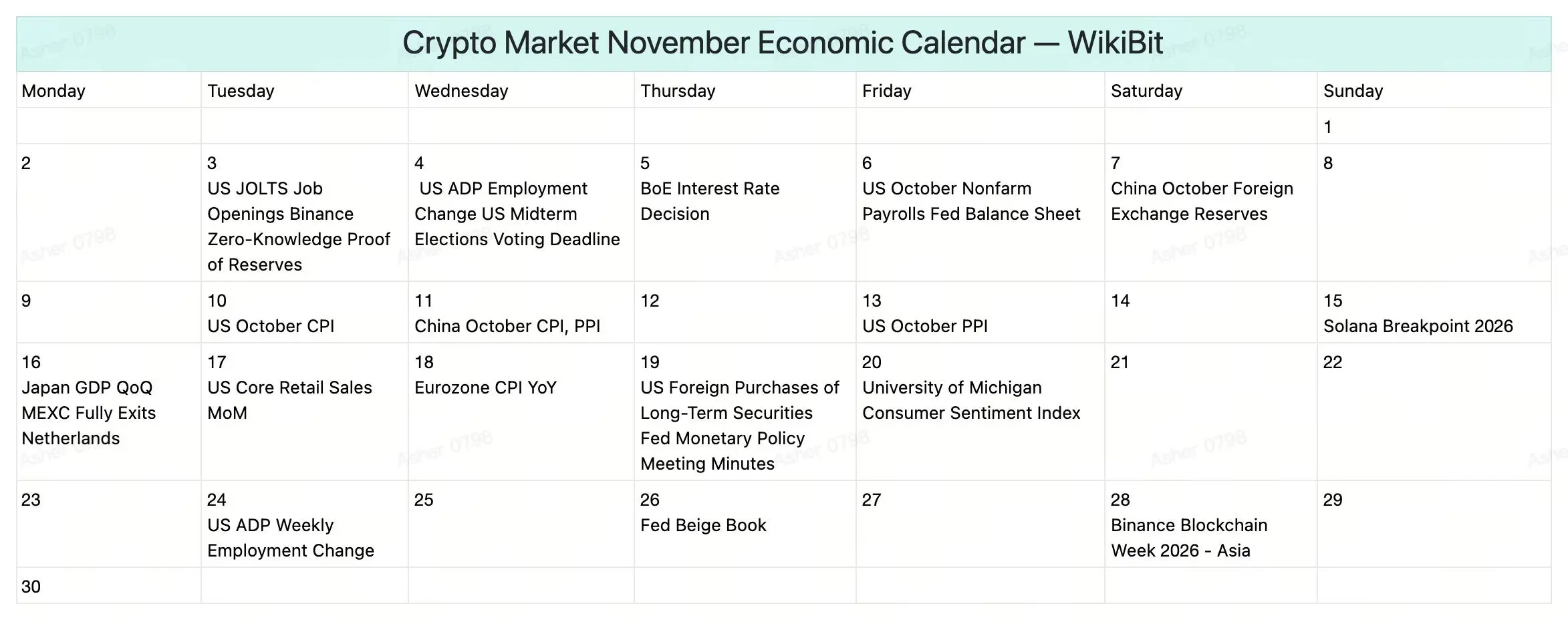
The U.S. CPI and PPI reports in November will be two critical variables. Global energy supplies and geopolitical conditions remain uncertain. Rising energy prices can feed into broader inflation through transportation, production, and consumer prices. If oil prices remain elevated, it will become much harder for the Fed to ease monetary policy.
Two key economic releases to watch in November:
November 10: U.S. October CPI
November 13: U.S. October PPI
Potential implications for BTC:

One particularly important point: if inflation declines while nonfarm employment deteriorates sharply, the market may not rally immediately. This could signal an approaching recession rather than a healthy economic soft landing.
U.S. Midterm Elections: Could Expectations for Crypto Regulation Change?
The U.S. midterm elections on November 3 are among the most closely watched political events of the month.
Voting in the U.S. midterm elections is expected to be completed around 2 p.m. on November 4. Based on vote-counting projections from major media outlets, a clearer picture of the results should emerge between November 8 and November 12.
Historically, Bitcoin has experienced significant declines following U.S. midterm elections.
The post-election declines in 2014, 2018, and 2022 were:
2014: -46%
2018: -49.9%
2022: -14.9%
Bitcoin subsequently bottomed and began recovering after 71 days, 39 days, and 13 days, respectively.
Historical averages:
Average decline to the bottom: Approximately -37.0%
Average time to reach the bottom: Approximately 41 days
If this historical pattern were to repeat, Bitcoin could potentially fall into the $40,000–$50,000 range before bottoming in mid-to-late December.
Of course, history never repeats itself exactly. At best, it rhymes.
Why might this happen?
U.S. midterm elections are not just about changes in congressional seats. They also have implications for several major policy areas:
Cryptocurrency regulation and policy
Stablecoin legislation and regulatory frameworks
Regulatory authority and jurisdiction of the SEC and CFTC
U.S. fiscal deficits and government spending
Regulation of the AI industry and technology companies
In other words, the election results could directly affect the predictability of U.S. policy over the next two years.
If Congress develops a more crypto-friendly policy environment, the market may begin pricing in renewed expectations for U.S. crypto regulatory reforms.
If Congress becomes significantly divided, however, legislative progress could slow.
Overall, though, global monetary policy and financial conditions are likely to have a more immediate impact on BTC than the midterm elections themselves.
AI and Technology Stock Corrections: Bitcoin Could Get Pulled Down Too
One development in global capital markets this year deserves particular attention: investors are beginning to reassess the growing gap between the scale of AI industry investment and its potential future profitability.
AI data centers, semiconductors, and cloud computing infrastructure require enormous capital expenditure. If future revenue growth fails to justify current investment levels, technology companies could face rising financing costs and credit risks.
Why does this matter for Bitcoin?
Over the past few years, institutional investors have increasingly treated BTC as a high-volatility risk asset.
When the Nasdaq falls and institutional investors reduce their overall risk exposure, Bitcoin may face simultaneous selling pressure.
However, another scenario is also possible.
If corrections in technology stocks push long-term Treasury yields lower while markets begin anticipating future monetary easing, BTC could attract renewed capital after an initial wave of short-term selling.
Therefore, in November, investors should monitor not only Bitcoin's price action but also:
The Nasdaq Composite Index
The U.S. 10-year Treasury yield
The U.S. Dollar Index (DXY)
Global Liquidity: The Real Long-Term Trend Worth Watching
Here is another set of data worth paying attention to.
According to CoinDesk Research's report on stablecoins and tokenized assets, published on October 30, 2026:
Global stablecoin market capitalization stood at approximately $306 billion, up 1% year to date.
Adjusted monthly stablecoin transfer volume increased by approximately 41.4%.
Stablecoin transaction volume from January to September 2026 reached approximately $2.33 trillion.
On-chain RWA value reached approximately $38.6 billion, representing year-to-date growth of around 51.3%.
These figures reveal an important trend: stablecoins are being used more frequently, while real-world assets on blockchain networks continue to expand.
Although stablecoin issuance has not experienced explosive growth, the speed at which capital circulates on-chain has increased. Tokenized U.S. Treasuries, equities, credit products, and other traditional financial assets are gradually forming new financial markets.
This suggests that future wealth-building opportunities in crypto will not necessarily come entirely from MEME coins or explosive altcoin rallies.
Stablecoins, RWA, on-chain trading infrastructure, and protocols capable of generating revenue from real economic activity may offer more sustainable long-term investment opportunities.
4. Where Are November's Biggest Wealth-Building Opportunities? Five Investment Themes to Watch
In my view, the biggest opportunity in November is not necessarily finding the next 100x MEME coin. It is identifying sectors that can attract sustained capital inflows.
Based on the current market environment, five major investment themes deserve attention.
1. Bitcoin (BTC): The Ultimate Barometer of Market Direction
Bitcoin remains the primary indicator of the overall crypto market's direction.
Key factors to monitor:
When Bitcoin ETF capital flows return to positive territory.
Whether BTC can hold the $75,000 support level.
Whether BTC can reclaim $82,000.
Only when Bitcoin regains institutional spot-market support will it have a stronger foundation for a sustained medium-term rally.
2. Ethereum (ETH): Waiting for Capital Rotation
Ethereum is worth watching as investors look for potential capital rotation opportunities.
Key factors to monitor:
Whether the ETH/BTC exchange rate can regain strength.
Capital flows into Ethereum ETFs.
Actual growth in stablecoins, DeFi, and RWA activity across the Ethereum ecosystem.
If ETH begins outperforming BTC, it could become an important signal that the broader altcoin market is recovering.
3. RWA Infrastructure: LINK, ONDO, SYRUP, CFG, PENDLE
The continued expansion of the RWA market is creating long-term demand for related infrastructure.
However, one important distinction must be made: industry growth does not automatically translate into token price appreciation.
Investors need to examine how each token captures value from the underlying ecosystem, including whether increased protocol usage actually generates economic benefits for token holders.
4. AI-Related Crypto Projects
Five AI-related projects worth monitoring include:
TAO: Building a decentralized machine intelligence network.
RENDER: Providing GPU computing resources needed for AI model training and inference.
FET: Focused on AI agents, decentralized AI services, and AI infrastructure.
ICP: Developing decentralized cloud computing and blockchain infrastructure.
VIRTUAL: Building an ecosystem for AI agent creation, tokenization, trading, and autonomous economic activity.
The key is to distinguish projects with real applications and revenue potential from those relying primarily on AI-related narratives.
5. On-Chain Derivatives: HYPE and Related Protocols
Focus on HYPE and other on-chain derivatives protocols.
Key indicators include:
On-chain perpetual futures trading volume.
Protocol revenue.
Tokenomics and value-accrual mechanisms.
When market volatility increases, on-chain derivatives platforms may benefit from higher trading volumes. However, their associated tokens can also experience substantial price fluctuations.
RWA Is No Longer Just a Narrative: Real Assets Are Moving On-Chain
On-chain RWA has moved beyond the conceptual stage.
According to CoinDesk statistics, as of September 2026, the total value of tokenized RWAs stood at approximately $38.6 billion, with U.S. Treasuries account for a significant share.
The value of tokenized equities also increased from approximately $678 million at the beginning of the year to around $3.19 billion.
This indicates that traditional financial assets are gradually entering blockchain infrastructure.
However, it is important to distinguish between three different layers of the RWA industry:
Real-world asset issuers: Provide the underlying financial assets that can be tokenized.
Infrastructure providers: Supply oracles, custody, cross-chain connectivity, and settlement services.
Trading and distribution platforms: Provide trading access, lending services, and liquidity.
LINK, ONDO, ETH, and other related tokens can be added to an investment watchlist, but investors should not automatically equate sector growth with token price appreciation.
November Investment Themes: Priority Watchlist
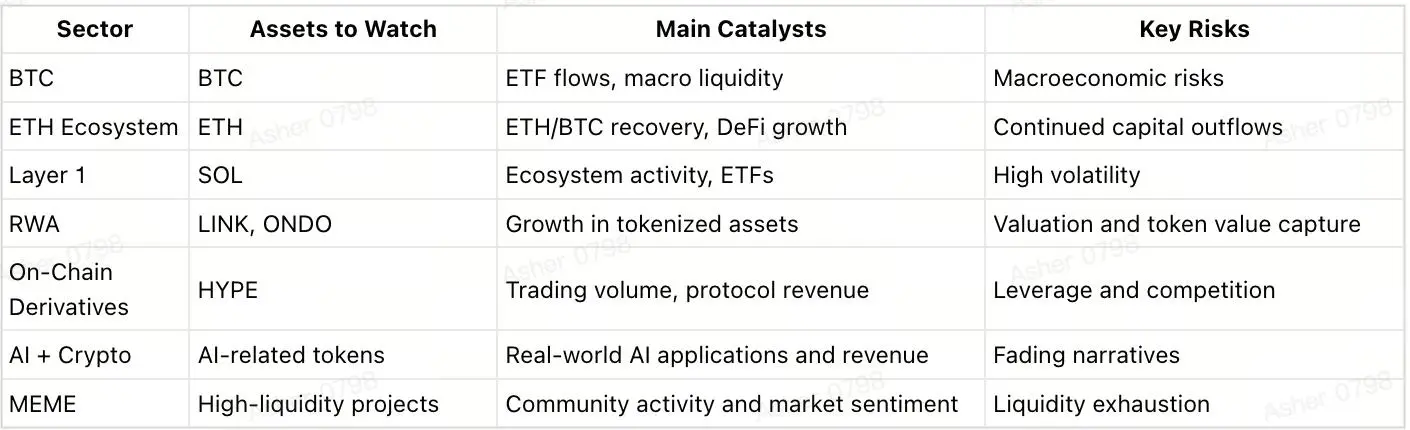
One point needs to be emphasized: we are not currently in a full-blown altcoin season.
The market environment in early November is better suited to focusing on liquidity, real-world adoption, and fundamentals rather than indiscriminately buying every popular crypto sector.
5. Major Token Unlocks in November: Which Coins Could Face Selling Pressure?
Token unlocks are a key variable to monitor in November, especially when investors, teams, or foundations hold a large share of supply, and when the unlock is significant relative to current circulating supply.
An unlock does not necessarily mean holders will sell. But it does mean potentially tradable supply is increasing. If new buying demand is not enough, this extra supply could create downward price pressure.
Novembers Major Token Unlock Calendar
The data is compiled from third-party token unlock tracking platforms as of November 1. USD values will move with token prices. For exact dates and quantities, always refer to each projects official tokenomics documentation.
Different tracking platforms may report different unlock dates, allocation categories, and calculation methods.
One important note: MON‘s 144.7% figure represents the unlock amount relative to current circulating supply estimated by the tracking platform, not its percentage of total token supply. Verify the actual unlock against Monad’s official disclosures.
Five Token Unlock Events That Deserve Particular Attention
MON, Monad — November 24 — $334 million
This is one of the largest token unlock risks this month. Monads mainnet launched in November 2025, and team, investor, and related treasury tokens were subject to previous lock-ups. Third-party platforms estimate about 17.1 billion MON could unlock on November 24, worth around $334 million.
ZRO, LayerZero — November 19 — $45 million
This unlock is about 5.9% of current circulating supply, mainly involving core contributors and strategic partners. This percentage deserves attention, especially if the token has already rallied before the unlock. Some investors may take profits in anticipation of additional supply.
H, Humanity Protocol — November 23 — 13.8%
About 293 million tokens, worth an estimated $16 million, are expected to unlock. The percentage relative to circulating supply is relatively high. Watch who receives these tokens and whether those recipients have strong incentives to sell.
GRVT — November 29 — 64.4%
About 73.6 million tokens, worth an estimated $17 million, are expected to unlock. Because current circulating supply is relatively small, this unlock percentage is particularly concerning.
STABLE — November 7 — 4.9%
About 889 million tokens, worth an estimated $24 million, are expected to unlock. This is a relatively significant supply increase early in the month. Watch whether the market has enough buying demand to absorb it.
Token Unlock Trading Strategies: Dont Automatically Assume Every Unlock Will Trigger a Price Drop
The real questions are: Who receives the unlocked tokens? Investors, team members, or the community? How large is the unlock relative to circulating supply and average daily trading volume? Can the tokens be sold immediately, or are there extra transfer restrictions? What is happening on-chain? Are large wallets moving tokens to exchanges? And what is the broader market environment? Is BTC trending up or down?
My strategy: avoid blindly chasing prices ahead of major unlocks. Instead, observe how the market absorbs the additional supply over the next two to three days. If a large number of tokens unlock but price does not fall significantly and volume remains active, the market may have already priced in and absorbed much of the selling pressure. Conversely, if the token rallies continuously before the unlock, followed by increasing net inflows to exchanges and a high-volume breakdown below key support, be alert to further correction.
6. November Airdrop Opportunities: Which Projects Are Worth Participating In?
If BTC remains range-bound in November, airdrops could provide another way for some investors to generate additional returns.
However, project teams are increasingly emphasizing genuine trading activity, on-chain interactions, capital utilization, and user retention.
So follow one basic principle: prioritize projects with clearly defined reward rules, official campaigns, and confirmed claim deadlines. Avoid committing substantial capital to points programs that do not even have a confirmed token.
November Airdrops and Reward Campaigns Worth Watching
Several projects deserve particular attention: Aster, ASTER; SoSoValue, SOSO; Doppler Finance, XDP; Push Chain; and Variational, VAR.
Important Risk Reminder
Do not deposit large amounts of assets into unfamiliar protocols just to qualify for an airdrop. Never trust so-called exclusive or insider claim links. Never provide your seed phrase or private keys to any website. Airdrops are not guaranteed profits. Points may have no conversion value into tokens, and projects may cancel reward programs altogether.
7. How Should You Trade in November? Four Practical Strategies
When market direction is uncertain, the most important thing is not how accurately you predict the market. It is whether your portfolio can withstand being wrong. I recommend different strategies for different investment styles.
Strategy 1: Long-Term Investors — Build Positions Gradually, Dont Try to Catch the Bottom All at Once
If your investment horizon is six to twelve months or longer, BTC and ETH should be among your primary assets to watch.
First entry: establish a small position near major support zones. Second entry: if prices correct again but key support remains intact, consider adding. Third entry: consider increasing exposure after a breakout above major resistance, ideally with ETF inflows confirming renewed institutional demand.
Do not assume a bottom is in simply because BTC has fallen 10%. For long-term investors, the most important factors are Bitcoins medium- to long-term trend, institutional capital flows, macroeconomic liquidity, and the overall market cycle.
Strategy 2: Short-Term Traders — Trade Around Key Support and Resistance Levels
Short-term traders can focus on key Bitcoin price zones. Do not immediately open short positions just because price breaks below support. Likewise, avoid chasing long positions after a single large bullish candle.
A better approach: wait until price reaches key zones, examine volume and aggressive buying and selling activity, and look for confirmation on the 15-minute, 1-hour, or 4-hour chart. Only execute after setting an appropriate stop-loss.
Strategy 3: Futures Traders — Reduce Leverage as Much as Possible in November
This is a point I particularly want to emphasize. BTC futures open interest remains relatively high, while funding rates have not cooled sufficiently. November also brings several major events, including the U.S. midterm elections, nonfarm payroll data, CPI, and PPI. Any of these could trigger sharp market movements within a short period.
My recommendations: use lower leverage whenever possible. Avoid oversized positions with excessive leverage. Keep the maximum loss on an individual trade within 5% to 10% of total trading capital. Avoid opening positions blindly ahead of major economic announcements. Never double down after consecutive losses. Never treat your liquidation price as your stop-loss price.
The core principle of futures trading is not getting every prediction right. It is making sure you can stay in the market when you get something wrong.
Strategy 4: Investors with Limited Capital — Focus on Airdrops and Low-Cost Ecosystem Participation
If you do not have enough capital to build meaningful spot positions and are not experienced in futures trading, consider participating in ecosystem campaigns and airdrop opportunities.
Projects and activities worth monitoring include: Push Chain Season 3; SoSoValue SSI; Doppler XDP claims for users who have already qualified; Variational ecosystem campaigns; and other ecosystem reward programs with clearly defined official rules.
But remember to factor in gas fees, capital lock-up requirements, and the time involved. Do not invest thousands of dollars just to chase an airdrop that might ultimately be worth only a few hundred dollars.