




A scammer no longer needs to break into your bank account to steal your money. An investment advert on Instagram or a convincing WhatsApp message can be enough to persuade you to send it yourself.
That shift is showing up in the UKs fraud figures. Investment scams cost UK victims £221.5 million in 2025, up 40% from the previous year, according to UK Finance. Total fraud losses approached £1.3 billion.
Losses from scams in which people authorised the payment rose 19%, while fraud involving payments taken without permission fell 5%.
That leaves payment firms trying to stop transfers their own customers insist are legitimate.
Chet Shah, CEO of Wirex Limited, the UK-regulated payments arm of Wirex, told BeInCrypto that much of the problem begins outside the banking system.
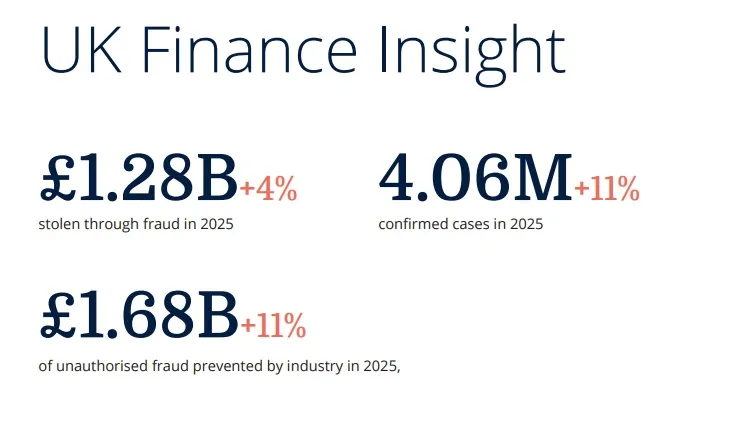
UK Fraud Statistics. Source: UK FinanceThe Scam Is Often Over Before the Money Moves
According to UK Finance, 66% of authorised push payment (APP) scam cases begin online. Wirex saw a similar pattern in the first half of 2026, when social media investment scams were its most common fraud type.
“Were seeing that fraud is moving away from theft and towards deception, and a lot of that comes from investment scams that start on social media, which was the most common type we saw.”
A fake investment opportunity or a message from someone impersonating a bank employee can build trust before the request for money arrives.
Shah said some victims even resist intervention from fraud teams, because they believe theyre not being scammed.
“The victim then authorises the payment willingly, often defending the decision if FinCrime teams question it.”
By that stage, stopping the transaction becomes considerably harder.
“Thats what makes it harder for a firm like Wirex to stop: by the time a payment instruction reaches us, the persuasion has already happened somewhere else, and the victim is snared.”
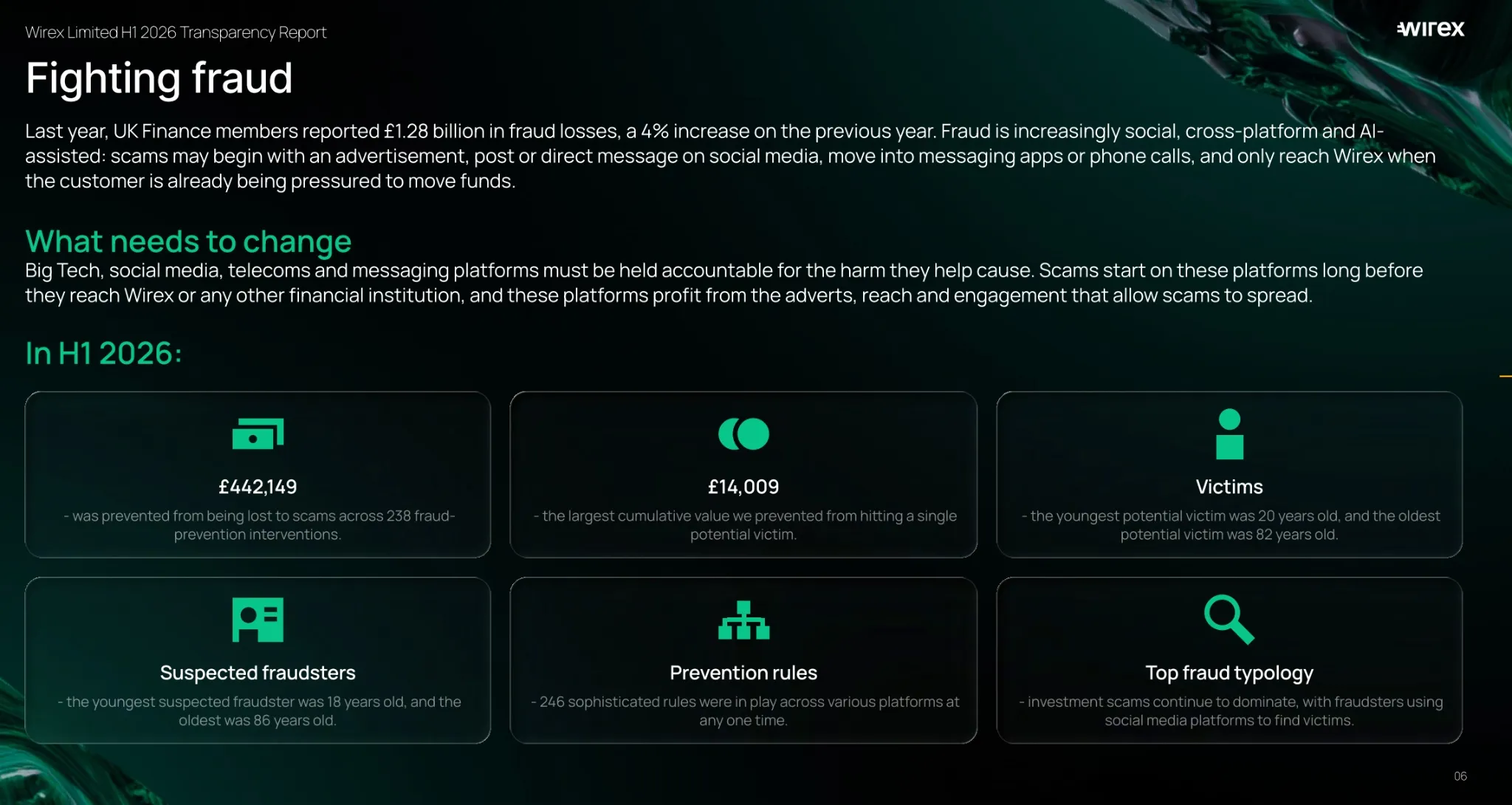
Fraud Prevention Results for January to June 2026. Source: Wirex Limited H1 2026 Transparency Report
The victims are not limited to one age group. Wirexs youngest potential victim was 20 and its oldest 82. Suspected fraudsters ranged from 18 to 86.
“This isn‘t a young person’s crime anymore, and mule recruitment isnt either.”
Shah suspects AI is helping criminals test new messages and scale the ones that work, although he says Wirex cannot know that for certain.
The person talking to you every day might not be real.
AI-powered romance scams are becoming a serious threat in crypto because they do not start with a wallet hack. They start by building trust.
It often begins on a dating app, social media platform, or messaging app. The… pic.twitter.com/PX0XdZeBpv
— Wirex (@wirexapp) June 27, 2026
Social Platforms Host the Scam. Banks Pay for It
Shah argues that the burden of stopping these scams falls too heavily on the companies handling payments.
Under UK rules introduced on October 7, 2024, eligible victims of APP scams through Faster Payments and CHAPS can be reimbursed up to £85,000 per claim. The sending and receiving payment firms generally split that cost equally.
The scam, however, may have begun on an entirely different companys platform.
“Even if we‘ve done everything possible to inform the customer it’s a scam, the big tech social media companies face no implications, giving them no incentive to stop it. In fact, these platforms profit from scam adverts, reach and engagement that allow fraud to spread.”
Regulators are considering changes. In July 2026, Ofcom published draft codes with nearly 40 proposed measures to tackle fraudulent advertising across social media, search engines and video platforms.
The consultation closed October 2. A final position is expected in mid-2027, with parliamentary approval still required afterward.
Seven Million Payments, and the Ones Wirex Stopped
Wirexs H1 2026 Transparency Report covers more than 7 million transactions worth about £600 million from January through June.
According to the company, it stopped £442,149 in potential scam losses through 238 interventions, blocked another £225,000 in suspected criminal funds, and filed 183 Suspicious Activity Reports with the National Crime Agency.
The figures show what the firm says it intercepted. They do not reveal how much fraud escaped detection, making it difficult to judge success from the headline totals alone.
Wirex says 246 prevention rules were operating at any one time during the period. It is also using AI to connect suspicious behaviour across large volumes of data.
The “support agent” in your DMs might be the scammer who drains your wallet.
Fake customer support scams have become one of the most common threats in crypto, especially on X, Telegram, Discord, Reddit, and community forums where people ask for help publicly.
Heres why this… pic.twitter.com/6ZffeDqyki
— Wirex (@wirexapp) May 21, 2026
Shah described how the technology helped uncover a criminal network that initially appeared to be a local problem.
“We spotted mule-like activity in a customer segment, which, on its own, looked like a regional issue. Using AI-assisted analysis to process account and transaction data at scale, we found the same behaviour running across borders. An analyst reviewing cases one at a time may not have connected the dots on this so quickly, but we turned this into a permanent detection rule.”
Wirex says analysts still make the final decisions. The firm plans to introduce Sentinel, an AI-assisted anti-money-laundering case review tool, and Tradecraft, a system that trains analysts using AI-generated scam scenarios.
When Your Bank Freezes the Wrong Person
Fraud checks create another problem. A frozen account can stop a criminal, but it can also leave an innocent customer unable to access money they need.
Shah acknowledged that Wirex has made the wrong call in some cases, including disputes that reached the Financial Ombudsman Service.
“What we‘ve learned is that a freeze is not a neutral, risk-free action just because it’s cautious. Sometimes we get that decision wrong: we‘re too slow to freeze, and the money’s gone, or we freeze a legitimate customers funds and cause real harm, even to someone who was already vulnerable.”
For Shah, how quickly a company resolves such cases is just as important as the original decision.
“A frozen account with no explanation is one of the most distressing things that can happen to someone, especially if they‘re relying on that money. We’ve learned that the speed of resolution matters almost as much as the accuracy of the original decision, and that being upfront early — even with limited information — reduces harm even when the freeze itself was justified.”
Wirex reported that complaints fell 42% and referrals to the Ombudsman declined 67% in the first half of 2026 compared with the second half of 2025. The figures do not erase individual mistakes.
The Number Wirex Wants to See Fall
Shah argues that fraud prevention must be measured through customer outcomes. A compliance audit alone may overlook wrongful freezes and missed scams.
“Compliance tells you whether you‘ve built the controls. It doesn’t tell you whether they‘re working. You can pass an audit with a well-documented framework and still be letting scams through, or freezing the wrong people’s money. So the question we ask ourselves is: what actually happened to the customer?”
Suspicious Activity Reports at Wirex fell by a quarter in the first half. Shah says the priority is making reports useful to investigators rather than increasing their number.
He also wants to shorten the time between spotting a new scam pattern and putting a detection rule in place.
Shah even hopes the £442,149 saved from scams eventually falls.
“In all honesty, I‘d like that number to come down; not because we’ve got worse at catching it, but because less of it is reaching us in the first place. That depends on better prevention upstream and on real consequences for the platforms where these scams start. What I want to go up is the proportion we stop of whatever does reach us.”
His point is that stopping scams upstream would protect people before a payment ever reaches the bank.
For now, payment companies are left making the final decision, often after the scammers have already won the victims trust.