






Central Bank of Brazil pushes for electronic money regulation for stablecoins
The debate around stablecoins is taking shape in Brazil, and the central banks opinion offers an insight into what might happen and how these tools might be considered in upcoming regulation.
In a recent hearing on Tuesday within the Congress Economic Development Committee, the central bank revealed its position, stressing that stablecoins should be considered electronic monetary instruments, a posture rejected by most of the crypto industry.
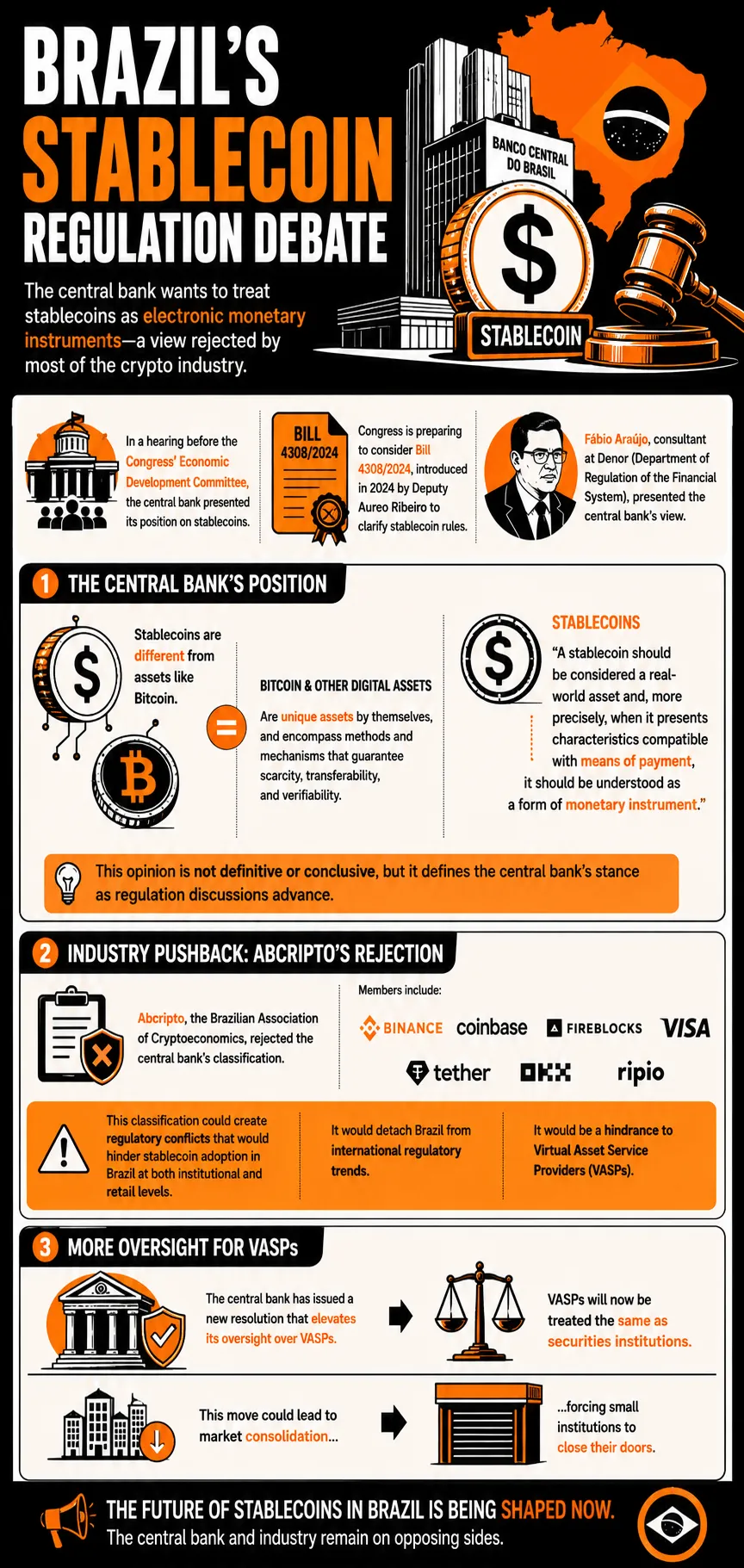
Fábio Araújo, consultant for the Department of Regulation of the Financial System (Denor), which assesses the central bank on regulatory issues, argued that stablecoins are different from other assets, such as Bitcoin, and that their regulation should also differ.
Araújo claimed that digital assets, including bitcoin and ether, constitute unique assets and offer mechanisms that guarantee scarcity, transferability, and verifiability by themselves.
“With stablecoins, its different… a stablecoin should be considered a real-world asset and, more precisely, when it presents characteristics compatible with means of payment, it should be understood as a form of monetary instrument,”he stressed.
While this opinion is not definitive or conclusive, it defines the central banks stance on the subject as Congress prepares to consider Bill 4308/2024, introduced in 2024 by Deputy Aureo Ribeiro to clarify stablecoin rules.
Abcripto, the Brazilian Association of Cryptoeconomics, which groups industry heavyweights like Binance, Coinbase, Fireblocks, Visa, Tether, OKX, and Ripio, has rejected this classification.
The association explained that this would introduce regulatory conflicts that would affect the adoption of stablecoins in Brazil at the institutional and retail levels, and that it would detach Brazil from international regulatory trends, becoming a hindrance to virtual asset service providers (VASPs).
The bank has also recently issued a new resolution that elevates its oversight over VASPs, whose treatment will now be equalized with that of securities institutions, a move that might lead to consolidation, forcing small institutions to close their doors.