






The Bank of Korea (BOK) held its benchmark rate at 3.00% on Thursday after two straight hikes. A 222.5% surge in early October chip exports keeps a November increase in play.
The seven-member board matched the forecast of all 34 analysts in a Reuters poll. Yet the Korea Composite Stock Price Index (KOSPI) fell 20.72% in 10 sessions through Oct. 20.
Why Does a Chip Boom Keep Rate Hikes in Play?
Semiconductor exports in the first 20 days of October rose 222.5% from a year earlier, AJP reported.
Sponsored

Sponsored
Meanwhile, that strength keeps price pressure alive, the Korea Times reported. Consumer prices rose 2.9% in September, above the banks 2% target, while core inflation eased to 2.8% from 3.4%.
The board raised rates by 0.25 percentage points in both July and August, lifting them from 2.5%.
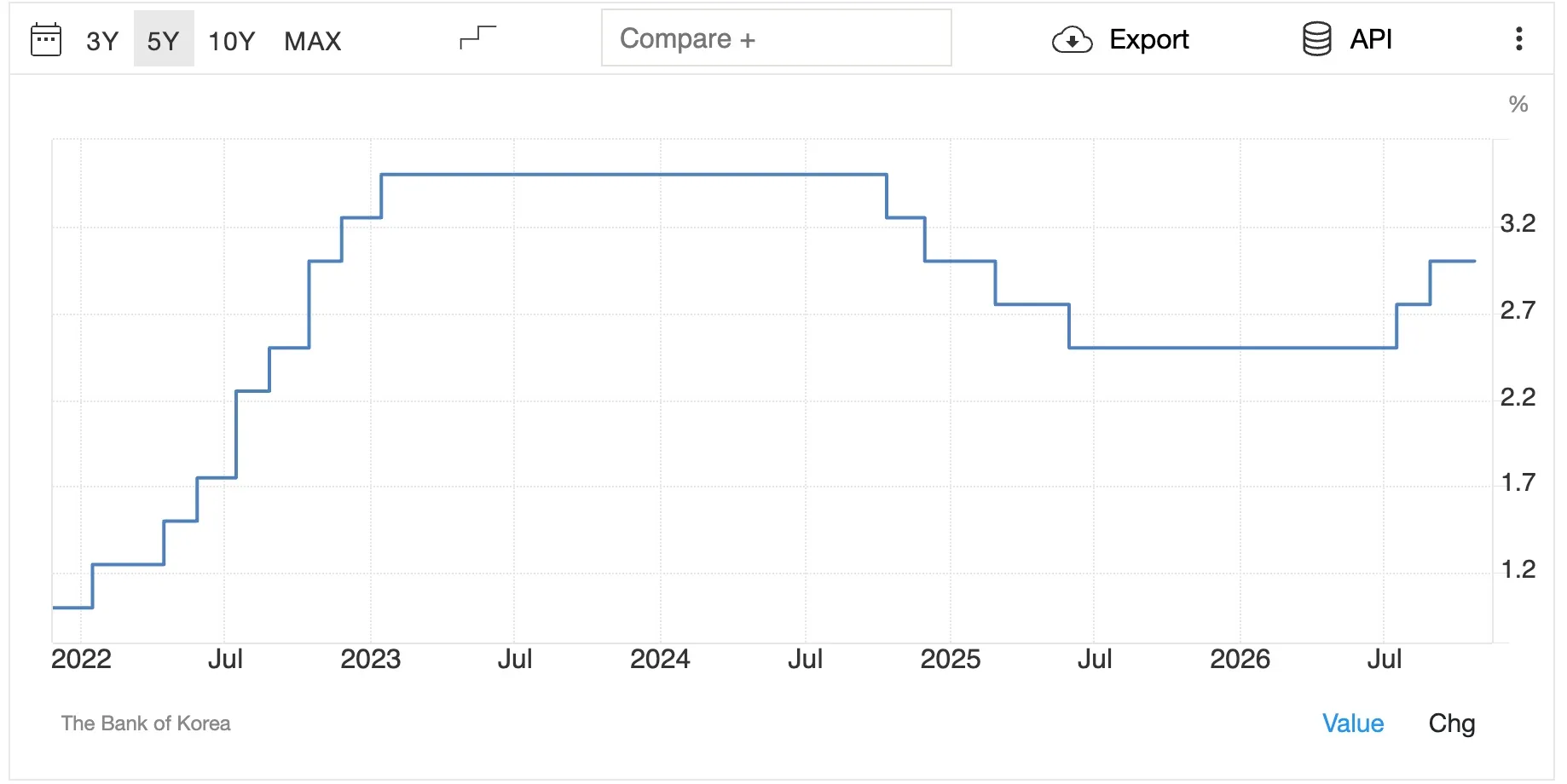
Rates have stayed at 3% for now. Source: Trading Economics
However, Governor Shin Hyun-song warned lawmakers on Oct. 12 that higher rates strain vulnerable borrowers. He also flagged Seoul home prices and household debt as risks.
Eighteen of 20 experts in a Seoul Economic Daily survey expect a November hike. Citibank and Morgan Stanley expect rates to reach 3.5% in early 2027.
Why Are Chip Stocks Falling Despite Surging Exports?
The KOSPI dropped 3.73% on Oct. 20 to 5,552.74. Samsung Electronics fell 2.98% and SK hynix 4.23% that day, the Herald Business reported.
Doubts over returns on AI spending are weighing on chipmakers. Noh Dong-gil, a researcher at Shinhan Securities, told broadcaster SBS the drop reflects an unwind of concentrated chip holdings. He saw no Korea-specific problem.
Brokerages are not calling a bottom yet. Korea Investment & Securities has flagged 5,100 as a possible floor. However, the index rebounded 3.29% on Wednesday to 5,735.66, then opened 1.14% lower on Thursday before the decision.
The BOK is tightening into an export boom that rests on AI spending markets now question. Therefore, its November call depends on chip demand as much as inflation. Korean commentary warning of chip oversupply from 2029 adds a longer-term risk.