






The cryptocurrency ecosystem was agog when the Ethereum Improvement Protocol (EIP) 1559 went live last week. The EIP 1559 upgrade, also called the London Hardfork introduced a few improvements into the Ethereum blockchain which prior was notably plagued with congestion and high network fees.
Prior to the launch of the hardfork, users engage in a bidding war with their transaction fees as a way catch the attention of miners who help in prioritizing the transactions when validating several entries. As the condition to get transactions faster was inherent in who have the bigger pocket to pay an attractive fee, these fees reportedly grew to new highs that made the network largely unusable.
All these are supposedly in the past with the emergence of the EIP 1559 upgrade. The new protocol now proposes a base fee which all network users pay for transactions. This base fee can be viewed in advance, and it is calculated on-chain based on the congestion in the network per time.
Is the Base Fee Model Solving the Gas Fee Hike Challenge?
Data from Glassnode shows that the average gas usage in the Ethereum network has hit a 5-year high of 43,799.060.
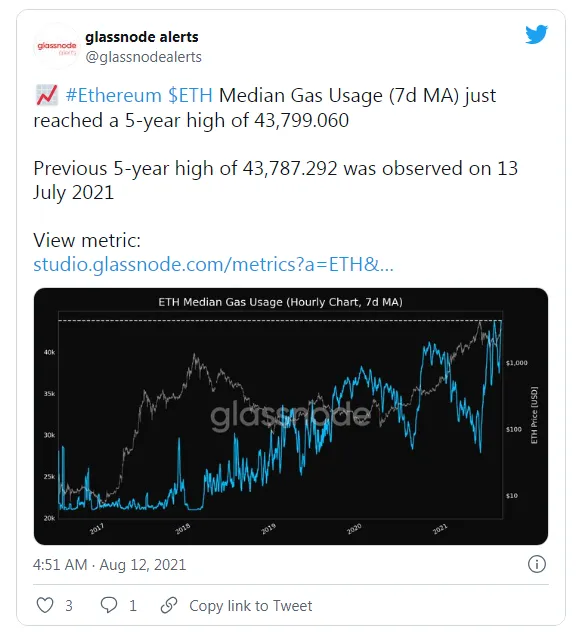
This metric is all about the functionality of the Ethereum network. The gas limit is a unit that measures the use of computational power in the Ethereum network. That is, how much effort computers processing a certain operation will need to put in to successfully execute the operation.
Typically the more complex the transactions, the higher the gas limit will be. Increased gas limit is a clear indication of more transactions occuring on the blockchain. Correspondingly, the more the transactions, the more is the gas fee that is billed to be paid. The emergence of the EIP 1559 upgrade has changed the gas war by users, however, with a provision for network users to drop a tip for the miners who maintains the network.
This incentive provision can be exploited to make the entire network spiral back to the old gas fee challenge. While the mode may differ of this challenge may differ, the Ethereum network is might continue to see a lot of congestion, perhaps until the full migration to Ethereum 2.0 is completed.