






Shipping firms that turn to cryptocurrency to pay potential transit fees to Iran could face significant sanctions exposure, according to Kaitlin Martin, senior intelligence analyst at Chainalysis.
Martin told Cointelegraph that under the current sanctions framework, any payments made to the Iranian regime, including those tied to passage through key waterways, could be interpreted as “material support,” putting companies at risk of violating US and international restrictions.
“Doing so could carry significant sanctions violation risk, as the Iranian Revolutionary Guard Corps is sanctioned by multiple jurisdictions and Iran is subject to comprehensive sanctions by the United States,” she said.
The warning comes amid reports that Iran may seek to collect transit fees in cryptocurrency. While there has been no official confirmation, US President Donald Trump has said he would not accept any attempt by Tehran to impose tolls on shipping through the vital waterway.
Related: White House warns staff as Iran bets add to growing insider trading concerns
Iran expands crypto use
Tehran has already expanded its use of digital assets, particularly stablecoins, to facilitate trade in oil, weapons and commodities, based on publicly available data, Martin said.
However, she noted that cryptocurrency is not a foolproof workaround for sanctions. While it enables cross-border transfers outside the conventional financial system, blockchain transactions are inherently transparent and leave a permanent record.
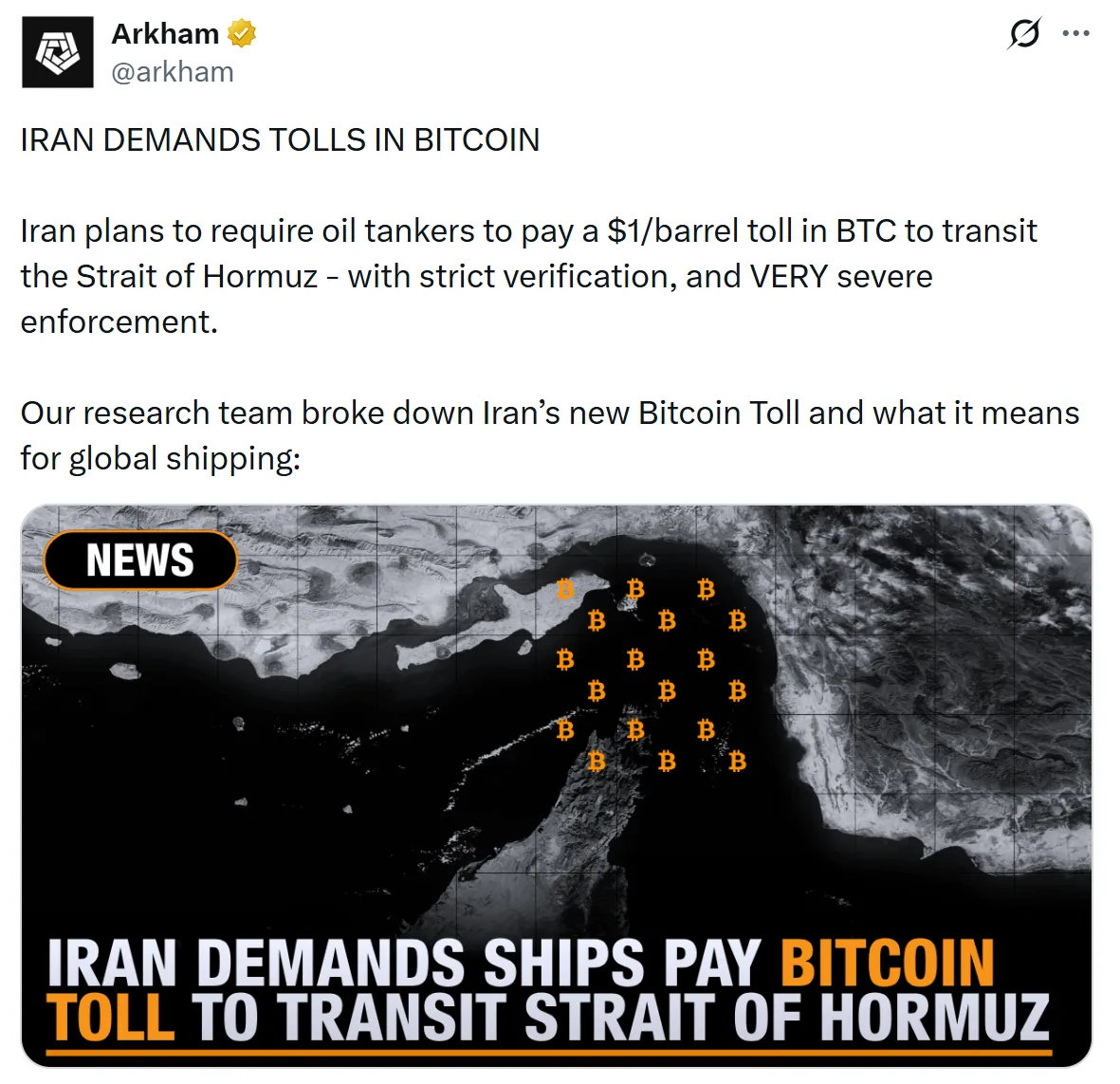
Source: Arkham
“In many ways, cryptocurrency is actually easier to trace than traditional methods of sanctions evasion,” she said, pointing to the ability of investigators to follow funds to cash-out points where assets can be frozen or seized.
Other sanctioned states have also explored similar approaches. Russia, for instance, has used digital tokens such as A7A5 to facilitate cross-border trade following sanctions imposed after its 2022 invasion of Ukraine.
Related: Bitcoin community weighs in on reports of Iran's crypto toll for oil ships
Irans Bitcoin hashrate drops sharply
As Cointelegraph reported, Irans Bitcoin (BTC) mining power has dropped significantly over the past quarter, losing around 7 exahashes per second and falling to roughly 2 EH/s, amid escalating tensions with the United States and Israel.
Despite the regional disruption, the global Bitcoin network remains stable, with total hashrate holding near 1,000 EH/s. Notably, the impact has been contained within Iran, with neighboring countries such as the United Arab Emirates and Oman unaffected.