




For years, Michael Saylors Bitcoin [$BTC] strategy looked nearly impossible to challenge. Every capital raise financed another Bitcoin purchase. Every rally reinforced the model. Shareholder dilution also seemed justified because the corporate treasury kept expanding.
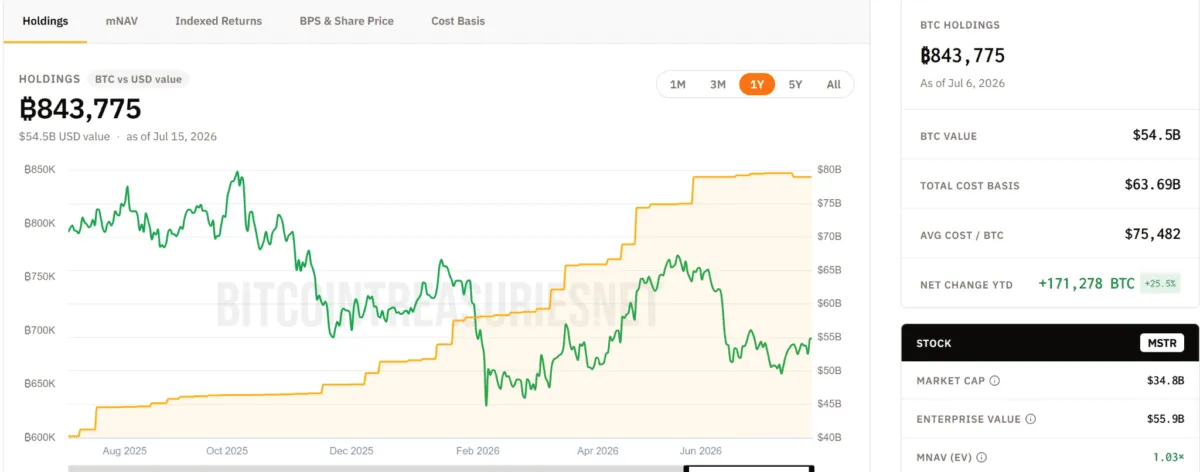
Yet, success gradually introduced a different challenge. The financial engine behind the relentless accumulation is now demanding more from the treasury it was built to grow. At press time, Strategy held 843,775 $BTC, worth about $54.5 billion. This milestone comes after adding 171,278 $BTC this year.
Source: Bitcoin Treasuries
However, those holdings carry a $63.69 billion cost basis, with an average purchase price of $75,482. That gap has shifted attention from accumulation toward the sustainability of the model. Reflecting that transition, the recent sale of 3,588 $BTC was used to support STRC dividends and strengthen $3 billion in cash reserves.
That said, the real question remains. Can Bitcoins future appreciation continue offsetting dilution, financing costs, and an increasingly self-dependent capital structure?
The engine behind Strategy
Dependence on the rising price of Bitcoin is no accident; it has been the foundation of Strategys accumulation engine since day one.
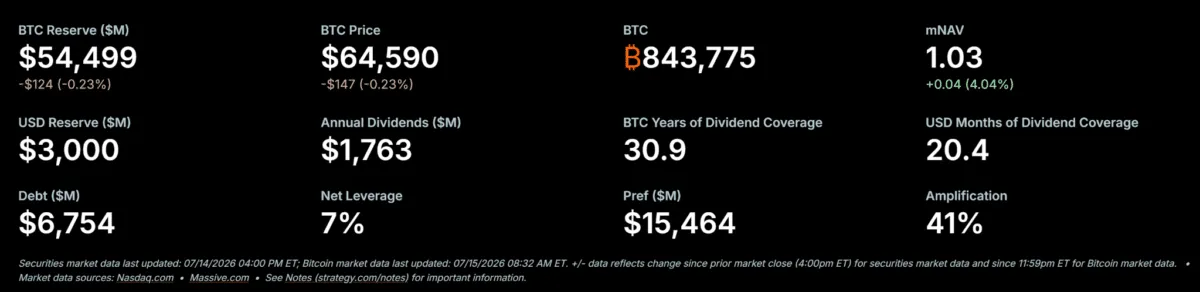
Meanwhile, the Market to Net Asset Value (mNAV) has slipped to just 1.03x. The metric gauges how the market values a Digital Asset Treasury (DAT). Previously, it spiked as high as 2.51x, but the sharp decline has eroded the premium that once made equity issuances highly accretive.
Rather than relying on operating cash flow, the company depended on maintaining an enterprise mNAV above 1, allowing it to issue shares at a premium and recycle fresh capital into Bitcoin purchases.
For years, that formula worked remarkably well in favor of the DAT. As mNAV climbed to 3.89x, Strategy raised $25.3 billion during 2025 and accelerated its treasury expansion without materially weakening shareholder exposure. However, currently, the math has changed.
Source: Strategy
Therefore, Strategy will likely have to shift its focus away from adding to its Bitcoin holdings and toward creating flexibility within its balance sheet. Still, not everyone views the recent pressure as evidence that the model is failing.
Lead Information Compliance Assurance Manager at SpaceX, Vincent Peters, observed,
People often confuse volatility with failure. Bitcoin has experienced extraordinary appreciation punctuated by significant corrections.
He added that while those corrections create headlines, they “dont necessarily invalidate a long-term strategy.” Unless Bitcoin regains sustained upward momentum, rebuilding the premium may prove more important than acquiring the next Bitcoin.
The per-share challenge
That changing reality is also reshaping how Strategy measures success. The company was never trying to own more Bitcoin for the sake of it. Instead, the objective was to ensure every shareholder owned more Bitcoin over time. Such a distinction made $BTC Yield and Bitcoin per share the clearest measures of whether the model was truly creating value. For several years, the model delivered on that promise.
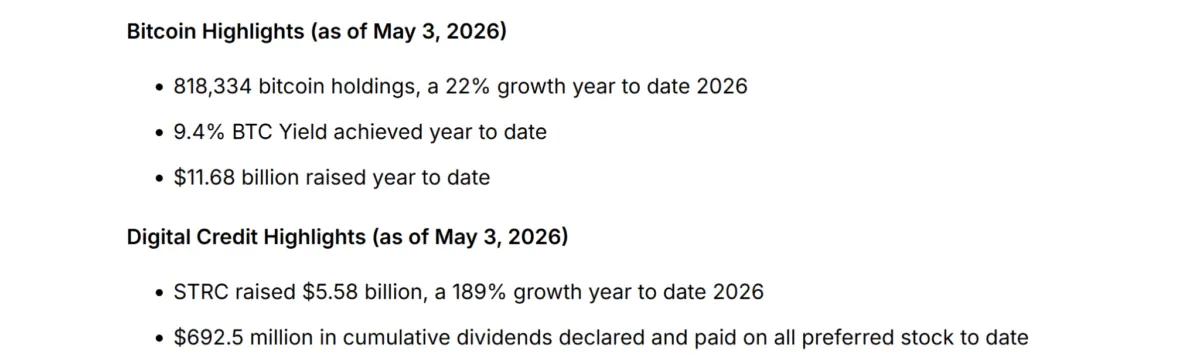
$BTC yield reached 9.4% in early 2026, while Bitcoin per share climbed to 207,776 satoshi (sats), supported by 171,278 $BTC in net accumulation. Yet, the $BTC yield has fallen off slightly, hovering around 6.6% as of press time. Although the flywheel has slowed down considerably, that same slowdown has started to impact how well Strategy is performing, according to those same metrics.
As enterprise mNAV compressed toward 1.03x, each new share issued generated less incremental Bitcoin ownership than before.
Source: Strategy
More importantly, investors are no longer watching Strategy solely for the size of its Bitcoin treasury. They are watching whether it can continue funding future purchases. That debate has also attracted criticism from longtime Bitcoin skeptic Peter Schiff, who questioned Strategys capital allocation. He argued,
The model needlessly destroyed shareholder value by selling discounted MSTR shares instead of Bitcoin.
That shift matters. Rather than being simply the largest owner of Bitcoin, Strategy has become a proxy indicator for institutional demand for Bitcoin.
Therefore, the debate is moving beyond treasury growth alone, with the focus now on whether Strategy can maintain investor confidence in its ability to generate shareholder wealth over the long term by continuing to fund future purchases.
The cost of conviction
Building the world‘s largest corporate Bitcoin treasury has given Strategy its greatest financial burden. That trade-off is becoming harder to ignore as Strategy’s capital structure grows more complex.
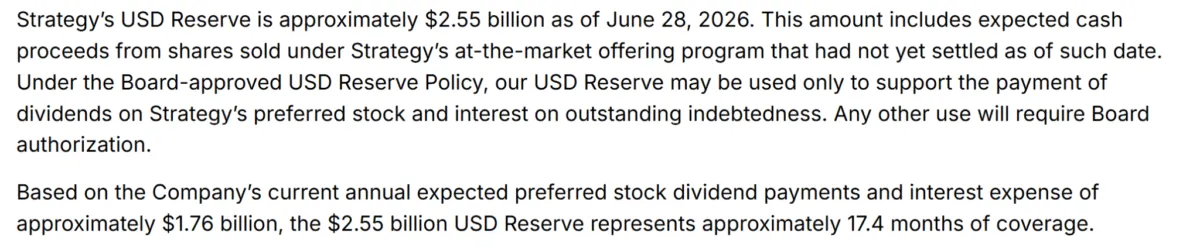
The DAT has approximately $1.76 billion annually in Stretch (STRC) dividend obligations. In addition to those, it also has convertible notes and continuing equity financing. Meanwhile, its software business generates only about $500 million in annual revenue.
Source: Strategy
Therefore, there exists a large funding gap. This funding gap explains why, currently, capital markets are equally important to the price of Strategys Bitcoin.
As Andrew Bahlmann, founder of Deal Leaders International, noted,
Having conviction with respect to an asset does not equate to having confidence in the ability to finance it.
He added that lenders ultimately favor collateral that remains stable across market cycles rather than assets whose value fluctuates sharply.
Strategy has approximately $2.5 to $3 billion in cash reserves. Therefore, it retains some financial flexibility. Still, prolonged mNAV compression may limit access to accretive capital. This would increase reliance upon reserves or selective sales of the Strategys Bitcoin to meet obligations. As such, this challenge is evident when compared to peers.
Metaplanet continues to expand through lower-cost yen-denominated financing. This is by accepting currency risk in exchange for cheaper capital despite mNAV near 0.92x. In contrast, Semler Scientific has adopted a more conservative approach, relying on lower issuance and minimal preferred obligations.
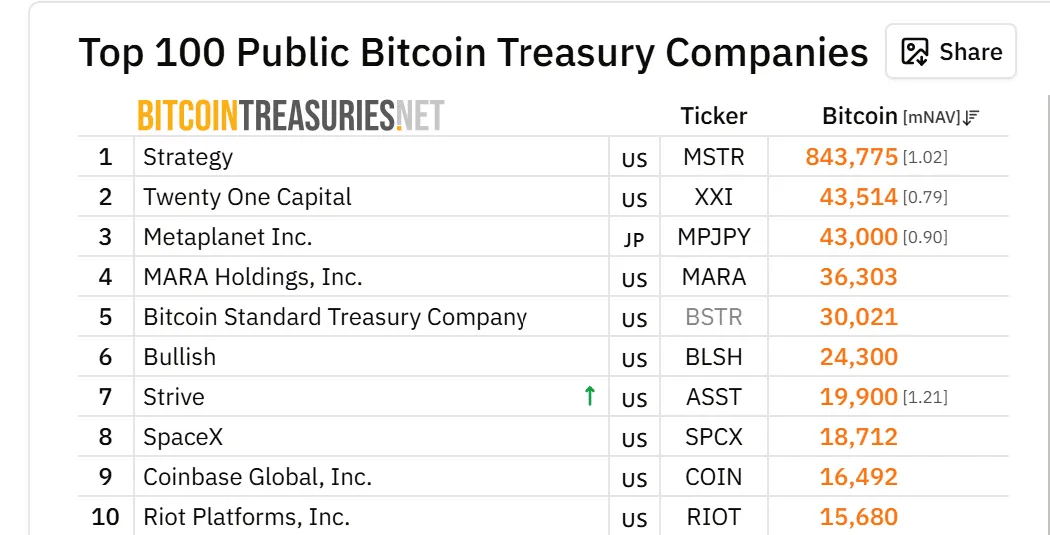
Source: Bitcoin Treasuries
Strategy still commands unmatched scale with 843,775 $BTC, yet its funding model is also the most demanding. The comparison highlights a growing trade-off across Bitcoin treasury companies.
All in all, aggressive accumulation can accelerate growth, but resilient capital structures ultimately determine how well that growth survives prolonged market stress.
Final Summary
- Bitcoin accumulation alone no longer guarantees Strategys long-term success.
- $BTC treasury growth now hinges on sustainable capital, not just larger holdings.