




Global corporate bond yield premiums have climbed to their highest since May 2025, a Bloomberg index shows.
In Asia, the strain reached both bonds and stocks on Friday. Spreads on higher-rated Asian dollar bonds hit their widest since last July, while the regions major stock indexes fell.
Sponsored

Sponsored
Bond Investors Retreat From Corporate Risk
Those premiums reached as much as 129 basis points as worries over debt-funded artificial intelligence (AI) spending grew. Rising geopolitical tension added pressure and pushed investors toward safer assets.
Asian credit moved in line with the global jump in corporate bond premiums. Traders said regional credit-article_nowater swaps (CDS) widened about 1.5 basis points to 78 at Fridays open.
But what are credit-article_nowater swaps? CDS work like insurance against default, so a higher price means investors see more risk.
Chinese debt saw some of the largest moves, with technology spreads 3 to 5 basis points wider. Chinas investment-grade spreads also widened by up to 5 basis points. By comparison, Indian investment-grade and Korean spreads widened by as much as 3 basis points.
Investors looking for safety turned to US government bonds instead. Treasuries rallied across all maturities for their best day in more than 2 years.
Traders also rushed into Treasury futures to unwind bearish bets and cover short positions. Stock markets in the region came under similar pressure on Friday.
Follow us on X to get the latest news as it happens
Sponsored
Sponsored
Asian Stocks Stay Under Pressure
Japan‘s Nikkei 225 fell 1.72% from its previous close to 61,825.26 by late morning in Tokyo. South Korea’s KOSPI posted a steeper drop, losing 1.97% to 5,424.96 by late morning in Seoul.
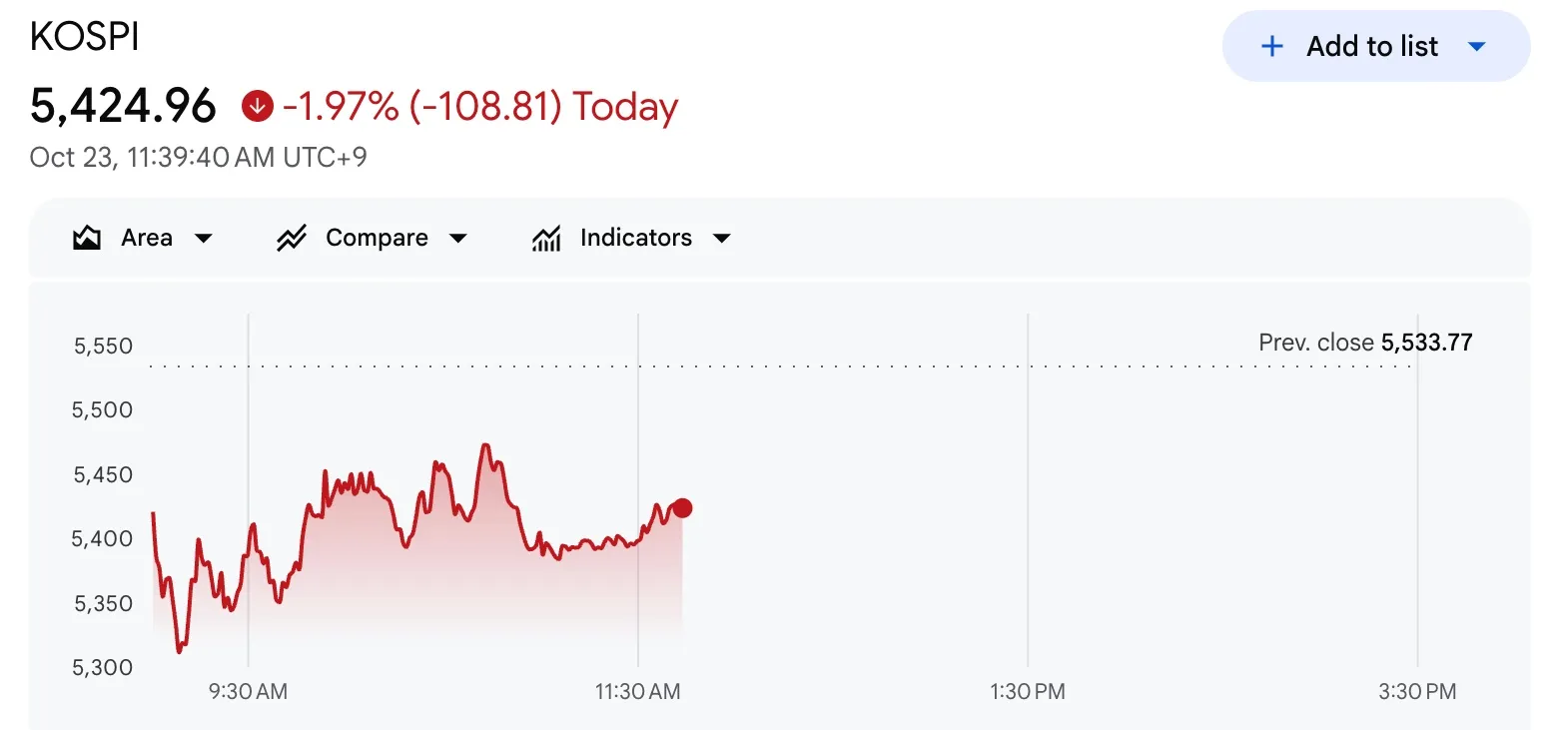
KOSPI Index Performance. Source: Google Finance
Chinas CSI 300 dropped a smaller 0.70% to 4,008.12 in morning trade. However, it touched 3,958.14 earlier in the session, a fresh 52-week low.
That low came a day after the index entered a bear market following 10 straight weeks of losses. Much of the selling in both stocks and bonds links back to concerns over how companies are funding AI.
Why AI Debt Puts Lenders on Edge
Bloomberg reported that markets fear debt-fueled AI spending will not deliver profits quickly enough.
In July, a Bloomberg Macro View analysis noted that AI-related debt issuance was accelerating. It warned that competition for capital would lift yields and widen credit spreads. Wider spreads, in turn, raise the cost of new borrowing for companies building AI infrastructure.
Fidelitys Jurrien Timmer argued this week that any AI bubble risk lies in debt. At the time, CoreWeave bond yields had climbed above 15%.
The last time spreads were this wide, tariffs were the trigger. After the US announced sweeping import duties on April 2, 2025, credit spreads widened sharply.
According to S&P Global, US investment-grade spreads jumped from 82 to 102 basis points by April 7. A 90-day tariff pause followed on April 9, and spreads eased to 89 basis points by April 28.
Even after easing, spreads stayed well above the 60 to 70 basis-point lows of late 2024 and early 2025.
For equity investors, the latest widening also carries a warning. Fairlead‘s Katie Stockton has listed wider credit spreads among the signs that could deepen the stock selloff. Friday’s readings show that signal is now in place.
Investors Split on the AI Bubble Question
Prominent investors remain divided on whether the AI worries behind this move are justified.
Citadels Ken Griffin warned that AI is almost certainly in a bubble. In contrast, Blackstone President Jon Gray described demand as nearly parabolic.
BitMine Chairman Tom Lee also sees relief ahead. He argued that falling rates and a crowded tech short point to the AI selloff nearing its end.
In 2025, the tariff pause gave credit markets a clear reason to recover. This time, a recovery may depend on whether AI spending starts to show returns.