






Polkadot has come up with a major change in its networks staking model. Polkadot OpenGov is scheduled to vote on Referendum 1890, which would mandate that each validator self-stake at least 10,000 $DOT of their own money.
Since many validators currently depend on nominator capital, this rule would directly increase the economic risk for the validators instead of the nominators.
Assessing present-day Polkadot infrastructure
For context, Polkadot employs a two-player team-like system known as Nominated Proof-of-Stake (NPoS). In this case, validators are in charge of operating the computers that process transactions and maintain network security.
Nominators, on the other hand, are regular $DOT holders who lend their $DOT to validators to improve them rather than operating computers themselves.
In exchange, they receive a portion of the benefits. Currently, the risk is being shared by validators and nominators. Therefore, the new modifications would serve as a prerequisite for two additional staking upgrades.
Referendum 1890 – A catalyst for the networks staking model?
The first prerequisite is “nominators becoming unslashable,” and the second is the “fast unbonding.”
Currently, even if the user does nothing wrong, they would still lose money if they had lent their $DOT to a validator and they made a mistake. In this new system, the slashing risk would be directly borne by validators.
Instead of immediately burning the money of numerous small stakers, any validator that misbehaves or goes offline would first lose its own 10,000+ $DOT bond. While their principal would be protected, nominators could still receive rewards.
Polkadot added,
Nominators can continue earning staking rewards without exposing their principal to slashing.
In the latter prerequisite, one had to wait 28 days to get their $DOT back after unstaking it. Thats almost a month in which the user is unable to use, sell, or transfer the money.
Therefore, the staked $DOT unbonding period would now be shortened from 28 days to 24 to 48 hours. Intriguingly, with all these changes, Polkadot would also be able to weed out bad actors and those who dont put in much effort.
Polkadot market dynamics
These developments came on the heels of $DOTs price trading at $1.25 at press time. This could be a good sign because the altcoin recently recovered from a Hyperbridge exploit that caused $DOT to lose a large share of its market capitalization.
Source: Token Terminal
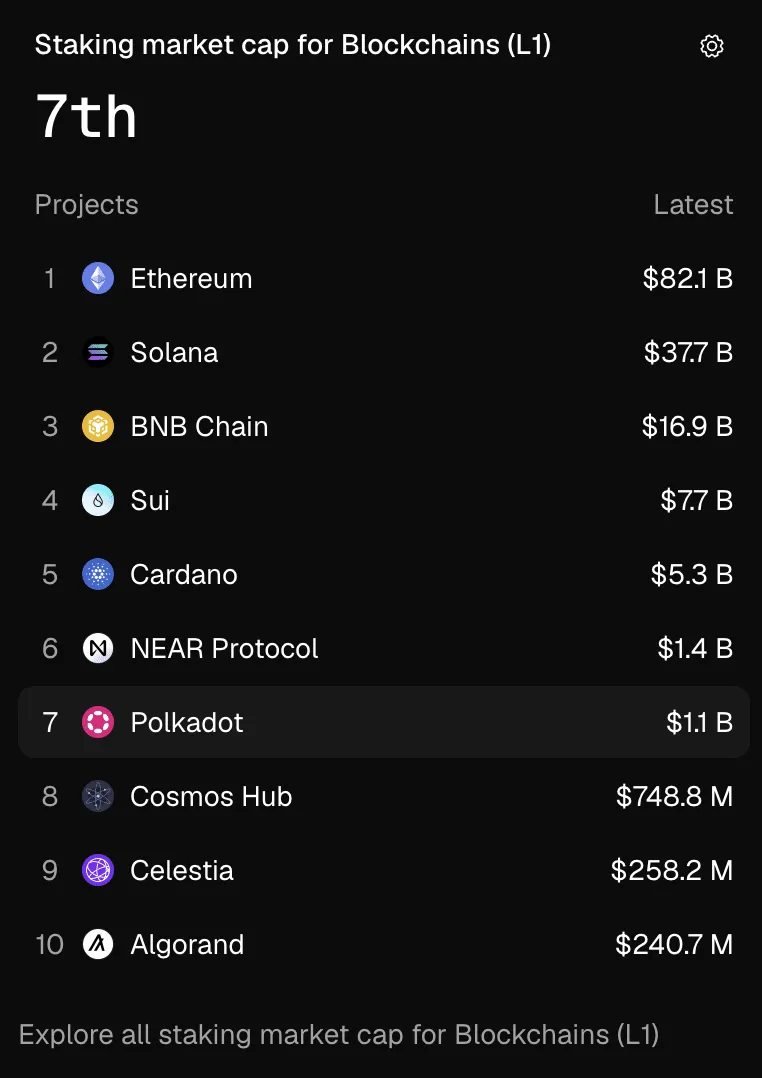
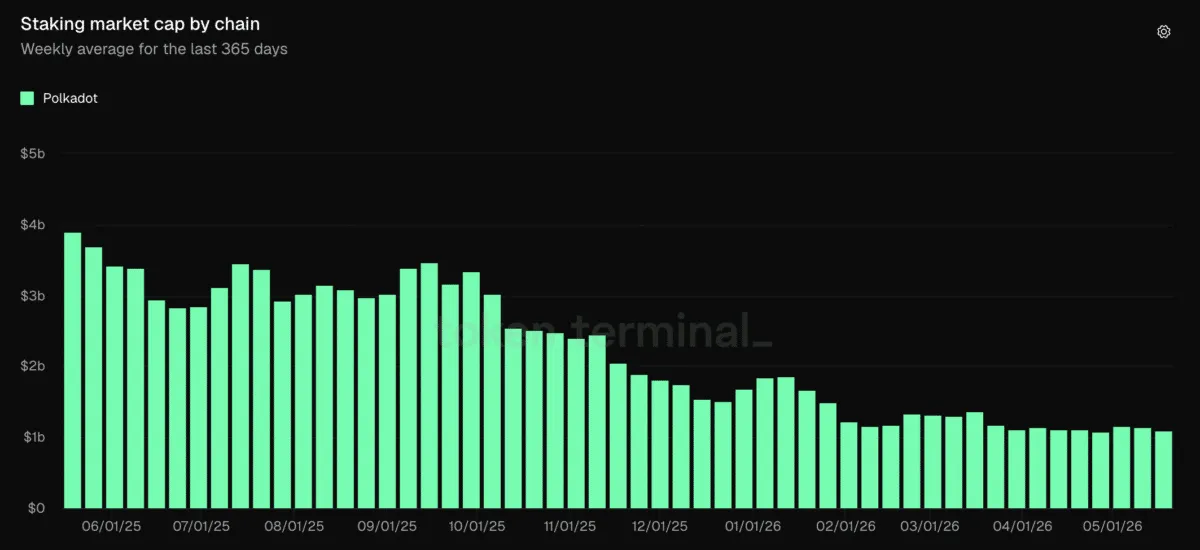
Here, its worth noting that in terms of staking market capitalization for L1s, Polkadot was ranked seventh with $1.1 billion. On the other hand, Ethereum [ETH] led with $82.1 billion.
This might be because staking market capitalization by chain revealed a decline in 2026, compared to 2025.
Source: Token TerminalFinal Summary
- Polkadot OpenGov is geared up to vote for a major upgrade that is the prerequisite for the next major staking upgrade.
- With the Referendum 1890 upgrade, more risks will be borne by validators and not nominators.