






As DeFi United works to restore rsETH backing, Lido DAO [$LDO] proposes a targeted fix to protect Lido Earn $ETH [EarnETH] vault users from leftover losses. The EarnETH vault holds about 9% exposure, roughly $21.6 million, while residual losses are estimated at 400–600 $ETH.
These losses fall below the 1% trigger tied to the $3 million first-loss buffer, which leaves a gap in protection. This situation emerges because external parties resolve the main loss, yet smaller impacts remain.
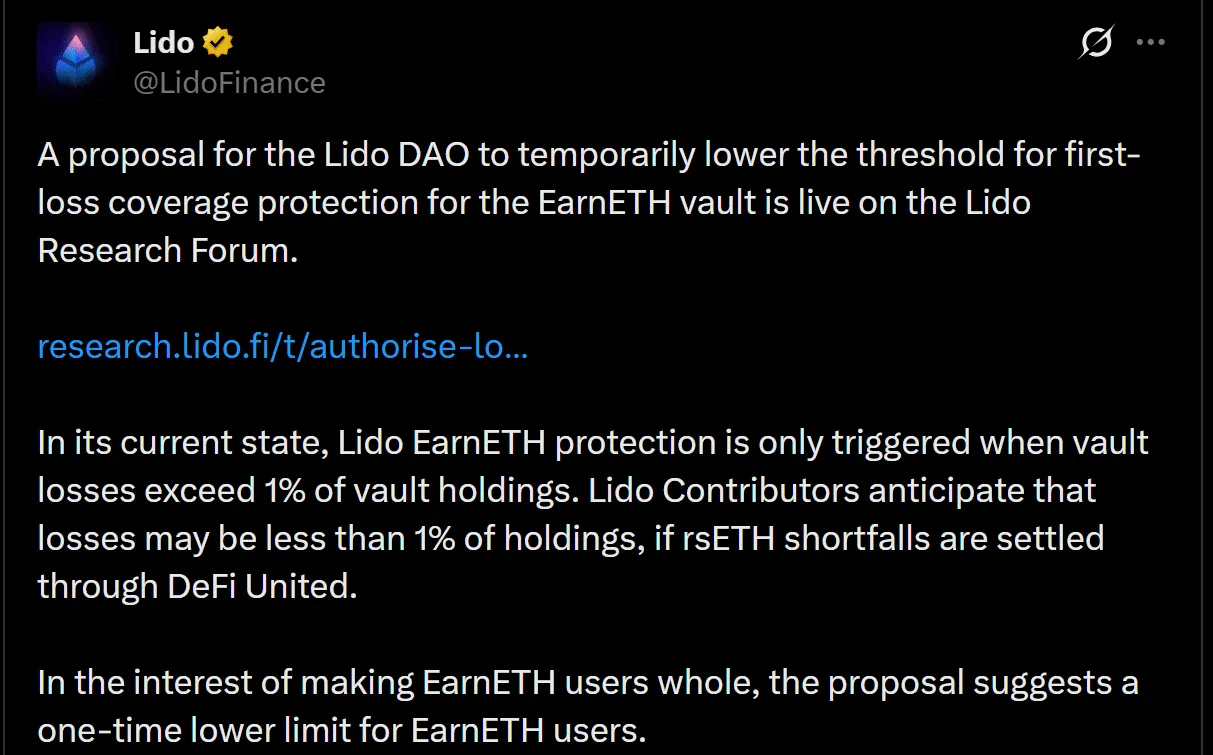
Source: Lido Finance on X
To address this, Lido proposes a one-time threshold adjustment to cover these amounts. This move aims to preserve user trust and prevent lingering losses.
If accepted, confidence may stabilize, while a limited scope helps contain broader protocol risk.
Treasury intervention tests Lidos resilience and limits
Beyond immediate user protection, Lidos response begins to test the strength and limits of its treasury.
Following the rsETH shock, the DAO allocated up to 2,500 stETH, which equaled about $5 million, to stabilize affected positions and prevent forced liquidations.
This move happens because external risks have spilled into integrated products, which require internal support. While the treasury stands at nearly $94 million, this allocation remains relatively small.
However, it introduces a new dynamic, where protocol funds absorb external stress. Governance approval also signals strong coordination, yet it subtly shifts expectations.
If such interventions repeat, reserves may tighten over time, while users may increasingly expect protection beyond the protocols original design.
Lido limits liability while containing integration risk
While the Kelp exploit exposed how external integrations can transmit risk, Lidos response shifts focus toward defining clear responsibility limits.
Rather than expanding coverage, the DAO proposes using its existing first-loss fund only for Kelp-related losses, without changing the 1% rule or adding new capital. This approach emerges because the core protocol remains unaffected, yet user exposure still requires a response.
As a result, Lido balances protection with restraint, aiming to restore confidence without setting broad bailout expectations.
This shift signals that future risks may not receive similar support. If users accept this boundary, trust may stabilize, while uncertainty around coverage could influence participation and risk perception.
Final Summary
- Lido DAO [$LDO] targets residual losses with limited treasury use, balancing user protection and risk control without expanding long-term bailout expectations.
- Lido reinforces trust in the short term, but repeated interventions could strain reserves and reshape user expectations around protocol-level risk coverage.