






Crypto industry leaders are voicing frustration after the U.S. Senate failed to advance the CLARITY Act before its August recess, leaving the market structure bill facing a crucial procedural vote weeks before the 2026 midterm elections.
Summary
- Senate leaders filed cloture, setting up a Sept. 15 procedural voteon the CLARITY Act.
- Coinbase executives and Sen. Cynthia Lummis called the pre-recess failure disappointing and frustrating.
- Ethics restrictions and stablecoin rewards remain unresolved as the bill seeks 60 Senate votes.
- Polymarket traders give CLARITY a 25% chance of becoming law during 2026.
CLARITY Act faces a Sept. 15 procedural vote
Senate Majority Leader John Thune filed cloture on the motion to proceed to the Digital Asset Market Clarity Act shortly before the Senate began its month-long recess, according to the Senate Daily Press.
The filing positions the legislation for an initial procedural test after senators return to Washington on Sept. 14. The cloture motion is scheduled to ripen on Sept. 15, according to previous crypto.news coverage.
The vote would determine whether the Senate begins formally considering the bill. It would not amount to final passage.
CLARITY would still need to move through debate and possible amendments before receiving a separate approval vote. Any Senate-approved version that differs from the measure passed by the House would also need to return to the lower chamber before reaching President Donald Trumps desk.
You might also like:
CLARITY Act gains U.S. security backing from ex-defense chief
The legislation needs at least 60 votes to clear the Senates cloture threshold. Republicans cannot reach that number without Democratic support, making the remaining bipartisan negotiations central to its prospects.
The House approved the CLARITY Act by a 294–134 vote on July 17, 2025, with 78 Democrats supporting the legislation. The Senate Banking Committee advanced its portion of the legislation by a 15–9 vote in May 2026, with Democratic Sens. Ruben Gallego and Angela Alsobrooks joining Republicans.
Crypto leaders criticize the Senate delay
Industry executives and advocates reacted negatively after lawmakers left Washington without holding a procedural vote.
“You can imagine how frustrated I am,” Sen. Cynthia Lummis said after the chamber failed to schedule the legislation for consideration before the recess.
My statement on Clarity Act⬇️⬇️ pic.twitter.com/azGOtse9ID
— Senator Cynthia Lummis (@SenLummis) August 7, 2026
Lummis added that she would continue working with other senators and described the effort as “far from over.” She had previously pushed for a CLARITY Act vote before the August recess, saying negotiators had spent months working through the bills CFTC provisions and other disputes.
Coinbase CEO Brian Armstrong also called the delay disappointing but argued that broader crypto adoption would continue regardless of Congress schedule.
Armstrong pointed to stablecoin adoption, tokenization, and expanding digital asset markets as sources of continued momentum. Coinbase Chief Policy Officer Faryar Shirzad similarly said September would offer lawmakers another opportunity to “finish the job.”
As crypto.news previously reported, the delay has not produced an immediate decline in Coinbase shares. COIN closed Friday at $153.60, gaining about 5.7% during the session.
BitMine Chair Tom Lee offered a similar market assessment in the companys weekly report. Lee said investors appeared more focused on softer inflation and employment data than on the immediate consequences of CLARITY failing to advance before the recess.
Ethics and stablecoin rewards divide senators
The September timetable gives lawmakers more time to negotiate but also pushes the vote closer to the Nov. 3 midterm elections. The Senate will have roughly seven weeks between its return and Election Day, narrowing the available floor time for a complex bill.
Democratic demands for stronger ethics restrictions remain one of the main obstacles. Several lawmakers want the bill to address crypto investments and business interests held by senior federal officials and their families.
Those concerns have centered on Trumps association with World Liberty Financial and the Official Trump memecoin launched shortly before he returned to office. Sen. Elizabeth Warren supports creating a federal crypto framework but has rejected the current CLARITY Act over corruption, consumer protection, national security, and financial stability concerns.
Banking groups are pressing senators from another direction. They argue that the legislation could still allow crypto companies to provide stablecoin rewards under certain conditions, potentially drawing deposits away from community banks.
The current framework distinguishes between interest paid simply for holding a stablecoin and rewards connected to activities such as trading, payments, or loyalty programs. That distinction has placed companies such as Coinbase at the center of the dispute.
Banking associations have urged the Senate to close what they describe as stablecoin-yield loopholes. Crypto advocates counter that the legislation already prevents stablecoin issuers from paying deposit-like interest and that broader restrictions would protect banks from competition.
Prediction markets remain split on passage
Prediction markets show traders expect the Senate to vote on CLARITY in September, but they remain doubtful that the legislation will become law before the end of 2026.
A Kalshi contract with approximately $1.23 million in trading volume placed the probability of a Senate vote before Oct. 1 at 88%. That closely aligns with the Sept. 15 procedural schedule created by Thunes filing.
However, a separate Polymarket contract assigned only a 25% probability that CLARITY would be signed into law during 2026. More than $5.79 million had been traded on that market.
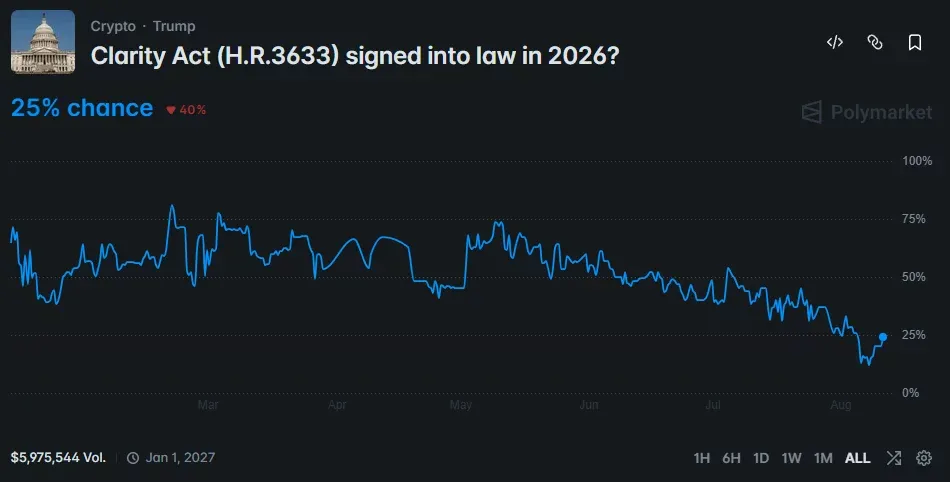
Source: Polymarket
The difference reflects the additional steps required after the first Senate vote. Lawmakers must clear the 60-vote threshold, settle disagreements over ethics and stablecoin rewards, approve a final Senate text, and reconcile it with the House version.
Longer-term contracts have increasingly shifted expectations into 2027. Kalshi traders recently placed the probability of the legislation taking effect before July 1, 2027, at 41%, while assigning higher odds to passage under later deadlines, according to crypto.news reporting.
The Sept. 15 vote will provide the next concrete test. Clearing cloture would allow senators to begin considering the bill, but its final passage would still depend on whether negotiators can convert procedural support into a durable bipartisan agreement.