







Consumers risk losing all their money invested in cryptoassets and could fall prey to scams, the European Unions securities, banking, and insurance watchdogs said in a joint statement (pdf).
“Consumers face the very real possibility of losing all their invested money if they buy these assets. Consumers should be alert to the risks of misleading advertisements, including via social media and influencers. Consumers should be particularly wary of promised fast or high returns, especially those that look too good to be true,” regulators said in the statement.
The statement made by The European Supervisory Authorities (EBA, ESMA, and EIOPA – the ESAs) marks a ramping up of direct warnings to consumers about cryptocurrencies by EU authorities, explicitly spelling out that consumers have no protections or recourse to compensation under existing EU financial services law.
Consumers buy crypto without being aware of the risksRegulators are increasingly worried that ever more consumers are buying the thousands of different cryptocurrencies, including bitcoin (BTC) and ether (ETH), which account for 60% of the market, without being fully aware of the risks, the regulators said.
Specifically, the regulators list seven types of risks consumers may encounter in the crypto market. Consumers risk extreme price movements, misleading information, absence of protection, product complexity, fraud, and malicious activities, market manipulation, lack of price transparency and low liquidity, and finally hacks, operational risks, and security issues.
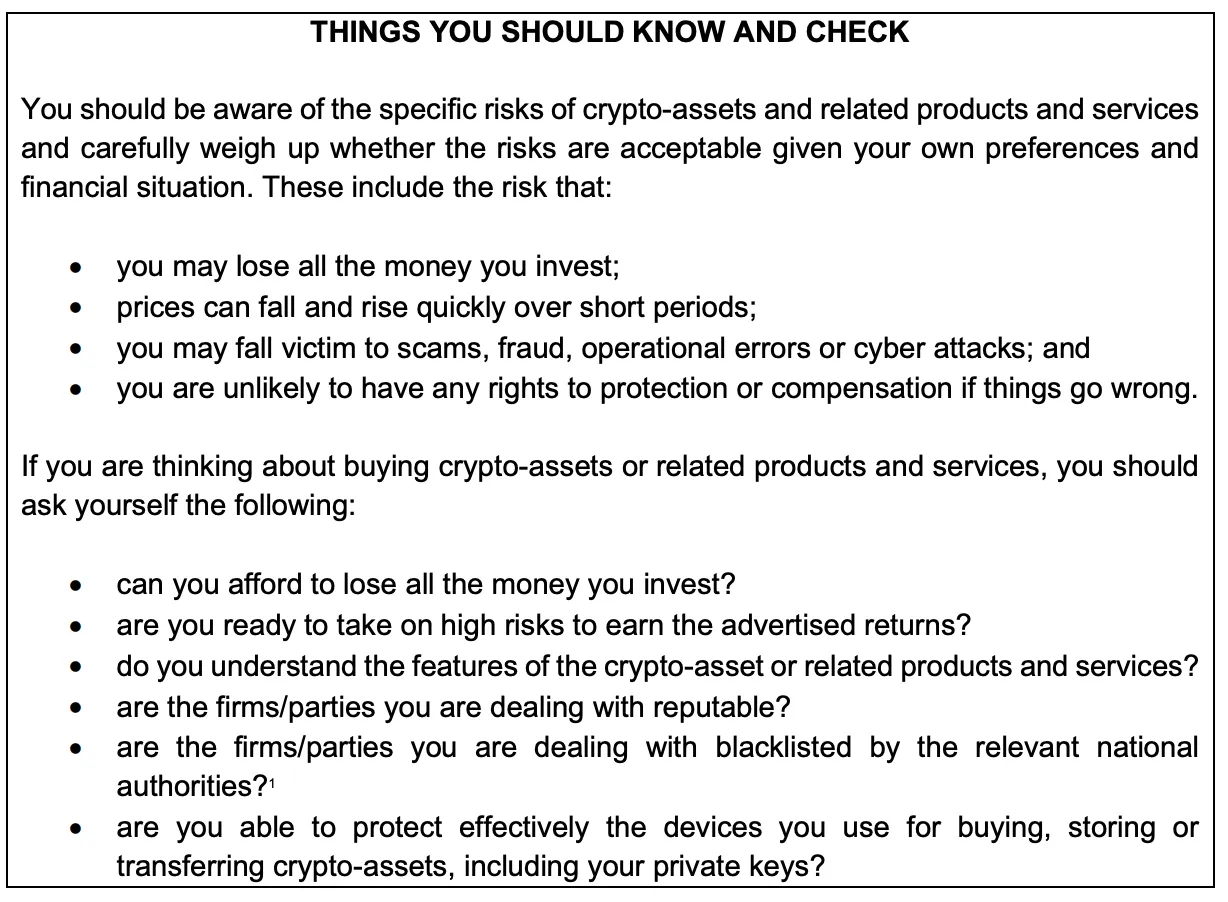
EU regulators advice for crypto consumers.
According to the statement, the warning is based on Article 9(3) of the founding Regulations of the ESAs. It follows earlier warnings about the risks of buying and holding crypto assets. The regulators define crypto-assets as “a digital representation of value or rights which may be transferred and stored electronically, using distributed ledger technology or similar technology.”
“The ESAs note growing consumer activity and interest in crypto-assets, including so-called virtual currencies and the emergence of new types of crypto-assets and related products and services, for instance, so-called non-fungible tokens (NFTs), derivatives with crypto-assets as underlying, unit-linked life insurance policies with crypto assets as underlying and decentralized finance (DeFi) applications, that claim to generate high and/or fast returns,” the statement says.
No mentioning of if theres a demand for protectionFurthermore, “The ESAs are concerned that an increasing number of consumers are buying those assets with the expectation that they will earn a good return without realizing the high risks involved.”
“Consumers should be alert to the risks of misleading advertisements, including via social media and influencers. Consumers should be particularly wary of promised fast or high returns, especially those that look too good to be true,” the statement says.
The regulators do not, however, mention any increase in the number of consumers complaining about the results of their dealings with cryptocurrencies; nor if there are any reports of consumers getting in trouble when investing in crypto assets, or even if there is any demand coming from consumers asking regulators to protect them.
The regulators do, however, take the chance to put in a final line in the statement about the environmental impact of some crypto assets.
“Consumers should also be aware that energy consumption for producing some crypto assets is high and the environmental impact this has,” the statement concludes.