At 9:30 PM Beijing time on November 10, the United States will release its October CPI data. As the final inflation report before the Federal Reserve's December policy meeting, it could play a decisive role in shaping expectations for the Fed's next interest rate decision.
This release comes with an unusual complication: because last year's U.S. government shutdown resulted in missing baseline data, year-over-year figures for both headline and core CPI are likely to be unavailable. As a result, markets will have to rely heavily on month-over-month readings and individual components to assess the true direction of inflation.
Meanwhile, Bitcoin has continued its downward slide, recently hitting a low of around $73,500. From its late-September rebound peak of $87,400, BTC has fallen approximately $13,000, representing a decline of 15.9%. Ethereum has suffered an even steeper correction, dropping from its rebound high of $2,806 to a recent low of $2,050, a maximum decline of 26.9%.
So, what comes next? Will Bitcoin continue falling, or is a powerful rebound around the corner?
CPI Data: Unlikely to Reverse Rate-Hike Expectations, but Could Trigger Sharp Short-Term Volatility
The current consensus forecasts are:
Headline CPI MoM: +0.3% (previous: +0.6%)
Core CPI MoM: +0.2% (previous: +0.3%)
The most likely outcome is that both figures come in line with expectations, with headline CPI rising 0.3% month over month and core CPI increasing 0.2%.
Overall, this would still be somewhat bearish. Inflation remains relatively sticky, while the crypto market is already facing multiple negative catalysts. However, there is also a possibility of a classic “buy the rumor, sell the news” or “sell the rumor, buy the news” reaction, with bearish expectations already priced in.
Bitcoin could initially rally before reversing, followed by volatile sideways trading and potentially a sharp two-sided wick. The expected trading range would be around $74,000–$76,000.
The second most likely scenario is that headline CPI comes in at 0.2% or lower, while core CPI remains at 0.2% or below. This would confirm further cooling in underlying inflation.
Although the probability of a December rate hike would remain elevated, expectations for subsequent monetary policy could gradually shift in a more dovish direction. This would represent a rare positive catalyst for crypto markets.
Under this scenario, Bitcoin could break above $76,000 and potentially test $78,000.
The worst-case scenario would be headline CPI at 0.4% or higher, combined with core CPI at 0.3% or above. While less likely, this outcome would have the greatest downside implications.
A December rate hike would become virtually certain, and the Fed could even continue raising rates at meetings next year. Such an outcome would add further pressure to an already fragile market, potentially sending Bitcoin toward the $70,000 support level.
It is also worth noting that some market pricing assigns a probability of more than 36% to core CPI remaining at 0.3% or higher. This represents a major tail risk for Bitcoin bulls.
Why does CPI matter so much? Because it directly influences the Fed's interest rate decisions, which in turn have a fundamental impact on crypto market performance.
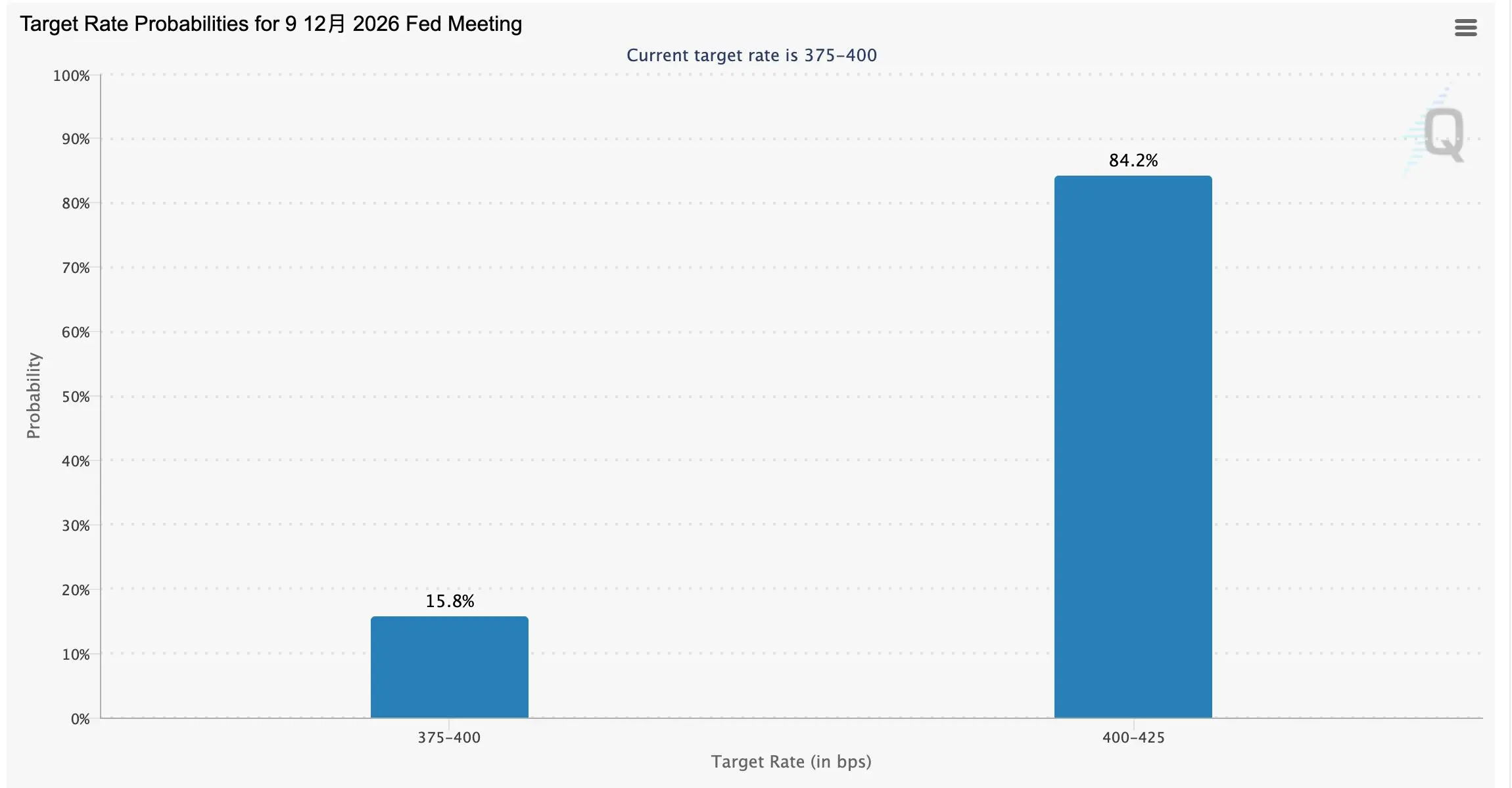
According to current CME market pricing, the probability of a 25-basis-point rate hike in December stands at 84.2%—meaning a hike is already largely priced in. The real significance of tonight's CPI report is whether that decision can be implemented without further escalation in hawkish expectations, or whether the Fed will be pushed toward an even more aggressive stance.
Base Case (Approximately 44% Probability)
Core CPI rises 0.2% month over month, while headline CPI increases 0.3%, broadly matching expectations.
The Fed would likely proceed with its planned December rate hike. Its statement would probably maintain the assessment that inflation remains elevated, without signaling any additional acceleration in monetary tightening.
The market reaction could be relatively muted, with attention quickly shifting toward the December meeting itself and subsequent economic data.
Dovish Scenario (Approximately 37% Probability)
If core CPI falls to 0.2%, it would mark the slowest monthly increase in three months, strengthening the view that inflationary pressures are gradually easing.
However, this may not be enough to overturn expectations for a December rate hike. Strong October nonfarm payrolls have already reinforced the Fed's concerns about labor market resilience.
A more likely outcome would be that the rate hike goes ahead, but the Fed adopts a softer tone in its statement, reducing market expectations for additional rate increases next year. Current market pricing suggests approximately two cumulative hikes by next summer.
Hawkish Scenario (Approximately 19% Probability)
If core CPI remains at 0.3% or higher, it would provide direct evidence that inflation remains stubbornly persistent.
Some strategists have explicitly warned that even a modest upside surprise in CPI could make a December rate hike virtually inevitable.
More importantly, markets could be forced to reprice the 2027 interest rate outlook, incorporating the possibility that the rate-hiking cycle is not yet over.
This would be the most unfavorable scenario for the crypto market.
What Really Matters Is Not Tonight's Data: Will Bitcoin Start With $60,000 or $80,000?
In the short term, $75,000 is the critical line in the sand.
Bitcoin was already in an extremely fragile position ahead of the CPI release. Prices were moving within a narrow $74,400–$75,200 range, after briefly dropping to around $73,510 early Monday morning, its lowest level since August.
More importantly, approximately $1.12 billion in leveraged positions across the crypto market were liquidated in the 24 hours preceding the CPI announcement. This has left bullish positioning particularly vulnerable.
For short-term traders, the key technical levels are:
Resistance: $75,500–$76,000. If positive CPI data helps BTC reclaim this zone, the next potential target would be $76,500.
Immediate support: $74,000. A decisive break below this level could expose the next downside target around $71,000.
Overall, tonight's CPI report is a potential trigger, but Bitcoin's current challenges run much deeper than a single inflation release.
At the beginning of 2026, Bitcoin's macro narrative was relatively straightforward: expectations of rate cuts, improving liquidity conditions, and accelerating institutional participation combined to drive prices from $57,700 to a cycle high of $87,350.
By November, however, the foundations of that narrative have fundamentally shifted.
Expectations of rate cuts, one of Bitcoin's most important macro tailwinds in 2026, have effectively disappeared for the time being. Market pricing has shifted from expectations that interest rates would fall toward 3.25% to concerns that the rate-hiking cycle may not yet be over.
Institutions including Bank of America and Fidelity have even raised the possibility of consecutive rate hikes in December and March next year.
This means Bitcoin is undergoing a fundamental repricing of its valuation framework: moving away from liquidity-driven valuation expansion and toward a search for a new equilibrium in an environment where interest rates may remain higher for longer.
The first anchor is opportunity cost.
If a hawkish CPI outcome further reinforces the rate-hiking outlook, the yields available on short-term U.S. Treasuries and cash will continue to offer an attractive alternative.
The relative cost of holding highly volatile, zero-cash-flow assets such as BTC will consequently increase.
This mechanism does not depend on any single event. Instead, it creates systematic pressure on institutional investors' willingness to allocate capital to Bitcoin over the medium and long term.
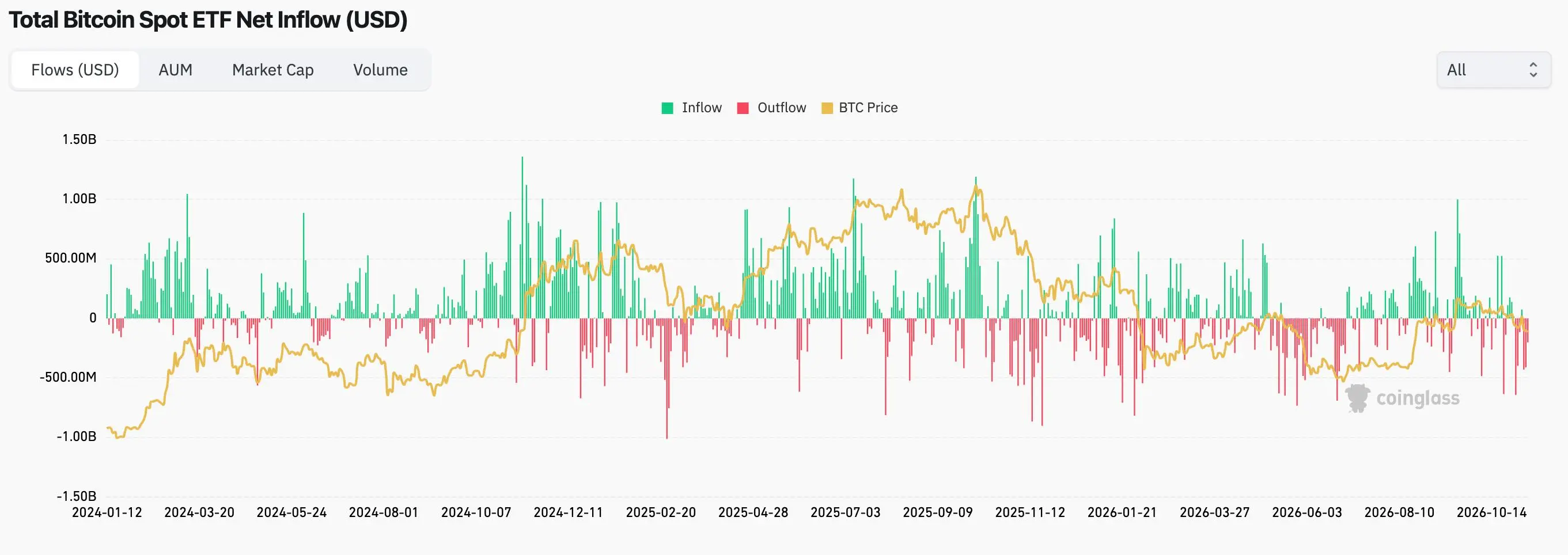
Persistent outflows from spot Bitcoin ETFs are, to some extent, a micro-level reflection of this dynamic. It does not necessarily mean institutions have lost faith in Bitcoin itself. Rather, they are reassessing portfolio allocations in response to the prevailing interest rate environment.
The second anchor is the stress test facing Bitcoin's “digital gold” narrative.
Comments made by Kraken co-CEO Dave Ripley on the eve of the CPI release are worth considering.
He believes institutions are increasingly viewing Bitcoin as “digital gold” and a store of value, describing the current correction as potentially one of the mildest in Bitcoin's history and suggesting that the adjustment phase may be approaching its end.
However, there is another side to the idea of a “mild” correction: a lack of independent resilience.
Bitcoin's recent correlation with the Nasdaq has remained around 40%. In an elevated interest rate environment, BTC has not consistently demonstrated safe-haven characteristics independent of traditional risk assets.
If persistent inflation forces interest rates to remain elevated for longer, this correlation could once again dominate market pricing, making it difficult for Bitcoin to generate an independent rally against a challenging macroeconomic backdrop.
The third anchor, often obscured by short-term price fluctuations, is the timing mismatch between supply and demand.
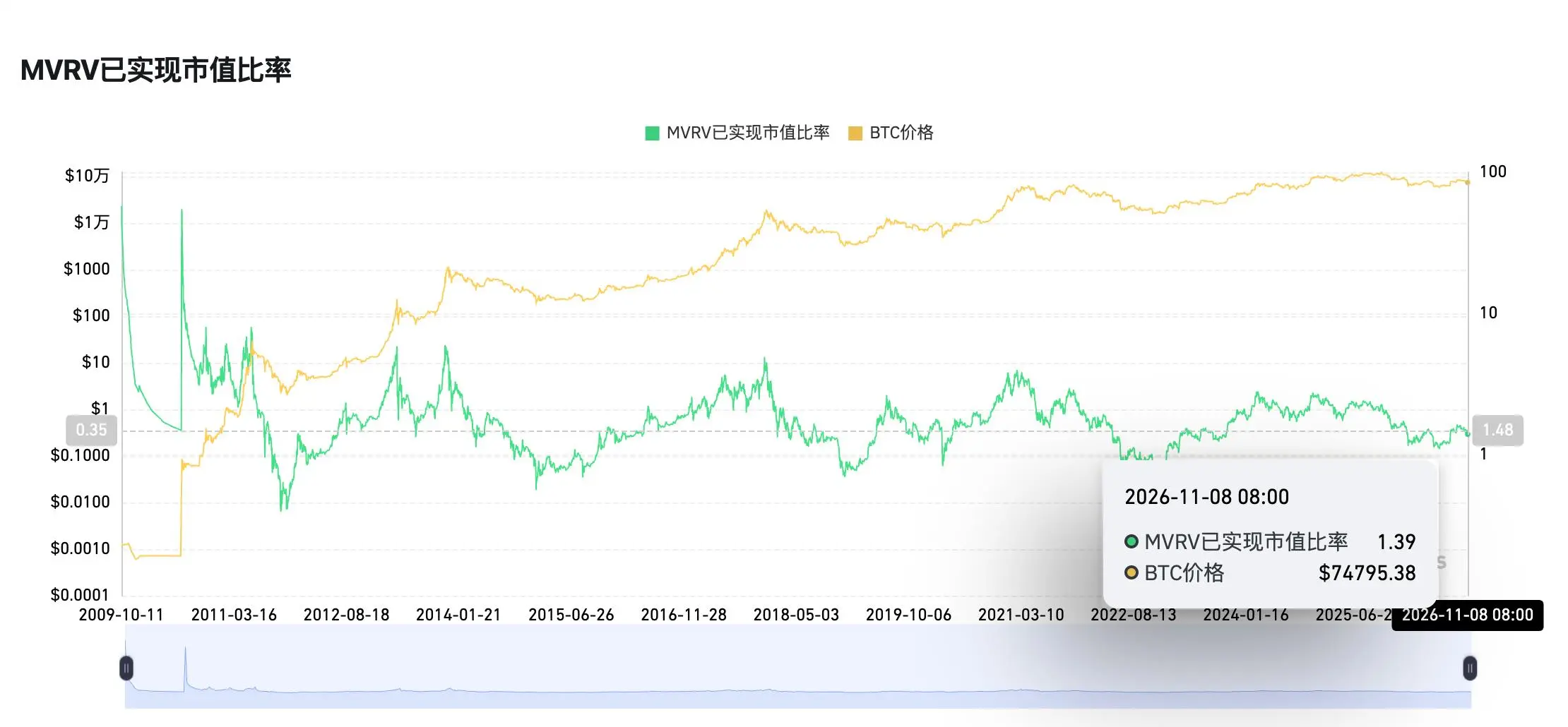
Long-term holders have an average cost basis of approximately $48,000 and are still sitting on roughly 65% unrealized profits. The MVRV ratio is around 1.4, while NUPL stands at approximately 0.29.
These indicators point to the relatively normal optimism of a mid-cycle market, rather than extreme speculative euphoria.
This suggests that selling pressure from long-term holders is not yet particularly urgent, meaning the supply side remains relatively stable.
The demand side, however, is undergoing a systematic contraction and repricing. This includes spot ETF flows, institutional allocations, and leveraged retail trading activity.
Supply remains relatively stable, while demand is retreating.
This combination often points toward a market that needs time to consolidate rather than one facing an immediate collapse in prices.
However, how long this consolidation lasts will depend on when the interest rate environment establishes a new direction.
Conclusion
The most important short-term price level for Bitcoin is $74,000.
Its significance goes beyond technical analysis. It sits at the intersection of several competing forces: residual bullish positioning following leveraged liquidations, institutional capital flows weakened by ETF outflows, hawkish tail risks surrounding CPI, and a macroeconomic environment transitioning from a rate-cut narrative toward higher-for-longer expectations.
Tonight's data may provide a short-term directional signal, but it will not provide the final answer.
Under a dovish scenario, Bitcoin could rebound toward $76,000–$78,000. However, if ETF flows fail to reverse and BTC cannot reclaim its 50-week moving average, the sustainability of such a rebound will remain questionable.
Under a hawkish scenario, a break below $74,400 could open the door to $72,550 and potentially even $69,000. That would represent a genuine test of the narrative that Bitcoin is experiencing only a mild correction.
The medium- and long-term outlook will depend on three variables that move more slowly than CPI but are ultimately more fundamental:
The Fed's December decision and its guidance on the 2027 interest rate path. The language used by policymakers will be crucial in determining whether further tightening remains on the table.
Whether spot Bitcoin ETFs can return to sustained net inflows. A recovery in institutional demand would provide an important foundation for a more durable rebound.
Whether regulatory frameworks such as the GENIUS Act and MiCA can continue advancing. Progress in these areas could provide institutional adoption with an independent growth driver, even in an unfavorable macroeconomic environment.
Until these variables deliver clearer signals, perhaps the most realistic way to price Bitcoin is through continued consolidation within the $72,000–$78,000 range, while the market waits for a more convincing catalyst to determine its next major move.
Clarify the CPI release timingReconcile the price level framework