






Irans oil minister, Mohsen Paknejad, quit on Sunday. State media gave no reason.
Hours earlier, he said oil money was still coming in. Yet Iran loaded no oil at its export terminals in September, Fortune reported. That had not happened since the 1979 revolution.
Sponsored

Sponsored
Irans Last Oil Cargoes Are Running Out
An official in President Masoud Pezeshkian‘s office announced that the president had accepted the resignation. Shortly before the news broke, state media carried Paknejad’s last public remarks on Irans oil income.
“…revenues of the oil that we have sold are still coming and that will continue God willing,” Paknejad said.
That money is from oil sold before mid-July. Then the US Navy reimposed its blockade of Iranian ports.
Since then, Iran has lived off crude already sitting on tankers outside the blockade. Kpler, a ship-tracking firm, put that stock at 90 million barrels in mid-July. By early September, it was about 29 million.
Kpler said it could be gone by mid-October. Payments may trail into December. Even those are hard to collect, President Masoud Pezeshkian has said.
Sponsored
Sponsored
“We can‘t even get our own money out of a country to which we’ve supplied goods…” Fortune reported, citing Pezeshkian.
Oil funds about a third of Irans budget. The rial has crashed to a record 2.7 million per dollar.
BREAKING: Iran's currency has fallen to 2.69 million per US Dollar, a record low.
— The Spectator Index (@spectatorindex) October 3, 2026
Why Crude Prices Have Not Jumped as Iran Goes Quiet
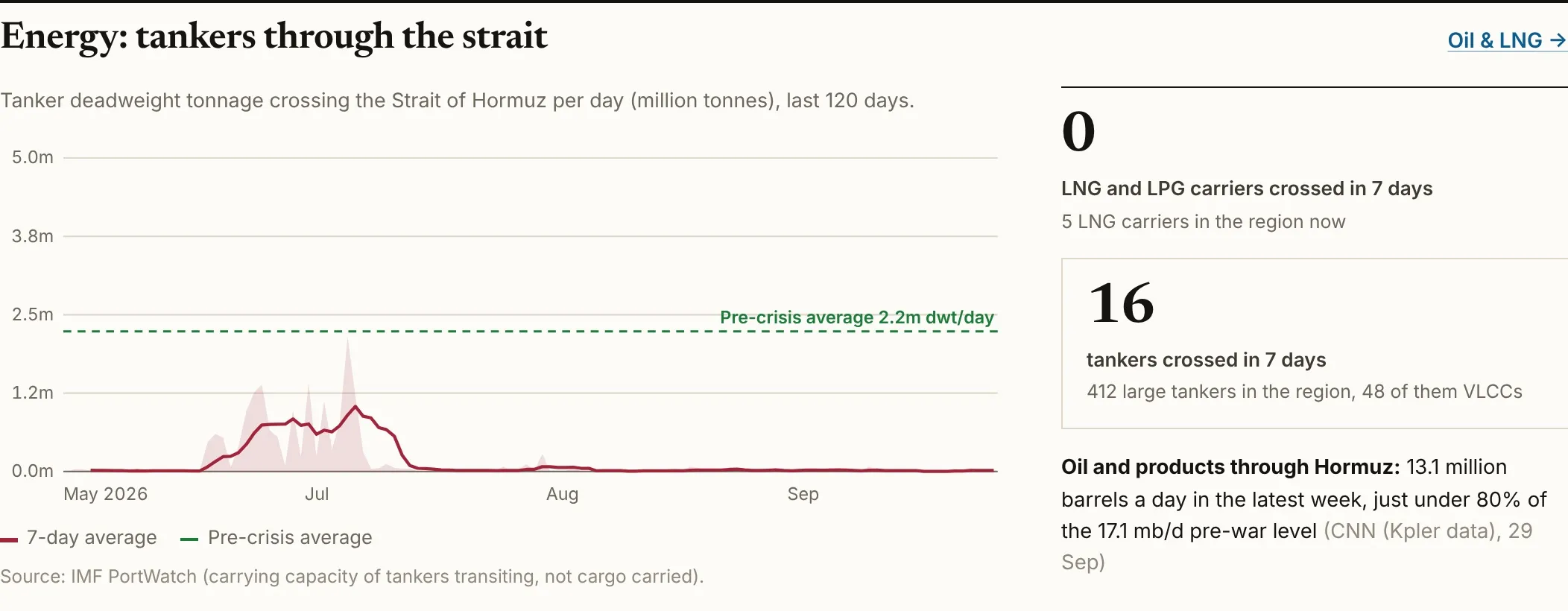
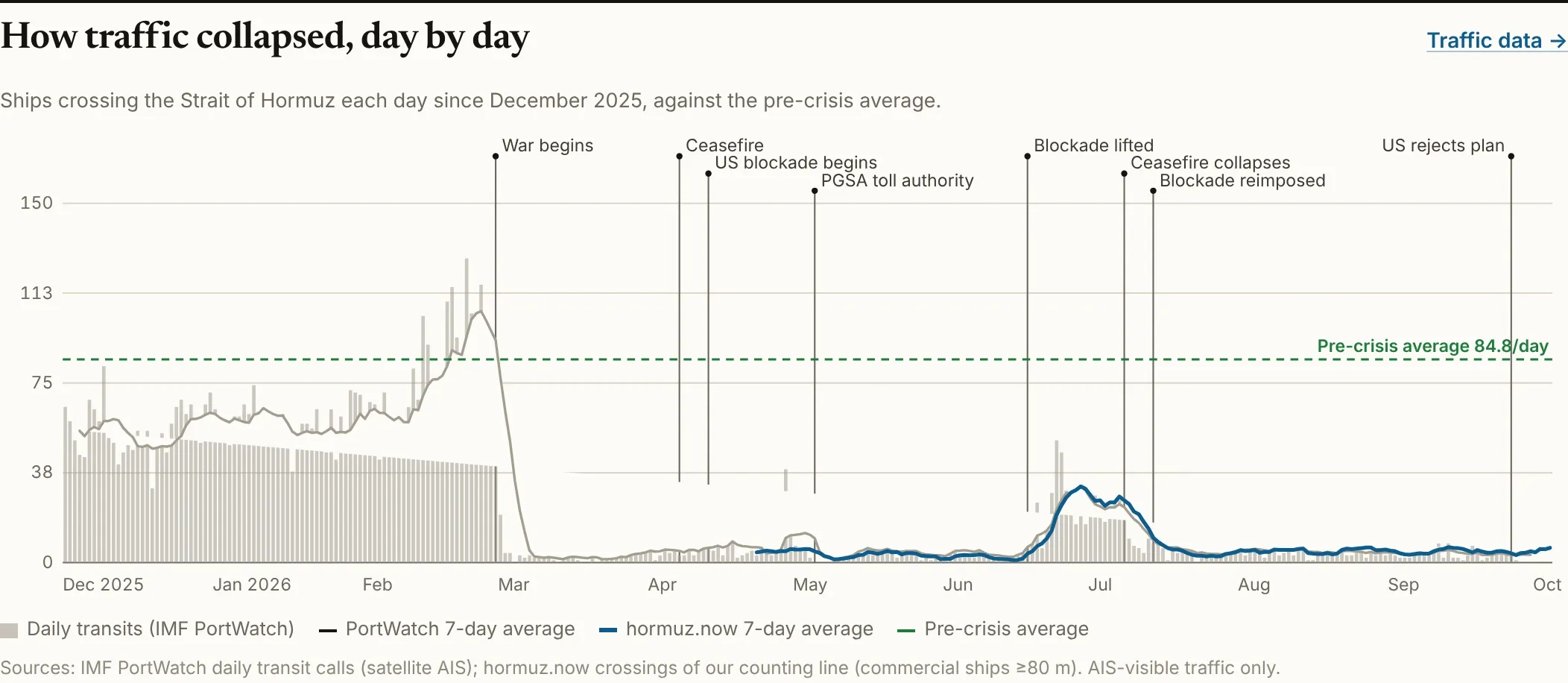
On screen, the Strait of Hormuz looks shut. About six ships a day are visibly crossing, 7% of normal, hormuz.now data shows. Only 16 visible tankers crossed in the past week.
Daily ships crossing Hormuz. Source: hormuz.now
But that count only sees ships broadcasting their location. Kpler estimates 13.1 million barrels a day of oil and fuel still crossed in the latest week, close to 80% of pre-war levels.
Tanker tonnage through Hormuz. Source: hormuz.now
The hidden flow belongs to Irans neighbors. In August, more than 70% of crude crossing the strait was swapped between tankers at sea, Kpler said. Pipelines now carry 40% around it.
Brent, the global benchmark, sits at $101.93, BeInCrypto chart data shows. That is up from the mid-$60s before the war, but well below springs peaks.
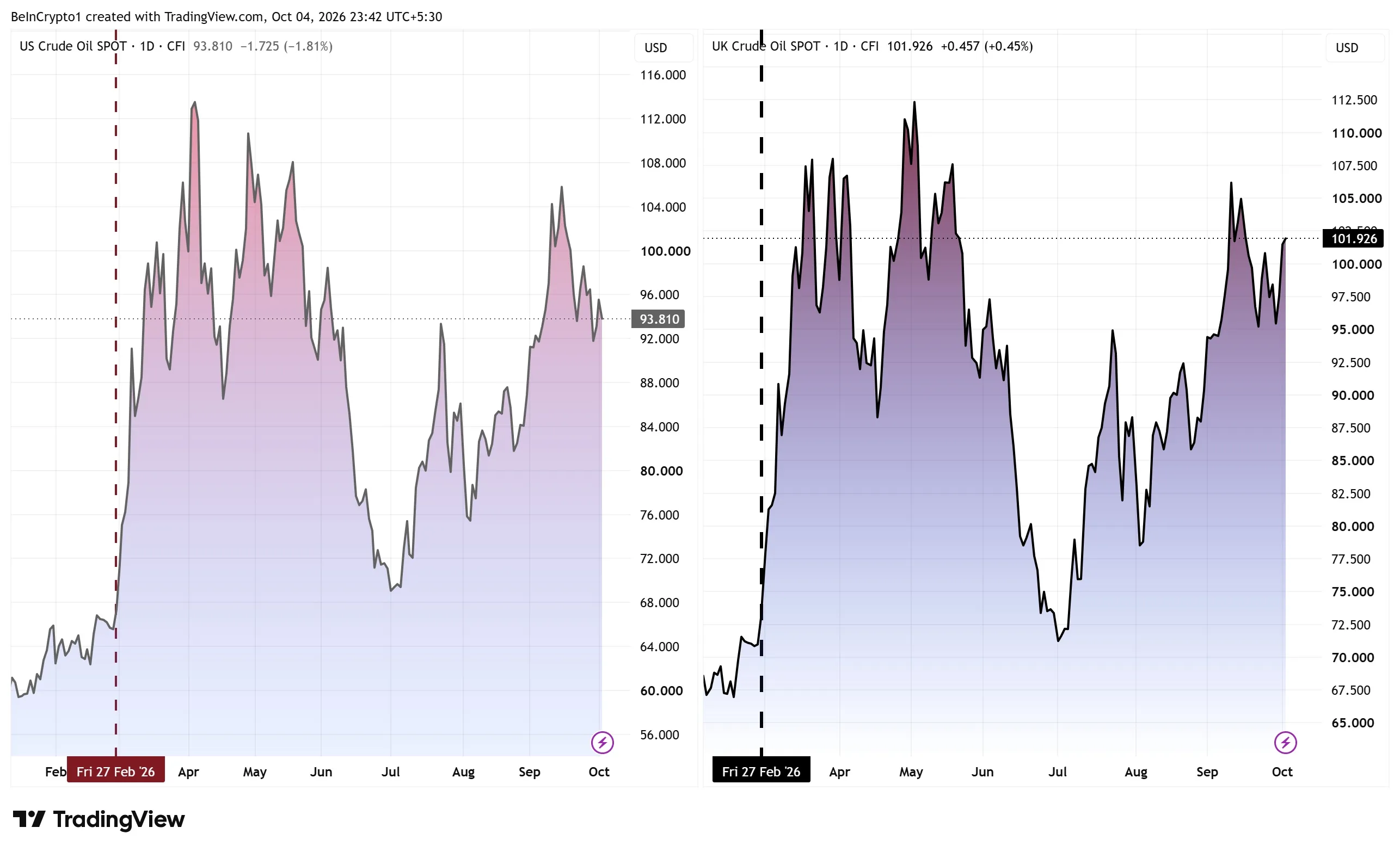
OIl Price Performance (WTI and BRENT). Source: TradingView
Oil barely moved after last weeks Hormuz tanker attack. Traders have even placed record bets against oil.
Kpler‘s mid-October date is now days away. Iran’s oil ministry is in the hands of Hamid Bovard, its acting minister and head of the state oil company.