In October 2025, Bitcoin had just touched its all-time high of $126,199 (according to Binance data) before suddenly staging a spectacular free fall from the sky. As the U.S.-China trade war reignited, the crypto market witnessed $19 billion in liquidations, with 1.6 million traders wiped out overnight. Altcoins suffered even more brutally, with most dropping 70%-80%, creating what many called a crypto version of “9/11.”
But the biggest contribution of this crash was not simply making investors lose money — it became a high-definition mirror exposing the truth. The exchanges that had been surviving on the bubble-driven bull market suddenly revealed their real condition overnight. Some disappeared, some shut down, and some turned against each other in public disputes. The drama became more spectacular in every case.
Even more shocking, in July 2026, three exchanges exited the stage within a single month: AscendEX, BitMEX, and BitMart all suffered major setbacks and withdrew from the battlefield. Combined with the exchanges that collapsed in 2025, including TradeOgre, XeggeX, and Tokenize Xchange, as well as earlier disasters such as JPEX and AAX, this is no ordinary bear market — it is a “Jurassic extinction event” for crypto exchanges.
After an exchange collapses, the biggest problem is always:
Users try to withdraw their assets.
That is when the real chaos begins. Exchanges start performing all kinds of “excuses and delay tactics”: withdrawal congestion, risk-control reviews, customer service avoidance, endless explanations and promises — or in many cases, they simply disappear completely.
This has even led crypto users to joke:
“Why do crypto exchanges love signing footballers as ambassadors? Because theyre pros at passing the buck — and the ball.”

BitMEX Once Sponsored Italian Football Giant AC Milan
Today, we‘re not talking about K-lines or bargain hunting. Instead, let’s rank the crypto exchanges that have delivered the most spectacular failures over the past two years.
Based on factors such as public backlash, absurdity, and level of attention, well divide these exchange collapses into different tiers.
Grab your popcorn and drinks — the show is about to begin.
S-Tier (Epic Exit): JuCoin — Six Rebrands in Six Years, $1.8 Billion Harvested
【Bad Reputation】★★★★★
【Absurdity】★★★★★
【Public Attention】★★★★★
This exchange can be considered a living fossil of the crypto industrys rebranding game — even more adaptable than a chameleon:
- In 2013, it started out as “Bitcoin Trading Network”.
- In 2018, it rebranded as “BiDan”. The token crashed immediately after launch, and after collecting funds, the platform disappeared.
- In 2019, it transformed into “BaoBi Network”.
- In 2024, it claimed to have been acquired by the Fortune Global 500 company EXOR Group and renamed itself JuCoin. However, investigations later revealed that the so-called EXOR involved was allegedly a shell company simply riding on the reputation of Italys Agnelli family.
Six years, six different identities. Every time it collapsed, it returned under a new name. A new wave of retail investors arrived, while the “harvesting machine” never stopped running.
In May 2025, JuCoin used the hype surrounding the “Butterfly Protocol” (BF) ecosystem to drive speculation around the JU token. Within just half a month, JU surged 300%. Seeing the chart “launch like a rocket,” countless retail investors rushed in — some reportedly selling property, borrowing money, and recruiting others to join.
But when September arrived, JU suffered a single-day crash of 66%. Its $1.6 billion market capitalization evaporated, and the account balances of 110,000 investors were wiped out almost overnight.
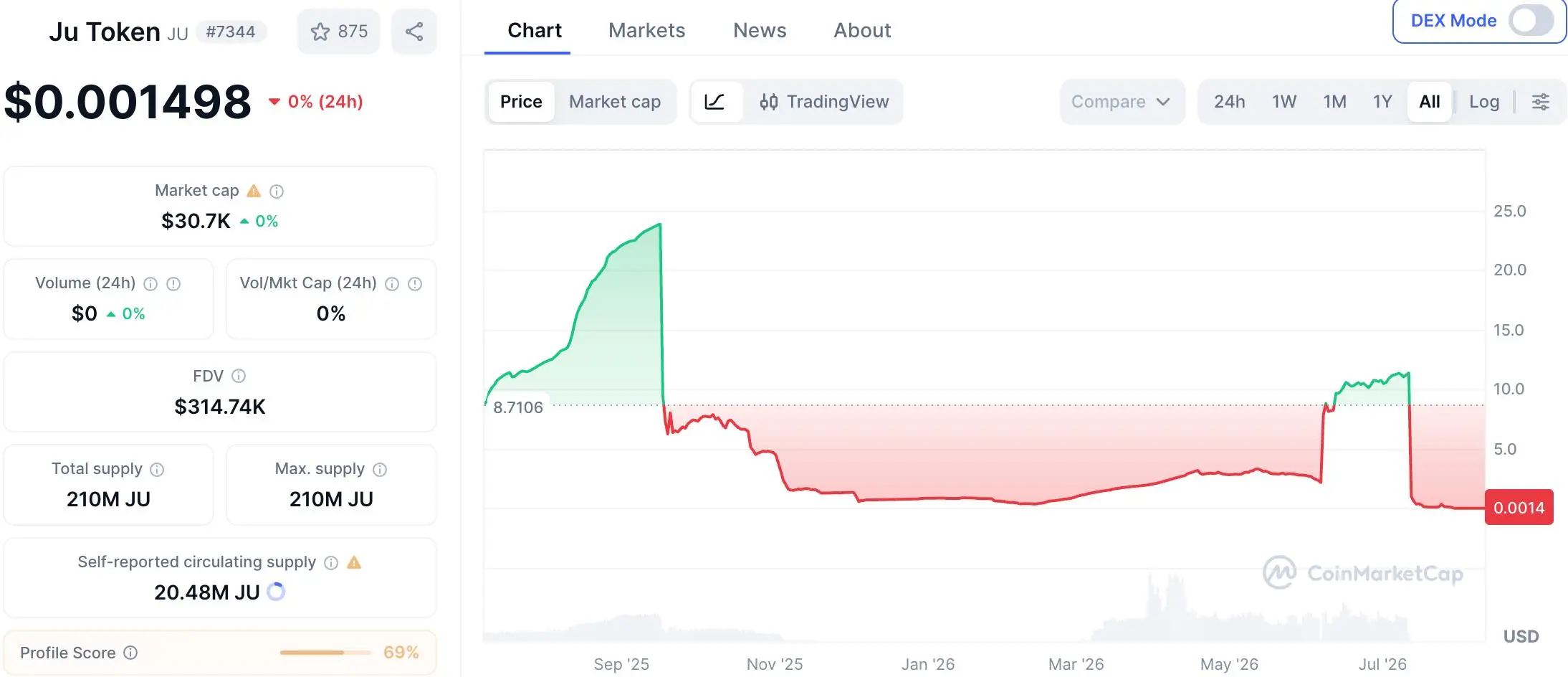
JU Token Status (Source: CoinMarketCap)
The most outrageous move came next: platform staff openly stated in community groups:
“Accounts that made profits will be frozen directly, while those who lost money will not be affected.”
Translated into plain language:
Made money? That was our mistake — we need to correct it.Lost money? That‘s your problem — we don’t care.
This was no longer trading. It was an outright robbery in broad daylight.
Even more alarming was its so-called “5M Protocol.” It claimed to offer a 3% daily return, but required half of the earnings to be forcibly transferred into a high-risk mining pool. This was a typical Ponzi scheme, using new users principal deposits to pay the “returns” promised to earlier users. Once market sentiment cooled and new capital stopped flowing in, the entire structure collapsed instantly.
The on-chain investigator ZachXBT, often described as the anonymous Sherlock Holmes of the crypto world, had already issued warnings as early as March 2025, but retail investors ignored them. In May 2026, JuCoin and its affiliated One Agent scheme collapsed simultaneously and disappeared, involving billions in funds. Member accounts were frozen, and withdrawals became impossible.
After harvesting $1.8 billion over six years, JuCoin fully deserves its S-Tier ranking — because it didnt just steal money; it betrayed trust, emotions, and the entire reputation attached to the words “long-established platform.”
A+ Tier (Massive Collapse): TradeOgre — Nearly a Decade in Business, Gone Overnight
【Bad Reputation】★★★★★【Absurdity】★★★★【Public Attention】★★★★
If JuCoin was a “slow-acting poison,” then TradeOgre was a sudden and unexpected death.
TradeOgre (also known as the “Ogre Exchange”) was a nearly 10-year-old no-KYC exchange. It promoted a philosophy of “no need to know your customer,” offered one of the fastest listing speeds in the industry, and strongly supported PoW-based tokens, attracting a large number of “crypto freedom” advocates.
From 2017 to 2025, it was considered one of the longest-running and lowest-incident exchanges among similar platforms.
Then suddenly:
Bang. Gone.
Starting in June 2025, its Twitter account suddenly stopped updating. By July, the website became inaccessible, leaving users with no way to seek assistance.
A New Jersey court filing eventually confirmed the devastating outcome: authorities were unable to locate any legitimate operating entity or physical address associated with TradeOgre. One plaintiff claimed that as many as 70 BTC transactions were stolen through phishing attacks linked to the exchange, totaling 353 BTC. Estimates suggested TradeOgre may have disappeared with tens of millions of dollars in user funds.
Even more bizarrely, the company was suspected of being anonymously operated by individuals from Russia. People involved in token listings reportedly said the team repeatedly changed contact emails to operate behind the scenes. Trying to trace the exchanges history was like searching for footprints in the dark — the only possible clue was through domain registration records.
A decade of reputation, wiped out overnight. Not even a goodbye.
In September 2025, the Royal Canadian Mounted Police (RCMP) carried out the largest cryptocurrency seizure operation in Canadian history, recovering more than 56 million Canadian dollars worth of crypto assets from TradeOgre and becoming the first law enforcement agency in Canada to shut down a cryptocurrency trading platform.
But the irony is that the recovered assets were seized by law enforcement — they were not returned to users. The victims losses remain uncompensated.
A Tier (Classic Collapse): AscendEX (formerly BitMax) — Deposits Allowed, Withdrawals Blocked, Founder Disappears
【Bad Reputation】★★★★【Absurdity】★★★★【Public Attention】★★★★
The name BitMax is familiar to many veteran crypto users. Founded in 2018 by a Chinese team with a Wall Street quantitative trading background, the platform suffered a major hack in 2021, losing more than $77 million. Later that year, it rebranded as AscendEX.
In June 2026, on-chain investigator ZachXBT issued a warning: multiple AscendEX users reported that withdrawals had been delayed for days or even weeks, with some completely unable to process withdrawals. Some users had already been restricted from withdrawing funds since May 6, well before any official announcement.
After examining AscendEXs hot wallets, ZachXBT found that the platform appeared to hold almost no reserves of major assets such as ETH, USDT, and SOL.
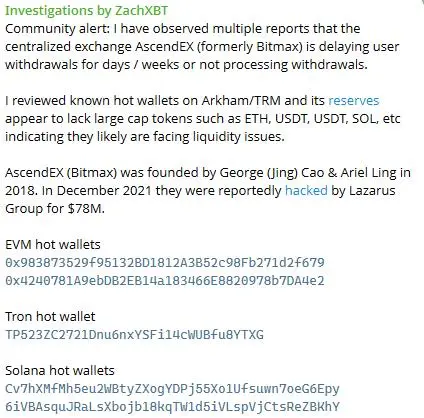
ZachXBT issued a warning about AscendEX.
The most outrageous part was this: users were unable to withdraw their funds, yet the platforms deposit function remained fully operational.
They shut off the faucet while continuing to collect water — an absolutely unbelievable move.
On July 1, AscendEX officially ceased operations. The company blamed the shutdown on “market conditions” and EU MiCA regulations. Starting July 6, all withdrawals were moved to manual review, with the announcement explicitly stating:
“The withdrawal time and amount cannot be guaranteed.”
Co-founder George Cao (Cao Jing) was accused of going missing, and multiple victims reported that repeated attempts to contact him received no response.
A “professional-grade” exchange founded by a Wall Street elite team ultimately left without even saying goodbye. As of July 8, verified user claims had already reached millions of dollars, while the platforms hot wallets held almost no available liquid assets.
B+ Tier (A Respectable Exit, But Still Hurt Users): BitMEX & BitMart
【Bad Reputation】★★★【Absurdity】★★★【Public Attention】★★★★★
BitMEX — The Silent Farewell of the Perpetual Contract Pioneer
The collapse of BitMEX was one of the most symbolic events in the entire crypto industry.
In May 2016, BitMEX launched XBTUSD, the worlds first perpetual contract. At its peak, BitMEX controlled 57% of the global crypto derivatives market share.
However, it eventually fell due to issues involving compliance, operations, and other challenges. On July 23, 2026, BitMEX officially announced its shutdown.
Crypto veterans including CZ expressed their disappointment over the news. Following the announcement, the platform token BMEX plunged 94% in a single day, falling nearly 99.8% from its all-time high.
The creator of perpetual contracts was ultimately defeated by the very game it created.
This was not an “exit scam” — it was a “dignified death.”
But the real question remained:
What about users assets?
During the final countdown to closure, nobody knew exactly how much users would actually be able to recover.
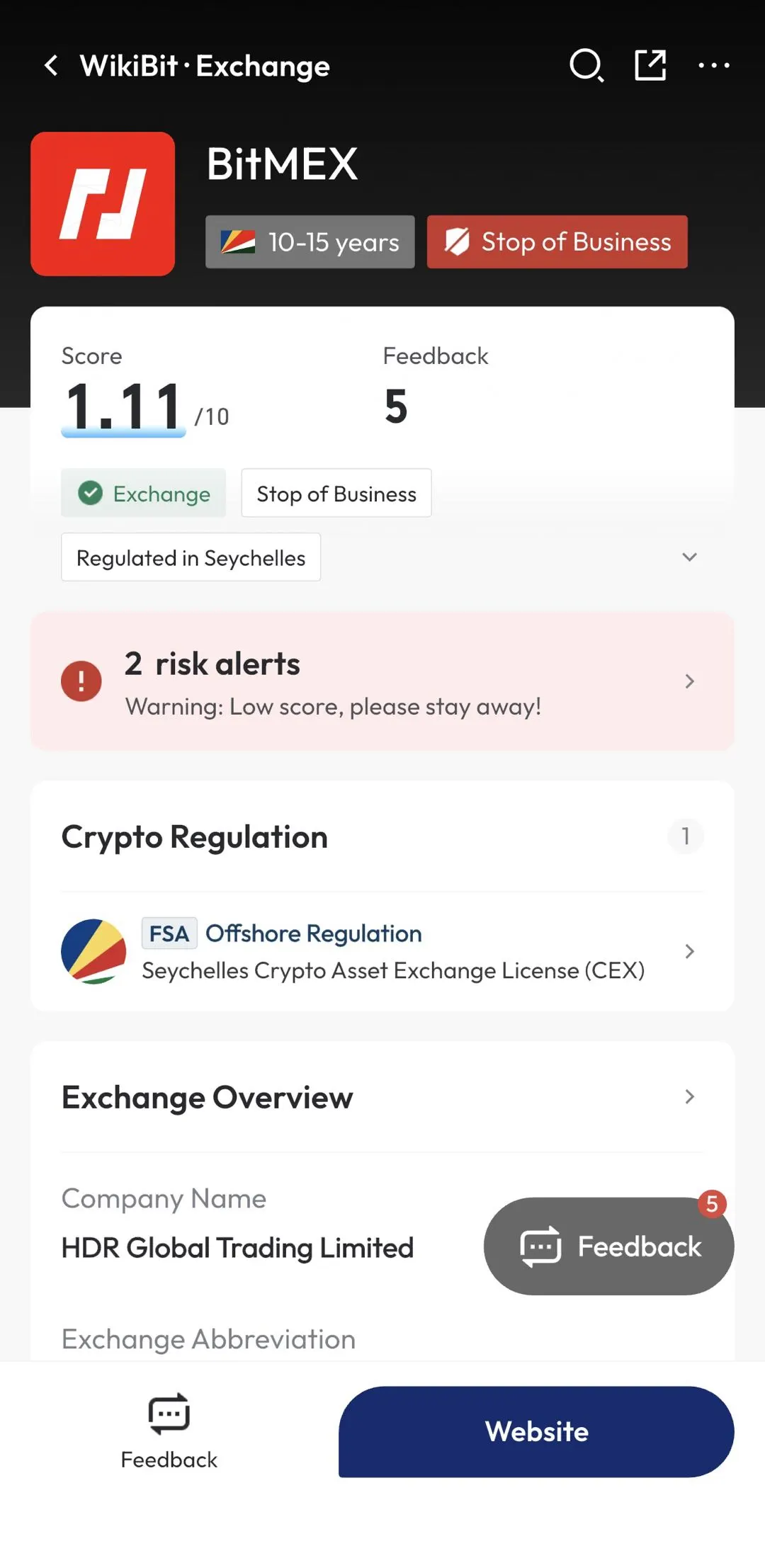
BitMEX Risk Assessment (Source: WikiBit)
BitMart — The Founder Said “We Didn‘t Run,” But Users Still Couldn’t Withdraw
In July 2026, BitMart began its shutdown process.
Founder Sheldon posted an emotional statement:
“We have not run away, and we will never run away!”
But users actual withdrawal experiences told a different story:
- Withdrawals remained stuck indefinitely at “processing”
- Some transactions showed “completed” but had no on-chain hash
- Others displayed messages indicating “on-chain freezing”
Large withdrawals?
Only possible in dreams.
Employees had already been massively laid off in May, with unpaid wages and workers publicly seeking help on Twitter.
After nearly nine years of operation, this veteran exchange finally exited the stage in a so-called “respectable” manner.
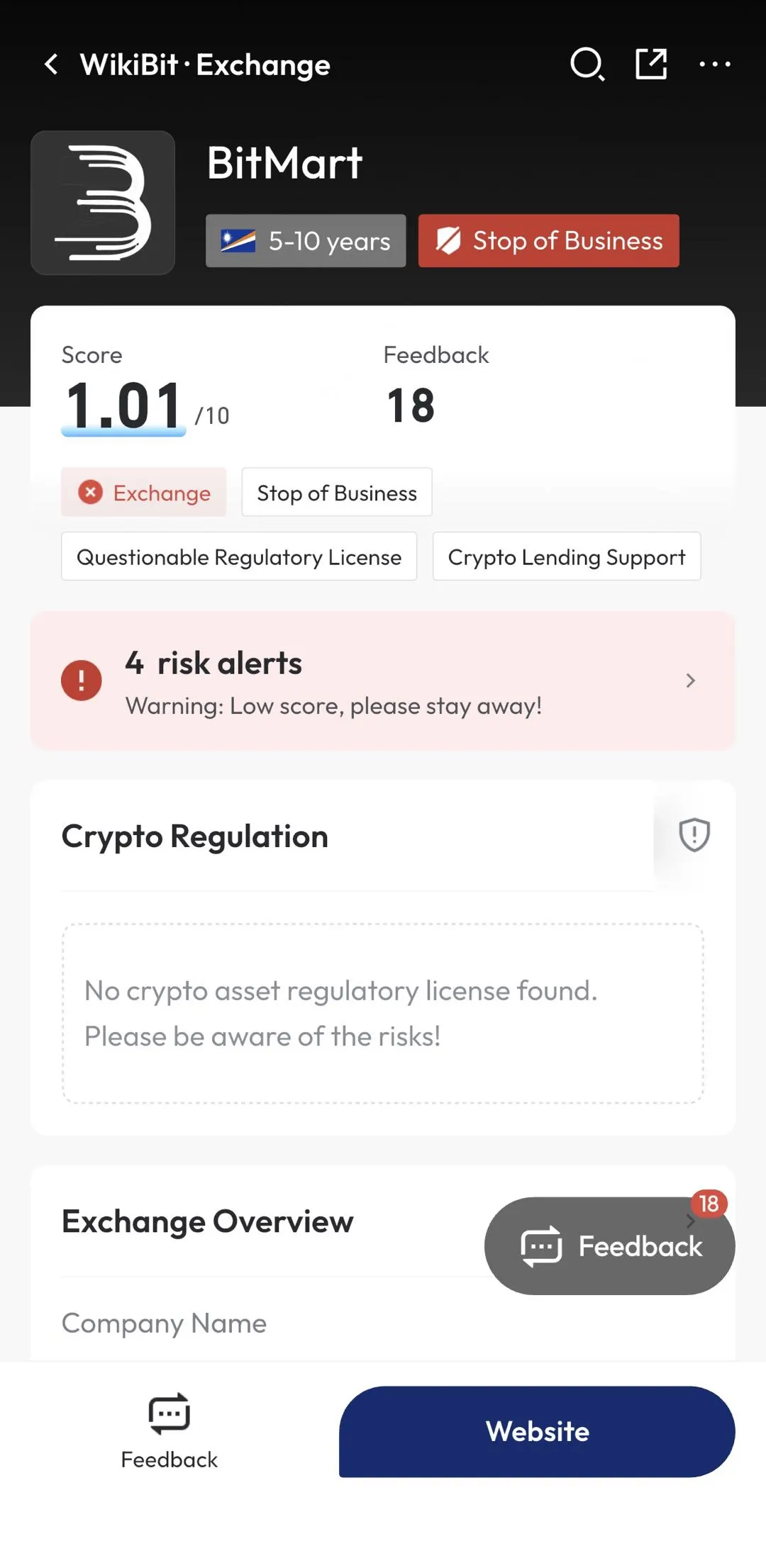
BitMart Risk Assessment (Source: WikiBit)
B Tier (Crushed by Compliance): Tokenize Xchange & EXMO
【Bad Reputation】★★【Absurdity】★★【Public Attention】★★★★
Tokenize Xchange — The First Victim of Singapores Regulatory Hammer
On July 4, 2025, the Monetary Authority of Singapore (MAS) officially rejected Tokenize Xchanges license application.
Afterward, MAS received multiple customer complaints alleging delayed withdrawals.
Investigations found that ATPL, the company behind the platform, allegedly lacked sufficient assets to fully return customer funds. It also failed to separate company assets from user assets and was accused of falsely claiming that asset segregation had already been completed in its license application.
Founder Hong Qi Yu was formally charged with fraudulent business conduct, facing up to seven years in prison.
More than 270 former users filed lawsuits seeking $60.5 million in damages.
Ironically, just before the crisis erupted, the company had publicly announced plans to expand into Taiwan and increase its R&D team.
One hand was selling a dream, while the other was preparing for collapse.
EXMO — “Sanctioned” by Sanctions
On May 26, 2026, the UK Foreign Office added EXMO to its Russia sanctions list.
On July 14, EXMO announced its shutdown.
British financial sanctions almost completely paralyzed its operations.
This may have been one of the most “unfair” exchange collapses in history:
It wasnt destroyed by its own mistakes — it was crushed by government sanctions.
Common Patterns Behind Failed Crypto Exchanges: Four Ways to Die, One Final Outcome
Looking across this wave of exchange collapses, almost every failed platform can be categorized into four types of failure:
Death Method 1: Ponzi-Style Collapse (JuCoin)
The worst type:
From the very beginning, the platform was never truly designed to operate as an exchange. It was simply a Ponzi scheme wearing an exchanges clothing.
High-yield promises, referral incentives, artificial token pumps, and using new users money to pay old users.
Once new money stopped flowing in, the entire system collapsed together.
Death Method 2: Crushed by Regulatory Compliance (Tokenize Xchange, EXMO, AscendEX)
From 2025 to 2026, global crypto regulation tightened dramatically.
Singapore‘s MAS launched strict enforcement actions, the EU’s MiCA framework entered full implementation, and UK financial sanctions directly restricted certain platforms.
Small and mid-sized exchanges that relied on regulatory gray areas suddenly lost the environment that allowed them to survive.
Notably, AscendEX stopped operations on July 1 — exactly the final day of the MiCA transition period.

European Securities and Markets Authority (ESMA) MiCA Dedicated Page
Death Method 3: Liquidity Crisis (TradeOgre, AscendEX)
No new users, no trading volume, no cash flow.
When the market enters a bear cycle, trading activity declines, and market makers withdraw, these exchanges become like small pools of water in a desert — slowly evaporating until nothing remains.
TradeOgres no-KYC model made it almost impossible to achieve regulatory compliance, obtain banking services, or attract institutional capital.
Freedom comes with a price. And the price is that nobody will come to save you when things go wrong.
Death Method 4: Collapse of Reputation (BitMEX)
Its first-mover advantage was exhausted, and the cost of regulatory pressure finally surfaced.
BitMEX once defined an entire industry, but regulatory action in 2020 damaged its reputation and caused users to leave.
In this industry, losing trust is more fatal than losing money.
Money can be earned again.
But once trust is gone, it may never return.
Final Thoughts: The Drama Is Over — Now Its Time to Learn the Lessons
After going through all these “crypto dramas,” we can laugh at the chaos, but behind every story are real financial losses and real victims.
Since 2026, more than 100 crypto projects have shut down.
This is not a joke.
1. “Long-established” Does Not Mean “Safe”
JuCoin changed its name six times in six years.
TradeOgre operated for nearly a decade and still disappeared overnight.
What lasts is not necessarily reputation — sometimes it is simply the accumulated experience of deception.
2. The Cost of No-KYC May Be “Nowhere to Seek Compensation”
TradeOgre spent ten years proving one thing:
No KYC also means no accountability.
You enjoy the freedom of fewer restrictions, but you must also accept the risk that when something goes wrong, nobody may be responsible.
3. Compliance Is the Bottom Line, Not a Bonus Feature
MiCA arrived.
Singapores MAS began enforcement actions.
The UK started imposing sanctions.
When choosing an exchange, check whether it has proper licenses and regulatory oversight first — not how impressive its marketing looks.
4. Diversifying Assets Is a Basic Survival Rule
BitMart‘s withdrawal problems, AscendEX’s blocked withdrawals, and JuCoins frozen accounts all prove one thing:
Putting your entire fortune into a single exchange is equivalent to voluntarily handing someone else control over your financial lifeline.
On-chain data shows that users who adopted diversified storage strategies experienced a loss rate of only 8% during exchange failure events, significantly lower than the industry average.
5. Stay Alert and Conduct Proper Due Diligence
Before depositing any funds, always conduct thorough due diligence:
Check whether the platform provides proof of reserves
Understand its regulatory licenses and compliance status
Monitor genuine community feedback
ZachXBT warned about JuCoin as early as March 2025.
The warning signs were always there.
The problem was that too many people chose to ignore them.
6. High Returns Always Come With High Risks
“3% daily returns,” “300% increase in half a month” — these numbers themselves are the loudest warning signals.
The essence of a Ponzi scheme has never changed:
Using money from later investors to pay the returns promised to earlier investors.
The day new capital stops flowing in is the day the entire system collapses.
The crypto world is a huge arena.
Where there are people, there are stories.Where there is money, there are always those holding the knives.
The greatest wealth in crypto is not predicting the next explosive rally.
It is:
Surviving every major collapse.
Over the past few years:
- Mt. Gox taught us that even major platforms can fail.
- FTX showed us that even celebrity founders and star teams can deceive users.
- Events like BitMart reminded us that years of operation do not guarantee permanent safety.
The market creates new dramas every day.
But after watching the chaos, the most important thing is:
Do not become the main character in the next headline.
In the crypto world:
Making money requires ability.Staying alive requires risk management.
Every exchange collapse is essentially a free risk-management lesson handed to users by the market.
Truly smart investors do not waste time searching for an exchange that will “never collapse” — because such a thing does not exist.
Instead:
Always make sure you have the ability to leave.