Australia Digital Assets Framework Act: Platform Licensing and the 2027 Transition

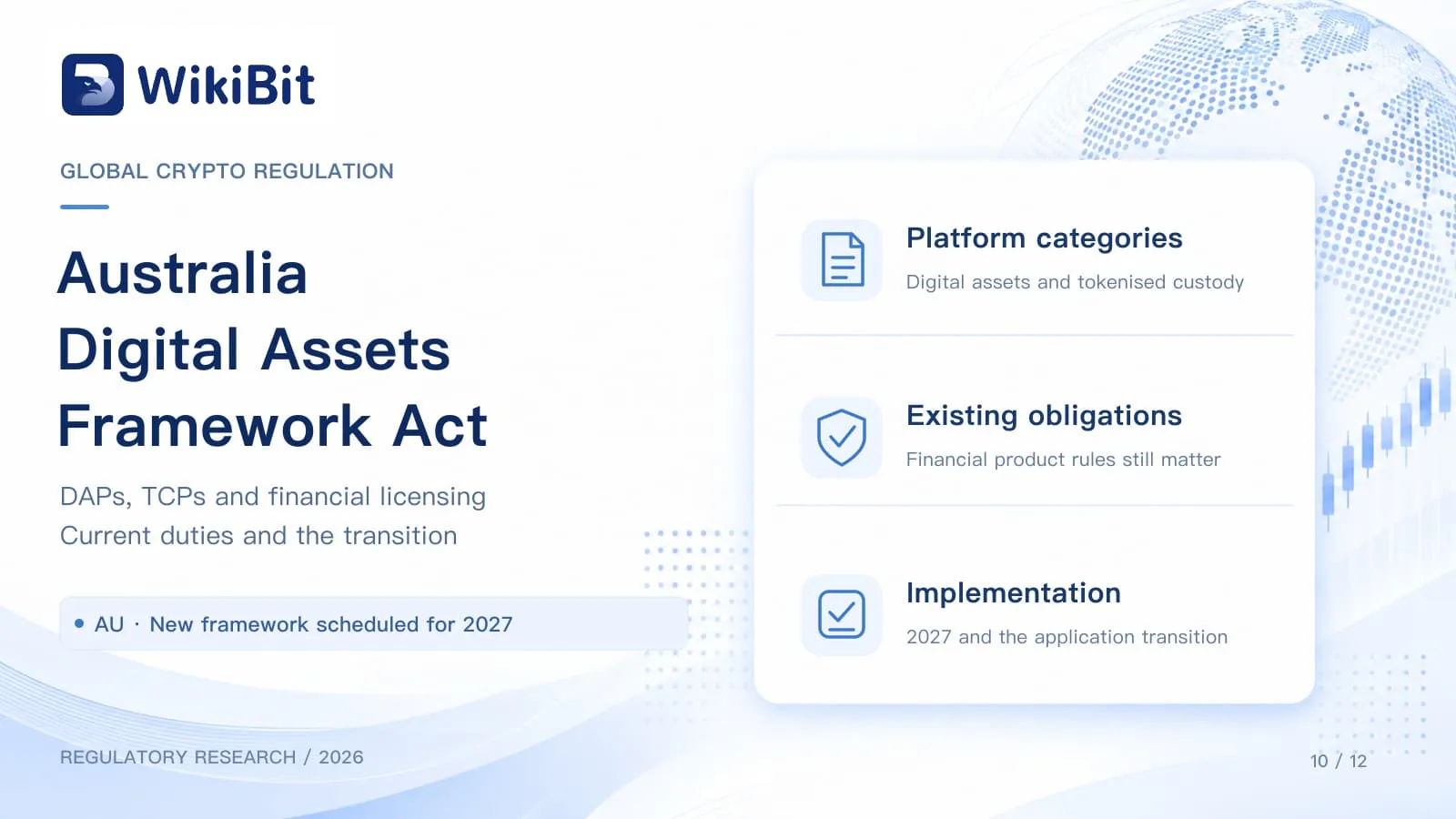
Australias digital-asset regulatory framework changed materially in 2026, but the most important new platform rules are not yet fully operational.  The Corporations Amendment (Digital Assets Framework) Act 2026, Act No. 38 of 2026, received Royal Assent on April 8, 2026. It creates a new financial-services framework for digital asset platforms (DAPs) and tokenised custody platforms (TCPs) under the Corporations Act.  The reform is significant because it regulates the platform arrangement itself rather than simply trying to classify every crypto token as a traditional financial product.  But enactment should not be confused with commencement.  ASICs current implementation roadmap says the new DAP/TCP framework will commence in April 2027, followed by a licensing transition. At the same time, Australias existing financial-services laws already apply where a digital-asset product or service falls within existing financial-product definitions.  That creates two parallel questions for businesses in 2026:  What law applies to my product today?  and:  What additional DAP or TCP obligations will apply when the new framework commences?  For users, the same distinction matters when an exchange says it is “preparing for Australias new crypto licence.” Preparation for a future regime does not establish that every service it provides today is already properly authorised.The Act is law, but the new framework starts in 2027  The
09-23انڈسٹری ریسرچ

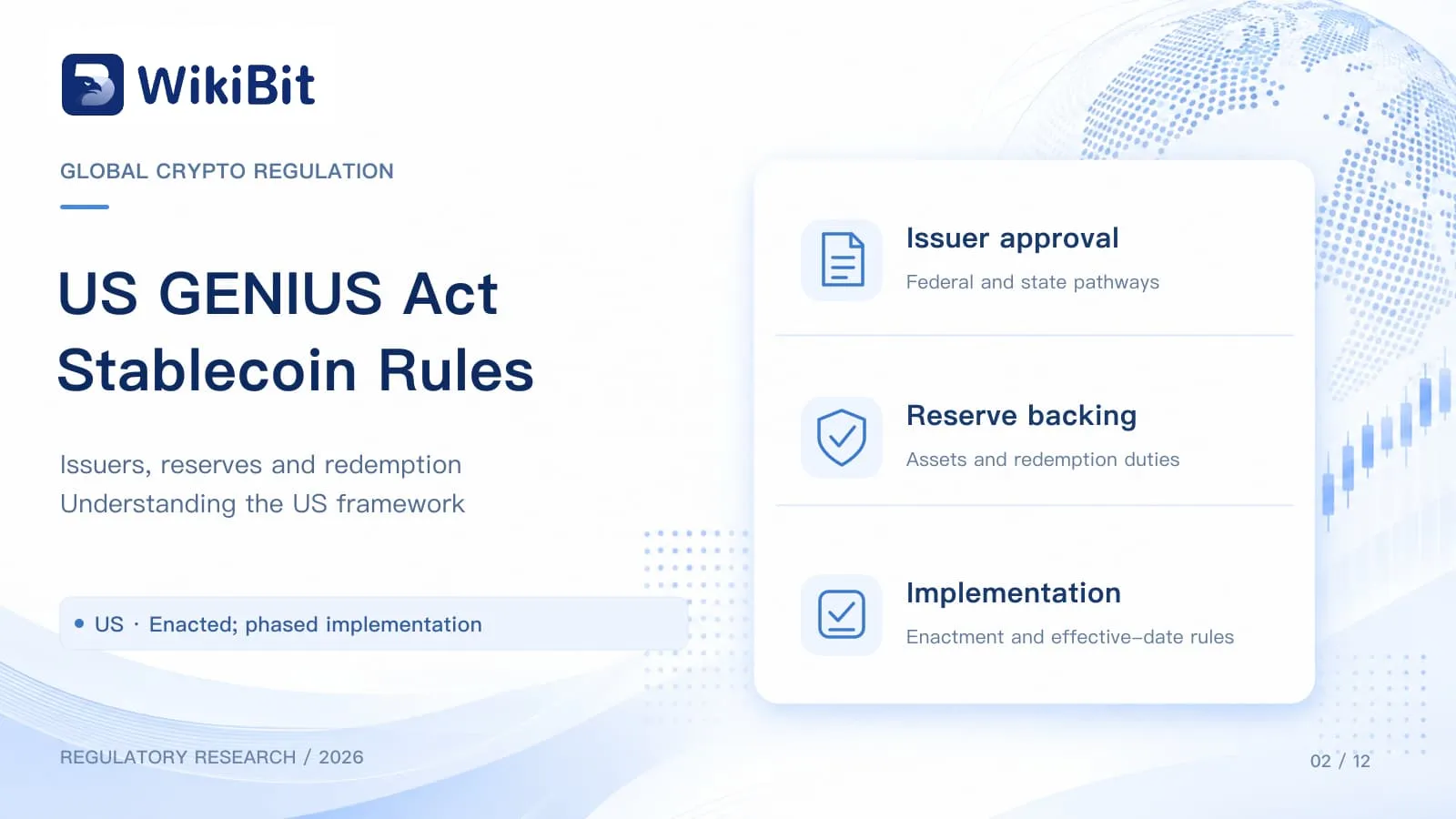
GENIUS Act Explained: US Stablecoin Rules and Implementation in 2026

The GENIUS Act is no longer only a policy framework waiting for an effective date.  The Guiding and Establishing National Innovation for U.S. Stablecoins Act, or GENIUS Act, became law on July 18, 2025 as Public Law 119–27.  Its principal effective date is now effectively fixed at January 18, 2027.  The statute originally used a two-part formula:18 months after enactment; or120 days after the primary federal payment stablecoin regulators issue final implementing regulations;  whichever occurs first.  The first date is January 18, 2027.  By late September 2026, the principal federal implementation packages remained in proposed-rule form. OCC had proposed its main framework, FDIC had proposed prudential and custody rules, and the federal banking agencies and FinCEN had proposed customer-identification requirements. No final implementing rule had been issued early enough for the 120-day mechanism to produce a date before January 18, 2027.  That makes the distinction between law enacted and regime effective much clearer than it was earlier in 2026.  For issuers, exchanges and users, however, one date is still not enough.  The Act also contains separate delayed restrictions, including a rule that, beginning three years after enactment — July 18, 2028 — digital asset service providers generally may not offer or sell payment stablecoins in the United States unless

09-23انڈسٹری ریسرچ

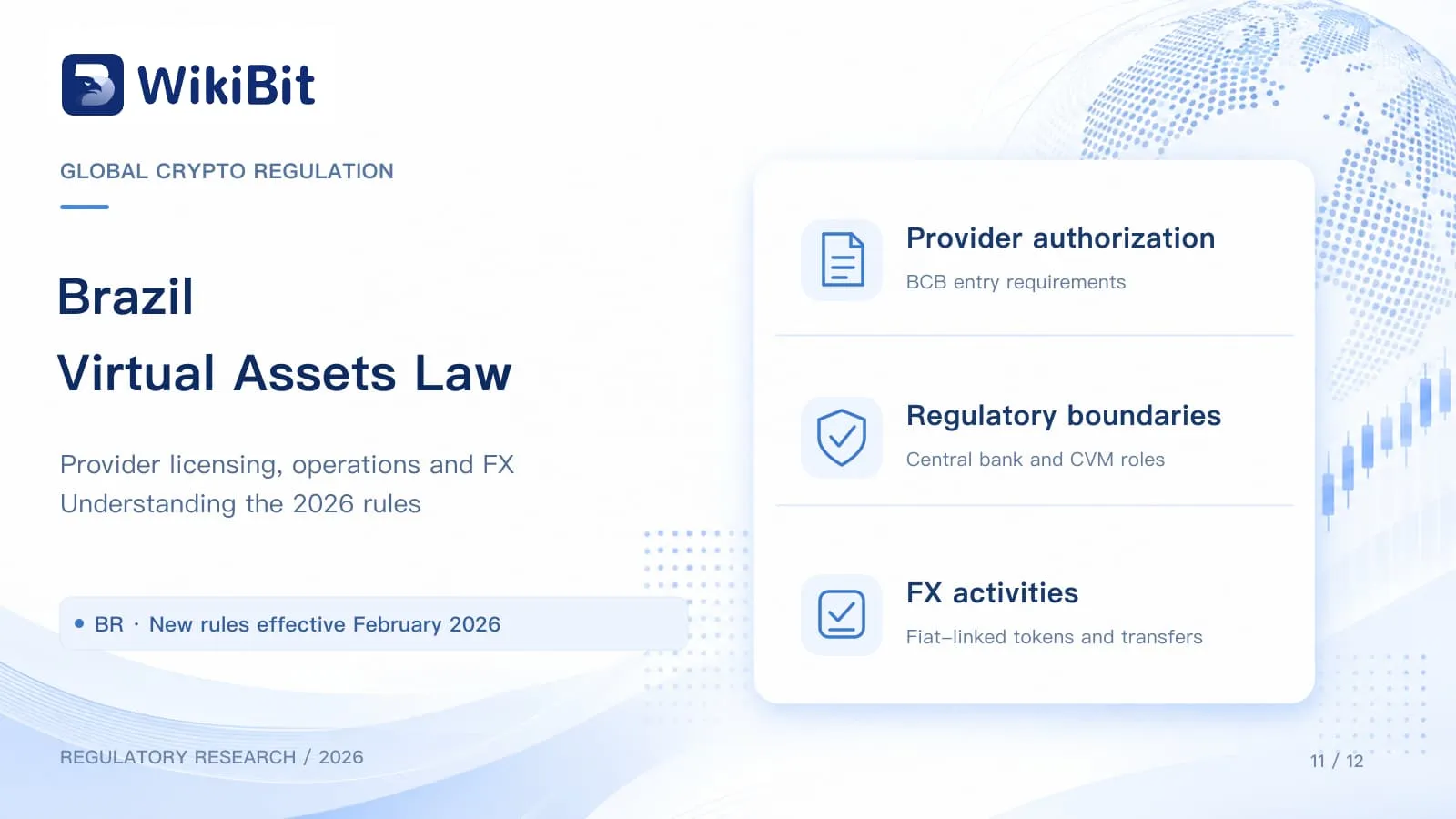
Brazil Virtual Assets Law: Central Bank Licensing, VASP Rules and FX Boundaries

Brazils crypto regulatory framework moved from broad legislation into detailed central-bank supervision in 2026.  The foundation remains Law 14,478 of 2022, which created a legal framework for virtual-asset services. But a current review can no longer stop there.  Decree 11,563 assigned the main authorization and supervisory role to the Banco Central do Brasil (BCB), while preserving the authority of the Comissão de Valores Mobiliários (CVM) over securities. Then, in November 2025, the BCB published Resolutions 519, 520 and 521, which became the operational core of the regime in 2026.  Those rules took effect primarily on February 2, 2026.  They address three different questions:who needs authorization and how the transition works;how virtual-asset service providers must operate;when virtual-asset transactions fall inside Brazils foreign-exchange and international-capital framework.  The result is much more specific than the phrase “crypto is regulated in Brazil.”  For users and businesses, the important questions are:  Which legal entity provides the service?  Is it authorized, in the authorization process or operating under a valid transition?  Is the product a virtual asset, a security, a derivative or a foreign-exchange service?  Which regulator and rule apply to that activity?  Those distinctions matter more than a generic “BCB regulated” label.Brazils framework now has several regulatory layers  Brazils virtual-asset regime can be understood through four main

09-23انڈسٹری ریسرچ

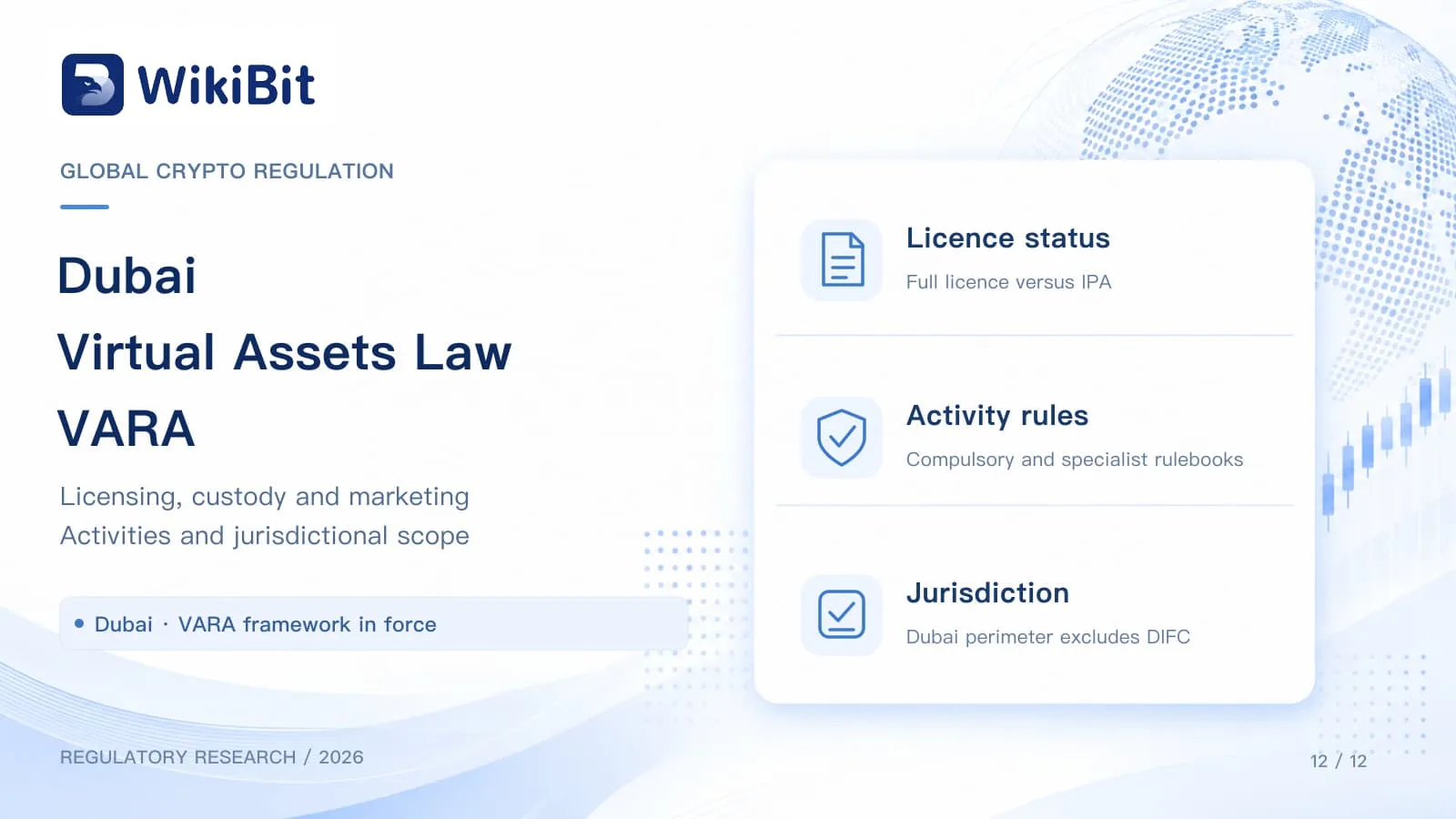
Dubai Virtual Assets Law and VARA: Licensing, Custody and Marketing Rules

Dubais virtual-asset regime is now mature enough that the phrase “VARA regulated” is no longer very informative on its own.  Law No. 4 of 2022 created the Virtual Assets Regulatory Authority, but the legal position of an exchange, custodian, broker or token issuer depends on much more than the existence of that law.  Users need to know:which legal entity provides the service;whether that entity appears in VARAs Public Register;whether it holds a full VASP licence or only In-Principle Approval;which activities the licence actually covers;whether the product is offered inside VARAs territorial perimeter;which version of the relevant rulebook applies.  Those distinctions became even more important in 2026.  VARA now publishes activity-specific permissions in its Public Register, including a separate designation for Exchange Services that include Exchange Traded Derivative Services. In March 2026, it also updated the Exchange Services Rulebook with detailed requirements for crypto derivatives covering areas such as client suitability, margin, leverage, segregation and insurance funds.  The practical lesson is simple:  A Dubai company registration, an In-Principle Approval or a licence for one virtual-asset activity should never be treated as permission for every crypto product offered under the same brand.VARA does not regulate the DIFC  The first boundary is geographic.  VARA regulates virtual assets and virtual-asset activities across

09-23انڈسٹری ریسرچ

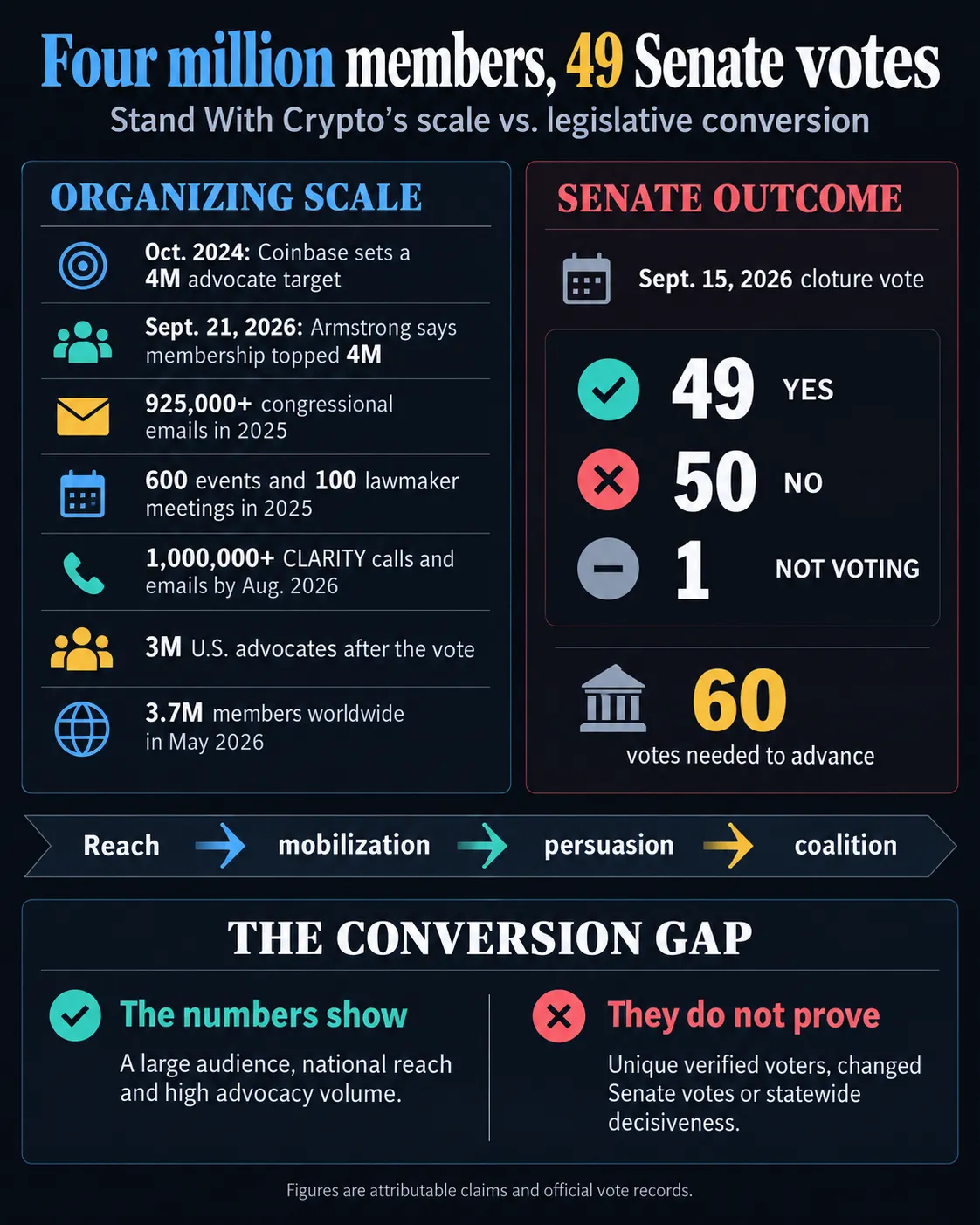
Stand With Crypto‘s 4 million registered advocates couldn’t get the CLARITY Act through the Senate

The Senate fell short of advancing the CLARITY Act on Sept. 15, when a 49-50 cloture vote failed to reach the 60-vote threshold. Six days later, Coinbase CEO Brian Armstrong said Stand With Crypto had surpassed four million members.  Armstrong wrote in a post that “the 2024 election proved the importance of the crypto voter,” adding that voters would remember who supported them.  The Senate vote concerned whether to begin considering H.R. 3633, not final passage or the effectiveness of one group. Their proximity instead put Stand With Cryptos political challenge in converting a large supporter list into the bipartisan votes needed to enact policy.  What Stand With Cryptos four million figure measures  Armstrongs statement marked the completion of an explicit Coinbase objective. In October 2024, the exchange committed to helping Stand With Crypto reach four million advocates before the 2026 midterm elections.  Coinbase had already said it helped create the organization in 2023, making membership growth part of its policy strategy.  Armstrong used “members,” while Stand With Crypto has also used “advocates.” After the Senate vote, the group described its US network as three million advocates. In May, it reported over 3.7 million members worldwide across six markets.  The figures cover different dates and geographies, so

09-22

South Korea to test CBDC backed deposit tokens for government expenses

South Korea has approved a pilot that will let public officials pay government operating expenses with blockchain based deposit tokens instead of physical government cards.  According to The Chosun Daily, the Ministry of Science and ICT approved the project during the 45th ICT Regulatory Sandbox Review Committee meeting held on Sept. 21, with the ministry announcing the decision a day later.  The blockchain based government fund execution project was among nine cases granted regulatory exemptions by the committee. It will allow officials to make eligible payments by scanning QR codes on smartphones and using deposit tokens connected to the Bank of Koreas digital currency infrastructure.  Existing rules under South Koreas National Treasury Funds Management Act have limited payment methods for government office operating expenses to tools including government purchase cards and bank transfers. The sandbox exemption creates a route for digital currency to be tested without first changing the underlying law.  Six banks will participate in the government payment trial, including KB Kookmin Bank, NH NongHyup Bank, Shinhan Bank, Woori Bank, Industrial Bank of Korea and Hana Bank.  Deposit tokens will replace cards for selected government payments  Under the pilot, participating public officials will be able to use deposit tokens for expenses such as business promotion

09-22انڈسٹری

Australias 40-year outlook names AI, omits crypto

Australia‘s Treasury has placed artificial intelligence among five transitions expected to reshape the economy through 2065–66, while digital assets are absent from the report’s five headline themes.  SummaryAustralias 2026 Intergenerational Report identifies artificial intelligence as one of five major long-term economic transitions.Treasury says agentic AI systems are becoming more autonomous, capable and widely used across society.Crypto receives no focus in the 40-year outlook despite separate government digital finance initiatives underway.Australias Financial Innovation Strategy links AI agents with real-time, interoperable and programmable payment infrastructure needs.DFCRC estimates full digital finance adoption could generate A$24 billion in annual Australian economic gains.  Treasury published the seventh Intergenerational Report on Sept. 21, covering Australia‘s economic and federal budget outlook for the next 40 years. The report identifies the AI revolution, geopolitical fragmentation, the energy transition, population aging and the country’s continuing move toward a services economy as its major transitions.  The government expects Australias economy to more than double in size by 2065–66, while real income per person is projected to rise 55%. Average annual economic growth is expected to slow as population growth and workforce expansion lose pace, leaving productivity as a larger part of the long-run growth equation.  You might also like:  NVIDIA expands Australia AI capacity with

09-22انڈسٹری

Animoca Brands suspends Currenc merger talks, keeps public listing plan

Animoca Brands has suspended talks on its proposed reverse merger with Nasdaq listed Currenc Group after the companies determined that the expected closing timeline no longer fit their short and medium term plans.  SummaryAnimoca Brands and Currenc Group suspended reverse merger talks after projected closing timelines no longer matched their strategic goals.Animoca remains committed to a major public exchange listing and is preparing its audited fiscal 2024 financial statements.The proposed deal would have left Animoca shareholders with approximately 95% of the combined company.Both companies may resume merger discussions if market conditions and their strategic priorities permit.  According to Animoca Brands, the decision was made mutually after the companies reviewed the time needed to complete the transaction and changing market conditions. The companies could reopen discussions if conditions permit, while Animoca said it remains committed to returning to a major public exchange.  The decision puts on hold a transaction that would have given the web3 and AI investor a route back into public markets more than six years after its shares stopped trading on the Australian Securities Exchange.  Animoca Brands keeps public listing plans in place  Animoca co founder and executive chairman Yat Siu said the company continues to work through the audit and compliance requirements

09-22انڈسٹری

SEI surges 25% as Canarys 90% staking plan tightens supply - Can the rally hold?

Seis breakout is accelerating after weeks of failed attempts near $0.052. This suggests a shift from a consolidation phase to an upward momentum.  After weeks trading below the $0.052 resistance, buyers pushed the price of the token to $0.06285. In turn, the token gained over 25% in 24 hours. Daily volume surged alongside the price to $203.44 million, a 289% spike according to CoinMarketCap data.  This suggested broader market participation behind the move rather than just speculation.  However, the breakout price has risen well beyond the prior trading range. Therefore, this leaves very little support for Sei [SEI] above $0.052. The RSI stood at 87.64, which also reinforced the imbalance, indicating that momentum has reached extreme levels.  Source: TradingView  Ultimately, even though the overall trend of Seis breakout remains bullish, buyers may find it difficult to sustain their recent gains. A hold at $0.052 will continue to validate the construction of the trendline, but another drop could put pressure on demand to absorb selling pressure.  Canarys ETF targets SEI staking  SEI‘s sharp breakout is now being reinforced by a proposed ETF structure that could change how new demand affects supply. Canary Capital’s amended S-1 proposes staking roughly 90% of the ETFs SEI holdings.  This could lead to the

09-22انڈسٹری

Gold price in Pakistan: Rates on September 22

Gold prices remained broadly unchanged in Pakistan on Tuesday, according to data compiled by FXStreet.  The price for Gold stood at 38,702.99 Pakistani Rupees (PKR) per gram, broadly stable compared with the PKR 38,731.66 it cost on Monday.  The price for Gold was broadly steady at PKR 451,424.10 per tola from PKR 451,758.50 per tola a day earlier.Unit measureGold Price in PKRDiscover moreEnterprise blockchain solutionsBrokerages & Day TradingBitcoin mining hardwareCrypto wallet reviewSecure crypto storagefinancialFinancial technology newsFintech investment reports1 Gram38,702.9910 Grams387,029.90Tola451,424.10Troy Ounce1,203,798.00  FXStreet calculates Gold prices in Pakistan by adapting international prices (USD/PKR) to the local currency and measurement units. Prices are updated daily based on the market rates taken at the time of publication. Prices are just for reference and local rates could diverge slightly.

09-22انڈسٹری
1
...
8284
...
1000