NASDAQ 100 extends losses with 2.1% drop as inflation fears rattle tech stocks

Tech  NASDAQ 100 extends losses with 2.1% drop as inflation fears rattle tech stocks  The NASDAQ 100 slid 2.1% in recent trading, extending a streak of losses that has rattled investors across both traditional equities and digital assets. The selloff hit information technology stocks hardest, with the sector leading the broader decline as Wall Street digests the uncomfortable reality that the Federal Reserve may not be cutting rates anytime soon.  The broader Nasdaq Composite also dropped 1.39%, confirming this isnt just a narrow blip.  Inflation data changes the calculus  Recent US inflation prints came in hotter than expected, pushing back the timeline for rate cuts that many had treated as a near-certainty. Thats a problem for growth stocks, which are essentially long-duration bets on future earnings. When interest rates stay elevated, the present value of those future cash flows shrinks, making it harder to justify paying premium prices for companies whose biggest profits are years away.  Tech stocks, which dominate the NASDAQ 100, are particularly sensitive to this dynamic. The index is heavily weighted toward companies that trade on growth expectations rather than current profitability.  The selloff wasnt entirely uniform, though. Take-Two Interactive managed to buck the trend, rising 6.8% intraday even as the rest of the

05-15

Bybit captures 77% of CEX market share for BILL token trading

BILLs broader market activity has also drawn attention, with over $2.19 billion in 24-hour global trading volume recorded across all venues.  Billions describes itself as a global human and AI network built on mobile-first verification, designed to confirm the identity and uniqueness of both humans and AI agents while offering users personalized experiences and rewards.  To coincide with the tokens momentum, Bybit is running a Token Splash promotion distributing a total of 29,000,000 BILL across its Spot and Alpha platforms with 20,000,000 BILL allocated to Spot users and 9,000,000 BILL to Alpha users.  Bybits fast listing strategy, deep liquidity, and tight spreads were cited as factors behind its dominance in early-stage token markets.  The post Bybit captures 77% of CEX market share for BILL token trading appeared first on Finbold.

05-15

BREAKING: THORChain Suffers $10M Exploit Across Bitcoin, Ethereum, BSC, Base Chains

Bitcoin Ethereum  BREAKING: THORChain Suffers $10M Exploit Across Bitcoin, Ethereum, BSC, Base Chains  THORChain, a decentralized cross-chain liquidity protocol, has paused trading after blockchain security researchers flagged an exploit worth over $10 million. The protocol has reportedly suffered an exploit across Bitcoin, Ethereum, BSC and Base. As a result, RUNE price crashed 12% in a few hours.  THORChain Hit By $10M Crypto Losses in Exploit  On-chain investigator ZachXBT on May 15 flagged an exploit on THORChain, claiming losses exceeding $10 million. The funds are stolen across multiple major blockchains, including Bitcoin, Ethereum, BNB Smart Chain (BSC), and Base.  In response, THORChain has halted all trading and swaps via its emergency protocol to contain the damage. The exploit involved large unauthorized outflows from THORChains router contracts across the affected chains.  Many security researchers and analytics platforms such as PeckShieldAlert revealed the attackers wallets. Notably, the wallets hold 36.85 BTC, 3,443 ETH, and 96.6 BNB, along with other tokens like USDT, USDC, and WBTC, according to Arkham data.  THORChain Exploiter Wallets Crypto Assets. Source: Arkham  The incident triggered THORChains built-in halt mechanism, where nodes pause operations upon detecting the exploit to protect liquidity providers (LPs). This is reportedly the second notable security event for THORChain this year, amplifying concerns about

05-15

Euro: Global Euro moment still unfulfilled – ING

Finance  Euro: Global Euro moment still unfulfilled – ING  ING‘s Carsten Brzeski argues that Europe has yet to earn its “global euro moment” outlined by European Central Bank (ECB) President Christine Lagarde in 2025. Despite progress on initiatives like the Savings and Investment Union and capital markets reforms, he stresses that fragmented capital markets and large, underused household savings continue to limit the Euro’s strategic international role.  Structural savings and market fragmentation persist  “And one year ago, ECB President Christine Lagarde stood in Berlin and declared that the fracturing global order had created Europe‘s ”global euro moment“: a rare chance to step up, earn influence, and reshape the international monetary system in Europe’s favour. Twelve months on, lets be honest: the optics are not good.”  “And yet – to borrow from Monty Python‘s Life of Brian – what has Europe ever done for us? Well, over the last 12 months: the Savings and Investment Union, launched in March 2025. A securitisation reform. A market integration and supervision package. Updated payment services rules. A Savings and Investment Accounts recommendation. EIB [European Investment Bank] defence investment tripled. EU defence spending is up 36% since 2022. A joint letter from Europe’s six largest economies demanding capital markets agreement

05-15

Copper: Tariff risk fuels rally – Commerzbank

Finance  Copper: Tariff risk fuels rally – Commerzbank  Commerzbanks Commodity Analyst Barbara Lambrecht highlights that Copper has surged to record levels on the London Metal Exchange, supported by structural demand from the energy transition and data centers. At the same time, the US is considering extending tariffs to refined Copper from 2027, encouraging pre-emptive stockpiling and tightening supply outside the US. Chinese production data due next week will be closely watched.  Record prices and looming US tariffs  “In the base metals markets, sentiment remains positive despite another significant rise in energy prices: The London Metal Exchange index even hit a new record high this week. A ton of copper cost more than USD 14,000.”  “In addition to concerns about a shortage of copper ore, fears of an expansion of US tariffs on metal imports are likely also playing a role in the current copper price rally. The US Department of Commerce is expected to decide by the end of June whether to extend the existing tariffs to refined copper.”  “The original proposal called for the introduction of a 15% tariff effective January 1, 2027. One year later, this was to be increased to 30%.”  “In contrast, imports nearly doubled last year, likely due to stockpiling ahead of

05-15

Bitcoin Surges to $82K on Clarity Act Vote: Enough to Save the Rally?

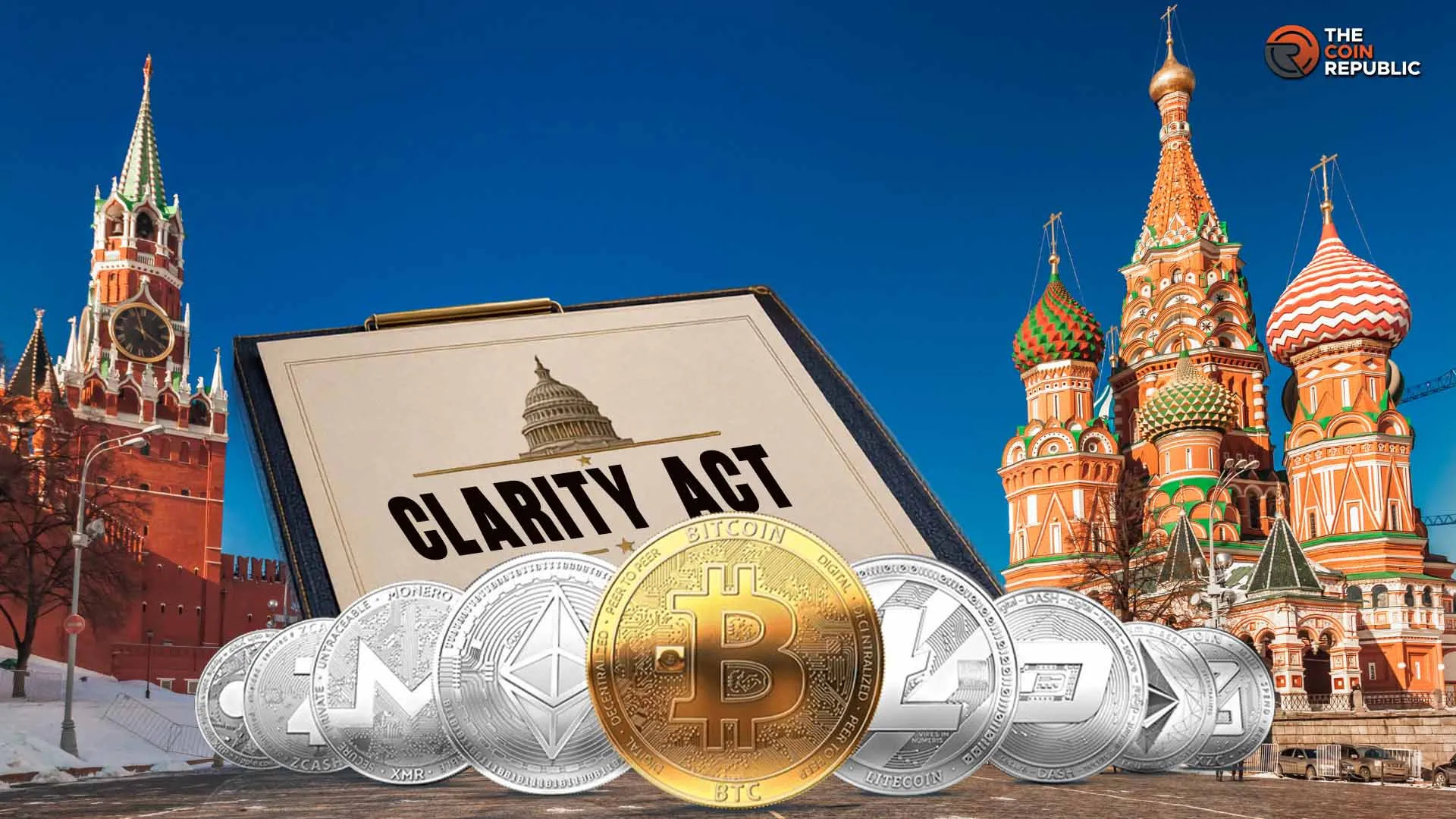
Bitcoin  Bitcoin Surges to $82K on Clarity Act Vote: Enough to Save the Rally?  The Clarity Act passed the Senate Banking Committee on Thursday leading to a rapid and strong rally for the Bitcoin price. Can this rally save the day for Bitcoin, or was the resulting lower high an omen of a possible crash to come?  $2,000 surge, but not enough  Source: TradingView  In Thursdays article on the $BTC price it was posited that: . This statement was made amidst the general negative tone of the article, and it was answered to perfection as the $BTC price surged around $2,000 briefly testing $82,000 on the Clarity Act news.  Be that as it may, the surge to $82,000 was sold down fairly quickly once it got there, leaving a candle wick to the upside. It can also be observed that the top of the wick failed to make a higher high, and the price fell down below the trendline.  As can be noted in the 4-hour chart above, the price is still above the major horizontal level and the top of the bear flag. However, with the Stochastic RSI indicators rolling over, leading to waning momentum, it may well be that the major level flips back to

05-15

THORChain Pauses Trading After Suspected $10M Exploit

Tech  THORChain Pauses Trading After Suspected $10M Exploit  Early estimates suggest that more than $10 million may have been stolen, although the exploit has not yet been officially confirmed. The incident only adds to a series of previous operational and security issues surrounding the protocol.  THORChain Hit by Suspected Exploit  Cross-chain liquidity protocol THORChain temporarily trading activity after blockchain investigators raised concerns over a suspected exploit that may have impacted multiple blockchain networks, including Bitcoin, Ethereum, BNB Smart Chain, and Base.  The incident was first pointed out by well-known on-chain security researchers ZachXBT and , who suspicious wallet activity tied to alleged theft addresses operating on Bitcoin and EVM-compatible chains. Early estimates suggest that the exploit may have resulted in losses of more than $10 million, although investigators made it clear that the attack had not yet been fully confirmed at the time of reporting.  The latest disruption only adds to a growing list of operational and security-related that have surrounded THORChain over the past two years. The protocol is designed to facilitate decentralized cross-chain swaps without intermediaries, but it has come under scrutiny because of its role in facilitating large asset transfers between different blockchain ecosystems.  While this functionality has made THORChain one of the more

05-15

JPMorgan Increases Bitcoin ETF Stake by 174% in Q1 2026

JPMorgan Chase made a bold move into Bitcoin ETFs during Q1 2026, increasing its stake in BlackRock‘s iShares Bitcoin Trust (IBIT) by 174%, according to its latest 13F filing. The bank boosted its holdings from 3 million shares in Q4 2025 to 8.3 million shares, representing an added value of $162 million. This brings JPMorgan’s total IBIT stake to $318.9 million as of March 31, 2026.  This aggressive accumulation came during a challenging quarter for Bitcoin. The cryptocurrency dropped by over 22% in Q1, closing the period at $79,318, according to CoinGlass. Spot Bitcoin ETFs also saw net outflows, reflecting broader market caution. However, JPMorgans significant increase in holdings suggests growing institutional comfort with regulated Bitcoin exposure despite price volatility.  Expanding Bitcoin ETF Bets  JPMorgan wasnt just focused on IBIT. The bank also increased its positions in other prominent Bitcoin ETFs, including the Fidelity Wise Origin Bitcoin Fund (FBTC) and the Bitwise Bitcoin ETF (BITB). Its holdings in BITB surged by nearly 900%, while FBTC holdings grew by 450%. Combined, these additions reflect a broader commitment to diversifying Bitcoin ETF exposure.  Interestingly, the bank dramatically increased its stake in the ProShares Bitcoin Strategy ETF (BITO)—a futures-based product—by over 3,000%. While smaller in absolute dollar

05-15

Venom Foundation Introduces Protocol-Level Fee Burning to Reduce $VENOM Supply

Venom Foundation has announced a major protocol upgrade that introduces a fee-burning mechanism for the $VENOM token, a move designed to tie token supply more closely to actual network activity. Under the new system, 50 percent of qualifying network fees will be sent to an irreversible burn address and permanently removed from circulation.  Unlike a buyback program, which depends on separate market activity and often sits outside the core protocol, Venoms burn mechanism is built directly into the network itself. That means every eligible transaction will automatically trigger the rule, with no manual intervention and no discretionary decision-making involved. Once tokens are burned, they cannot be recovered.  The foundation says the design is intended to create a more transparent and usage-driven economic model. In practical terms, the more activity the network sees, the greater the amount of $VENOM that will be taken out of circulation. A slower period on the chain would naturally result in a smaller burn, while a busier period would accelerate the reduction in supply. Over time, that creates a feedback loop in which token economics reflect real network demand rather than only market sentiment or external speculation.  Broader Technical Upgrade  The upgrade also fits into Venoms existing technical architecture. The

05-15

Irans Kharg Island oil shipments halt for first time since war began

Tech  Irans Kharg Island oil shipments halt for first time since war began  Irans main oil export terminal, Kharg Island, has gone dark. For the first time since regional conflict escalated, seaborne crude shipments from the facility have ground to a prolonged halt, with satellite imagery showing no tankers loading for multiple consecutive days.  The stoppage isn‘t a technical glitch or a scheduling gap. It’s the result of an intensified US naval blockade that has now prevented Iran from successfully exporting crude oil by sea for 28 straight days.  What Kharg Island means for Irans economy  Here‘s the thing about Kharg Island: it handles nearly 90% of Iran’s oil exports. Its not just important infrastructure. It is the infrastructure, the single chokepoint through which almost all of Irans crude reaches the global market.  Satellite images have confirmed what tracking data suggested: no oil tankers have been loading at the terminal for an extended stretch. Thats unprecedented in the context of the current war. Even during previous escalations, some level of export activity continued.  US officials have reportedly identified Kharg as a critical “pressure point” in their strategy to cripple Iran‘s export capacity. The logic is straightforward. If you can’t ship oil out, storage tanks fill up. Once

05-15
1
...
478480
...
1000