Introduction: A Derivatives Exchange with a Polished Product but a Fragile Foundation
In our previous 55 episodes, we investigated a wide range of exchanges, from HashKey to Coinbase. For Episode 56, we're turning our attention to a rather specialized player: BloFin.
When it comes to product design, BloFin does have some notable strengths. Founded in 2019 by Matt Hu, the founder of TokenInsight, the exchange officially launched in January 2023. Its core business focuses on perpetual futures and copy trading, offering 508 perpetual trading pairs, leverage of up to 150x, maker/taker futures fees of 0.02%/0.06%, and copy trading with a minimum starting amount of just 100 USDT.
Its copy trading system offers three position modes, while its trader leaderboard additionally discloses risk-adjusted performance metrics such as the Sharpe, Sortino, and Calmar ratios — features that are relatively uncommon among comparable platforms.
BloFin also claims to provide 1:1 asset reserves, Merkle Tree-based Proof of Reserves (PoR), independent monitoring by Nansen, and custody services through Fireblocks.
However, the picture looks very different on the regulatory and financial fronts.
BloFin is absent from ESMA's MiCA CASP register. France's financial regulator, the Autorité des Marchés Financiers (AMF), has included it on its cryptocurrency blacklist since December 2024. On September 9, 2026, India's Financial Intelligence Unit (FIU-IND) listed BLF Global Limited (BloFin) among 15 non-compliant virtual digital asset (VDA) service providers and required the removal of their applications and URLs.
In August 2026, institutional exchange assessment firm Margin Syndicate downgraded BloFin from AMBER to RED, citing a “withdrawal-integrity failure.”
Meanwhile, data from DefiLlama/Cryptonist showed that, as of October 3, 2026, BloFin had only $102.4 million in attributable on-chain reserves, ranking 36th out of 36 exchanges — dead last.
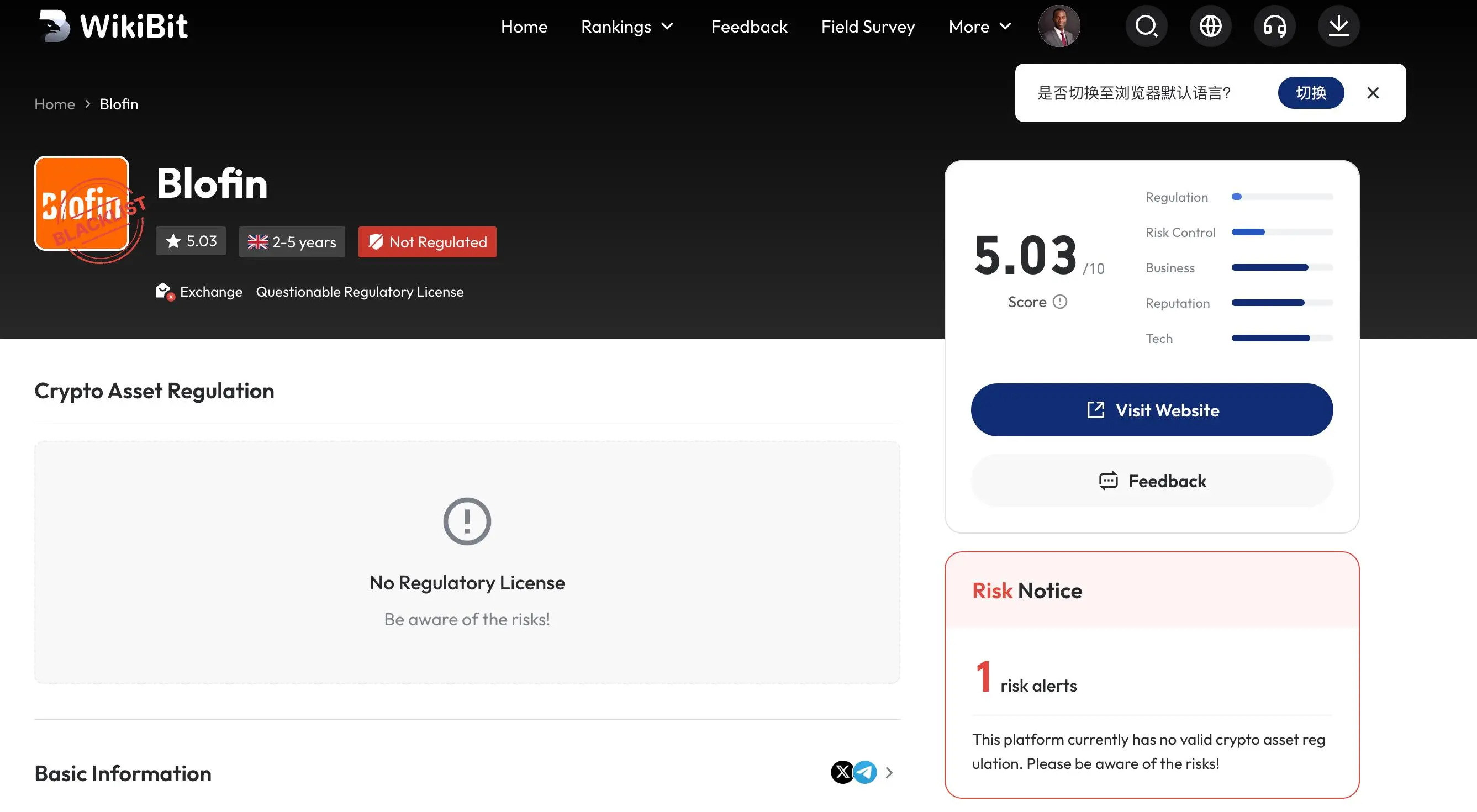
WikiBit's rating is just 5.03/10, with an explicit warning that the platform currently has no valid cryptocurrency regulatory authorization.
In previous episodes, our focus was on whether giants like OKX and Binance could stumble. This time, the question is different:
Can a small offshore exchange launched only in 2023, with daily trading volume nowhere near Bybit's, survive until the next bull market?
1. Regulatory Compliance: No MiCA Authorization, Blacklisted by France, Flagged by India's FIU
MiCA: Absent from ESMA's Register and Blacklisted by France's AMF
Multiple independent tracking platforms have reached the same conclusion regarding BloFin's regulatory status in the European Union.
On September 23, 2026, PerpFinder checked ESMA's CASP register and confirmed that BloFin is “Not MiCA-Authorized” and does not appear in the register. One MiCA tracking platform classified it as a “critical risk” for EU users.
On October 14, 2026, eumica.com conducted its own verification and likewise confirmed that BloFin does not hold a MiCA CASP license and is absent from ESMA's register.
More importantly, France's AMF added blofin.com to its cryptocurrency blacklist on December 3, 2024, citing the provision of cryptocurrency services in France without authorization.
A platform that has been formally blacklisted in one of Europe's major financial markets, while remaining absent from ESMA's register, is not simply facing “regulatory uncertainty.” Regulators have already delivered a negative assessment.
On September 9, 2026, India's Press Information Bureau (PIB), under the Ministry of Finance, announced that FIU-IND had issued non-compliance notices to 15 virtual digital asset service providers under Section 13 of the Prevention of Money Laundering Act (PMLA). BLF Global Limited (BloFin) was among the entities named.
The announcement also stated that FIU-IND had directed these entities to remove their applications and URLs because they were “illegally operating without complying with the relevant provisions of India's PMLA.”
This means BloFin is not merely operating without a license in India. It has been formally identified by the regulator as a non-compliant operator and is now subject to enforcement measures requiring the removal of its applications and website URLs.
Jurisdiction and Restricted Regions: Conflicting Cayman Islands/Marshall Islands Claims and Arbitration in Hong Kong
Information about BloFin's place of registration is inconsistent.
Tracxn identifies its headquarters as being in the Cayman Islands, while Crunchdata and ContactOut list the Marshall Islands. PerpFinder's assessment also notes that different sources refer to either the Cayman Islands or the Marshall Islands.
Its operating entity is BuildLight Future Limited.
Restricted jurisdictions reportedly include the United States, Canada, Singapore, India, mainland China, and the United Arab Emirates. However, EU/EEA countries are not included in its restricted-region list.
Under BloFin's user agreement, dispute resolution is subject to the Hong Kong International Arbitration Centre (HKIAC).
An exchange with conflicting registration information, offshore corporate structures, and Hong Kong arbitration provisions, but no MiCA authorization despite accepting EU users, presents an unclear legal identity and uncertain framework of user protection.
Risk Assessment: High Risk (Regulatory Compliance)
BloFin relies on complex offshore corporate structures, with references to the Cayman Islands and Marshall Islands. It has been formally blacklisted in France, has no MiCA regulatory authorization across the EU, yet continues to accept EU users under its own service framework.
For ordinary investors, the situation could become particularly problematic if a dispute arises or withdrawal integrity fails.
Users may have to pursue cross-border arbitration in Hong Kong through HKIAC, potentially involving substantial legal expenses and procedural complexity.
In practical terms, this creates significant hidden costs for users seeking to protect their rights, alongside a potentially substantial gap in accessible legal protection.
2. Account Security and Withdrawals: A Five-Business-Day Withdrawal Window and User Complaints of “Profits Triggering Account Freezes”
BloFin's Controversial Terms of Service: Five Business Days to Withdraw After Account Suspension or Termination
BloFin's Terms of Service contain several particularly concerning provisions.
After an account is suspended or terminated, users have only five business days to withdraw their digital assets. Furthermore, if BloFin determines that a user has engaged in “Prohibited Activities,” it reserves the right to claw back profits.
What does a five-business-day withdrawal window actually mean?
Suppose you're asleep, traveling, or sick and fail to notice the notification in time. What happens to your assets after the deadline?
The terms do not clearly explain this scenario.
This does not automatically mean the exchange intends to disappear with users' funds. However, it is a unilateral contractual provision drafted by the platform, leaving users with virtually no room to negotiate.
Large exchanges may also have similar provisions, but the key issue is how aggressively such clauses are enforced. Smaller offshore platforms may offer users considerably less certainty regarding their implementation.
The profit-clawback provision is even more concerning — particularly because users have already reported experiences that appear consistent with this type of conduct.
User Complaints: “Profits Trigger an Account Freeze, and Refreshing the Page Shows You're Already Liquidated”
One user review published on FXVerify, subsequently cited by multiple platforms, describes the following experience:
“After making substantial profits, I noticed that the platform completely froze and stopped working. I could only refresh the page, only to be told that I had been liquidated, long before reaching 100%. My closing profits were either significantly lower than they should have been or even negative... BloFin scams users by liquidating positions early, deliberately interrupting the platform, and creating a false impression of market conditions. In effect, it takes money directly from users' profits.”
The allegations are serious:
Accounts allegedly freeze after users make substantial profits.
Refreshing the page reportedly reveals that positions have already been liquidated.
Actual closing profits allegedly fall significantly below expected levels or even turn negative.
Users suspect premature liquidation and deliberate platform interruptions.
“Account freezes after profits, liquidation after refreshing, and missing profits” — these are recurring themes in complaints involving cryptocurrency exchanges. In BloFin's case, however, users have documented their allegations in particularly specific terms.
These are user-reported allegations, not independently verified proof of deliberate misconduct. Nevertheless, they warrant serious attention.
Margin Syndicate: Downgraded from AMBER to RED in August 2026
Margin Syndicate is an exchange quality assessment firm serving institutional traders.
In its August 2026 report, the firm identified withdrawal integrity as one of its core risk indicators. It explicitly noted that, from a trader's perspective, the consequences of technical infrastructure failures that trigger position liquidations and financial losses can be equivalent to those of AML/compliance-related seizures that leave funds frozen indefinitely.
In the same report, BloFin was downgraded from AMBER to RED, with the direct reason cited as an “August 2026 withdrawal-integrity failure.”
RED represents the highest risk category in the report. BloFin was placed in the same category as Bitget, which remained at RED following its September 24 hacking incident.
An institutional assessment firm has therefore classified BloFin's withdrawal integrity as having failed in August 2026.
This goes beyond isolated customer complaints. It represents a serious third-party assessment of the platform's operational reliability.
User Complaint: “They Took All My Funds for Two Consecutive Days and Returned Neither My Principal nor My Profits”
A user complaint in the KuCoin community stated:
“BloFin cannot pay its traders this week! I haven't received my trading funds or profits from ZEC trades. For two consecutive days, they took all my funds without returning my principal or trading balance!”
The allegation goes beyond missing profits. The user claims that both the original trading capital and the remaining trading balance were withheld.
This is different from a routine compliance review or temporary withdrawal restriction. It is a direct allegation that the platform unilaterally removed users' funds without returning them.
Again, this is an individual user's account and should not be treated as independently verified evidence of systematic fund misappropriation. However, when viewed alongside the institutional downgrade and other withdrawal complaints, it raises substantial concerns.
Trustpilot: 1.6/5, with 80% One-Star Reviews
BloFin has a Trustpilot rating of just 1.6/5, based on 123 reviews, with approximately 80% giving it one star.
The main complaint themes are remarkably consistent:
Withdrawal difficulties and delayed payments
Account freezes and restricted access to funds
Unresponsive customer support
Withdrawal problems after substantial trading profits
Disputed liquidations and allegedly unfair execution
Platform interruptions during trading
Among these complaints, withdrawal problems are one of the most frequently recurring issues.
Risk Assessment: High Risk (Account Security and Withdrawals)
3. Proof of Reserves (PoR): A “149% BTC Reserve Ratio” on Paper, but Only Three Assets Are Covered
BloFin's Own Claims: 1:1 Reserves and a Reserve Ratio Above 100%
According to BloFin's official Proof of Reserves (PoR) page, the exchange maintains a 1:1 reserve policy. Data dated May 15, 2026, showed the following reserve ratios:
USDT: 105.77%
BTC: 149.67%
ETH: 162.97%
BloFin also states that all customer assets are held in segregated accounts, completely separated from the company's own assets, and will not be lent out or staked without customers' explicit consent.
Its technical solution is based on Merkle Tree verification, allowing users to independently check whether their account balances are included in the exchange's total reserves.
Third-party elements include independent monitoring by Nansen and custody services provided by Fireblocks.
However, three significant issues remain.
Issue 1: Only Three Cryptocurrencies Are Covered
Bybit covers 21 major cryptocurrencies in its PoR reports, while OKX covers 22. BloFin, by comparison, covers only BTC, ETH, and USDT.
This means that other altcoins purchased on BloFin, platform tokens, and assets corresponding to users' futures margin balances are not necessarily included in the scope of its PoR coverage.
For users holding a diversified portfolio on the platform, this represents a significant transparency gap.
Issue 2: The Audit Provider Is Not Clearly Identified
Bybit and OKX at least identify Hacken as their named audit provider.
For BloFin, however, third-party sources do not provide a clear answer regarding who issued its PoR report, the precise scope of the audit, or the independence of the verification process.
Without a clearly identified independent auditor and a transparent audit methodology, users have limited ability to assess how much confidence they should place in the reported reserve ratios.
Issue 3: PoR Updates Do Not Follow a Fixed Schedule
BloFin currently updates its Proof of Reserves on an irregular rather than fixed schedule.
According to the exchange, the real-time ratios displayed on its PoR page are synchronized “upon completion of each audit.”
While this approach provides some visibility into reserve levels, it does not offer users the predictability of regular, scheduled verification.
For a second-tier exchange, implementing PoR is certainly a positive step. However, a 1:1 reserve ratio should be interpreted with caution when it comes to smaller platforms.
Why? Because users cannot independently establish whether liabilities have been secretly added or whether the company's overall financial position is healthy simply by looking at the reserve ratio.
PoR can help verify asset holdings, but it does not necessarily prove that all liabilities have been disclosed or that the exchange is financially solvent.
Risk Assessment: Medium-High Risk (Proof of Reserves Transparency)
4. Financial Strength: Trading Volume Looks Impressive, but the Actual Financial Foundation Remains Opaque
Third-Party Data: CoinGecko vs. CoinMarketCap
According to CoinGecko:
Exchange reserve assets: approximately $74.09 million
Reported 24-hour trading volume: approximately $2.02 billion
According to CoinMarketCap:
Total exchange assets: approximately $11.71 million
24-hour spot trading volume: approximately $3.259 billion
Significant Differences in Data Methodology
The two third-party platforms provide substantially different estimates of BloFin's assets.
These figures should not simply be added together, nor should either figure be treated as BloFin's complete balance sheet.
Possible reasons for the discrepancies include:
Differences in the range of wallet addresses identified
Different asset calculation methodologies
Different data update times
Differences in how third parties attribute wallet addresses to the exchange
CoinMarketCap specifically warns that its publicly displayed wallet asset data is not guaranteed to be complete or real-time.
High Trading Volume Does Not Mean an Exchange Has Deep Financial Reserves
Suppose an exchange processes $2 billion in trading volume every day. Users might naturally assume that the platform must hold billions of dollars in assets.
But trading volume represents the flow of funds generated by repeated buying and selling. It is not the exchange's own capital, nor is it equivalent to the total amount of customer deposits.
Think of it this way: a shopping mall may sell $100 million worth of goods every day, but that does not mean the mall owner's bank account contains $100 million in cash.
More importantly, BloFin's publicly available information still lacks comprehensive audited financial statements comparable to those of publicly listed exchanges, including detailed disclosures of net assets, cash flows, and liabilities.
As a result, we cannot accurately determine its capital buffer under extreme market conditions based solely on third-party trading volume or on-chain wallet balances.
The Platform Has Grown, but Its Financial Strength Still Lacks Independent Verification
Exchange data suggests that BloFin has established a certain level of market scale. It is no longer a newly launched platform without a functioning trading ecosystem.
However, what really matters to users is not its trading volume ranking, but a series of more fundamental questions:
How much proprietary capital does the platform actually have?
Are customer assets fully segregated from the company's operating funds?
Does it have significant borrowing obligations, related-party debts, or pledged assets?
If a large number of users request withdrawals simultaneously, does the platform have sufficient liquid assets to meet those demands?
At present, publicly available evidence is insufficient to answer these questions.
BloFin has achieved a certain market presence and has observable on-chain assets, but its financial position lacks sufficient independent disclosure.
We cannot conclude that it is insolvent, but neither can we establish that it has the repayment capacity of a major global exchange.
Risk Assessment: Medium-High Risk (Financial Strength)
BloFin is not an empty shell. It has real products, real trading volume, and a genuine community of copy traders.
In terms of trading volume, however, it sits in the lower-middle tier of the market.
Describing it as a “mid-sized exchange” is reasonable. But its underlying financial foundation appears considerably thinner than the sophistication of its products might suggest.
5. Internal Operations and Management Team: Matt Hu Is Publicly Identified, but Corporate Registration and Entity Information Remain Inconsistent
Founder: Matt Hu, Founder of TokenInsight
BloFin's founder, Matt Hu, is publicly identifiable.
According to CoinCentral and multiple other sources, Matt Hu founded the research firm TokenInsight in 2018. Before that, he worked in investment and portfolio management at a well-known Silicon Valley venture capital firm.
He founded BloFin in September 2019, and the exchange officially launched in January 2023.
Its operating entity is BuildLight Future Limited, although sources differ on whether it is registered in the Cayman Islands or the Marshall Islands.
Having a publicly identified founder with a research background and venture capital experience is a positive factor in an industry where anonymous founders remain relatively common.
Matt Hu's background at TokenInsight also helps explain why BloFin incorporates risk-adjusted performance metrics such as Sharpe, Sortino, and Calmar ratios into its copy trading products.
In other words, the platform does appear to incorporate research-driven thinking into its product design.
However, a Publicly Identified Founder Does Not Automatically Mean Transparent Corporate Governance
The inconsistent registration information, the need to verify the relationship between the operating entity and the BloFin brand through third-party databases, and the fact that dispute resolution is directed to arbitration in Hong Kong rather than a clearly identified regulatory jurisdiction all create uncertainty.
When users need to pursue legal action, they may find themselves dealing with a counterparty whose legal identity and corporate structure are not sufficiently clear.
This is different from MEXC, where the founder's identity cannot be independently verified. However, there is still a considerable gap between knowing who runs a platform and knowing exactly which legal entity is responsible, where it is registered, and under which jurisdiction accountability can be enforced.
Risk Assessment: Medium Risk (Management Team)
6. Product Experience and Trading Depth: Copy Trading Is a Genuine Differentiator, but Liquidity Remains a Limitation
Copy Trading: Three Modes Plus a Risk-Adjusted Leaderboard
BloFin's copy trading system is arguably its strongest product feature.
It offers three position allocation modes:
Smart Copy: Synchronizes leverage, margin mode, and position size with the lead trader.
Fixed Amount: Uses a fixed amount for each copied trade.
Fixed Ratio: Scales positions according to a selected multiple of the lead trader's position size.
Each copy trading setup also supports take-profit and stop-loss settings, cross-margin or isolated-margin selection, and the option to follow the lead trader's leverage or configure leverage independently.
Lead traders receive a standard profit-sharing rate of 10%, with a maximum of 20%.
Beyond conventional performance indicators such as ROI, win rate, and maximum drawdown, BloFin's leaderboard also displays the Sharpe, Sortino, and Calmar ratios.
For copy traders, these risk-adjusted metrics are considerably more informative than a leaderboard based solely on returns.
They at least attempt to answer a more important question:
How much risk did this trader take to generate those returns?
This is a genuine and verifiable point of differentiation in BloFin's product design.
But Liquidity Depth Is a Hard Constraint
CoinCentral's review explicitly points out:
“BloFin's open interest and order books are thinner than those of the largest exchanges. A very large market order may face significantly greater slippage than on Binance BTC-USDT or Bybit BTC-USDT.”
CoinCentral's overall conclusion is:
“If you're trading futures or copy trading in international markets and value transparency over the deepest liquidity, it's worth considering. If you want the absolute lowest taker fees or need access from the United States, it's not the right choice.”
This means BloFin's trading experience is somewhat segmented.
For copy traders and derivatives traders handling moderate position sizes, its copy trading tools and risk analytics can offer genuine value.
However, for large traders who require extremely deep liquidity, its relatively thin order books may not be able to accommodate their needs without significant slippage.
Risk Assessment: Medium Risk (Product Experience)
Copy trading is a genuine strength. Liquidity is a genuine limitation.
An exchange can simultaneously offer sophisticated copy trading tools and relatively thin order books. There is no contradiction between the two.
But this distinction ultimately determines which types of users BloFin is suitable for — and which traders may be better off looking elsewhere.
7. Comprehensive Exchange Runaway Risk Assessment
| Assessment Dimension | Risk Level | Key Findings |
| Regulatory Compliance | High | No MiCA authorization and absent from ESMA's register; blacklisted by France's AMF; non-compliance notice and delisting order from India's FIU; inconsistent corporate registration information. |
| Account Security / Withdrawals | High | Downgraded from AMBER to RED by Margin Syndicate in August 2026 due to a “withdrawal-integrity failure”; users report account freezes, liquidations, and withheld principal after generating profits. |
| Proof of Reserves Transparency | Medium-High | The PoR page reports a “149% BTC reserve ratio,” but coverage is limited to just three cryptocurrencies. |
| Financial Strength | Medium-High | BloFin has achieved a certain market scale and has observable on-chain assets, but independent financial disclosures remain insufficient. |
| Management and Operations | Medium | Founder Matt Hu is publicly identifiable and has a TokenInsight background, but corporate registration and legal entity information remain inconsistent. |
| Product Experience | Medium | Three copy trading modes and risk-adjusted performance metrics provide genuine differentiation, but order book depth remains relatively thin. |
| Community Feedback | High | Positive feedback on copy trading coexists with withdrawal and liquidation complaints; Trustpilot rating is just 1.6/5, with withdrawals being a recurring complaint. |
Overall Rating: High Risk of Exchange Failure
BloFin is not necessarily the kind of exchange that is likely to collect users' funds and suddenly disappear, like UZX or Azbit.
It has genuine products, a publicly identified founder, verifiable investment in PoR technology, and a trading platform with differentiated copy trading features.
It is unlikely to simply shut down and disappear overnight.
However, not disappearing does not mean being low-risk.
BloFin's risks are concentrated in three major areas:
1. The Regulatory Vacuum: An Unclear Legal Status
No MiCA license, absence from ESMA's register, blacklisted by France's AMF, and subject to an application and URL removal order from India's FIU.
This is not simply a matter of having a license with limited regulatory credibility. It means the platform has been explicitly identified as unauthorized or non-compliant in multiple major jurisdictions.
For users in these markets, the issue is not merely that regulatory protection is weaker. It is that local regulatory protection may be entirely unavailable.
2. The RED Rating for Withdrawal Integrity
In August 2026, Margin Syndicate downgraded BloFin from AMBER to RED, directly citing a “withdrawal-integrity failure.”
This is not simply a case of poor user experience. It represents a third-party assessment that questions the reliability of one of an exchange's most fundamental functions: whether users can successfully withdraw their funds.
User complaints involving account freezes, liquidations, and withheld profits after profitable trades reinforce these concerns.
3. Ranked 36th in On-Chain Reserves
BloFin's attributable on-chain reserves stood at approximately $102.4 million, ranking last among 36 exchanges.
Given the limitations of third-party wallet identification and asset calculation methodologies, this figure should not be interpreted as the platform's total assets.
Nevertheless, it indicates that BloFin's publicly observable on-chain asset base is among the thinnest in the comparison group.
Final Assessment: A Product More Sophisticated Than Its Financial and Regulatory Foundation
BloFin's situation can be summarized as follows: its product development is running ahead of its underlying financial and regulatory foundation.
Its copy trading tools genuinely offer advantages over many competing platforms. Its PoR implementation also involves more than superficial marketing claims, with Merkle Tree technology and Nansen tracking.
Its founder's TokenInsight background is also verifiable rather than fabricated.
However, the long-term safety of an exchange depends on more than how convenient its trading interface is.
It ultimately comes down to three fundamental questions:
Is its regulatory status legitimate?
Can users withdraw their funds reliably?
Can its financial foundation withstand extreme market stress?
On all three fronts, BloFin's performance — the AMF blacklist, absence from ESMA's register, India's FIU removal order, and Margin Syndicate's RED rating — looks considerably weaker than its copy trading products suggest.
8. Recommendations for New and Existing Users
Recommendations for New Users
1. First, confirm whether your jurisdiction falls within BloFin's regulatory coverage.
If you are in the European Union, BloFin does not have a MiCA license, is absent from ESMA's register, and has been blacklisted by France's AMF. You would therefore be using a platform without MiCA authorization in the EU.
If you are in India, FIU has already ordered the removal of its applications and URLs.
Do not assume that being able to register an account means you are protected by local financial regulators.
2. If you're joining for copy trading, test withdrawals with a small amount first.
BloFin's copy trading tools do offer genuine differentiation. However, Margin Syndicate's RED rating and user complaints about freezes and liquidations after profitable trades raise an important question:
Can you actually withdraw the money you make through copy trading?
Start with an amount you can afford to lose. Complete the entire process — deposit, copy trading, generate profits, and withdraw — and independently verify that the withdrawal channel works properly before considering a larger allocation.
3. Do not store funds here that you may need to access immediately.
The RED assessment of withdrawal integrity, combined with BloFin's standard policy of restricting withdrawals for one hour following a login from a new device, means that accessing your funds may involve unpredictable delays.
Only deposit funds that you can afford to lose and that you can afford to have temporarily inaccessible.
4. Use self-custody for large, long-term holdings.
The “149.67% BTC reserve ratio” displayed on BloFin's PoR page is a snapshot published by the exchange itself. Its 36th-place ranking in attributable on-chain reserves comes from third-party data.
There is an important difference between an exchange claiming to hold sufficient reserves and you having direct control over your assets.
For substantial long-term holdings, use a hardware wallet and maintain self-custody.
Recommendations for Existing Users
1. Monitor changes in Margin Syndicate's risk rating.
In August 2026, BloFin was downgraded from AMBER to RED, directly due to a “withdrawal-integrity failure.”
If the rating is not subsequently restored, or additional third-party assessments identify further withdrawal integrity problems, this should be treated as a serious warning signal.
2. If you have open copy trading positions, plan your exit strategy in advance.
The user complaints describing account freezes after profits and liquidation notifications after refreshing the platform suggest that, under extreme circumstances, you may be unable to close positions at your expected prices.
Avoid leaving all your positions in a situation where closing them or withdrawing the proceeds depends entirely on the platform's cooperation.
3. Keep all trading records and communication records.
If you encounter withdrawal disputes or liquidation-related problems, preserve:
Complete order and transaction records
Copy trading history
Screenshots of customer support conversations
Withdrawal requests and transaction confirmations
Relevant account notifications
These records form the essential evidence base for any subsequent complaint, appeal, or public effort to protect your rights.
Final Recommendations
Who Is BloFin Suitable For?
Derivatives traders who:
Value sophisticated copy trading tools and risk analytics.
Can accept the regulatory uncertainty associated with the absence of MiCA authorization and local licensing.
Are willing to independently test withdrawal reliability using small amounts.
Understand the risks associated with relatively limited liquidity depth.
Who Should Avoid BloFin?
EU users: No MiCA authorization, with France's AMF having placed the platform on its blacklist.
Indian users: FIU has issued an application and URL removal order.
Users who consider reliable withdrawals a non-negotiable requirement: Margin Syndicate's RED rating represents a serious third-party assessment of withdrawal integrity.
Investors holding substantial long-term assets: BloFin ranked 36th out of 36 exchanges in attributable on-chain reserves.
The Bottom Line
BloFin's situation can be described as a case of product development running ahead of regulatory compliance and financial fundamentals.
Its copy trading system demonstrates genuine effort in incorporating risk-adjusted performance indicators. Its PoR page uses Merkle Tree technology and Nansen tracking. Matt Hu's TokenInsight background is also verifiable.
But the long-term safety of a derivatives exchange is ultimately not determined by how sophisticated its copy trading leaderboard looks.
It depends on whether its regulatory status is legitimate, whether withdrawals are reliable, and whether its financial foundation can withstand market stress.
On these three critical dimensions, the evidence against BloFin — France's AMF blacklist, its absence from ESMA's register, India's FIU removal order, and Margin Syndicate's RED rating — carries considerably more weight than the strengths of its copy trading products.
Coming Next
WikiBit Exchange Runaway Risk Rankings – Episode 57: BTSE Exchange. Stay tuned!
Risk Disclaimer
This article reflects the author's independent analysis and opinions and does not constitute investment advice. Cryptocurrency investments involve substantial risks. Please exercise caution and conduct your own research before investing.
Information in this article was updated as of November 6, 2026. Please cross-check the latest developments with multiple sources before making any decisions.
WikiBit is a regulatory and risk intelligence platform built specifically for cryptocurrency investors. It provides real-time access to global exchange regulatory licenses, credit ratings, risk alerts, industry news, and genuine user reviews, helping investors identify potential risks, stay away from problematic platforms, and make more informed trading decisions.
Before investing in crypto, check WikiBit first!
Download the WikiBit App now and add an extra layer of protection to your crypto assets:
https://wikibit.onelink.me/wgfF/1b1dn69b