Last week, with veteran crypto exchanges BitMart and BitMEX announcing their shutdowns amid a harsh market environment, negative sentiment spread rapidly across the industry. Investors and market observers began asking one question: which exchange could be next to face a crisis?
WEEX, an eight-year-old crypto exchange, has also come under the spotlight after a series of negative claims surfaced online. An industry insider who had previously warned about BitMarts potential collapse two months earlier shared a prediction on X, stating: “WEEX is going to shut down.”


Some users have also filed complaints on FX110, claiming that they experienced issues such as unauthorized fund deductions, account freezes without explanation, and being asked to “delete their posts before withdrawals could be processed.”
Recently, an individual claiming to be a “former BitMart employee and current WEEX employee” posted on social media, accusing the company of poor internal management and misleading employees.
On one side, WEEX presents itself as a platform with strong financial backing and regulatory credibility — an official partner of LaLiga, a 1,000 BTC protection fund, and multiple regulatory registrations, creating the image of a well-funded and legitimate exchange.
On the other side, there are allegations including “funds deducted without notification,” “withdrawals only approved after deleting complaints,” “accounts frozen at will,” and “a very low rating on third-party risk platforms.” A large number of user complaints have raised serious concerns across the community.
So the question is:
Is WEEX another fraudulent platform preparing to disappear, or is it a legitimate exchange being damaged by impersonation websites and misinformation?
Today, we will examine the issue step by step using real data and real user feedback.
Regulatory Compliance: Many Licenses, but Their Value Remains Questionable
WEEX claims that it has obtained the U.S. MSB registration and Canadian MSB registration, and announced in July 2026 that it had obtained a financial license from Saint Vincent and the Grenadines Financial Services Authority (SVGFSA). The platform also states that it is applying for additional regulatory approvals, including Australias DCE registration and licenses from other jurisdictions.
From its public messaging, WEEX has consistently positioned itself as “one of the most comprehensively regulated cryptocurrency exchanges.”
However, the key question remains:
How much regulatory value do these licenses actually provide?
The U.S. MSB registration is essentially a Money Services Business registration, which has relatively low entry requirements. It does not mean that an exchange is subject to substantive supervision by major U.S. financial regulators such as the SEC or CFTC.
Meanwhile, the SVGFSA license from Saint Vincent and the Grenadines has often been viewed within the industry as an offshore registration with limited regulatory oversight — relatively easy to obtain, but offering limited investor protection.
Among the more valuable regulatory frameworks are registrations such as El Salvadors DASP/BSP licenses, while European jurisdictions have introduced VASP frameworks, although obtaining a VASP registration does not automatically mean the platform holds a full MiCA license.
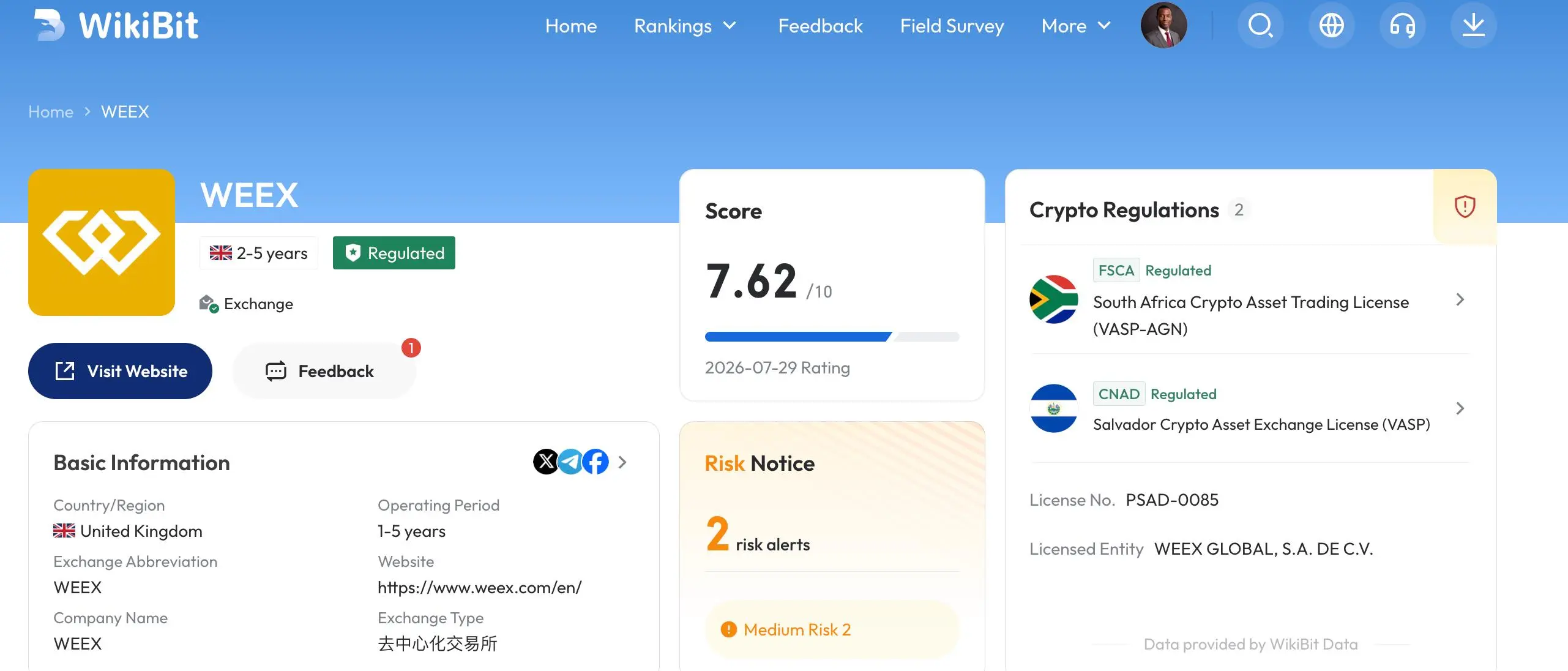
WEEX Risk Assessment (Source: WikiBit)
Overall, WEEX does hold several regulatory registrations, but the actual regulatory effectiveness of these licenses appears to be limited. The platform has not yet obtained top-tier financial regulatory licenses from major jurisdictions such as the United States or Europe.
Account Freezes and Withdrawal Issues: User Complaints Raise Serious Concerns
This is arguably the most controversial aspect surrounding WEEX.
Lets look at a real user complaint posted on WikiBit:
One day, I opened my account and found that my balance had been reduced by 2,200 USDT without any explanation. There was no SMS notification, no app push notification, and no email alert — absolutely no notice at all.
I contacted customer support, and they told me it was a ‘risk reserve deduction.’ I asked what the basis was and what specific risk had occurred. The only response I received was that it was a ‘system decision’ and that I should check a certain clause in the user agreement myself.
The most outrageous part was that I posted my experience on Weibo. I didn‘t insult anyone — I simply stated the facts. Shortly afterward, WEEX’s social media team contacted me and said:
‘Please delete the relevant inaccurate statements. After deletion, we can prioritize handling your withdrawal request.’
In other words: if you don‘t delete the post, you won’t be able to withdraw your funds.
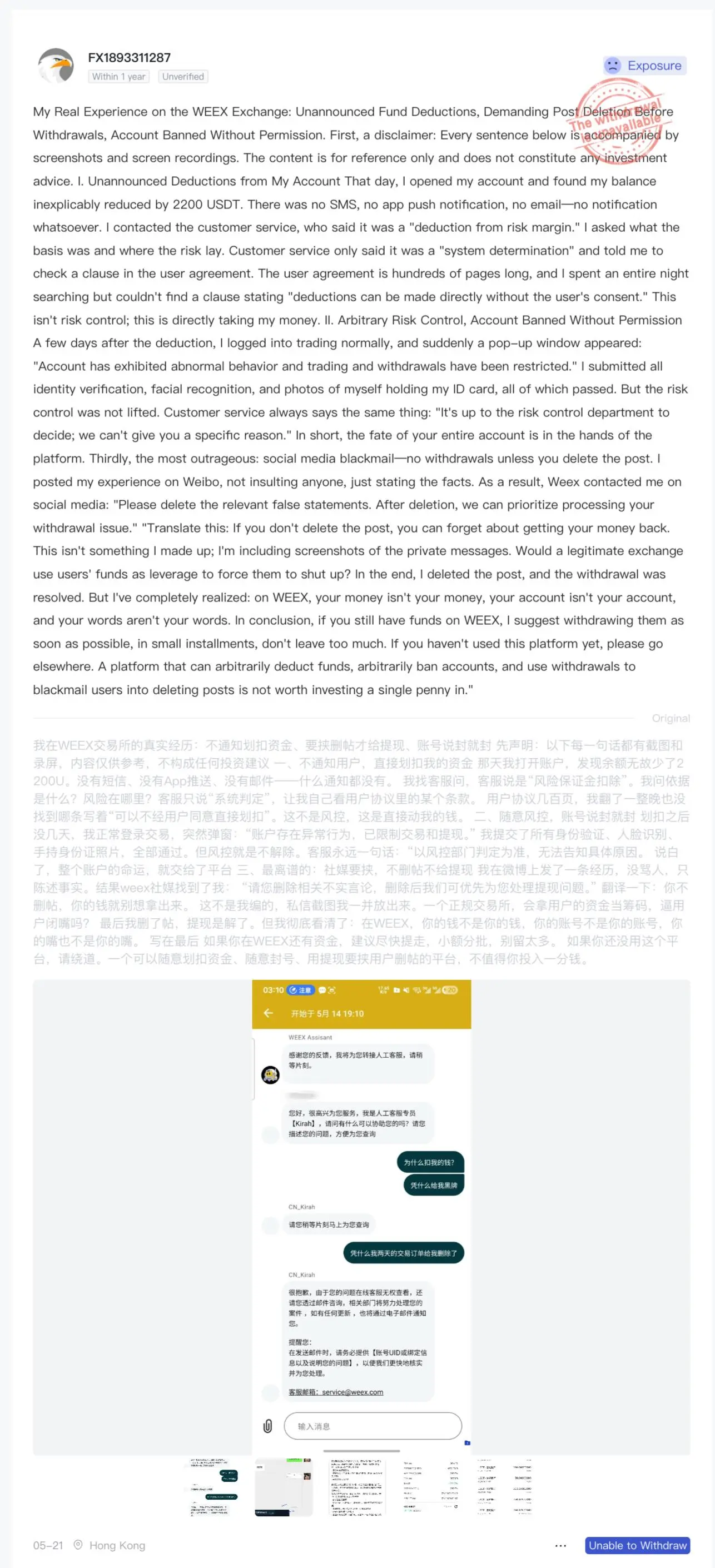
User Feedback (Source: WikiFX)
This Is Not an Isolated Case
On the FX110 complaint platform, one user accused WEEX of restricting withdrawals, stating:
“There were some assets in my account that I wanted to withdraw, but the platform refused to process the withdrawal and kept finding different reasons to lock my funds.”
Another user reported on FX110 that their account had been restricted from trading and withdrawals since May 12, 2026, with the review process lasting 14 days.
More concerning is the issue of phishing and impersonation websites.
Research indicates that in many so-called WEEX scam cases, 88% of users had accessed clone domains such as weex-vip.xyz or weex-trading.cc rather than the official website. These fake platforms typically operate using a “pig-butchering scam” model:
The first withdrawal request is rejected. Customer service then claims the account is suspected of money laundering and requires the user to pay 20% of their funds as a risk-control fee to unlock the account. After the payment is made, withdrawals still remain unavailable, and users are then told they must complete trading volume equal to 100% of their principal amount before they can withdraw.
However, there is a critical question:
Are these complaints actually targeting the official WEEX platform, or are they related to impersonation websites?
Some complaints do indeed appear to involve fake websites. However, other cases — such as allegations of “2200 USDT deducted without notification” and “accounts being frozen without explanation” — reportedly occurred on the official weex.com domain, with users providing screenshots and screen recordings as evidence.
Therefore, WEEX is facing a dual challenge:
- Risk-control disputes involving the official platform itself
- Scam activities carried out through impersonation websites
- “Funds deducted without notification”
- “Users allegedly pressured to delete complaints before withdrawals are processed”
- “Accounts frozen without clear explanation”
- Immediately test whether withdrawals can be completed successfully.
- Do not store more funds on WEEX than you can afford to lose.
- Keep all transaction records, screenshots, and communication history for future reference.
- “funds deducted without notification”
- “withdrawals restricted unless complaints are deleted”
- Risk ratings
- User reviews
- Regulatory information
- License details
- Platform risk indicators
- User trust is declining as complaints increase
- Business operations appear to be contracting through repeated delistings
- Regulatory scrutiny is increasing
- Fake websites are damaging brand credibility
Even after excluding complaints related to fake websites, allegations involving the official platform — including “unauthorized deductions” and “pressuring users to delete complaints before withdrawals are processed” — continue to exist, with supporting screenshots and video evidence provided by some users.
Reserve Fund Transparency: Strong Claims, But How Transparent Is It in Practice?
WEEXs public messaging around reserve fund transparency appears impressive.
The platform claims to have established a 1,000 BTC Investor Protection Fund and publicly disclosed the hot wallet address of the fund, allowing users to monitor and verify the holdings. WEEX also states that Proof of Reserves (PoR) is a mechanism used to verify whether a custodian holds sufficient assets to cover all user balances.
However, a closer review reveals a key issue:
The PoR page on the WEEX website mainly explains what Proof of Reserves is and why it matters, but does not provide specific reserve data or detailed audit results.
In comparison, Bitget updates its Proof of Reserves data regularly and publishes specific reserve ratios (for example, 123%), while Binance and OKX also periodically release detailed reserve information.
From this perspective, WEEXs “PoR” appears more like an educational and promotional page rather than a fully transparent verification mechanism.
Therefore, whether the 1,000 BTC protection fund is fully backed, actively maintained, and independently verifiable remains a question that currently lacks third-party confirmation.
Internal Operations: Running Promotions While Suspending Deposits and Withdrawals
WEEXs internal operations present a contradictory picture.
On the positive side, WEEX was still actively running various campaigns in July 2026, including the “TradFi Trading Carnival” and “First Trade Loss Protection” campaigns. The exchange also became the official regional partner of LaLiga in Hong Kong and Taiwan. Sponsoring a top-tier sporting event like LaLiga typically involves strict compliance reviews and significant financial commitments.
This raises a question:
If WEEX were truly preparing to disappear, why would it spend substantial amounts of money on branding and sponsorships?
However, the negative side cannot be ignored.
On July 14, 2026, WEEX announced the suspension of BDX deposits and withdrawals. On July 20, it issued another announcement stating that BDX withdrawals remained suspended. The platform explained that the suspension was due to “asset data verification” and “network instability.”
However, in the context of a crypto bear market, repeated deposit and withdrawal suspensions naturally create anxiety among users.
In other words, WEEX appears to be operating in two opposite directions:
On one hand, it is spending heavily on brand expansion (LaLiga sponsorships and marketing campaigns); on the other hand, it appears to be reducing operational scope (frequent delisting of trading pairs and suspension of deposit/withdrawal services).
This contradiction — “spending aggressively with one hand while shrinking operations with the other” — makes it difficult for the market to clearly understand WEEXs actual financial condition.
Overall Assessment: Will WEEX Eventually Exit the Market?
Based on a comprehensive evaluation across seven dimensions, WEEXs current risk profile can be summarized as follows:
| Dimension | Assessment | Risk Signals |
| Regulatory Compliance | Holds licenses, but their value is limited | WikiBit flags concerns regarding the effectiveness of its regulatory licenses |
| Account Freezes | Concentrated user complaints | Allegations of “unauthorized deductions” and “withdrawals requiring complaint deletion” |
| Platform Integrity | Claims exist, but evidence is incomplete | Reports involving deleted transaction records and deducted funds |
| Customer Support | Extremely poor feedback | Template responses, delays, and withdrawal-related pressure |
| Reserve Transparency | Strong marketing, limited disclosed data | PoR page provides explanations rather than verifiable reserve data |
| Team Transparency | Highly unclear | Founder background difficult to verify; recruitment from failed exchanges raises questions |
| Internal Operations | Contradictory behavior | LaLiga sponsorships alongside frequent delistings and withdrawal suspensions |
Overall Conclusion:
At present, WEEX does not appear to be in an immediate “exit scam” situation.
The LaLiga sponsorship represents a real financial commitment, and the claimed 1,000 BTC Investor Protection Fund also exists as a public initiative. These activities require substantial capital investment.
A platform planning to disappear would generally not spend millions of dollars on major sponsorships shortly before shutting down.
However, WEEX does appear to have a serious trust deficit problem.
Issues such as:
do not necessarily prove an impending collapse — but they may be even more damaging than a sudden shutdown.
A shutdown is a one-time event: once funds disappear, they are gone.
But this type of selective risk-control behavior creates a different problem: users never know whether they will become the next person affected.
Another Structural Risk: Impersonation Websites
WEEX also faces a major structural challenge: fake and impersonation websites.
Research suggests that 88% of users involved in alleged WEEX scam cases accessed imitation domains rather than the official platform.
This means WEEXs brand reputation is being seriously diluted.
Every “WEEX scam” complaint circulating on social media — even when involving fake websites — consumes user trust in the official platform.
And once that trust is exhausted, a wave of withdrawals and potential liquidity pressure could emerge.
Recommendations for Users
If You Already Hold Assets on WEEX:
If You Have Not Used WEEX Yet:
Proceed with caution.
A platforms credibility should not be judged by its marketing claims alone — it should be evaluated through actual user experiences and independent risk assessments.
Among WEEX-related complaints, allegations such as:
are issues that should never occur on a fully trusted exchange.
If you want to conduct your own research:
Visit WikiBit (wikibit.com) and search for “WEEX.”
You can review:
to make your own judgment about whether WEEX is trustworthy.
Final Thoughts
WEEX may not be on the verge of shutting down today, but it is accumulating several warning signs that deserve attention:
BitMEX operated for 11 years. BitMart operated for 8 years.
Before they shut down, they also appeared to be operating normally.
Will WEEX become the next major exchange to fail?
No one can know with 100% certainty.
But one thing is clear:
If your funds are stored on a platform where money can allegedly be deducted without notification or withdrawals may depend on deleting complaints, then regardless of whether the platform eventually collapses, you are already taking a significant risk.