Ether May Soar to Five-Digit Prices Fueled by Rising Institutional Adoption

Tech  Ether May Soar to Five-Digit Prices Fueled by Rising Institutional Adoption  Market analysts said Ether (ETH) was ready to continue its uptrend following moves by JPMorgan and BlackRock to launch tokenized funds on the Ethereum network.  Key takeaways:Institutional adoption is underway as JPMorgan and BlackRock plan to launch tokenized funds on Ethereum.Strong technical structures in multiple time frames suggest ETH price is bottoming out.  ETH traders anticipate the price to “outperform”  Data from TradingView showed ETH/USD trading at $2,320, up 2% over the last 24 hours.  The pair last week, as spot Ether exchange-traded fund (ETF) outflows and rising balance on Binance .  As such, bulls must push and hold the ETH/USD pair above $2,400 to continue the uptrend.  In a Wednesday post on X, analyst CryptoJack ETH is “getting ready for a pump” as it consolidates inside a symmetrical triangle on lower time frames.  “A breakout could lead to a strong move soon.”  Crypto Patel‘s ETH trading inside an ascending triangle that has guided its price action since 2020. ETH is bouncing off the triangle’s lower trendline around $1,800, a zone that previously acted as a launchpad for large upside moves.  The analyst sets the upside target for Ether at $10,000-$15,000, saying:  “$ETH will outperform this cycle.”  Fellow crypto analyst Celal

05-14

Coinbase CEO backs CLARITY Act before Senate markup

Coinbase CEO Brian Armstrong has backed the latest version of the Digital Asset Market Clarity Act before the Senate Banking Committees Thursday markup.   SummaryArmstrong says latest CLARITY Act draft has stronger bipartisan footing before Thursday Senate markup vote.Stablecoin yield compromise allows activity-based rewards while banning passive payments for simply holding tokens alone.HarrisX poll shows 52% support CLARITY Act, while 11% oppose passage before Thursdays markup vote.  His comments mark another shift in the long-running debate over U.S. crypto market rules. Armstrong said the bill is now in its strongest position after months of talks between lawmakers, banks and crypto firms.  Meanwhile, the main change centers on stablecoin yield. Armstrong said banking and crypto groups reached a “healthy compromise” brokered by Senators Thom Tillis and Angela Alsobrooks. He said both sides left talks partly unhappy, but reached terms they could accept.  You might also like:  Fidelity International launches Moodys-rated FILQ tokenized fund  The revised draft bars passive yield paid only for holding stablecoins. However, it still allows activity-based rewards tied to payments, platform use and real crypto network activity. Earlier reports noted that this issue helped stall the bill in January after Coinbase rejected the earlier version.  Revised draft adds DeFi and CFTC changes  Armstrong also said the

05-14

Paybis Secures MiCA and Payment Licenses in Latvia in Stablecoin Play

Founded in 2014, Paybis supports 90 cryptocurrencies and serves seven million users across 180 countries. It also holds money services business licences in the US and Canada.  EU weighs “MiCA 2” amid rising scrutiny  In April, a European Commission adviser said the EUs MiCA crypto regulation is likely to evolve over time, with the Commission planning a public consultation to assess whether the rules are working for market participants. Speaking at Paris Blockchain Week 2026, Peter Kerstens said it would be “rather unusual” if there were no “MiCA 2” at some point, noting that EU financial legislation typically develops in stages.  The comments came amid growing scrutiny and opposition from the crypto industry. Stablecoin issuer Circle has pushed back on euro stablecoin thresholds, while policymakers debate whether supervision of major crypto firms should be centralized under the European Securities and Markets Authority.

05-14

OpenAI move revives fears, pushing Indias IT shares to three-year low

Tech  OpenAI move revives fears, pushing Indias IT shares to three-year low  India‘s technology sector just had one of its worst days in recent memory, and the catalyst wasn’t a missed earnings report or a client bankruptcy. It was OpenAI announcing it wants to do what Indian IT companies do, but with AI doing the heavy lifting.  The Nifty IT index fell approximately 3.7% to around 28,235, its lowest level since May 2023. Every single one of the index‘s 10 constituents closed in negative territory. LTIMindtree led the rout with a decline of around 5%, followed by Tech Mahindra at roughly 4.4%. Infosys and TCS, the sector’s heavyweights, shed between 2% and 5%.  What OpenAI actually did  OpenAI introduced what it‘s calling a “Deployment Company,” a new business unit staffed with forward deployed engineers whose job is to help enterprises integrate AI into their operations. The company also acquired Tomoro, a consulting firm, signaling that OpenAI isn’t content with just building AI models. It wants to sell the implementation, too.  In English: OpenAI is moving into the enterprise consulting and integration business. Thats the exact territory where Indian IT giants like Infosys, TCS, Wipro, and HCL Technologies have built multi-billion-dollar empires over the past three decades.  The

05-14

Keeta Network: Will its new launch help KTA turn $0.26 into support?

Keeta Network [$KTA] continues to collaborate with the Coinbase-backed Base chain for liquidity provision, even after launching its Layer 1 blockchain late last year. $KTA is among the trending tokens in the past 24 hours, gaining over 37% at press time, as speculative trading surges.  The altcoin saw an increase in daily trading volume of about 236%, surpassing $7.50 million. Here is what led to the surge in speculative trading activity on the network.  Upcoming ‘Keeta Personal’ drives speculation  Keeta Network announced plans to launch ‘Keeta Personal’, an all‑in‑one account for payments, crypto, and investments on the 15th of May, according to founder Ty Schenk. A demo video showed features such as bank transfers, deposits, USD and EUR account details, routing numbers, and balances across fiat and stablecoins.  The system is designed to move value globally in real time across both traditional finance and blockchain rails. The Keeta network also plans to roll out Keeta Checkout for online payments and Keeta Business for global on‑chain banking.  Source: Keeta  These developments are set to increase transaction activities involving payments on the network. Moreover, Keeta led the top three activity gainers as per Chainspect.  $KTA price flips supertrend indicator bullish  The price action chart showed $KTA was bullish after a

05-14

Bitcoin firms dump holdings as treasury losses reach $30B – Whats next?

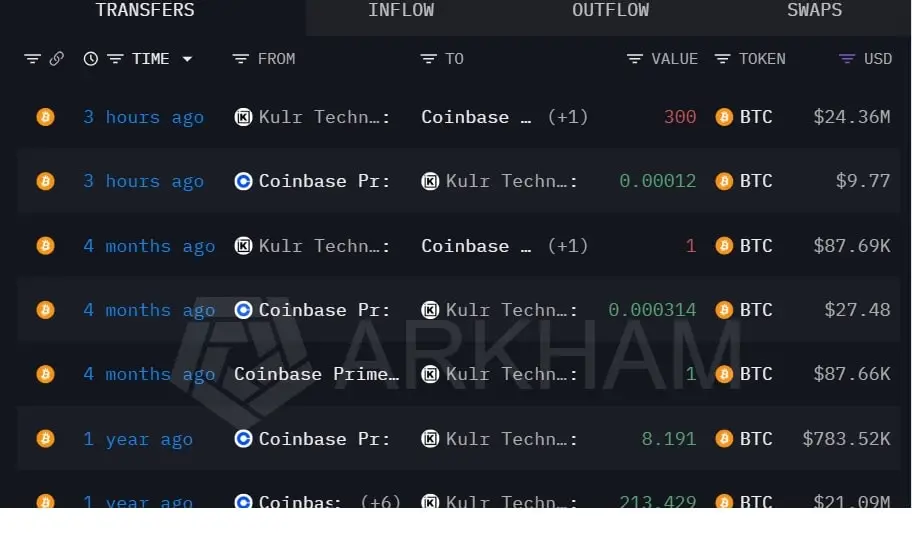
Bitcoin [$BTC] has failed to keep up with the market expectations. During the institutional boom of 2024–2025, many firms accelerated aggressive Bitcoin accumulation.  By 2026, as market conditions turned unfavorable, some treasuries were forced to liquidate positions to fund operations.  KULR Technology Group dumps $24.36 million in $BTC  With $BTC struggling, KULR Technology Group has begun selling its holdings, most likely to cut losses. According to Arkham data, KULR Technology Group transferred 300 $BTC, worth $24.36 million, to Coinbase Prime.  In December 2024, KULR announced it would allocate 90% of its surplus cash to Bitcoin. By July 2025, the company had built a reserve of 1,021 $BTC worth $101 million, purchased at an average price of $98,923.  Source: Arkham  Entering the market during the institutional boom, KULR benefited from favorable sentiment and a U.S. policy shift, with its stock soaring 10x to $43.92 after the reserve announcement.  Now, with $BTC trading well below its average entry price, the companys holdings have lost $18.25 million.  Source: Google Finance  The fading market frenzy has also hit its stock hard, which has dropped 74% year‑on‑year to $3.19, underscoring the struggles faced by public firms holding Bitcoin on their balance sheets.  Bitcoin public companies scale back amid rising losses  In addition to KULR Technology, Bitcoin

05-14

Ethereum Community Unveils Feature to End Blind Signing

The security feature comes as bad actors target the crypto industry with increasingly sophisticated hacks and scams despite considerable improvements in security measures in recent years.  North Korean state-backed workers have stolen over $7 billion in funds alone since 2009, with a large share of that coming from crypto protocols. The Bybit hack was its largest crypto heist by compromising a third-party service provider and manipulating transaction signatures.  Trezor chief technology officer Tomáš Sušánka told Cointelegraph that attackers have been exploiting this relentlessly due to there not being a widely accessible security feature that is capable of distinguishing malicious smart contracts from legitimate transactions.  This issue has led users to “unknowingly sign them, and lose everything,” Sušánka said, adding that the Clear Signing feature “directly addresses this by making transactions human-readable before approval.”  The Clear Signing feature was introduced through the Ethereum Foundations Trillion Dollar Security Initiative and initiated by Ledger through the open-source ERC-7730 token standard.  The foundation said the key components of the Clear Signing feature include “human-readable transaction descriptions” and a “neutral, mirrorable descriptor registry.”  It also includes an attestation framework enabling auditors to verify those descriptors.  A host of crypto platforms are supporting Clear Signing  Several other crypto wallets and Ethereum privacy and security

05-14

ETH Price Prediction: $2,450 Target Within 14 Days as Momentum Shifts Bullish

ETHs Technical Reality Check  Ethereum sits in a precarious but promising position at $2,301.70, trading well below its 200-day moving average of $2,639.58 but showing signs of base-building. The RSI hovering at 49.95 indicates neither overbought nor oversold conditions—classic consolidation territory where smart money accumulates before the next leg up.  The MACD histogram at dead zero tells the real story here: momentum has completely stalled, but this flatline often precedes explosive moves. With price sitting 40% of the way through the Bollinger Bands (0.39 position), Ethereum has room to run toward the upper band at $2,382.18 before hitting any technical ceiling. Blockchain.news technical analysis suggests this consolidation phase is nearing its end.  Volume & Price Alignment  The derivatives market is painting a bullish picture that spot traders are missing. With $514 million in 24-hour spot volume—respectable but not extraordinary—the real action is happening in futures. Open interest dropped 4.72% to $4.83 billion, typically signaling weak hands getting flushed out before stronger moves.  More telling is the positioning data: retail traders are 72.5% long while top traders (the smart money) are 69% long. When both retail and whales align on direction, price typically follows. The 1.10 taker buy/sell ratio confirms aggressive buying pressure is building, even

05-14

Previous Bitcoins Market Top Was Hidden Behind Sophisticated Whale Distribution — Analyst Explained

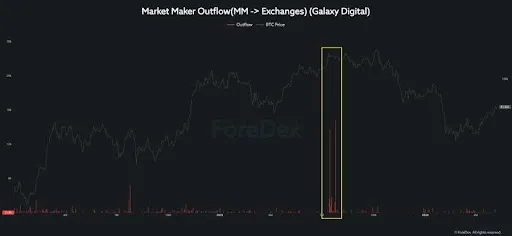
The previous Bitcoin market top may not have been marked by a dramatic crash or obvious sell signal, but by a highly coordinated, sophisticated wave of whale distribution. While most participants were driven by optimism and bullish conviction, large holders were quietly offloading positions in a way that blended seamlessly into normal market activity.  How Whale Distributed Bitcoin Without Triggering Warning Signals  The Bitcoin market top last year was less obvious than in past cycles, unfolding through a quiet, highly coordinated wave of whale distribution. ForeDex on X revealed that at a time when $BTC participants were filled with optimism and conviction, a whale moved roughly 30,000 $BTC to exchanges over 10 days via Galaxy Digital. Meanwhile, most market participants failed to recognize the significance of these flows.  ForeDex explained that $BTC was split into smaller amounts and distributed across multiple exchanges, unlike previous cycles. In earlier market tops, large flows often ranging from several thousand to 10,000 $BTC were sent directly to platforms such as Coinbase, Binance, or Gemini in a single transaction, making these movements relatively easy to detect.  Source: Chart from ForeDex on X  However, after the ETF approval, market structure and trading behavior became more sophisticated. As selling pressure was distributed

05-14

Genesis Wallet Dormant Since 2015 Transfers 790 ETH Worth $1.78 Million

The address recorded zero outgoing or incoming transactions from 2015 through May 12, 2026. That stretch covers roughly 3,940 days, or 10.8 years. Around 21:47 UTC on May 13, 2026, the wallet became active. It first executed nine small test transactions, including dust amounts near 0.0000001 .  The holder then moved approximately 790.1739 across two transfers, 1 followed by 789.17388714 , to a brand-new receiving address identified as 0x0b9bcde72cd4390a9f91f5f52a29e0535e695942. That destination wallet had zero prior history and was created for this transfer.  At approximately $2,257 per at the time of the move, the transferred balance carried a value near $1,782,979. Alert was the first major onchain monitoring account to flag the transfer publicly. The math on the return is straightforward. A $244 entry at genesis pricing grew to roughly $1.783 million at the time of the move.  That represents approximately a 7,300-fold return over 10.8 years. Had the holder moved during s all-time high near $4,878, the same stack would have been worth over $3.85 million. The original address retains a small residual balance near 0.000024 along with negligible legacy token holdings, including minor amounts of LPT and OMG from early decentralized finance experiments.  Those positions carry minimal dollar value. No signs currently point

05-14
1
...
889891
...
1000