‘Only hedge funds, retail sold’ — Will BTC sustain rally as Bitcoin ETF flows turn positive?

U.S Spot Bitcoin ETFs have been on a winning streak for the past five days, effectively hauling in $2.65B in net inflows.  The strong demand has flipped the ETF positive on a year-to-date (YTD) basis and lifted BTCs price to an eight-month high of $87K. However, the bullish momentum is still facing renewed bond market pressure and a potential Fed rate hike in October.  Can Bitcoin ETF demand survive macro pressure?  This weeks massive Spot BTC ETF demand turned YTD flows positive with $349M, according to Galaxy Research data.  On Monday alone, the ETF complex attracted $1B in daily inflows. On Tuesday, they hauled in another $714M, with these figures dropping slightly on Wednesday to $346M.  Discover more  Crypto trading course  Blockchain development tools  Digital payment systems  Source: Galaxy Research  Overall, the ETF complex pulled in $2.65B. Out of the $2.65B demand seen over the past five days, BlackRock drove half of the ETF flows.  In fact, even Bloomberg analyst James Seyffart noted that the recent traction could soon help the cumulative flows (aggregate demand since inception) turn positive too.  Since last October, the cumulative flows had dipped by $12B (77.8K BTC). However, the rebound has now erased it by half. The cumulative flows, or total BTC held by the ETF complex,


09-25انڈسٹری

AxLabs releases Simple Agent Wallet for autonomous AI payments across EVM, Solana, Hedera

AxLabs has released its Simple Agent Wallet, a command-line wallet designed for AI agents to autonomously pay for resources across multiple blockchains using the x402 payment protocol, with Neo X as a supported settlement chain. The open-source tool, now at v0.3.1, enables agents to inspect and execute payments without human intervention.  Traditional crypto wallets assume a human is present, with browser extensions that open popups and mobile apps that require a tap to confirm. For AI agents operating programmatically, these interaction models create friction that effectively blocks autonomous commerce. SAW addresses this by providing a wallet built entirely around CLI workflows and scriptable payment flows.  Agent-native design  SAW‘s core workflow follows an inspect-then-pay pattern: saw inspect decodes an HTTP 402 payment requirement so an agent can evaluate the cost and terms, then saw pay --confirm signs and executes the transaction. Private keys are stored locally in a permissions-locked wallet file, and secrets are accepted only through stdin or environment variables, never as CLI flags, which could leak into process lists or shell history. AxLabs said in it’s tweet:  “Agents shouldn‘t have to wait for a human to click ’confirm to get work done.”  The wallet also includes preflight balance checks, optional encryption, and native support

09-25

New York Sues Polymarket, Calling Prediction Market an Illegal Gambling Operation

New York Attorney General Letitia James and Governor Kathy Hochul on Thursday filed a lawsuit against crypto-based prediction market Polymarket, accusing the platform of running an unlicensed gambling operation in the state.  An investigation by the Attorney General‘s office concluded that these markets meet New York’s legal definition of gambling because users stake money on uncertain outcomes they cannot control.  Polymarket never obtained a license from the New York State Gaming Commission, the suit alleges, and so avoided the taxes that licensed casinos and mobile sportsbooks pay. That revenue helps fund public schools, youth sports programs and problem gambling treatment.  The suit comes as regulators like the Securities and Exchange Commission and the Commodity Futures Trading Commission are working to regulate crypto-powered prediction markets.  Polymarket and rival Kalshi argue they arent gambling sites at all, but rather federally regulated exchanges offering “event contracts,” a type of derivative, which would put them under the Commodity Futures Trading Commission rather than state gaming laws.  The CFTC agrees, and it has joined the fight on the platforms side. In 2026 it sued nine states, arguing that it should have exclusive nationwide authority over the industry.  Thursdays complaint also says the platform is open to users aged 18 to 20,

09-25

U.S. Federal Reserve moves on proposals to implement GENIUS Act for stablecoins

The U.S. Federal Reserve proposed two rules on Thursday that would accomplish its part of the multi-agency work needed to establish stablecoin issuer oversight under the Guiding and Establishing National Innovation for U.S. Stablecoins ($GENIUS) Act.  These proposals, which are now open for 60-day public comment periods, would establish the legal safety net behind the tokens being issued and would set up the procedures for Fed-regulated banks to issue stablecoins. Last years $GENIUS Act required the U.S. banking regulators and Treasury Department to put regulations in place by July of 2026, meaning the agencies are all well past the legal deadline, though theyve made significant progress in recent months.  The Feds regulatory approach also echoes the Office of the Comptroller of the Currencys own proposal where it addressed the laws ban on issuers paying interest or yield for holding stablecoins.  “Under the proposal, certain types of arrangements involving third parties would be presumed to be prohibited payments of interest or yield,” the Fed wrote, noting that its approach is consistent with the OCCs. Though the regulations arent final, the agencies seem to be allowing a very narrow approach by crypto platforms to offer stablecoin rewards akin to credit-card incentive programs.  The question of how

09-25

Useless Coin drops 13% as $1.68M unlock adds pressure – Will $0.29 hold?

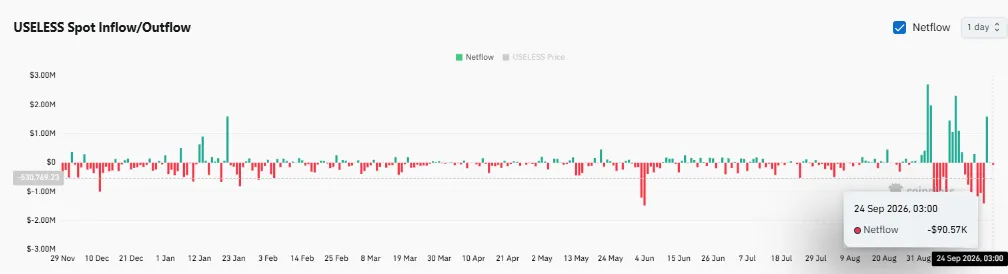
As the weak market conditions and sector rotations pressured high-beta assets, Useless Coin [$USELESS] declined 13.19% over the last 24 hours at press time.  The price fall emerged alongside a broader crypto market correction, which reduced risk appetite across the weaker-performing assets. Besides the price decline, $USELESS also recorded a 23.73% decrease in trading volume within the same 24-hour period.  This lower volume suggested that market participation contracted as the token lost part of its weekly parabolic gains. Meanwhile, capital rotated toward stronger-performing sectors, leaving the meme narrative with less support during the broader pullback.  The selloff, therefore, reflected a wider market weakness alongside the declining participation instead of an isolated token-specific development.  Fresh supply adds another pressure point  Additionally, a $1.68 million supply unlock introduced another challenge as the memecoin navigated the broader market-driven decline.  In particular, Coinbase Prime Custody and Cold Storage unlocked 5.6 million $USELESS into circulation. Reportedly, a portion of the unlocked supply was immediately moved toward trading venues capable of increasing available market liquidity.  Notably, approximately 1.53 million $USELESS, worth roughly $465,000, went directly towards Wintermutes market-making engines. An additional 721,000 $USELESS tokens, valued around $210,000, landed on Gate.io to deepen the resting spot books.  These deposits introduced accessible liquidity as the trading

09-25

HYPE slips from $98 record high: are whales about to trigger a deeper selloff?

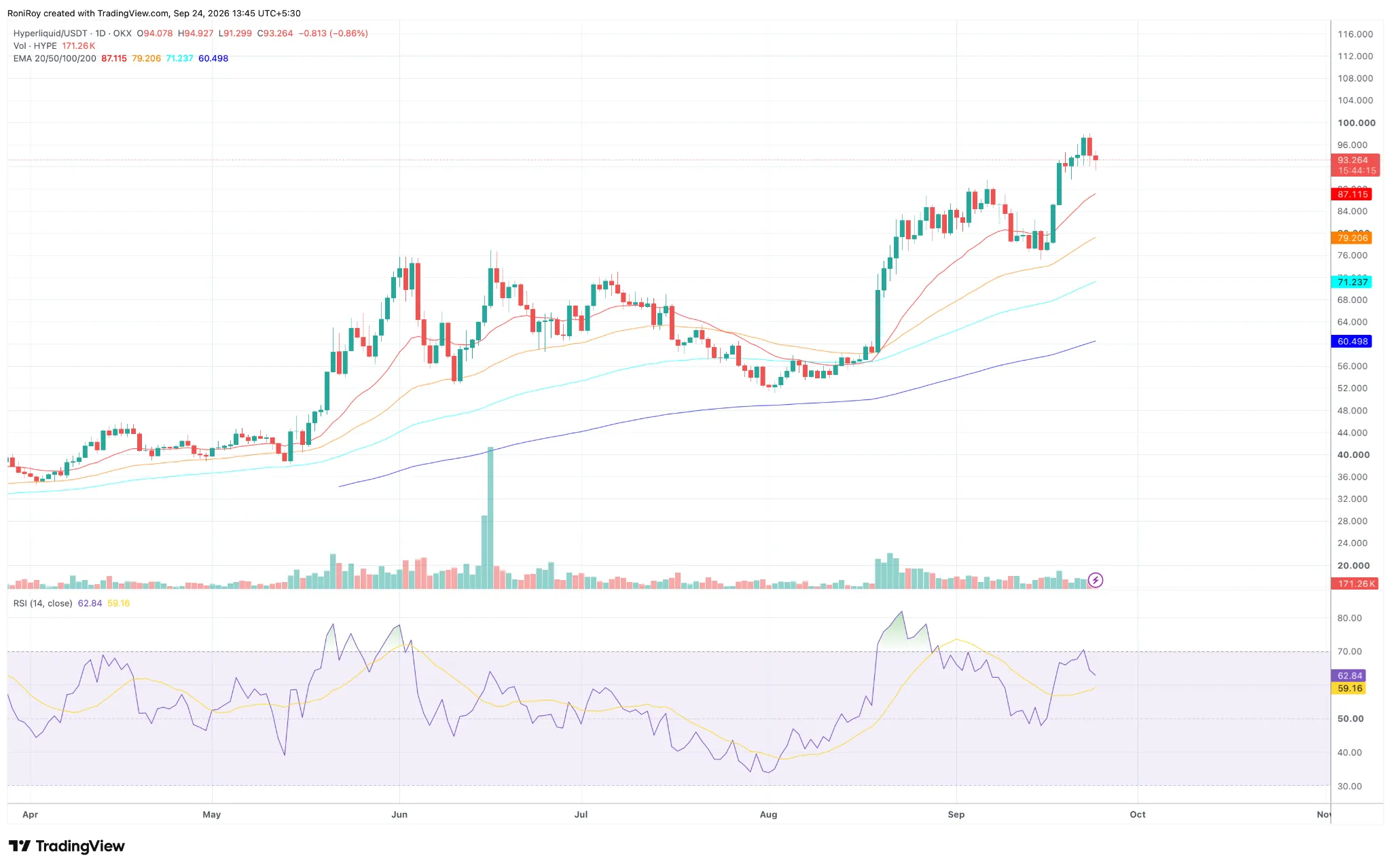
Hyperliquids $HYPE price has fallen more than 3% over the past 24 hours on September 24 as renewed Multicoin Capital transfers to Coinbase Prime raised selling concerns.  CoinGecko showed $HYPE trading near $93.80 at the time of writing, after the token fell from above $96 and briefly traded below $92 during the day.  Despite the pullback, $HYPE remained up 18.4% over the past seven days and 16.1% over 30 days.  The decline followed a run to a record high of $97.98 on September 23. $HYPE had gained roughly 25% from its September 17 level near $78 before sellers emerged just below the psychological $100 level.  Selling concerns picked up after onchain analytics platform Lookonchain reported that Multicoin Capital transferred another 130,331 $HYPE, worth $12.15 million, to Coinbase Prime after pausing such transfers for one week.  Multicoin Capital has deposited roughly 4.23 million $HYPE worth $285 million to Coinbase Prime since July 28, according to Lookonchain.  Transfers to Coinbase Prime do not confirm that the tokens were sold, as the platform provides institutional custody and execution services, but the latest deposit returned attention to the amount of $HYPE being moved by the large holder.  Potential supply from other large holders has come into focus as well. Lookonchain reported

09-25

HIFI raises $37M to expand stablecoin payments, tokenized markets

Stablecoin infrastructure company HIFI has raised $37 million in a Series A funding round led by Left Lane Capital as the use of stablecoins for payments and cross-border transfers continues to grow despite weakness in the broader crypto market.  Cross-border stablecoin flows rose 77.5% to $220.3 billion in the 12 months ending June 2026, even as the wider crypto market shrank by more than a third over the same period, according to Chainalysis.  HIFI CEO Zach Walsh told Cointelegraph that the Series A is the companys first priced funding round. The company did not disclose its valuation. “HIFI is processing approximately $7 billion in annualized volume directly through its platform,” Walsh said.  The funding comes as more payments and financial assets move onto blockchains, increasing demand for infrastructure connecting those networks to the banking system.  Firms such as Visa and the Depository Trust & Clearing Corporation (DTCC) have been rolling out or testing blockchain-based financial infrastructure.  HIFI expands into tokenized capital markets  HIFIs infrastructure allows customers to move dollars into and out of stablecoins, send payouts through US banking rails and cards, and settle the cash side of tokenized repo and Treasury transactions in US dollars.  “This financing will support the scaling of HIFIs tokenized capital markets

09-24انڈسٹری

Apollo limits private credit withdrawals for third consecutive quarter

The slow-motion liquidity crisis in private credit has rolled into its third quarter, with Apollo gating another three months of withdrawal requests from its flagship retail private credit fund.  On Tuesday, the fund disappointed investors who had asked to cash out 14.7% of their shares.  It will honor about two thirds less at just 5%, and has gated withdrawals for at least nine months.  The rationed exit is supposed to prevent a stampede for the exits that gating during the first and second quarters was supposed to alleviate.  Stock prices across the private credit market continue to crater. Apollos own common stock closed down 14% year-to-date, far underperforming the S&P 500 at +12% YTD.  Private credit peers are also underperforming their benchmarks year-to-date: Blackstone has lost 22%, Ares is down 24%, KKR is down 23%, Carlyle is down 33%, and Blue Owl has declined 36%.  Year-to-date stock prices of listed private credit companies. Source: TradingView  Apollo Debt Solutions BDC, a private credit fund, is a retail vehicle holding a $25.9 billion portfolio of senior secured loans.  Investors wanted to redeem 11.2% of shares in the first quarter but were told to expect about 45 cents per dollar worth of requests.  In the second quarter, they asked for 16.8% of

09-24انڈسٹری

Alpen says AI identified Liquids $320M BTC exploit in an hour. Could a payout limit have stopped it?

On September 6, 2026, Liquids federation released roughly 3,996 BTC after its network accepted L-BTC that lacked Bitcoin backing. Liquid is a Bitcoin sidechain whose L-BTC is meant to represent bitcoin held in a federation reserve. A validly authorized withdrawal turned the invalid sidechain state into a real Bitcoin payment worth about $320 million at the time. A payout limit before federation signing might have interrupted that exit.  Related Asset Bitcoin #1 BTC · $83,509.77 24-hour change: down 2.27% Loading price history… 24H Down 2.27% 7D Up 8.76% 30D Up 5.66%  Alpen Labs CEO Simanta Gautam now says his AI agents traced the flaw and reproduced it locally in about an hour. The work began after he heard of the September 6 attack. His September 22 account and technical report give a detailed explanation of the failed proof check. The demonstration came after the funds left, so its speed says little by itself about whether a standing AI monitor would have raised an actionable warning before the attack.  Elements, the software underlying Liquid, caches successful checks of the cryptographic proofs attached to confidential transactions. A September 1 code change tried to make each cached result depend on all the context that affects verification,

09-24انڈسٹری

EU could tighten access to DeFi lending as EBA pushes new MiCA rules

The European Union has moved closer to tighter oversight of DeFi lending access after the European Banking Authority called for crypto borrowing and lending services to be brought within the scope of the blocs Markets in Crypto Assets framework.  According to the European Banking Authority, crypto asset service providers that connect customers to decentralized lending protocols could face new requirements if the European Commission decides to expand MiCA as part of its ongoing review.  The EBA wants the Commission to conduct a cost benefit analysis of legislative changes that would add the intermediation of crypto borrowing and lending to the list of services regulated under MiCA. Its recommendations go beyond centralized crypto lenders and consider how regulated firms provide customers with access to DeFi protocols.  Possible measures include suitability tests for users, limits on leverage and extra disclosure requirements. The regulator raised the prospect of restrictions involving lending products that use asset referenced tokens or e money tokens requiring authorization under MiCA.  A certification regime for DeFi lending protocols could be considered as another option, particularly where regulated crypto firms act as the gateway through which customers access decentralized lending services.  DeFi lending access could face MiCA checks  Crypto lending activity has been identified in at

09-24انڈسٹری
1
...
7274
...
1000