ATOM Price Prediction: $2.10 Breakout Attempt as Bulls Hold 61% Smart Money Edge

ATOM trades at $1.98, pressed against its upper Bollinger Band at $2.05 while institutional positioning reveals growing confidence in higher prices. The token sits in a narrow consolidation pattern that has formed over recent sessions, with smart money maintaining a commanding 1.60 long-to-short ratio despite aggressive profit-taking activity from retail traders.  The current price action reflects a market caught between competing forces. Bulls have established control above the 12-period EMA at $1.92, yet the broader trend remains constrained by overhead resistance near $2.00. This creates a compressed trading environment where each breakout attempt becomes increasingly significant for determining ATOMs next directional move.  Institutional Positioning Signals Confidence  Derivatives data reveals sophisticated traders are positioning for upside despite recent momentum cooling. The $22.2 million open interest represents solid institutional engagement, while the taker buy-sell ratio of 0.77 shows retail investors are taking profits into strength. This divergence between institutional accumulation and retail distribution often precedes significant price movements.  Blockchain.news analysis shows the neutral funding environment removes immediate pressure from either direction, allowing price discovery to occur organically. The moderate 1.84% daily increase in open interest suggests measured rather than speculative positioning, indicating institutions are building positions without forcing dramatic price swings.  Technical Structure Points Higher  Multiple timeframe analysis

04-30

LTC Price Prediction: $62 Target Within 14 Days as Whale Accumulation Builds

LTCs Technical Reality Check  Litecoin is painting a textbook accumulation pattern that smart money traders dream about. Trading at $56.05, LTC sits perfectly positioned in the upper half of its Bollinger Bands at 0.69, indicating controlled bullish pressure without overextension. The RSI at 54.15 tells the real story here—we‘re in that sweet spot where momentum hasn’t peaked but buying interest is clearly building.  The MACD histogram flatlining at zero isn‘t bearish weakness; it’s consolidation before the next leg up. When combined with price holding firmly above all short-term moving averages, this technical picture screams “coiled spring ready to pop.”  Volume thats conviction.  The slight selling pressure in taker flow (0.81 buy/sell ratio) is actually healthy profit-taking from weaker hands, allowing stronger buyers to accumulate at better prices. Open interest climbing 1.16% confirms fresh money entering long positions rather than existing longs simply adding size.  Expert Outlook Context  The analyst consensus has been remarkably consistent, and here‘s why that matters. Per Blockchain.news reporting, multiple experts including Timothy Morano and Rebeca Moen have converged on the $87-95 range target, contingent on holding $82 support. But here’s the disconnect—were trading at $56, not $82.  MEXC‘s recent analysis calling for $80-130 range with $105 average makes mathematical sense given current price

04-30

Twenty One Capital jumps as Tether backs Strike merger plan

Twenty One Capital shares rose after hours after Tether backed a proposed merger with Strike and Elektron Energy. Twenty One Capital shares gained after hours after Tether backed a three-way Bitcoin merger plan.Strike would add payments and financial services, while Elektron would bring Bitcoin mining infrastructure.Tether said the deal could move Twenty One beyond Bitcoin treasury exposure alone.  The plan could move the Bitcoin-buying company beyond treasury holdings and into payments, mining, and financial services.  Tether said it intends to vote in favor of merging Twenty One Capital with Strike. The combined company would then merge with Bitcoin mining firm Elektron Energy.  The proposal would bring together three parts of the Bitcoin market. Strike would add payments, distribution, and regulatory infrastructure. Elektron would add mining operations and execution capacity.  Twenty One Capital shares climb after hours  Twenty One Capital shares closed Wednesday down 1.7% at $7.83. However, the stock later rose to $9.28 in after-hours trading.  The shares settled at $8.35 after the bell, marking a 6.6% gain. The move came as investors reacted to Tethers merger proposal.  Moreover, Tether proposed Elektron founder and CEO Raphael Zagury as president of the merged company. Strike founder Jack Mallers would also hold an executive role.  Tether said the proposed structure

04-30

Pi Network News Today: Half a Billion Tasks Done as Pi Targets the AI Human Data Market

The post Pi Network News Today: Half a Billion Tasks Done as Pi Targets the AI Human Data Market appeared first on Coinpedia Fintech News  Pi Network has completed more than 526 million human validation tasks through a distributed workforce of over one million identity-verified participants, the project announced this week, positioning itself as one of the largest verified human labour networks in the world at a moment when demand for exactly that kind of infrastructure is accelerating rapidly.  The work was carried out as part of Pis native KYC system, with validators paid directly in Pi tokens for completing verification tasks. The result is a network that has verified over 18 million people across more than 200 countries and regions, combining AI automation with human judgment in a way that most identity verification systems cannot replicate at scale.  Why It Matters for AI  Building reliable AI is not purely a computing problem. Human judgment remains important for refining outputs, catching errors, resolving ambiguity, and ensuring AI systems reflect genuine human preferences rather than shortcuts.  The challenge for AI companies is that building this kind of human input network from scratch is expensive, slow, and operationally complex.  Pi Networks blog explained, “Non-human reinforcement and automated training

04-30

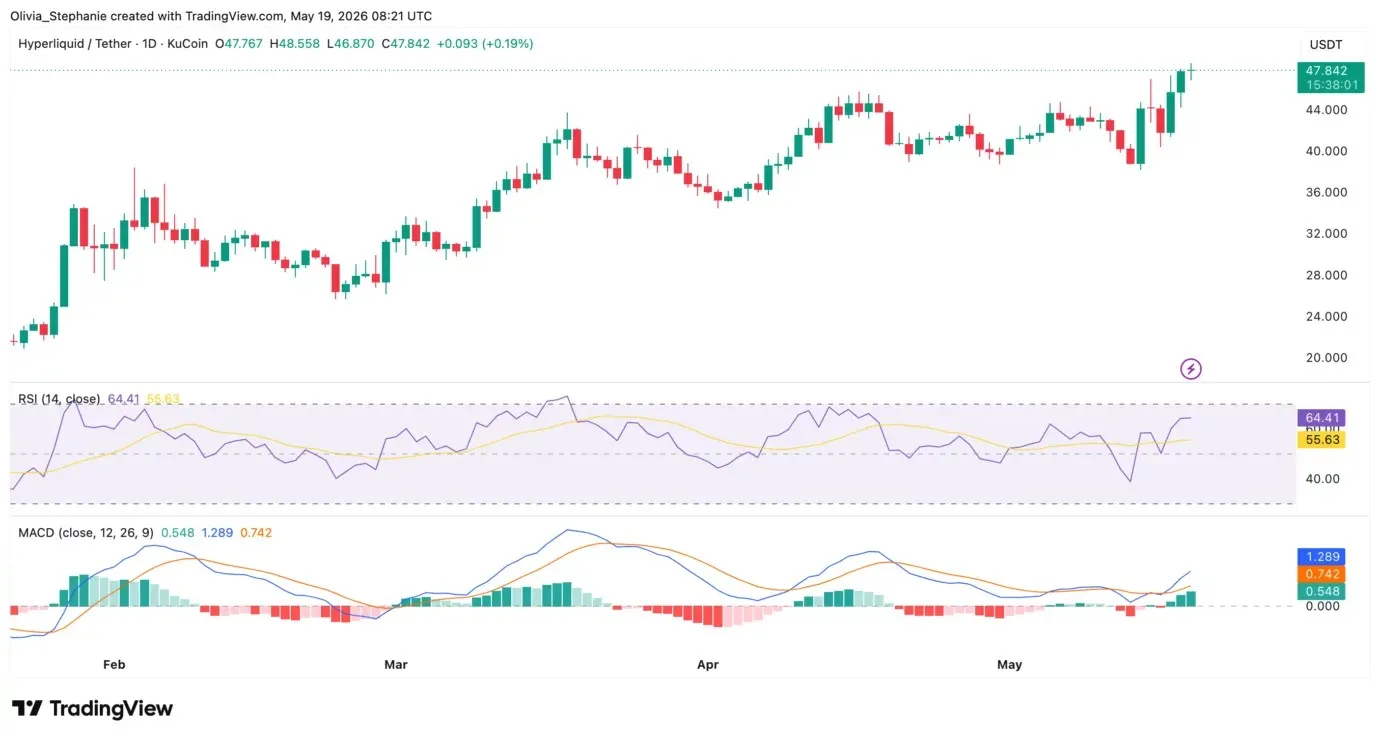
Hyperliquid’s HYPE token could be its prediction market weapon, Arthur Hayes says

Leading decentralized exchange Hyperliquids push into prediction markets is about who captures the upside, not just cheaper trading, according to Arthur Hayes, co-founder of BitMEX exchange and CIO of Maelstrom fund.  CoinDesk reported earlier that Hyperliquid is preparing a zero-fee-to-open model for event trading under HIP-4. The Hyperliquid Improvement Proposal (HIP)-4 is a proposal that introduces event trading on Hyperliquid.  Hayes said that structure is only the first layer. In a note to CoinDesk, he argued that the real differentiator is HYPE, Hyperliquids exchange token, which he said allows users to benefit from platform activity in a way Polymarket and Kalshi currently do not.  “HIP-4 will quickly become a dominate prediction market because of Hyperliquids large user base, much cheaper trading fees, and very robust tech infrastructure,” Hayes told CoinDesk. “Users who own the $HYPE token can directly profit from their usage of HIP-4.”  Polymarket is expected to launch a token, often referred to as $POLY.  On Gate, premarket perpetual contracts tied to a potential $POLY token are trading around $14, implying a fully-diluted valuation of roughly $14 billion. HYPE, by comparison, has an FDV of about $38 billion, according to CoinGecko data.  Pre-listing markets are often highly speculative and can be thinly traded, meaning any

04-30

BCH Price Prediction: $750 Target Within 30 Days as Whales Position for Q1 Breakout

The Immediate Setup  Bitcoin Cash is trading in no man‘s land at $453.80, caught between conflicting forces that have traders scratching their heads. The price action over the last 24 hours tells the story of a market that can’t decide its next move – up 1.79% but still range-bound within a tight $13 corridor. Whats interesting is how BCH is dancing around its short-term moving averages, with the 7-day SMA at $454.60 acting as immediate resistance while the 20-day at $446.98 provides a floor.  The momentum picture is equally murky. With RSI sitting dead center at 51.67, we‘re seeing neither overbought euphoria nor oversold capitulation. The MACD histogram has flatlined at zero, suggesting the recent bullish momentum has completely stalled out. This isn’t necessarily bearish – its more like a coiled spring waiting for the next catalyst.  Key Levels Exposed  The technical landscape reveals a classic consolidation pattern with clearly defined battle lines. The immediate resistance cluster sits between $458.70 and $463.60, where profit-taking has consistently emerged over recent sessions. More concerning for bulls is how BCH remains trapped well below its 200-day SMA at $521.44 – a reminder that the long-term trend remains decidedly bearish.  Support levels paint a more encouraging picture for short-term

04-30

US plans Middle East deployment of Dark Eagle hypersonic missiles against Iran

Tech  US plans Middle East deployment of Dark Eagle hypersonic missiles against Iran  The U.S. is looking to position its Dark Eagle hypersonic missile system in the Middle East, per Bloomberg. This increases the odds of a U.S. invasion of Iran by December 31, 2026, currently at ? YES.  Market reaction  The potential deployment represents a direct escalation in military capabilities aimed at Iran. The US Forces Enter Iran market is closely linked, with hypersonic weapons use possibly preceding or coinciding with U.S. ground troop movements into Iran.  Why it matters  The Dark Eagle, if approved for deployment, would see its first operational use. The system is designed to target high-value missile launchers deep within Iranian territory. This is strategic positioning for potential strikes, not a capability demonstration. It raises the stakes for direct military confrontation.  What to watch  Traders should note the limited liquidity in related markets. With actual USDC traded far below face value, small moves can have outsized effects. It takes only $167 to shift odds by 5 points in the Military Actions Against Iran market, where odds sit at a static 0.2% YES.  At current pricing, a bet on U.S. forces entering Iran pays off significantly if realized. The contrarian case: major military escalation would

04-30

W Group Strengthens Regulated Infrastructure As White Tech Wins Hanfa Approval Under Mica

WHITE TECH, a company within the W Group ecosystem and majority-owned by Volodymyr Nosov, founder and CEO of WhiteBIT, has received authorization from the Croatian Financial Services Supervisory Agency (HANFA) to operate as a crypto-asset service provider (CASP) under the European Unions Markets in Crypto-Assets (MiCA) regulation.  The approval, announced on 29 April 2026 from Zagreb, places White Tech among the earliest entrants into Croatias MiCA-regulated market and signals a deeper move by W Group into formally supervised European crypto infrastructure.  What does the MiCA authorization allow White Tech to do?  The HANFA license enables White Tech to offer a defined set of regulated crypto-asset services across the European Union under a single harmonized rulebook.  Specifically, the company is authorized to provide the exchange of crypto-assets for fiat currencies, the exchange of crypto-assets for other crypto-assets, transfer services for crypto-assets on behalf of clients, and the custody and administration of crypto-assets.  The company will operate under continuous HANFA supervision, with compliance obligations covering governance arrangements, risk management frameworks, and user protection standards as set out in MiCA.  For institutional and retail users, that translates into clearer expectations around how customer assets are safeguarded and how operational risks are managed.  Why is the timing significant for the EU

04-30

BitMEX Launches 24/7 Crypto-Margined FX Perpetual Swaps

Building on BitMEXs expertise in cryptocurrency derivatives, the launch represents a revitalized forex-linked perpetual product extension.FX Perpetual Swaps eliminate the need for fiat deposits, bank transfers, and broker onboarding by enabling traders to post cryptocurrency as margin.   Six FX Perpetual Swap contracts have been introduced by BitMEX today, giving traders round-the-clock access to international currency markets using crypto as collateral.  The new offering, which offers exposure to some of the most traded currency pairings without depending on conventional brokers or fiat funds, comprises EUR/USD, USD/JPY, GBP/USD, AUS/USD, USD/CHF, and USD/CAD. Even on weekends when traditional currency markets are closed, the contracts are always open.  Building on BitMEXs expertise in cryptocurrency derivatives, the launch represents a revitalized forex-linked perpetual product extension intended to satisfy changing trader demand with a more targeted and scalable offering.  “Forex is the largest and most liquid market globally, yet access still depends on fragmented and time-bound systems,” said Stephan Lutz, CEO at BitMEX. “With FX Perpetual Swaps, traders can access major currency pairs at any time using crypto as margin, without the operational friction of traditional brokerage models. This reflects a broader shift toward always-on, borderless trading.”  FX Perpetual Swaps eliminate the need for fiat deposits, bank transfers, and broker

04-30

Pi Network News Today: Half a Billion Tasks Done as Pi Targets the AI Human Data Market

The post Pi Network News Today: Half a Billion Tasks Done as Pi Targets the AI Human Data Market appeared first on Coinpedia Fintech News  Pi Network has completed more than 526 million human validation tasks through a distributed workforce of over one million identity-verified participants, the project announced this week, positioning itself as one of the largest verified human labour networks in the world at a moment when demand for exactly that kind of infrastructure is accelerating rapidly.  The work was carried out as part of Pis native KYC system, with validators paid directly in Pi tokens for completing verification tasks. The result is a network that has verified over 18 million people across more than 200 countries and regions, combining AI automation with human judgment in a way that most identity verification systems cannot replicate at scale.  Why It Matters for AI  Building reliable AI is not purely a computing problem. Human judgment remains important for refining outputs, catching errors, resolving ambiguity, and ensuring AI systems reflect genuine human preferences rather than shortcuts.  The challenge for AI companies is that building this kind of human input network from scratch is expensive, slow, and operationally complex.  Pi Networks blog explained, “Non-human reinforcement and automated training

04-30
1
...
899901
...
1000