How Ethereums new 2,048 ETH staking rule could lock up user rewards longer than expected
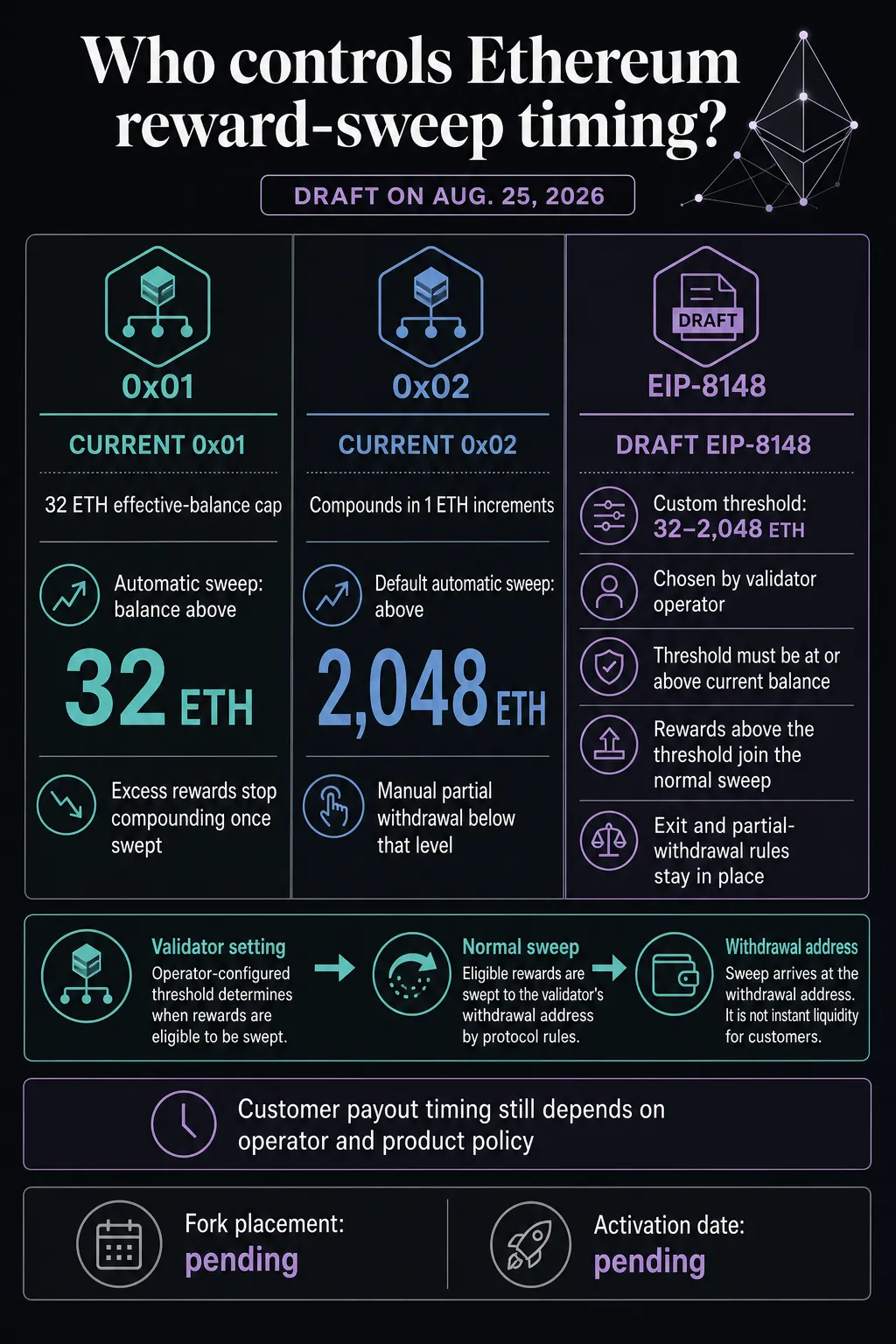
Ethereum is considering a change that would let compounding validators set how much $ETH should remain on a validator before excess rewards enter the networks automatic withdrawal sweep. An Aug. 20 edit to draft EIP-8148 lowered the proposals minimum custom threshold from 33 $ETH to 32 $ETH and added a way to set the initial threshold when a new validator is created. If activated, the proposal would let 0x02 validators select a level between 32 $ETH and the current 2,048 $ETH default. The change would affect reward-sweep timing while Ethereums existing exit rules continue to govern principal withdrawals. Ethereums 32 $ETH change controls reward-sweep timing Ethereum currently treats its two execution-address withdrawal credentials differently. Validators using legacy 0x01 credentials have a 32 $ETH effective-balance cap. Any balance above 32 $ETH is periodically swept to the withdrawal address, so those rewards stop compounding on the validator. Compounding 0x02 validators can increase their effective balance in 1 $ETH increments up to 2,048 $ETH. Under Ethereums current withdrawal-credential rules, their balance is automatically swept only after it exceeds 2,048 $ETH. Accessing $ETH below that level requires a manually requested partial withdrawal.Validator setupWhat happens to rewardsAutomatic sweep thresholdCurrent 0x01Excess rewards stop compounding once sweptAbove 32 $ETHCurrent 0x02Rewards compound in