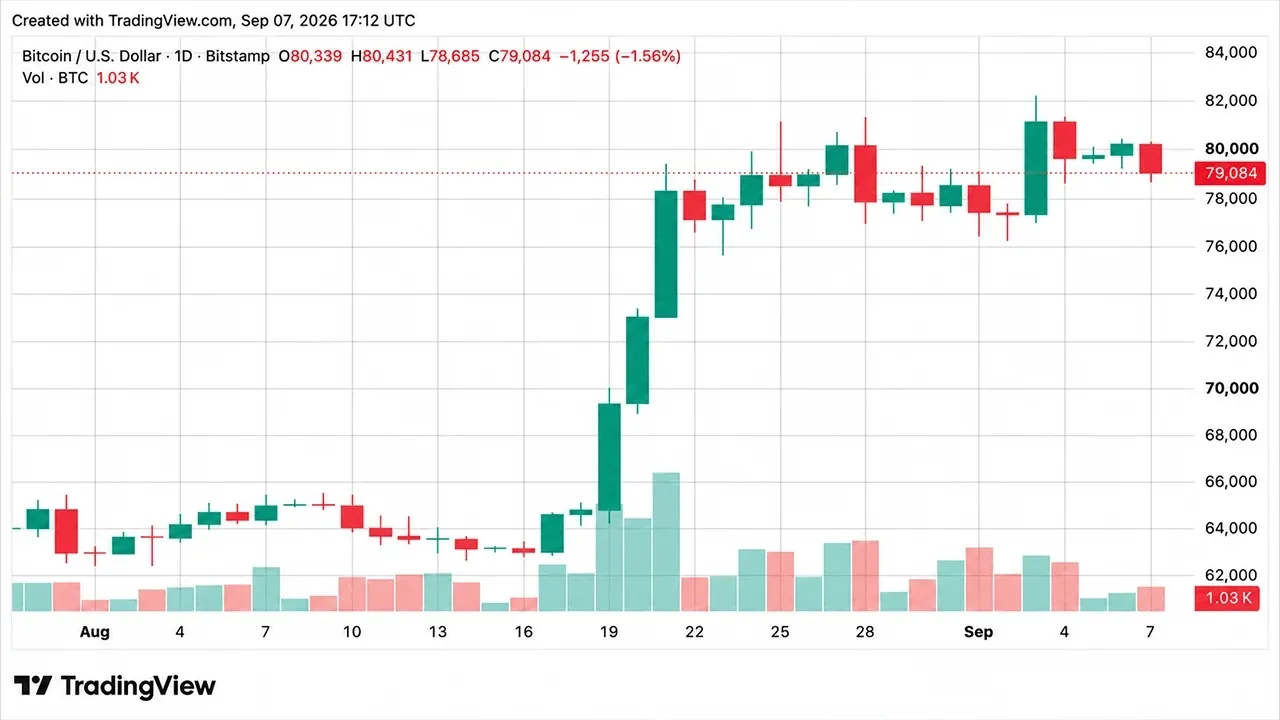
BlackRock And Strategy Send 7,459 Bitcoin To Coinbase Prime – Will Demand Hold Up?

Sebastians journey into the world of crypto began four years ago, driven by a fascination with the potential of blockchain technology to revolutionize financial systems. His initial exploration focused on understanding the intricacies of various crypto projects, particularly those focused on building innovative financial solutions. Through countless hours of research and learning, Sebastian developed a deep understanding of the underlying technologies, market dynamics, and potential applications of cryptocurrencies.  As his knowledge grew, Sebastian felt compelled to share his insights with others. He began actively contributing to online discussions on platforms like X and LinkedIn, focusing on fintech and crypto-related content. His goal was to expose valuable trends and insights to a wider audience, fostering a deeper understanding of the rapidly evolving crypto landscape. Sebastians contributions quickly gained recognition, and he became a trusted voice in the online crypto community.  To further enhance his expertise, Sebastian pursued a UC Berkeley Fintech: Frameworks, Applications, and Strategies certification. This rigorous program equipped him with valuable skills and knowledge regarding Financial Technology, bridging the gap between traditional finance (TradFi) and decentralized finance (DeFi). The certification deepened his understanding of the broader financial landscape and its intersection with blockchain technology.  Sebastians passion for finance and writing is evident

05-30

Ripple’s On-Demand Liquidity Service Pushes Cross-Border Payments Toward Real-Time Settlement

Ripple ODL settles cross-border transfers within seconds using XRP liquidity.ODL removes costly pre-funded accounts for banks handling global payments.XRP Ledger processes 1,500 transactions per second with minimal transfer fees.  Cross-border payments still frustrate businesses and consumers despite advances in digital finance. Traditional transfers often move through several intermediary banks before reaching the recipient. Consequently, the process increases delays and raises transaction costs. Ripple developed its On-Demand Liquidity service to solve these long-standing issues.  The system uses XRP as a bridge asset between currencies, allowing institutions to move funds within seconds instead of days. Moreover, the model removes the need for banks to maintain expensive foreign currency reserves across multiple countries.  How Ripples ODL Changes International Payments  Ripples On-Demand Liquidity, commonly called ODL, operates through RippleNet, the companys global payment network. RippleNet connects more than 300 financial institutions across over 55 countries. However, only ODL transactions actively use XRP during settlement.  Under the system, financial institutions convert local currency into XRP at the moment a transaction begins. The XRP then travels through the XRP Ledger almost instantly. Afterward, the receiving exchange converts the XRP into the destination currency. This process eliminates the traditional requirement for pre-funded overseas accounts.  Additionally, the XRP Ledger supports around 1,500 transactions per

05-30

Why Hedge Funds Are Eyeing Kalshi and Polymarket

What are the regulatory lines and compliance considerations?  Kalshis key differentiator is regulatory status. As a CFTC-regulated DCM, it operates under U.S. derivatives law, implements KYC/AML, sets position limits, and publishes a rulebook. That framework can simplify institutional onboarding, surveillance, and audit trails. However, listing scope is defined by what the CFTC permits for event contracts, and those boundaries can evolve.  Polymarket, by contrast, is a crypto-native venue that previously faced CFTC enforcement and subsequently restricted U.S. users. Access typically depends on the participants jurisdiction and internal policies. Compliance teams should assess local regulations, including derivatives, wagering, and securities rules, before transacting. Many institutions choose to limit on-chain prediction activity to non-U.S. affiliates where permissible.  Across both, policies should cover market manipulation, conflict-of-interest controls, and MNPI handling—especially when outcomes overlap with companies in the portfolio. Written supervisory procedures, trade surveillance, and communications archiving can help satisfy internal and external oversight.  Nothing here is legal advice. Institutions should obtain counsel and review official guidance from regulators such as the CFTC before engaging.  How do these markets settle—and can outcomes be gamed?  Settlement mechanics are as important as price. On Kalshi, settlements follow the exchanges rulebook and predefined data sources. If an event resolves to “Yes,” the contract

05-30

DOGE Price Prediction: $0.085 Target Within 10 Days as Bulls Retreat

Market Context: Why DOGE is Moving Now  Dogecoin remains trapped below the critical $0.10 psychological barrier, with price action revealing weakening buyer conviction despite modest daily gains. The meme coin trades in an increasingly tight range with minimal volatility, suggesting a major directional move approaches. Multiple failed attempts to break above this round number highlight the challenge bulls face at current levels.  The consolidation phase reflects broader crypto market hesitation, with Blockchain.news tracking institutional flows showing cautious positioning across risk assets. This compressed trading range typically precedes either explosive breakouts or sharp corrective moves – and technical evidence increasingly supports the latter scenario.  Indicator Alignment  Technical momentum shows clear deterioration across multiple timeframes. The RSI at 39.02 has shifted from bullish to neutral territory, signaling reduced buying pressure. The MACD configuration presents additional concerns, with the histogram flatlining at zero while both MACD lines converge in negative territory at -0.0014 – a setup that historically precedes renewed selling.  Dogecoins position at 0.18 within the Bollinger Bands indicates price is hugging the lower boundary, suggesting recent bounces lack institutional support. The moving average structure reinforces this weakness, with DOGE trading below both the 20-day and 200-day SMAs at $0.11, creating layered overhead resistance.  Whales & Analyst Targets  Derivatives

05-30

Ripple’s On-Demand Liquidity Service Pushes Cross-Border Payments Toward Real-Time Settlement

Ripple ODL settles cross-border transfers within seconds using XRP liquidity.ODL removes costly pre-funded accounts for banks handling global payments.XRP Ledger processes 1,500 transactions per second with minimal transfer fees.  Cross-border payments still frustrate businesses and consumers despite advances in digital finance. Traditional transfers often move through several intermediary banks before reaching the recipient. Consequently, the process increases delays and raises transaction costs. Ripple developed its On-Demand Liquidity service to solve these long-standing issues.  The system uses XRP as a bridge asset between currencies, allowing institutions to move funds within seconds instead of days. Moreover, the model removes the need for banks to maintain expensive foreign currency reserves across multiple countries.  How Ripples ODL Changes International Payments  Ripples On-Demand Liquidity, commonly called ODL, operates through RippleNet, the companys global payment network. RippleNet connects more than 300 financial institutions across over 55 countries. However, only ODL transactions actively use XRP during settlement.  Under the system, financial institutions convert local currency into XRP at the moment a transaction begins. The XRP then travels through the XRP Ledger almost instantly. Afterward, the receiving exchange converts the XRP into the destination currency. This process eliminates the traditional requirement for pre-funded overseas accounts.  Additionally, the XRP Ledger supports around 1,500 transactions per

05-30

Why Hedge Funds Are Eyeing Kalshi and Polymarket

What are the regulatory lines and compliance considerations?  Kalshis key differentiator is regulatory status. As a CFTC-regulated DCM, it operates under U.S. derivatives law, implements KYC/AML, sets position limits, and publishes a rulebook. That framework can simplify institutional onboarding, surveillance, and audit trails. However, listing scope is defined by what the CFTC permits for event contracts, and those boundaries can evolve.  Polymarket, by contrast, is a crypto-native venue that previously faced CFTC enforcement and subsequently restricted U.S. users. Access typically depends on the participants jurisdiction and internal policies. Compliance teams should assess local regulations, including derivatives, wagering, and securities rules, before transacting. Many institutions choose to limit on-chain prediction activity to non-U.S. affiliates where permissible.  Across both, policies should cover market manipulation, conflict-of-interest controls, and MNPI handling—especially when outcomes overlap with companies in the portfolio. Written supervisory procedures, trade surveillance, and communications archiving can help satisfy internal and external oversight.  Nothing here is legal advice. Institutions should obtain counsel and review official guidance from regulators such as the CFTC before engaging.  How do these markets settle—and can outcomes be gamed?  Settlement mechanics are as important as price. On Kalshi, settlements follow the exchanges rulebook and predefined data sources. If an event resolves to “Yes,” the contract

05-30

DOGE Price Prediction: $0.085 Target Within 10 Days as Bulls Retreat

Market Context: Why DOGE is Moving Now  Dogecoin remains trapped below the critical $0.10 psychological barrier, with price action revealing weakening buyer conviction despite modest daily gains. The meme coin trades in an increasingly tight range with minimal volatility, suggesting a major directional move approaches. Multiple failed attempts to break above this round number highlight the challenge bulls face at current levels.  The consolidation phase reflects broader crypto market hesitation, with Blockchain.news tracking institutional flows showing cautious positioning across risk assets. This compressed trading range typically precedes either explosive breakouts or sharp corrective moves – and technical evidence increasingly supports the latter scenario.  Indicator Alignment  Technical momentum shows clear deterioration across multiple timeframes. The RSI at 39.02 has shifted from bullish to neutral territory, signaling reduced buying pressure. The MACD configuration presents additional concerns, with the histogram flatlining at zero while both MACD lines converge in negative territory at -0.0014 – a setup that historically precedes renewed selling.  Dogecoins position at 0.18 within the Bollinger Bands indicates price is hugging the lower boundary, suggesting recent bounces lack institutional support. The moving average structure reinforces this weakness, with DOGE trading below both the 20-day and 200-day SMAs at $0.11, creating layered overhead resistance.  Whales & Analyst Targets  Derivatives

05-30

Buy Side Explodes: XRP Liquidity 7x Heavier Than Sells On Coinbase

They say journalists never truly clock out. But for Christian, that‘s not just a metaphor, it’s a lifestyle. By day, he navigates the ever-shifting tides of the cryptocurrency market, wielding words like a seasoned editor and crafting articles that decipher the jargon for the masses. When the PC goes on hibernate mode, however, his pursuits take a more mechanical (and sometimes philosophical) turn.  Christians journey with the written word began long before the age of Bitcoin. In the hallowed halls of academia, he honed his craft as a feature writer for his college paper. This early love for storytelling paved the way for a successful stint as an editor at a data engineering firm, where his first-month essay win funded a months-long supply of doggie and kitty treats – a testament to his dedication to his furry companions (more on that later).  Christian then roamed the world of journalism, working at newspapers in Canada and even South Korea. He finally settled down at a local news giant in his hometown in the Philippines for a decade, becoming a total news junkie. But then, something new caught his eye: cryptocurrency. It was like a treasure hunt mixed with storytelling – right up his

05-30

Ripple News: Solana Onboards Top XRP Ledger DApp As RLUSD Minting Tops 37 Million Tokens

RLUSD remains one of Ripples newest products in the digital payment sector. Stablecoins have become increasingly important in crypto because they are often used for transfers, trading, and settlement of payments.  Large minting activity can sometimes point to growing demand. Traders usually watch these updates closely because fresh supply may signal higher usage across exchanges or payment systems. Ripple has continued to deepen its presence in the stablecoin market while maintaining its main focus on international payments.  The company has often promoted blockchain payments as a faster, cheaper alternative to older banking systems. Ripple News links to RLUSD have remained active in recent months as users continue to watch how the stablecoin develops.  Market observers are also paying attention to whether RLUSD can gain stronger adoption in the crowded stablecoin sector.  SBI Remit Transfer Volume Tops $15 Billion  In another Ripple news, SBI Remit announced that its cumulative international money transfer transaction volume has crossed 2.5 trillion yen. The figure equals more than $15 billion based on current exchange rates.  The company started using RippleNet and XRP for transfer options in 2021. Since then, SBI Remit has become one of the strongest examples of XRP being used in cross-border payments.  Supporters of XRP viewed the latest milestone

05-30

Visa Invests in Replit to Bring Secure Payments Into AI Agents and Apps

Visa has made a strategic investment in Replit, the AI software creation platform, as the payments giant looks to embed its commerce infrastructure into the next generation of developer tools.  The companies said they are working to integrate Visa Intelligent Commerce into Replit‘s platform. The goal is to allow developers to build applications and AI agents that can initiate secure transactions and accept payments through Visa’s global network without leaving their development workflow.  The partnership reflects a broader shift in software development. More companies are using AI tools to move from idea to working application faster, while payments firms are preparing for a future in which software agents may transact on behalf of users and businesses.  Visa has already been using Replit internally for prototyping and development. More than 1,000 Visa employees now use the platform, according to the announcement.  As part of the collaboration, Replit is also exploring how agents built on its platform could join Visas Trusted Agent Protocol registry. That system is designed to identify agents as Visa-trusted, allowing them to transact across merchant and service endpoints on behalf of consumers.  Visa and Replit said they are also studying machine-to-machine and agent-driven payment experiences. These could support high-frequency, low-value transactions between services

05-30
1
...
243245
...
1000