






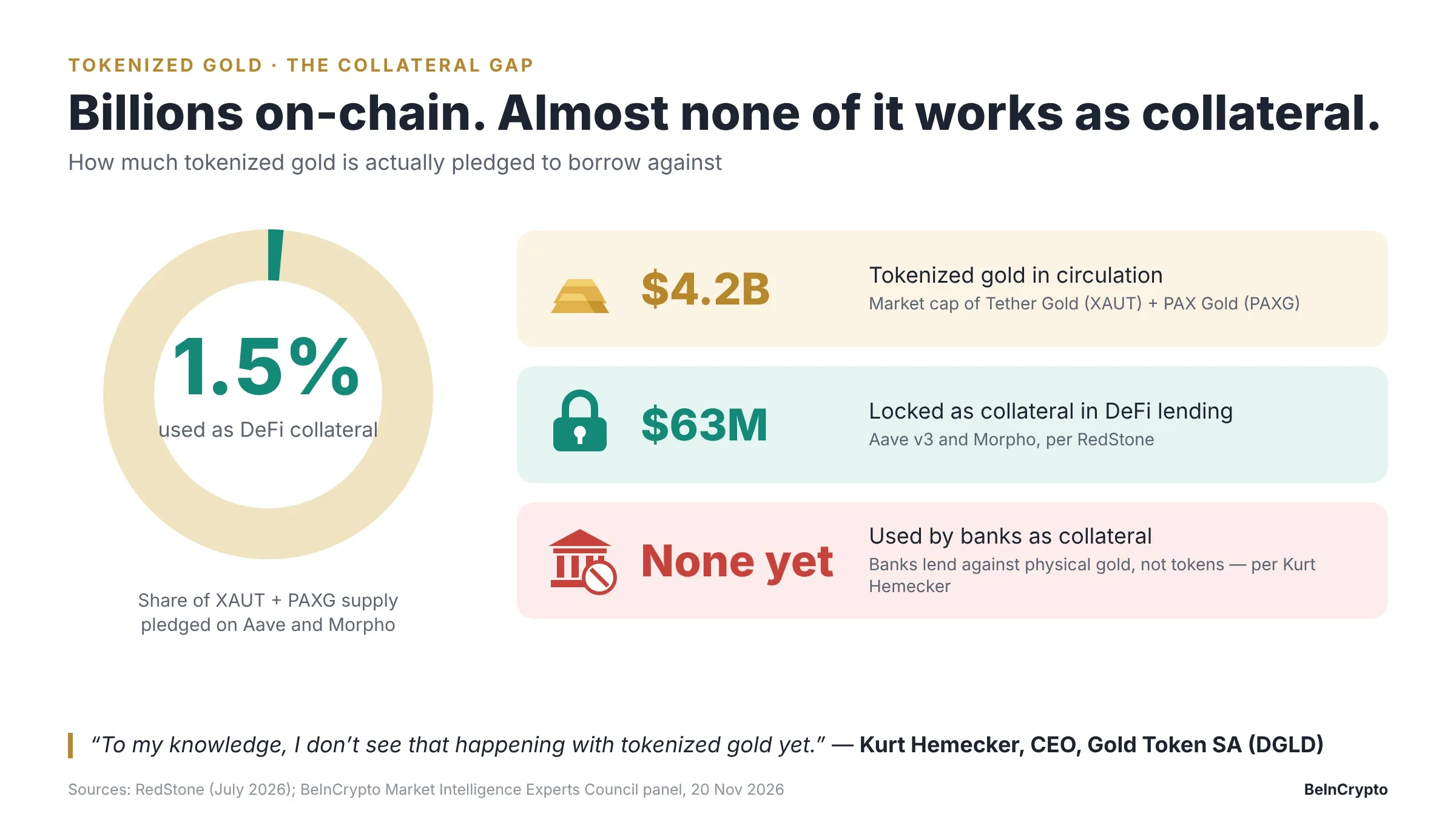
No bank uses tokenized gold as collateral yet, says Kurt Hemecker, CEO of DGLD issuer Gold Token SA. That leaves the sectors biggest pitch, gold tokens as cash-like bank collateral, still unproven.
Banks do lend against physical bars. Yet Basel rules still exclude gold from high-quality liquid assets (HQLA), the cash-like buffer banks must hold. For now, demand for gold tokens rests on crypto users.
If Not Banks, Who Uses Tokenized Gold as Collateral?
Hemecker spoke on a BeInCrypto Market Intelligence Experts Council panel recorded Nov. 20, alongside aNEWfn founder Clem Chambers. Gold Token SA is part of Swiss refiner MKS PAMP.
Earlier this year, Hemecker argued that tokenization could help gold qualify as HQLA. On the panel, he conceded that institutional use has not arrived.
“To my knowledge, I dont see that happening with tokenized gold yet in terms of institutions and banks providing lending using tokenized gold,” Kurt Hemecker, CEO of Gold Token SA said.
Instead, holders lend out gold-backed crypto tokens on Decentralized Finance (DeFi) protocols to earn yield, he said. Even there, usage remains thin.
In July, oracle provider RedStone counted about $63 million in gold tokens pledged on Aave and Morpho. The tokens were Tether Gold (XAUT) and PAX Gold (PAXG), roughly 1.5% of their $4.2 billion combined market value.
That collateral did hold up under stress. In March, during golds worst week in over four decades, Aave cleared its largest batch of XAUT liquidations without disruption.
Hemecker sees three types of buyers. Some want gold without storage and insurance costs, while crypto natives want a non-crypto asset on familiar rails. A third group wants a settlement layer.
Settlement is where he sees the larger prize. The traditional bullion market closes from Friday night to Sunday.
Even where gold trades on weekends, settlement waits for the working week and typically takes one or two days.
Perpetual futures on Hyperliquid, a decentralized exchange, already drive weekend on-chain price discovery. Hemecker called that activity a wake-up call for the industry, adding that backed tokens could settle almost instantly.
Is Security a Bigger Problem Than Cost?
Chambers was less convinced. He called security cryptos Achilles heel, pointing to North Korean hackers who can drain funds that are never recovered.
He also estimated that roughly 90% of crypto activity is gambling. His view of the two hard assets was blunt.
“I have this model which is gold is for war, Bitcoin is for flight.”
Clem Chambers, founder of aNEWfn
Both guests also pushed back on BeInCryptos Tokenization, Tested report. It found a one-week, $10,000 gold position cost about $12 at brokers IG and CMC Markets. Two on-chain venues charged $18 to $30.
Hemecker said that test measured renting price exposure, not owning metal. That matches the reports scope, which covered leveraged perpetual contracts rather than backed tokens. With DGLD, he said, custody and insurance costs are built into the token.
Can Tokenized Gold Reach $700 Billion Without Banks?
The World Gold Council (WGC) is the gold industry‘s market development body. In October, it estimated tokenization could unlock up to $700 billion in new demand. That roughly equals today’s physically backed gold ETFs.
Chambers dismissed the figure as wishful thinking. Hemecker called it a ceiling, arguing that $150 billion to $200 billion is more realistic.
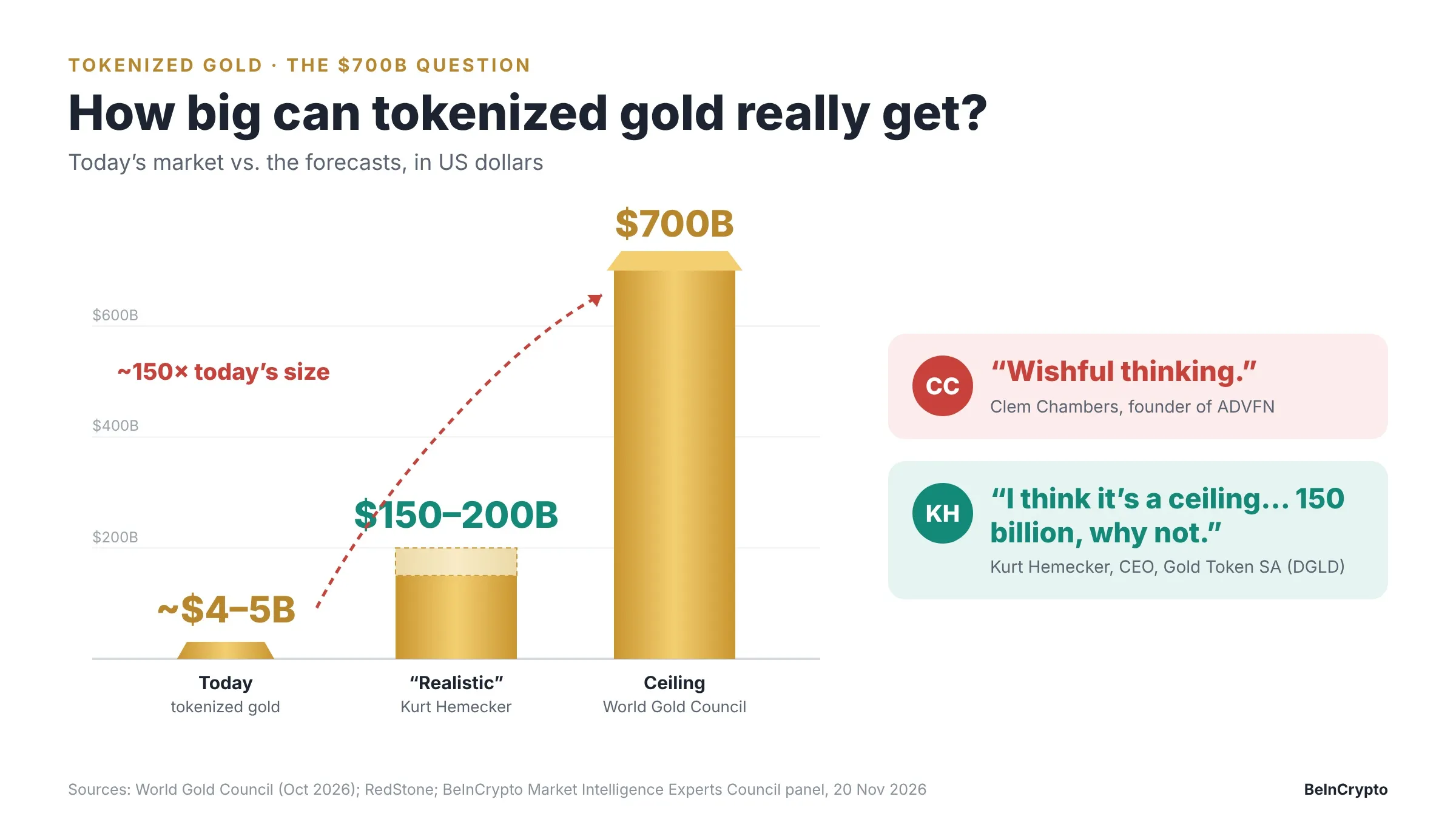
Even the lower target implies roughly 35 times growth from the two largest tokens July market value.
The price backdrop is harsh. Gold fell to $3,526 on Nov. 20, about 35% below its $5,405 January record and near the $3,500 floor Chambers had flagged.
Prices have since rebounded toward $3,600, though a likely December Fed rate hike keeps pressure on non-yielding metals.
Banks remain the missing buyer. The London Bullion Market Association (LBMA) is lobbying for gold to count as top-tier HQLA. Until regulators agree, tokenized golds growth depends on crypto-native demand.