







The AI agent frenzy was kickstarted by GOAT. GOAT is a Solana memecoin that spawned from an experiment by creator Andy Ayrey when he pitted two Claude AI models in an endless debate. GOAT still sits today at a comfortable $404 million market cap, but no longer dominates the mindshare it once did.
First to copy GOAT‘s success was the AI agent Luna (LUNA). It’s a busty anime girl chatbot that streams 24/7 on social media — need I say more? Chat with her, tip her with her own LUNA token (why does anyone do that?), or be like A16z-backed Story Protocol: Hire Luna for social media marketing.
The Luna virtual companion was launched on Virtuals Protocol, an “AI Agent launchpad” on Base that is the most recognizable brand name in this meta right now.
Formerly the PathDAO gaming guild, Virtuals took pump.fun‘s successful formula and applied it to AI agents. Launch an agent token, hit a target market cap on a bonding curve, and pair the agent’s token in a liquidity pool on Uniswap.
What Virtuals did differently, however — and what has gotten investor-types bullish on its token — was tying its native VIRTUALS token to the cost of launching agents and running inferences, as well as pairing it with agent tokens in a Uniswap liquidity pair (rather than SOL).
Within the Virtuals ecosystem, Luna faces competition for speculative capital from other similarly looking chatbots like Airene, or more “utility-based” agents like aixbt, an agent that scrapes troves of social media data to surface trading alpha (aixbt is incidentally bullish on everything).
Just as agents face competition, so too do the picks-and-shovels of agents. Besides Virtuals, a myriad of AI agent launchpads already exist, such as vvaifu.fun, Creator.Bid, MyShell.ai, Zentients and more.
Then we have the AI agent “frameworks.” These are simply code libraries that make it easy for devs to customize their agents and integrate them into the virtual Wild West.
The leading agent framework is ai16z‘s “Eliza,” but there’s also Virtuals G.A.M.E (Generative Autonomous Multimodal Entities), the Python-based ZerePy, the Solana-focused RIG, and more. And of course, each one of these frameworks has its own token that speculators are furiously aping into.
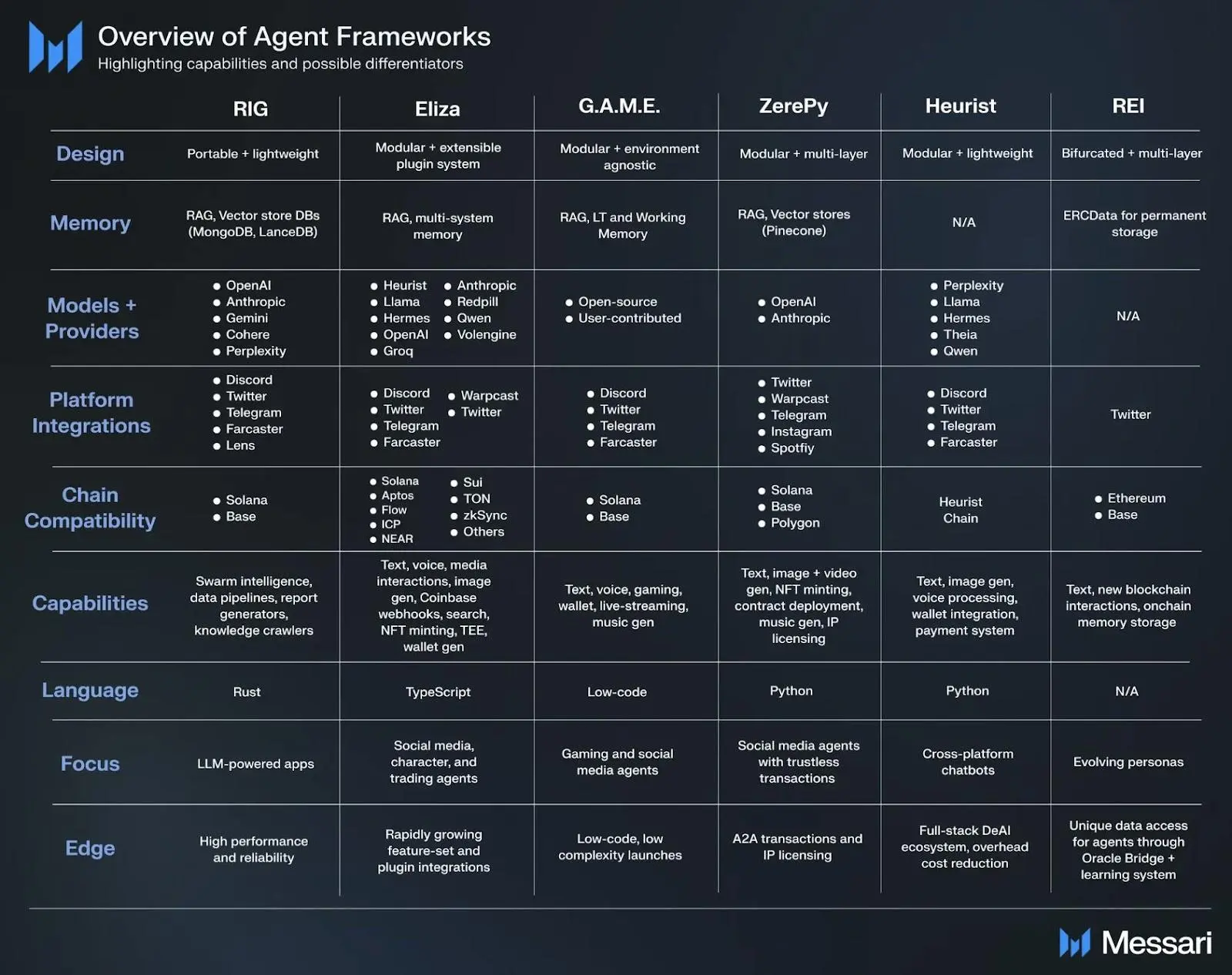
Source: Messari
Finally, we have the AI investment DAOs. The idea is simple: Deposit SOL/ETH and receive a DAO token that lets you share in the “hedge funds” upside.
Ai16z was the first investment DAO to launch on Solana, now with an AUM of $23.4 million. People apparently really trust the investor acumen of AI agents. Presently, its native AI16Z token is valued at an astounding $1.4 billion market cap.
Daos.world and VaderAI are two upcoming AI investment platforms on Base that have gained steam in the past week. At least six funds have already emerged on both platforms, with about a collective million in capital raised.